
PSYC-105 · Lesson 4 of 12 · 20 min
Adolescence and adulthood
▶ Video coming soon A video version of this lesson is on the way.
Owen admits that the class's discussion of teenage brains makes him uncomfortable. 'Half my audience is fifteen,' he says, 'and every article I read says their brains are broken.' Navarro shakes her head. 'Not broken. Under construction, and built for a different job than a ten-year-old's or a forty-year-old's. Adolescents are not just bad adults. They are very good at what adolescence is for.' This lesson follows development from puberty through the end of life.
Puberty and the adolescent brain
Adolescence is the transition from childhood to adulthood. It begins with puberty, the period of sexual maturation, and ends at a point defined more by culture than biology: independence, work, partnership or simply turning a certain age. Puberty is triggered by hormonal changes that begin in the brain. The pituitary gland signals the ovaries and testes to increase production of sex hormones, leading to a growth spurt and to the development of primary sex characteristics, the reproductive organs, and secondary sex characteristics, such as breasts, facial hair and a deeper voice.
Puberty now begins earlier than it did a century ago, probably because of better nutrition and health, and girls typically begin about one to two years before boys. Timing matters. Early-maturing girls, on average, face more risks, including more depression, earlier sexual activity and more contact with older peers, partly because others treat them as older than they are. For boys, the picture is more mixed: early maturation brings some social advantages but is also associated with more risk-taking in some studies.
The adolescent brain is changing too. Synaptic pruning continues, and myelination of connections, especially those linking the frontal lobes to other regions, increases into the mid-twenties. One influential model, the dual systems model associated with Laurence Steinberg, proposes that brain systems involved in reward and emotion become very responsive at puberty, while systems supporting self-control mature more gradually. The gap between them may help explain why adolescents take more risks, especially in the presence of peers.
In one widely cited experiment, Steinberg's team had adolescents, young adults and older adults play a driving video game. Alone, the age groups took similar risks. When friends were watching, adolescents took far more risks, while adults were barely affected. Navarro emphasizes that this is not irrationality. Adolescents can reason about risks as well as adults when calm and alone; under emotional arousal and social reward, their decisions shift. From an evolutionary perspective, a period of exploration, novelty-seeking and attention to peers helps young people leave the family and build their own social world.
Navarro also warns against neuroscience overreach. Brain differences are averages, they vary widely among individuals and no brain scan can tell whether a particular teenager is mature. The popular claim that the brain 'finishes' at exactly 25 is a simplification: development continues across the lifespan, and different regions mature at different rates.
Identity
Erik Erikson, a psychoanalyst trained in Vienna who emigrated to the United States, proposed in the 1950s that development across the whole lifespan involves a series of psychosocial stages, each centred on a crisis or challenge. His theory was among the first to treat adulthood as a time of continued development.
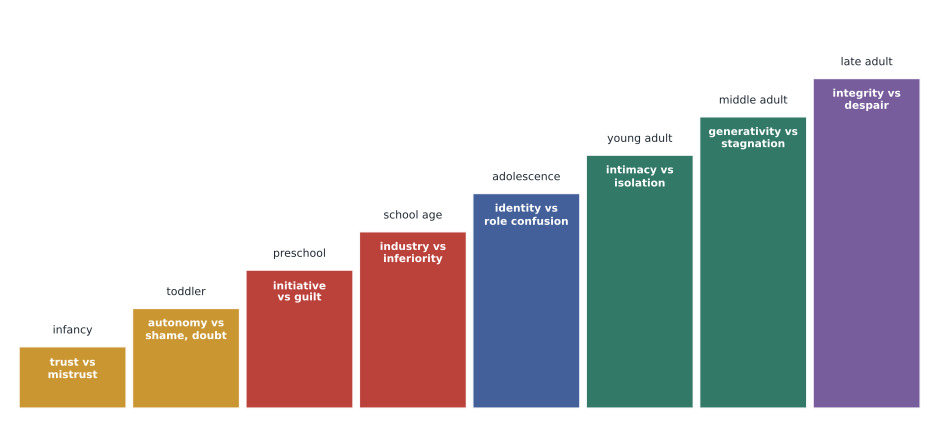
| Stage | Approximate period | Central challenge |
|---|---|---|
| Trust vs mistrust | Infancy | Can I rely on others to meet my needs? |
| Autonomy vs shame and doubt | Toddlerhood | Can I do things myself? |
| Initiative vs guilt | Preschool | Can I plan and carry out activities? |
| Industry vs inferiority | School age | Am I competent compared with others? |
| Identity vs role confusion | Adolescence | Who am I and what do I value? |
| Intimacy vs isolation | Young adulthood | Can I form close, committed relationships? |
| Generativity vs stagnation | Middle adulthood | Am I contributing to the next generation? |
| Integrity vs despair | Late adulthood | Has my life had meaning? |
For adolescents, Erikson said, the central task is forming an identity, a coherent sense of who one is, what one believes and where one is going. James Marcia later described four identity statuses based on whether young people have explored options and whether they have made commitments. Identity diffusion involves neither; foreclosure involves commitment without exploration, such as adopting a parent's career plans unquestioned; moratorium involves active exploration without commitment; and identity achievement involves commitment after exploration. Identity is not settled once and for all: people revisit questions about work, values and relationships throughout life.
Ethnic, cultural and sexual identities are part of this process. For many Indigenous young people in Canada, connection to culture, language and community has been found to protect mental health; Michael Chandler and Christopher Lalonde's research in British Columbia found that First Nations communities with more markers of cultural continuity and self-government had markedly lower youth suicide rates. Navarro notes that identity grows from belonging as well as from individual choice.
Relationships in adolescence
Contrary to the popular image, most adolescents get along reasonably well with their parents. Conflict does rise in early adolescence, usually over everyday matters such as chores, curfews and clothing, and then declines. Teenagers spend more time with peers and less with family, and peer influence on behaviour, both positive and negative, is strong. Adolescents are also more sensitive to social exclusion than adults are.
Social media are now a large part of adolescent social life, and their effects on mental health are hotly debated. Rates of depression and anxiety among adolescents, especially girls, rose in several countries from the early 2010s, around the same time smartphones became widespread. Some researchers, notably Jonathan Haidt and Jean Twenge, argue that the link is causal. Others, including Candice Odgers and Amy Orben, point out that most studies find small average associations, that the direction of influence is unclear, and that effects differ greatly between young people and types of use. Owen finds this frustrating but useful: what seems to matter most is how social media are used, how much they displace sleep and activity, and the experiences of particular groups, such as young people who are harassed online.
Emerging adulthood
In many industrialized societies, the years from about 18 to the late twenties have become a distinct period that the psychologist Jeffrey Arnett has called emerging adulthood. Young people take longer to finish education, settle into careers, marry and have children than previous generations did. Emerging adults often feel in between: not adolescents, but not fully adults. Arnett describes the period as one of identity exploration, instability, focus on oneself, and optimism about possibilities. The concept fits best where economic conditions allow young people a prolonged transition; in many societies and communities, adult responsibilities still come early.
Marcus, who is 19 and living with his parents to save money, says the description fits him exactly. Ruth, who had a full-time job and a mortgage by 23, laughs and says it would not have fit her. Navarro points out that both are typical of their cohorts and circumstances, which is exactly the kind of cohort effect lesson 1 described.
Adulthood: work, love and change
Physical abilities peak in the twenties and decline gradually after that, though regular exercise slows the decline considerably. In midlife, women experience menopause, the end of menstruation, typically around age 50, with symptoms such as hot flashes that vary widely. The once-popular idea of a universal 'midlife crisis' has little support: surveys find that only a small minority of adults report a crisis triggered by age itself, and most report that midlife brings both stresses and satisfactions.
Adult development revolves around love and work, as Freud is said to have put it. Most adults form long-term partnerships. Relationship satisfaction tends to be higher when partners show responsiveness, affection and constructive ways of handling conflict. John Gottman's observational research identified four patterns that predicted later breakup: criticism, contempt, defensiveness and stonewalling, which he called the four horsemen. His specific predictions have been questioned for overfitting small samples, but the importance of contempt and hostility is well supported.
Many studies find that, on average, life satisfaction follows a shallow U-shape across adulthood, dipping somewhat in middle age and rising again later, although the size and even existence of the dip are debated and depend on how the data are analysed. Older adults often report fewer negative emotions than younger ones. Laura Carstensen's socioemotional selectivity theory explains this: as people perceive their time as more limited, they focus on emotionally meaningful goals and relationships and let go of less important ones.
Ageing and cognition
Cognitive ageing is uneven. Fluid intelligence, the ability to reason quickly and solve new problems, peaks in early adulthood and declines gradually. Crystallized intelligence, accumulated knowledge and vocabulary, rises through much of adulthood and holds steady until late life. Processing speed slows with age, which affects many tasks, but older adults compensate with experience and strategy. The Seattle Longitudinal Study found that most abilities show little decline before the sixties and that declines vary greatly between people.
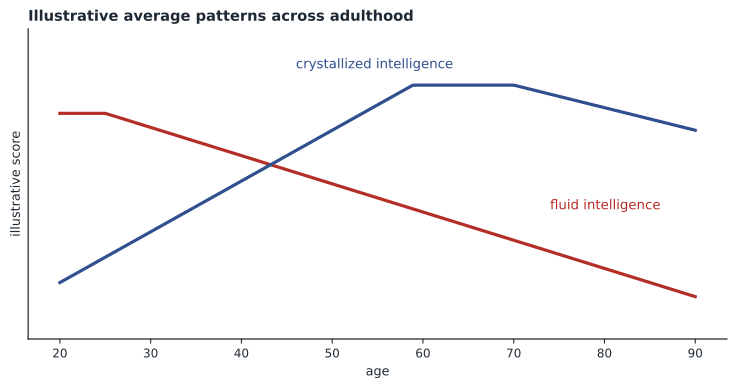
Marcus models the idea with two simple curves to show how an older person's overall performance on a task can stay steady when it relies on both kinds of ability.
# Illustrative scores on a 0-100 scale (not real test norms)
def fluid(age): return 80 - 0.5 * max(0, age - 25)
def crystallized(age): return min(85, 50 + 0.9 * (age - 20)) if age < 70 else 85 - 0.4 * (age - 70)
for age in (25, 45, 65, 85):
    f, c = fluid(age), crystallized(age)
print(f"age {age}: fluid {f:.0f}, crystallized {c:.0f}, average {(f + c) / 2:.1f}")age 25: fluid 80, crystallized 54, average 67.2 age 45: fluid 70, crystallized 72, average 71.2 age 65: fluid 60, crystallized 85, average 72.5 age 85: fluid 50, crystallized 79, average 64.5
In this made-up example, the average stays within about five points from 25 to 65 because rising knowledge offsets slowing reasoning; only late in life do both fall. Real tasks differ in how much they draw on each ability, which is why experienced older workers often perform as well as younger ones in familiar jobs.
Dementia is not a normal part of ageing. It is a decline in memory and other thinking abilities severe enough to interfere with daily life, caused by diseases such as Alzheimer's disease, the most common cause, and vascular disease. The risk rises steeply with age. Research suggests that a substantial share of dementia risk is linked to modifiable factors across life, including education, hearing loss, high blood pressure, physical inactivity, smoking, social isolation and depression, although which of these are causes and how much prevention can achieve are still being studied. Staying physically, mentally and socially active is associated with healthier cognitive ageing.
Death and dying
Elisabeth Kübler-Ross proposed in 1969 that dying people pass through five stages: denial, anger, bargaining, depression and acceptance. The stages entered popular culture and are still widely quoted, but research does not support them as a fixed sequence. People facing death or grief show a wide variety of reactions, in varying orders, and many never experience some of the stages at all.
Research on bereavement by George Bonanno and others has found that resilience is the most common response to loss: many grieving people experience intense sadness but continue to function and return to their usual level of well-being within months. A smaller group experiences prolonged grief that disrupts life for a year or more, now recognized as a diagnosable condition. Grief also takes very different forms across cultures and faiths, and Navarro cautions the class never to tell a grieving person how they should feel or for how long.
Worked problem
Identity statuses
Classify each person's identity status: (a) Priya has never thought about a career and has no plans. (b) Daniel is taking courses in three fields to decide what he enjoys. (c) Mia will become a dentist because her parents are dentists and she has never considered anything else. (d) Leon tried engineering and music before deciding, after much thought, to become a teacher.
Show solution
- Ask two questions for each: has the person explored options, and have they committed?
- Priya: no exploration, no commitment, which is identity diffusion.
- Daniel: exploring but not committed, which is moratorium.
- Mia: committed without exploring, which is foreclosure.
- Leon: explored and committed, which is identity achievement.
Answer: Diffusion, moratorium, foreclosure and achievement, respectively.
Common mistakes
MistakeAdolescents cannot reason about risk.
InsteadThey reason about risks as well as adults when calm and alone; arousal and peers shift their decisions.
MistakeThe brain stops developing at exactly 25.
InsteadDifferent regions mature at different rates, and the brain changes throughout life.
MistakeMost adults go through a midlife crisis.
InsteadOnly a minority report a crisis caused by age itself.
MistakeGrieving people pass through five fixed stages.
InsteadReactions vary widely; resilience is the most common pattern.
Summary and key terms
- Puberty is triggered by hormones; early maturation carries extra risks, especially for girls.
- Reward systems become very responsive at puberty while self-control systems mature gradually, increasing risk-taking with peers.
- Erikson described eight psychosocial stages; adolescence centres on identity, which Marcia classified into four statuses.
- Parent-teen conflict is usually mild; the effects of social media on mental health are debated and vary by person and use.
- Emerging adulthood is a prolonged transition in some societies, shaped by economics and culture.
- Fluid intelligence declines gradually with age while crystallized intelligence holds steady; dementia is a disease, not normal ageing.
- Kübler-Ross's stages are not supported as a fixed sequence; resilience is the most common response to loss.
- Puberty
- The period of sexual maturation that begins adolescence.
- Identity
- A coherent sense of who one is, what one values and where one is going.
- Emerging adulthood
- A period from about 18 to the late twenties in some societies, between adolescence and settled adulthood.
- Fluid intelligence
- The ability to reason quickly and solve new problems.
- Crystallized intelligence
- Accumulated knowledge and verbal skills.
- Dementia
- A decline in thinking severe enough to interfere with daily life, caused by disease.
Practice problems
Work each problem on paper first, then reveal the answer to check.
What did Steinberg's driving game show about peers?
Show answer
Adolescents took far more risks when friends were watching, while adults were barely affected.
Which Erikson stage corresponds to middle adulthood?
Show answer
Generativity versus stagnation.
In the code, why does the average stay steady between 25 and 65?
Show answer
Gains in crystallized intelligence offset declines in fluid intelligence.
What does socioemotional selectivity theory predict about older adults?
Show answer
That they focus on emotionally meaningful goals and relationships as they perceive time as limited.
Lesson quiz · 5 questions
Score 60% or more to complete this lesson.
Create a free account to save your progress, take quizzes and earn a certificate.