
PSYC-105 · Lesson 5 of 12 · 21 min
Motivation and emotion
▶ Video coming soon A video version of this lesson is on the way.
Marcus has been staying up until three in the morning working on a programming project that nobody assigned and nobody will grade. 'I can't stop,' he says, sounding pleased rather than worried. Owen, meanwhile, says he can barely make himself edit videos anymore, even though his channel now earns him money. Navarro tells them they have handed her the lesson. 'Why do people do what they do, and why does the same activity feel like play one month and a chore the next? That is the psychology of motivation.' The second half of the lesson turns to emotion, the feelings that so often supply the push.
What motivation is
Motivation is the set of processes that energize, direct and sustain behaviour. Psychologists have explained it in several ways, each capturing part of the picture. Early in the twentieth century, many theorists explained behaviour through instincts, complex, unlearned patterns common to a species. Instinct theory faded because naming an instinct for every behaviour explained nothing: saying people are sociable because of a 'social instinct' just renames the behaviour.
Drive-reduction theory, developed by Clark Hull in the 1940s, proposed that physiological needs, such as for food or water, create aroused states called drives that push us to reduce them. The aim is homeostasis, keeping internal conditions such as temperature and blood sugar steady. Drive reduction explains hunger and thirst well, but it cannot explain why people seek stimulation they do not need, such as riding roller coasters, reading mysteries or, in Marcus's case, writing code all night.
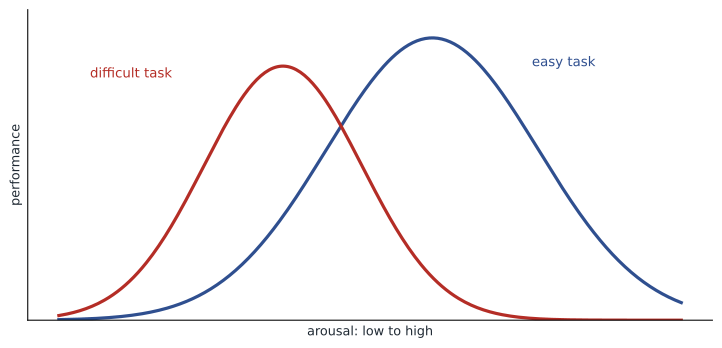
Arousal theory fills that gap. People seem motivated to maintain an optimal level of arousal, seeking stimulation when bored and calm when overwhelmed. The Yerkes-Dodson law, based on 1908 experiments with mice and later generalized, holds that performance is best at moderate arousal and worse when arousal is too low or too high, and that the optimal level is lower for difficult tasks than for easy ones. A little nervousness helps a sprinter; a lot of it can ruin a complex exam.
Needs and their order
Abraham Maslow proposed in 1943 a hierarchy of needs, often drawn as a pyramid: physiological needs at the base, then safety, then belonging and love, then esteem, and at the top self-actualization, the fulfilment of one's potential. He argued that lower needs generally must be met before higher ones become motivating.
Maslow's idea is intuitive and widely taught in business and nursing, but research gives it only partial support. People do tend to prioritize survival needs when they are badly threatened, and a large study by Louis Tay and Ed Diener in 2011, using data from more than 120 countries, found that the fulfilment of basic, safety, social and esteem needs was each associated with well-being. But the needs did not have to be satisfied in order: people in poverty could still experience strong social satisfaction and meaning. Maslow himself never drew the pyramid; it was added by later writers. Navarro suggests treating the hierarchy as a reminder that needs compete, not as a strict ladder.
Intrinsic and extrinsic motivation
Intrinsic motivation is doing something for its own sake, because it is interesting or enjoyable. Extrinsic motivation is doing something to obtain an outcome separate from the activity, such as money, grades or praise. Marcus's late-night project is intrinsically motivated; Owen's editing has become extrinsically motivated.
Edward Deci and Richard Ryan's self-determination theory proposes that people have three basic psychological needs: autonomy, feeling that one's actions are self-chosen; competence, feeling effective; and relatedness, feeling connected to others. When these needs are supported, people are more likely to be intrinsically motivated and to internalize the value of activities they do not find inherently enjoyable. As the first course described, rewards can undermine intrinsic motivation when they feel controlling, an effect called overjustification, but rewards that give information about competence, such as specific praise for a well-made video, can support it.
Owen recognizes himself. When the channel became a job, sponsors began telling him what to make, and the deadlines started to feel controlling. Navarro suggests he look for ways to restore autonomy, such as reserving some videos for topics he chooses, and to notice competence, such as the skills he has gained. Self-determination theory has been applied widely in schools, workplaces, health care and sport, with generally supportive evidence, though effects in field interventions are often modest.
Achievement motivation is the desire for significant accomplishment and mastery. People differ in whether they focus on mastery goals, aimed at learning and improving, or performance goals, aimed at demonstrating ability compared with others. Mastery goals tend to be associated with deeper learning and persistence after failure. Angela Duckworth popularized grit, perseverance and passion for long-term goals, but meta-analyses suggest grit overlaps heavily with the established personality trait of conscientiousness and predicts success only modestly.
Hunger
Hunger illustrates how biology, psychology and culture interact in motivation. Signals from the body tell the brain about energy needs. When the stomach is empty, it releases the hormone ghrelin, which increases hunger; after eating, the gut releases hormones that signal fullness. Fat cells release leptin, which signals long-term energy stores to the hypothalamus, a key brain region for regulating hunger. Blood glucose levels also matter, and insulin from the pancreas helps cells take in glucose.
But people do not eat only when their bodies need energy. We eat because it is mealtime, because food is in front of us, because others are eating, because we are stressed or bored, and because certain flavours have been associated with comfort since childhood. Culture shapes what counts as food and when meals happen. In studies by Brian Wansink, larger plates and bowls were reported to increase how much people ate, but many of his papers were later retracted for flawed and misreported data, a cautionary example for the class. The broader finding that portion size and food availability affect intake is supported by other research.
Eating disorders, such as anorexia nervosa, bulimia nervosa and binge-eating disorder, involve serious disturbances in eating and in thoughts about food, weight and shape. Anorexia nervosa has one of the highest mortality rates of any mental disorder, and eating disorders arise from interacting genetic, psychological and social factors. Lesson 11 returns to them. People who are worried about their own eating can contact the National Eating Disorder Information Centre (NEDIC) or a family doctor.
What emotion is
An emotion is a response of the whole organism involving three components: physiological arousal, such as a racing heart; expressive behaviour, such as a smile or a frown; and conscious experience, the feeling itself, along with the thoughts and interpretations that accompany it. Psychologists have argued for well over a century about how these components relate.
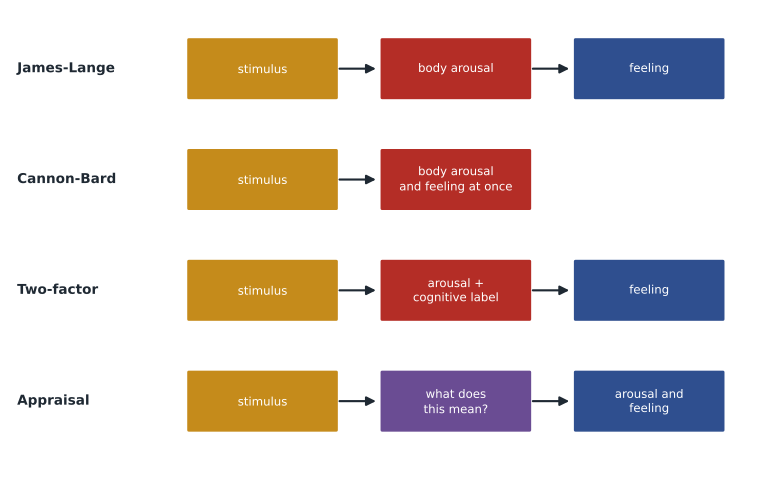
In the 1880s, William James and the Danish physician Carl Lange independently proposed that the feeling follows the body's response. In the James-Lange theory, we see a bear, our heart races and we run, and then we feel afraid because we perceive our bodily reaction. In the 1920s, Walter Cannon and Philip Bard objected that bodily responses are too slow and too similar across emotions to explain the rich variety of feelings. The Cannon-Bard theory proposed that the emotion-arousing stimulus triggers bodily arousal and subjective feeling at the same time.
In 1962, Stanley Schachter and Jerome Singer proposed the two-factor theory: emotion requires both physical arousal and a cognitive label for it. In their experiment, participants injected with adrenaline, which raises heart rate, and not told what to expect, reportedly felt more euphoric or angrier depending on the mood of a confederate in the room. The results were weaker and less consistent than often claimed and have been hard to replicate, but the broader idea that interpretation shapes emotion has strong support. In a well-known 1974 field study by Donald Dutton and Arthur Aron on a swaying suspension bridge in North Vancouver, men approached by a woman on the frightening bridge were more likely to call her afterward than men approached on a stable bridge, perhaps because they misattributed their arousal to attraction.
Richard Lazarus argued that emotions depend on appraisal, often very rapid evaluation of what a situation means for one's well-being, while Robert Zajonc argued that some emotional reactions, such as preferring a familiar face, occur without conscious thought. Both were partly right: some emotional responses travel a fast route through the amygdala before conscious appraisal, as Joseph LeDoux's research showed, while others depend on more elaborate thinking.
Expressing and reading emotion
In the 1960s and 1970s, Paul Ekman and his colleagues showed photographs of posed facial expressions to people in many cultures, including a remote group in Papua New Guinea with little exposure to Western media. People across cultures matched expressions of happiness, sadness, anger, fear, surprise and disgust to stories at rates well above chance, which Ekman interpreted as evidence for universal basic emotions. Cultures also have display rules, norms about when it is appropriate to show which emotions.
This view has been challenged. Lisa Feldman Barrett and others argue that facial expressions vary much more across situations and cultures than the classic studies suggested, that recognition rates fall when people are not given a list of emotion words to choose from, and that emotions are constructed by the brain from bodily sensations, concepts and context rather than triggered as fixed programs. The debate matters for technologies that claim to read emotions from faces, which often perform poorly and unevenly across groups.
The facial feedback hypothesis proposes that facial expressions can influence emotional experience. A famous 1988 study reported that people who held a pen in their teeth, forcing a smile, rated cartoons as funnier than those who held it in their lips. A large 2016 multi-laboratory replication found no effect, but later studies, including a 2019 meta-analysis and a 2022 international collaboration, found small effects under some conditions. Navarro uses the sequence as a model of how science corrects itself: a striking finding, a failed replication, and a more modest conclusion.
Emotion, the body and the polygraph
Emotions involve the autonomic nervous system described in the first course. The sympathetic division prepares the body for action, raising heart rate, blood pressure and breathing; the parasympathetic division calms it. The polygraph, often called a lie detector, measures these signs of arousal while a person answers questions. But arousal signals anxiety, not lying. Innocent people may be anxious and guilty people may stay calm, and countermeasures can fool the machine. A 2003 review by the United States National Research Council concluded that polygraph testing had a weak scientific basis for screening. In Canada, the Supreme Court ruled in R. v. Béland in 1987 that polygraph results are not admissible as evidence, though police still use polygraphs in some investigations.
Happiness
Positive psychology, launched as a movement by Martin Seligman in the late 1990s, studies well-being and strengths. Subjective well-being combines life satisfaction with frequent positive and infrequent negative emotions. People adapt to many changes, a process called hedonic adaptation: the thrill of a raise or a new car fades. A widely cited 1978 study by Philip Brickman and colleagues compared lottery winners and people with spinal cord injuries and found smaller differences in happiness than expected, though the sample was small and later research found that some events, such as disability, unemployment and the death of a spouse, can have lasting effects.
Does money buy happiness? Within countries, richer people report higher life satisfaction, with each doubling of income linked to a similar gain. A 2010 study by Daniel Kahneman and Angus Deaton suggested that day-to-day emotional well-being stopped rising above an income of about 75,000 US dollars a year, while a 2021 study by Matthew Killingsworth found it kept rising. In 2023, the two sides published an adversarial collaboration, in which rivals design a study together. They concluded that for most people, emotional well-being keeps rising with income, but that for the least happy fifth of people it levels off at moderate incomes, because more money does not cure the sources of their unhappiness.
Stronger predictors of happiness include close relationships, health, meaningful work and a sense of control. Marcus runs a quick calculation that shows why each doubling of income matters about the same amount on a logarithmic scale.
import math
# Illustrative: life satisfaction rises by a fixed amount for each doubling of income
for income in (20_000, 40_000, 80_000, 160_000):
print(f"income {income:>7,}: doublings above 20,000 = {math.log2(income / 20_000):.0f}")income 20,000: doublings above 20,000 = 0 income 40,000: doublings above 20,000 = 1 income 80,000: doublings above 20,000 = 2 income 160,000: doublings above 20,000 = 3
Going from 20,000 to 40,000 is one doubling, and so is going from 80,000 to 160,000. If satisfaction rises by the same amount per doubling, an extra 20,000 matters far more to a person earning 20,000 than the same sum to a person earning 160,000.
Worked problem
Explaining motivation with self-determination theory
A nursing student, Fatima, finds medication math tedious, yet she wants to master it. Using self-determination theory, suggest ways she or her instructor could support internalized motivation.
Show solution
- Autonomy: explain why accurate dosing matters for patient safety, and let her choose among practice formats.
- Competence: give graded problems with specific feedback so she can see her accuracy improve.
- Relatedness: practise with peers in a study group linked to real clinical scenarios.
- Avoid purely controlling incentives, such as threats or rewards tied only to passing, which can undermine internalization.
Answer: Supporting autonomy, competence and relatedness helps her internalize the value of the task even if it is not enjoyable in itself.
Common mistakes
MistakePeople must satisfy each need in Maslow's hierarchy before moving to the next.
InsteadLarge cross-cultural data show that needs contribute to well-being somewhat independently, not in strict order.
MistakeA polygraph detects lies.
InsteadIt measures arousal, which can come from anxiety as well as deception.
MistakeFacial expressions are recognized identically across all cultures.
InsteadRecognition is above chance in many cultures but varies with context and method; the extent of universality is debated.
MistakeAbove a certain income, money never adds to happiness.
InsteadFor most people, emotional well-being keeps rising with income, though with diminishing returns per dollar.
Summary and key terms
- Motivation energizes, directs and sustains behaviour; instinct, drive-reduction and arousal theories each explain part of it.
- The Yerkes-Dodson law describes better performance at moderate arousal, with lower optimal arousal for hard tasks.
- Maslow's hierarchy is only partly supported; needs contribute to well-being without a strict order.
- Self-determination theory identifies autonomy, competence and relatedness as needs that support intrinsic motivation.
- Hunger depends on hormones such as ghrelin and leptin, the hypothalamus, and psychological and cultural cues.
- Theories of emotion differ on the roles of arousal and thought; appraisal and interpretation strongly shape emotion.
- Emotional expressions are partly universal and partly cultural; polygraphs measure arousal, not lying; happiness depends most on relationships, health and meaning.
- Homeostasis
- The tendency to maintain a steady internal state.
- Yerkes-Dodson law
- The principle that performance is best at moderate arousal.
- Intrinsic motivation
- Doing something for its own sake.
- Self-determination theory
- A theory that autonomy, competence and relatedness support motivation and well-being.
- Two-factor theory
- The theory that emotion requires physical arousal plus a cognitive label.
- Hedonic adaptation
- The tendency for emotional reactions to changes to fade over time.
Practice problems
Work each problem on paper first, then reveal the answer to check.
Why does drive-reduction theory struggle to explain roller coasters?
Show answer
Riding one increases arousal rather than reducing a need-based drive.
Which three needs does self-determination theory identify?
Show answer
Autonomy, competence and relatedness.
How did the 2023 adversarial collaboration reconcile the income findings?
Show answer
Emotional well-being rises with income for most people but levels off for the least happy fifth.
In the code, how many doublings separate incomes of 20,000 and 160,000?
Show answer
Three.
Lesson quiz · 5 questions
Score 60% or more to complete this lesson.
Create a free account to save your progress, take quizzes and earn a certificate.