
PRIN-131 · Lesson 9 of 12 · 25 min
Exceptions and exception plans
An exception is a situation where it can be forecast that there will be a deviation beyond the agreed tolerance levels. Exceptions are not failures of PRINCE2; they are PRINCE2 working as designed. The level of management that set a tolerance has said, in effect, tell me if this boundary will be crossed, because then the decision is mine. This lesson covers how exceptions are recognized and escalated at each level, what goes into an exception report, the options a board has, how project-level exceptions reach the business layer, and how an exception plan is approved. PRIN-130 described the planning side of exception plans; here the focus is on the decision.
Exceptions at each level
| Level of tolerance | Who notices first | How it is escalated | Who decides |
|---|---|---|---|
| Work package | Team manager | Raises an issue to the project manager | Project manager, within stage tolerance |
| Stage | Project manager | Exception report to the project board | Project board, within project tolerance |
| Project | Project board, usually on the project manager's advice | Board refers the exception report to the business layer | Business layer |
A work package exception is normally resolved by the project manager, who can move work or tolerance between work packages, approve changes within his or her authority, or adjust the work package. It becomes a stage exception only if the project manager cannot resolve it within the stage tolerances. Likewise, the board can absorb a stage exception within the project tolerances, for example by approving a stage exception plan with revised stage tolerances, as long as the project as a whole remains within the limits the business layer set. Each level tries to solve problems within its own authority before passing them up, but none hides a forecast breach of a tolerance it does not control.
Raising an exception early
The value of an exception lies in its timing. Raised early, it gives the board options; raised late, it gives the board a bill. The project manager should raise an exception report as soon as a forecast breach is reasonably certain, even if the forecast may later improve. The board can always decide to take no action other than watching. What the board cannot do is recover time that has already passed. A culture in which project managers fear raising exceptions, perhaps because they are treated as personal failures, defeats the whole mechanism: the board then learns of breaches only when they become actual.
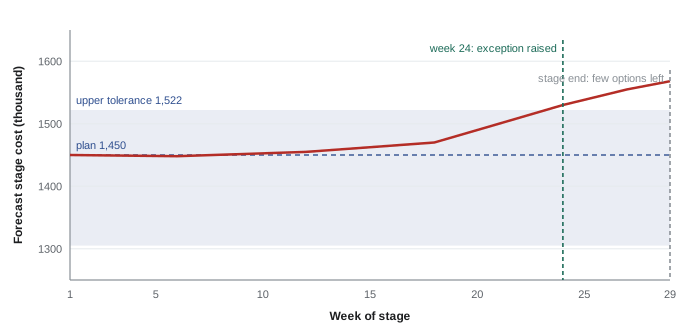
The exception report
In plain terms, an exception report describes the situation, explains its cause, sets out its consequences for the stage and the project, lists the available options with their effects on the performance targets and the business case, makes a recommendation and records any lessons. It should be short enough to read in a board meeting and specific enough to decide from. It is prepared by the project manager and may draw on issue reports, risk assessments and forecasts. An exception report often accompanies or follows informal warning in highlight reports.
| Section | What it should say | Ridgeline Water pilot, week 24 |
|---|---|---|
| Title and situation | What exception is forecast, against which tolerance | Stage cost forecast 1,568 thousand against an upper tolerance of 1,522 |
| Cause | Why it has happened | Billing system needs a data-cleansing step not identified in planning: 70 thousand |
| Consequences | Effect on stage, project and business case if nothing changes | Stage cost exceeds tolerance by about 46 thousand; project cost tolerance still sufficient |
| Options | Realistic alternatives with their effects | See the options table below |
| Recommendation | Preferred option and why | Option B: stage exception plan with revised cost tolerance |
| Lessons | What should be learned | Include data-quality assessment of legacy systems in initiation |
Options and their evaluation
The options in an exception report should be genuine alternatives, not one recommendation and two straw men. They usually include some combination of using a different method to recover within tolerance, reducing scope or quality within acceptable limits, accepting the deviation with revised tolerances, and, for serious exceptions, closing the project prematurely. Each option should show its effect on all the performance targets and on the business case, because an option that fixes cost by delaying benefits may not be better overall.
tol = {"cost": 1522, "time": 31, "scope_min": 2500, "quality_min": 97.0}
options = {
    # name: (stage cost k, stage weeks, connections, read rate %, effect on project NPV k)
    "A reduce pilot to 2,500 connections": (1530, 29.5, 2500, 97.4, -15),
    "B revised stage cost tolerance": (1568, 30.0, 2800, 97.6, -35),
    "C defer portal features to rollout": (1516, 29.5, 2800, 97.4, -60),
    "D manual data cleansing by staff": (1505, 33.0, 2800, 97.4, -25),
    "E close project prematurely": (1250, 26.0, 0, 0.0, -2309),
}
for name, (cost, weeks, conn, rate, npv) in options.items():
    fails = []
    if cost > tol["cost"]: fails.append("cost")
    if weeks > tol["time"]: fails.append("time")
    if conn < tol["scope_min"]: fails.append("scope")
    if rate < tol["quality_min"]: fails.append("quality")
    verdict = "within current tolerances" if not fails else "breaches " + ", ".join(fails)
print(f"{name:38} NPV effect {npv:6}k {verdict}")A reduce pilot to 2,500 connections NPV effect -15k breaches cost B revised stage cost tolerance NPV effect -35k breaches cost C defer portal features to rollout NPV effect -60k within current tolerances D manual data cleansing by staff NPV effect -25k breaches time E close project prematurely NPV effect -2309k breaches scope, quality
Option A just misses the cost tolerance and uses the bottom of the scope tolerance. Option B breaches cost tolerance by design: it asks the board to approve a revised tolerance. Option C stays within every current tolerance but costs the most of the recovery options in NPV terms, because deferring portal features delays the customer benefits. Option D breaches time tolerance because staff can clean data only part-time. Option E, premature closure, would lose the whole NPV of the do-something option from PRIN-130's appraisal and is listed only to show the board the cost of stopping. The project manager recommends B: it keeps the full pilot scope and quality, has a modest NPV effect, and the project tolerance can absorb the extra 46 thousand. C is a reasonable alternative if the board prefers to stay within current tolerances.
The board's responses
When it receives an exception report, the board may respond in several ways. It may ask for more information before deciding. It may decide that the situation can be handled within current tolerances after all, for example by approving a change or a recovery action that the project manager could not authorize. It may approve the recommended option and ask the project manager to produce an exception plan. It may reject all options and instruct a different course. Or, if the project is no longer justified, it may decide to close the project prematurely. If the exception would also exceed project tolerances, the board cannot approve a solution on its own authority and must refer the matter to the business layer.
| Board response | When appropriate | What happens next |
|---|---|---|
| Ask for more information | The report leaves important questions open | Project manager investigates and reports again quickly |
| Approve a recovery within current tolerances | An action outside the project manager's authority solves the problem | Plans updated; no exception plan needed |
| Request an exception plan | The stage cannot finish within tolerance but the project remains justified | Project manager prepares an exception plan for approval at an exception assessment |
| Refer to the business layer | Project tolerances would also be exceeded | Business layer decides, possibly setting new project tolerances |
| Close the project prematurely | The business case is no longer viable | Controlled closure; products and lessons are preserved |
The exception plan and exception assessment
If the board requests one, the project manager prepares an exception plan. It replaces the remainder of the current stage plan, or of the project plan if project tolerances are affected, and has the same format as the plan it replaces. Its preparation is handled in the managing a stage boundary process, which also updates the business case, risk register and project plan to reflect the exception. The board then holds an exception assessment, which is a decision point like a stage boundary: it reviews the exception plan, the updated business case and risks, and decides whether to approve the plan and continue. An approved exception plan becomes the new baseline.
| Feature | Normal stage boundary | Exception assessment |
|---|---|---|
| Trigger | End of a planned stage | Board's request for an exception plan |
| Plan reviewed | Next stage plan | Exception plan for the rest of the stage or project |
| Also reviewed | End stage report, updated project plan, business case, risks | Exception report, updated project plan, business case, risks |
| Decision | Authorize the next stage | Approve the exception plan, ask for changes, or close the project |
| Process | Managing a stage boundary, then directing a project | Managing a stage boundary, then directing a project |
Project-level exceptions
When an exception threatens project tolerance, the board refers it to the business layer with its own view. The business layer may approve new project tolerances, change the project's objectives, accept a reduced scope or close the project. In public organizations this may involve a formal approval route. Because these decisions often take longer, the board should warn the business layer early, through whatever regular reporting it has agreed, that a project-level exception is becoming likely.
In a Canadian federal department, for example, significant changes to a project's cost, schedule or scope may need to return to the department's senior governance committees, and for larger projects to Treasury Board, under the Policy on Planning and Investment and the Directive on the Management of Projects and Programmes; municipalities usually need council approval for budget increases beyond delegated limits. Check the current versions of these instruments and your organization's delegation of financial authority, because they define who the business layer really is for your project.
Worked problem
A project-level exception
During rollout stage 2, a national shortage of meter chips means meter prices will rise by 22 % for the rest of the project, adding about 1.1 million. Project cost tolerance is +8 % on 14 million, about 1.12 million, and 0.4 million of it has already been used. What happens?
Show solution
- The project manager raises an exception report: the price rise breaches stage tolerance and, combined with the tolerance already used, forecasts a breach of project tolerance (0.4 + 1.1 = 1.5 million against 1.12 million).
- The board considers options, such as slowing rollout to wait for prices to fall, changing meter supplier, reducing scope to the districts with the largest leak losses, or accepting the cost.
- Because project tolerance is affected, the board cannot approve a solution on its own; it refers the exception report with its recommendation to the business layer.
- The business layer decides, for example approving revised project tolerances with an updated business case, after which the board asks for an exception plan to replace the project plan.
Answer: A forecast breach of project tolerance goes through the board to the business layer, which owns project tolerances. The board's job is to present clear options and a recommendation, not to approve the overrun itself.
Common mistakes
MistakeWaiting for a breach to become actual before raising an exception.
InsteadRaise the exception report as soon as a breach is forecast with reasonable confidence.
MistakePresenting one real option and two unrealistic ones.
InsteadOffer genuine alternatives, each assessed on all targets and the business case.
MistakeThe board approving changes that exceed project tolerance.
InsteadRefer project-level exceptions to the business layer.
MistakeTreating an exception as a personal failure of the project manager.
InsteadTreat early exceptions as the control system working; criticize hidden breaches, not reported ones.
MistakeContinuing work under the old plan after the board has asked for an exception plan without agreement.
InsteadAgree with the board what work may continue while the exception plan is prepared.
Summary and key terms
- An exception is a forecast deviation beyond agreed tolerances.
- Work package exceptions go to the project manager, stage exceptions to the board, project exceptions to the business layer.
- Exception reports describe the situation, cause, consequences, options, recommendation and lessons.
- Options should be genuine and assessed on all performance targets and the business case.
- The board may ask for information, approve recovery, request an exception plan, refer upward or close the project.
- An exception plan replaces the rest of the stage or project plan and is reviewed at an exception assessment.
- Raising exceptions early gives decision-makers options.
- Exception
- A situation where a deviation beyond agreed tolerances is forecast.
- Exception report
- A report from the project manager to the board describing an exception and options.
- Exception plan
- A plan that replaces the remainder of a stage or project plan after an exception.
- Exception assessment
- A board review of an exception plan, similar to a stage boundary decision.
- Premature closure
- Closing a project before its planned end because it is no longer justified or viable.
- Project tolerance
- The tolerances for the whole project, set by the business layer.
- Stage tolerance
- The tolerances for a management stage, set by the project board.
Practice problems
Work each problem on paper first, then reveal the answer to check.
Define an exception.
Show answer
A situation where it is forecast that there will be a deviation beyond agreed tolerances.
How does a team manager escalate a forecast breach of work package tolerance?
Show answer
By raising an issue to the project manager.
Who receives an exception report?
Show answer
The project board.
List four sections of an exception report.
Show answer
For example: situation, cause, consequences, options, recommendation, lessons.
Who decides on a forecast breach of project tolerance?
Show answer
The business layer.
What does an exception plan replace?
Show answer
The remainder of the current stage plan, or of the project plan if project tolerances are affected.
In which process is an exception plan prepared?
Show answer
Managing a stage boundary.
Name two responses a board may make to an exception report.
Show answer
For example, request an exception plan, or close the project prematurely.
Why include premature closure among options?
Show answer
To show the board the cost of stopping, so it can compare it with continuing.
Why should exceptions be raised early?
Show answer
Early exceptions leave decision-makers time and options.
Lesson quiz · 5 questions
Score 60% or more to complete this lesson.
Create a free account to save your progress, take quizzes and earn a certificate.