
PRIN-131 · Lesson 5 of 12 · 27 min
The issues practice: types of issue and the register
Risks are things that might happen. Issues are things that have happened, or requests that have been made, and that need someone to decide what to do. A project that handles its issues well keeps a clear record of every significant event, assesses each one against the baselines, and makes sure decisions are taken at the right level. A project that handles them badly ends up with changes nobody approved, defects nobody owns, and a board that learns about problems from rumours. This lesson covers what counts as an issue, the types PRINCE2 recognizes, the records used to capture them and the procedure for managing them. Lesson 6 looks closely at change control.
What an issue is
In plain terms, an issue is a relevant event that has happened, was not planned, and requires management action. It can be raised by anyone with an interest in the project at any time: a team member, a supplier, a user, a board member or a member of the public. Issues can be about anything that affects the project: a request to change a product, a product that does not meet its specification, a problem with a supplier, a question from a stakeholder, a change in the law or an opportunity that has suddenly appeared. What makes it an issue is that it needs a decision.
| Situation at Ridgeline Water | Risk or issue? | Why |
|---|---|---|
| The supplier says its factory may close for two weeks next quarter | Risk | Uncertain future event |
| The supplier has announced the factory will close for two weeks next month | Issue | It has happened (the announcement); action is needed |
| The billing manager asks for monthly instead of quarterly bills from the pilot | Issue (request for change) | A request to change a baselined product |
| The radio network covers only 96 % of pilot addresses against 98 % required | Issue (off-specification) | A product does not meet its specification |
| A council member asks why the pilot district was chosen | Issue (problem or concern) | A concern that needs a response |
Types of issue
PRINCE2 groups issues into three types, because each type tends to be handled differently. A request for change is a proposal to change a baseline, such as a product description, a plan or the business case. An off-specification is something that should be provided by the project but currently is not, or is forecast not to be, provided: a missing product or a product that does not meet its specification. A problem or concern is any other issue that the project manager needs to resolve or escalate, such as a supplier dispute, a stakeholder complaint or an external event. Some study guides list external events and business opportunities as separate categories; in practice these are usually handled as problems or concerns, or, if they are still uncertain, as risks.
| Type | Definition (summary in our words) | Typical handling | Ridgeline Water example |
|---|---|---|---|
| Request for change | A proposal to change a baseline | Assessed against the business case, plans and risks; decided by the change authority or board | Billing manager asks for monthly bills in the pilot district |
| Off-specification | Something the project should provide but does not or will not, including a product that misses its quality criteria | Fix it, grant a concession, or escalate if tolerances are threatened | Radio coverage of 96 % against 98 % |
| Problem or concern | Any other issue the project manager must resolve or escalate | Resolved by the project manager within tolerance or escalated | Supplier announces a factory shutdown; a council member's question |
Only requests for change and off-specifications go through change control, because only they affect an agreed baseline. A problem or concern may lead to a request for change, for example if the factory shutdown means the plan must be altered, but in itself it is handled by the project manager's judgment within the stage tolerances, or escalated if it threatens them.
Formal and informal handling
Not every issue needs the full procedure. PRINCE2 distinguishes between issues that can be handled informally, which the project manager notes in the daily log and resolves, and issues that need formal handling, which are recorded in the issue register and may be described in an issue report. The issue management approach for the project defines where the line falls. A useful test is whether the issue affects a baseline, needs a decision above the project manager, or needs a formal audit trail. If none of these apply, the daily log is enough.
| Record | What it holds | Who keeps it | When used |
|---|---|---|---|
| Daily log | The project manager's informal diary of problems, actions, events and minor risks or issues | Project manager | For items handled informally, and as a first note of anything that may become formal |
| Issue register | The formal record of all issues being managed formally | Project support or the project manager | For issues that affect baselines, need decisions or need an audit trail |
| Issue report | A description, impact assessment and recommendation for one or more issues | Project manager | When an issue needs a formal decision, for example by the change authority or board |
In PRINCE2 7, the daily log and the issue register, together with the risk register, quality register, lessons log and product register, are all described as parts of the project log. This reflects how most projects now work: one tool, often a project management application or a shared workspace, holds all the records, with different views for different purposes.
The issue management approach
During initiation, the project manager prepares an issue management approach, approved by the board as part of the project initiation documentation. It describes how issues and changes will be handled on this project. In plain terms it covers the procedure, the tools and records, the scales used for priority and severity, the change authority and change budget, how off-specifications and concessions are handled, how issues are reported, the timing of reviews and the roles involved. It also sets the line between informal and formal handling.
| Topic | Ridgeline Water |
|---|---|
| Procedure | Capture, assess, recommend, decide, implement (described below) |
| Records | Daily log and issue register in the project log; issue reports for decisions above the project manager |
| Priority scale | Must, should, could, won't for requests for change |
| Severity scale | Severity 1 to 4 for off-specifications and problems, with 1 needing board attention within two working days |
| Change authority | Project manager up to 10 thousand per change; senior user and senior supplier jointly up to 60 thousand; board above that (lesson 6) |
| Change budget | 50 thousand in the pilot stage at the project manager's level |
| Formal handling threshold | Anything that affects a baseline, needs a decision above the project manager or involves a regulator or councillor |
| Reporting | Open issues summarized in each highlight report; severity 1 reported immediately |
The issue management procedure
PRINCE2 describes a procedure for managing issues formally. In plain terms its steps are: capture the issue and decide whether it needs formal handling; assess its impact on the project's objectives, business case, plans and risks; recommend options and a preferred course of action; decide, by the person or body with the authority to do so; and implement the decision, updating plans and records. Throughout, the project manager keeps the person who raised the issue informed.
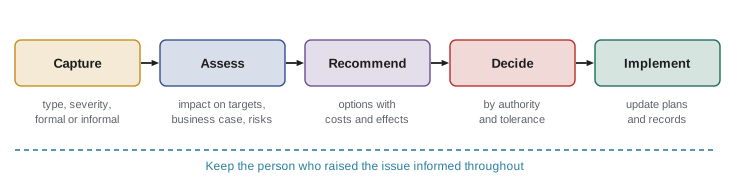
| Step | Key questions | Output |
|---|---|---|
| Capture | What type is it? How severe or high priority? Formal or informal? | Entry in the daily log or issue register |
| Assess | What is the impact on time, cost, scope, quality, benefits, risk and sustainability? On the business case? | Impact assessment, often with the help of team managers and assurance |
| Recommend | What are the options and their costs and effects? Which is preferred? | Recommendation, usually in an issue report if a decision above the project manager is needed |
| Decide | Who has the authority? Is the decision within tolerance? | Decision recorded in the issue register |
| Implement | What must change in plans, product descriptions and registers? | Updated plans and records; originator informed |
Decisions depend on the issue type and size. For a request for change, the decision-maker may approve, reject, defer or ask for more information. For an off-specification, the options include requiring the product to be fixed, granting a concession so the product is accepted as it is, or deferring. For a problem or concern, the project manager may resolve it within tolerance, or escalate it if it threatens stage tolerances. An issue that would cause a stage tolerance to be exceeded is escalated to the board, usually in an exception report, which lesson 9 covers.
Keeping the register healthy
An issue register can easily become a graveyard of old items that nobody closes. A healthy register has few very old open issues, clear owners and dates for each, and a mix of types that makes sense for the stage. The code below reads a small extract of Ridgeline Water's register in week 22 of the pilot, calculates how long each open issue has been open, flags any that have been open longer than the limit set for their severity, and summarizes the open issues by type.
today = 22
limits = {1: 1, 2: 3, 3: 6, 4: 10}  # weeks allowed open by severity
issues = [
    # id, type, severity, raised week, closed week or None, summary
    ("I-01", "request for change", 3, 8, 12, "Monthly bills in pilot district"),
    ("I-02", "off-specification", 2, 13, None, "Radio coverage 96 % against 98 %"),
    ("I-03", "problem or concern", 2, 15, None, "Factory shutdown announced"),
    ("I-04", "off-specification", 2, 15, 19, "Meter batch 2 failed sample"),
    ("I-05", "problem or concern", 4, 9, None, "Councillor query on district choice"),
    ("I-06", "request for change", 3, 18, None, "Add Spanish and French alert text"),
    ("I-07", "request for change", 4, 20, None, "Change portal logo"),
]
open_items = [i for i in issues if i[4] is None]
print(f"open {len(open_items)} of {len(issues)}")
for iid, typ, sev, raised, closed, text in sorted(open_items, key=lambda x: x[2]):
    age = today - raised
    flag = "  OVER LIMIT" if age > limits[sev] else ""
    print(f"{iid} sev {sev} open {age:2} weeks  {text}{flag}")
by_type = {}
for i in open_items:
    by_type[i[1]] = by_type.get(i[1], 0) + 1
print(by_type)open 5 of 7
I-02 sev 2 open 9 weeks Radio coverage 96 % against 98 % OVER LIMIT
I-03 sev 2 open 7 weeks Factory shutdown announced OVER LIMIT
I-06 sev 3 open 4 weeks Add Spanish and French alert text
I-05 sev 4 open 13 weeks Councillor query on district choice OVER LIMIT
I-07 sev 4 open 2 weeks Change portal logo
{'off-specification': 1, 'problem or concern': 2, 'request for change': 2}Five of the seven issues are open. Three are over their limits: the radio coverage off-specification (9 weeks against 3 for severity 2), the factory shutdown (7 weeks against 3) and the councillor's query (13 weeks against 10). The two severity 2 items should already have been decided; their age suggests they are waiting for a decision above the project manager, and both should appear prominently in the next highlight report. The councillor's query is minor in project terms but politically sensitive, and leaving it unanswered for three months is a communication failure that the issue management approach was meant to prevent.
Worked problem
Classifying and routing three issues
In one week Ridgeline Water's project manager receives: (a) the head-end vendor reports that a software update will delay daily read collection by a week; (b) the senior user asks for an extra alert when water use falls to zero for three days, as a welfare check for elderly customers; (c) user assurance reports that 6 % of installation photographs are missing, against a quality criterion requiring a photograph for every meter. Classify each and suggest how it is handled.
Show solution
- (a) is a problem or concern: an external event with schedule impact. The project manager assesses it against the stage time tolerance and resolves it within tolerance, for example by resequencing, or escalates if it threatens tolerance.
- (b) is a request for change: it changes the baselined alert design. It is assessed for cost, schedule, benefits and privacy impact and decided by the change authority according to its cost.
- (c) is an off-specification: the installation product does not meet a quality criterion. Options are to require the installer to return and photograph the meters, or for the senior user to grant a concession if the photographs are not essential.
- All three are recorded in the issue register because each affects a baseline or needs a decision; (a) might be handled informally if its impact is trivial.
Answer: One problem or concern, one request for change and one off-specification, each routed according to the issue management approach and the change authority limits.
Common mistakes
MistakeRecording uncertain future events as issues.
InsteadIf it has not happened, it is a risk; if it has, it is an issue.
MistakePutting every minor item into the issue register.
InsteadHandle minor items informally in the daily log, as the issue management approach allows.
MistakeTreating a problem or concern as a request for change automatically.
InsteadOnly issues that propose or require a change to a baseline go through change control.
MistakeLeaving issues open without dates or owners.
InsteadGive each issue an owner, a target date and an ageing limit by severity.
MistakeForgetting to tell the person who raised the issue what was decided.
InsteadKeep the originator informed at each step.
Summary and key terms
- An issue is a relevant event that has happened, was not planned and needs management action.
- The three types are request for change, off-specification and problem or concern.
- Only requests for change and off-specifications go through change control.
- Minor issues are handled informally in the daily log; others are recorded in the issue register.
- The issue management approach sets the procedure, scales, change authority, budget and reporting.
- The procedure is capture, assess, recommend, decide and implement, keeping the originator informed.
- In PRINCE2 7 the daily log and issue register are parts of the project log.
- Issue
- A relevant event that has happened, was not planned and requires management action.
- Request for change
- A proposal to change a baseline.
- Off-specification
- Something that should be provided by the project but is not, or is forecast not to be.
- Problem or concern
- Any other issue that the project manager needs to resolve or escalate.
- Concession
- An off-specification that is accepted by the customer without corrective action.
- Daily log
- The project manager's informal record of problems, actions and events.
- Issue register
- The formal record of issues being managed.
- Issue report
- A report describing one or more issues, their impact and a recommendation.
- Issue management approach
- The description of how issues and changes will be handled on a particular project.
- Project log
- In PRINCE2 7, the collection of logs and registers used to manage the project.
Practice problems
Work each problem on paper first, then reveal the answer to check.
Name the three types of issue.
Show answer
Request for change, off-specification, problem or concern.
A supplier says it might be late next quarter. Risk or issue?
Show answer
Risk.
A product misses a quality criterion and cannot be fixed within tolerance. Which issue type?
Show answer
Off-specification.
Which two issue types go through change control?
Show answer
Requests for change and off-specifications.
Where are informally handled issues recorded?
Show answer
In the daily log.
List the five steps of the issue management procedure.
Show answer
Capture, assess, recommend, decide, implement.
What is a concession?
Show answer
Acceptance of an off-specification without corrective action.
Which management product describes how issues will be handled?
Show answer
The issue management approach.
What document supports a formal decision on an issue?
Show answer
An issue report.
What should happen to an issue that would cause a stage tolerance to be exceeded?
Show answer
It is escalated to the board, usually through an exception report.
Lesson quiz · 5 questions
Score 60% or more to complete this lesson.
Create a free account to save your progress, take quizzes and earn a certificate.