
PRIN-131 · Lesson 10 of 12 · 25 min
Integrating quality, risk, issues and progress across the project
Lessons 1 to 9 studied the four control practices one at a time. On a real project they are never separate. A failed quality check creates an off-specification; the off-specification may realize a risk that was already in the register; deciding it may need a change, funded from the change budget; and the change consumes tolerance that the progress practice monitors. This lesson looks at how information flows between the four practices, how they are set up during initiation, how they appear in the processes, and how the project log ties their records together. It ends with a worked trace of a single event through all four practices.
How the practices pass information
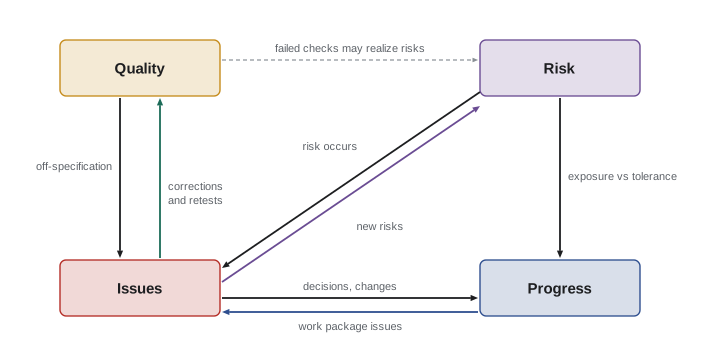
| From | To | What passes | Ridgeline Water example |
|---|---|---|---|
| Quality | Issues | A failed check that cannot be fixed within tolerance becomes an off-specification | Radio coverage 96 % against 98 % |
| Quality | Progress | Approved products are the measure of progress | Head-end approved: earned value recognized |
| Risk | Issues | A risk that occurs becomes an issue | Supplier factory shutdown announced |
| Issues | Risk | Assessing an issue reveals new or changed risks | Monthly billing raises a risk of customer confusion |
| Issues | Progress | Decisions and approved changes update plans and consume tolerance | Language change uses one week of time tolerance |
| Progress | Issues | A forecast breach at work package level is raised as an issue | Billing interface three weeks late |
| Risk | Progress | Risk exposure is monitored against risk tolerance and reported | Interface risk at 96 % of the limit |
| Progress | Quality | Plans schedule quality activities and track them | Usability test overdue in the quality register |
Two flows deserve particular attention. First, the link from risk to issue: when a risk occurs, it should be closed in the risk register and raised in the issue register, with a reference between them, so that the board can see whether the planned response worked. Second, the link from issues to progress: every approved change alters a baseline and may use tolerance, and if the progress practice does not see the change, forecasts will be compared with plans that no longer exist.
Setting up the practices in initiation
All four practices are set up during initiating a project, when the project manager prepares the management approaches that become part of the project initiation documentation. PRINCE2 7 also introduced further management approaches that relate closely to the control practices, including a digital and data management approach, which describes how the project will use data and digital tools, and a commercial management approach. Lesson 11 returns to the digital and data approach. The approaches should be prepared together, because they share scales, roles and reporting.
| Management approach | Practice | Key decisions it records | Shared with |
|---|---|---|---|
| Quality management approach | Quality | Standards, methods, records, quality assurance, responsibilities | Issues (off-specifications, concessions); progress (quality activities in plans) |
| Risk management approach | Risk | Procedure, scales, risk tolerance, risk budget, roles, reporting | Progress (risk tolerance); issues (risks that occur) |
| Issue management approach | Issues | Procedure, severity and priority scales, change authority, change budget | Progress (changes against tolerance); quality (off-specifications) |
| Digital and data management approach | Supports all | Tools, data standards, record keeping, security and privacy of project data | All four practices' registers and reports |
Consistency matters more than length. If the risk management approach scores impact in thousands while the issue management approach rates severity on a different scale, the same event may be treated as minor in one register and severe in the other. A single page that defines common scales, a shared escalation threshold and one reporting rhythm for all four practices is often more useful than four separate documents.
The practices across the processes
The processes, which PRIN-140 and PRIN-141 study in detail, are where the practices are carried out. The table below shows, in outline, where each control practice is most active. The pattern is regular: approaches and baselines are set up in initiation, monitored during each stage, reviewed at stage boundaries and closed at the end.
| Process | Quality | Risk | Issues | Progress |
|---|---|---|---|---|
| Starting up a project | Customer quality expectations and acceptance criteria in the project product description | Initial risks noted in the daily log | Concerns noted in the daily log | Project tolerances from the mandate |
| Initiating a project | Quality management approach; product descriptions | Risk management approach; risk register | Issue management approach; issue register | Project plan and controls; tolerances; reporting frequency |
| Controlling a stage | Monitor quality activities; off-specifications | Monitor risks; implement responses | Capture, assess and decide issues | Highlight reports; exception reports |
| Managing product delivery | Carry out quality checks; update quality register | Report risks in checkpoint reports | Raise issues to the project manager | Checkpoint reports; work package tolerances |
| Managing a stage boundary | Quality results reviewed for the end stage report | Risk register reviewed and updated | Issue register reviewed | End stage report; next stage plan or exception plan |
| Directing a project | Approve approaches; confirm acceptance | Approve risk tolerance; risk budget | Decide escalated issues and changes | Authorize stages; respond to exceptions |
| Closing a project | Confirm acceptance against the project product description | Hand over open risks | Hand over open issues as follow-on actions | End project report |
The project log as the shared record
In PRINCE2 7 the project log brings the records of all four practices together: the daily log, issue register, risk register, quality register, lessons log and product register. Linking records is what makes integration visible. An off-specification in the issue register should refer to the quality register entry that found it and the product register entry for the product. A risk that occurs should refer to the issue it became. A change approved by the change authority should refer to the plan versions it altered. Most project tools support these links directly; on a small project a simple identifier convention does the job.
Tracing one event through all four practices
The code below traces a single event, the factory shutdown announced in week 15 of the pilot, through the four practices as linked records. It shows how one event creates or updates entries in several registers, each referring to the others, and ends with the effect on tolerance used. The structure is a teaching model of what a project tool would hold.
log = {"risk": {}, "issue": {}, "quality": {}, "product": {}, "change": {}}
log["risk"]["R1"] = {"text": "Pilot meters delivered late", "status": "open", "ev_k": 31.5}
log["product"]["P-04"] = {"title": "Meters installed", "planned_week": 20, "forecast_week": 20}
time_tol, time_used = 2.0, 0.0

# week 15: the supplier announces a two-week factory shutdown -> the risk occurs
log["risk"]["R1"]["status"] = "occurred -> I-03"
log["issue"]["I-03"] = {"type": "problem or concern", "from_risk": "R1", "status": "assessing"}
# assessment: meters 2 weeks late; installation has 1 week of float -> 1 week stage delay
log["product"]["P-04"]["forecast_week"] = 22
time_used += 1.0
# response: supplier ships part of the batch by air at its own cost (contract transfer clause)
log["change"]["C-02"] = {"for_issue": "I-03", "effect": "resequence installation", "cost_k": 0}
log["issue"]["I-03"]["status"] = "decided: resequence; supplier pays air freight"
# quality: the air-shipped meters need the same factory sample test
log["quality"]["Q-018"] = {"product": "P-04", "method": "factory sample of 50", "planned_week": 18}

for reg, entries in log.items():
    for k, v in entries.items():
        print(f"{reg:8} {k:6} {v}")
print(f"time tolerance used {time_used} of {time_tol} weeks ({time_used / time_tol:.0%})")risk R1 {'text': 'Pilot meters delivered late', 'status': 'occurred -> I-03', 'ev_k': 31.5}
issue I-03 {'type': 'problem or concern', 'from_risk': 'R1', 'status': 'decided: resequence; supplier pays air freight'}
quality Q-018 {'product': 'P-04', 'method': 'factory sample of 50', 'planned_week': 18}
product P-04 {'title': 'Meters installed', 'planned_week': 20, 'forecast_week': 22}
change C-02 {'for_issue': 'I-03', 'effect': 'resequence installation', 'cost_k': 0}
time tolerance used 1.0 of 2.0 weeks (50%)One event produced or changed five records: the risk was closed as occurred with a pointer to the issue; the issue was assessed and decided; the product's forecast date moved two weeks; a change was recorded to resequence installation; and a quality activity was added for the air-shipped meters. The net effect on progress is one week of the two-week stage time tolerance, half of it, because installation had one week of float. Without the links, the board would see a closed risk, a decided issue and a late product as three unrelated facts.
Worked problem
Integrating the practices at a stage boundary
At the end of Ridgeline Water's pilot stage, the project manager prepares the end stage report and the plan for rollout stage 1. What should each control practice contribute?
Show solution
- Quality: confirm which pilot products are approved, which off-specifications were accepted by concession (such as 97 % coverage in difficult streets), and add quality activities for rollout to the next stage plan.
- Risk: close risks that no longer apply, such as pilot meter delivery; reassess risks for rollout, such as installer capacity; update the risk budget request.
- Issues: review open issues, transfer those that affect rollout into the next stage, and report change budget used.
- Progress: report performance against all seven tolerances, propose tolerances for rollout stage 1 based on pilot experience, and record lessons such as the legacy data problem.
- Assemble these into the end stage report, the next stage plan, the updated project plan and business case, for the board's decision.
Answer: The stage boundary is where all four practices are reviewed together. Each feeds the board's decision on whether, and how, to continue.
Signs that the practices are not integrated
Assurance reviews often find that each register looks tidy on its own while the project as a whole is drifting. The symptoms are recognizable, and each points to a broken link between two practices. The table below lists the most common ones and the link to repair.
| Symptom | Broken link | Repair |
|---|---|---|
| Highlight report shows all targets green, but the product register shows several late products | Products to progress | Forecast from product status, not from activity percentages |
| Risk register still shows a risk as open months after it occurred | Risk to issues | Close occurred risks with a reference to the resulting issue |
| Change budget is fully used but stage plan has never been revised | Issues to progress | Update the stage plan and forecasts each time a change is approved |
| Quality register shows failed checks with no matching off-specification | Quality to issues | Raise an off-specification whenever a failure cannot be fixed within tolerance |
| Exception report lists options without their effect on quality or risk | Progress to quality and risk | Assess every option against all seven performance targets |
| Lessons log is empty at the end of the stage | All practices to learning | Ask at each boundary what each practice taught the team |
None of these failures requires more documentation to fix. Each needs one habit: when something changes in one register, ask which other registers and plans must change too. Project support can build this habit into the weekly register review by working through a short checklist of cross-references, and project assurance can test it at stage boundaries by picking one recent event and tracing it through every record it should have touched, just as the code above did.
Common mistakes
MistakeClosing a risk that has occurred without raising the resulting issue.
InsteadClose the risk as occurred and raise an issue, linking the two.
MistakeApproving changes without updating the plans and forecasts that the progress practice uses.
InsteadReflect every approved change in the baselines and in tolerance used.
MistakeWriting management approaches with inconsistent scales and thresholds.
InsteadDefine common scales, escalation thresholds and reporting rhythms across the approaches.
MistakeKeeping registers in separate tools with no cross-references.
InsteadLink records in the project log so one event can be traced across practices.
MistakeReviewing practices in isolation at stage boundaries.
InsteadReview quality, risk, issues and progress together to inform the board's decision.
Summary and key terms
- The four control practices continuously pass information to one another.
- Failed quality checks become off-specifications; risks that occur become issues; approved changes consume tolerance.
- The control practices are set up together in initiation through management approaches with shared scales and thresholds.
- PRINCE2 7 adds approaches such as the digital and data management approach that support all practices.
- Each process uses the practices in a regular pattern: set up, monitor, review and close.
- The project log links the records of all four practices.
- Stage boundaries are where the practices are reviewed together for the board.
- Management approach
- A description of how a practice will be applied on a particular project.
- Digital and data management approach
- In PRINCE2 7, the description of how a project will use data and digital tools.
- Project initiation documentation
- The set of documents that brings together the information needed to authorize the project.
- Cross-reference
- A link between records in different registers that relate to the same event or product.
- Exception assessment
- A board decision point to review an exception plan.
- Integration
- The way practices share information and decisions so the project is controlled as a whole.
Practice problems
Work each problem on paper first, then reveal the answer to check.
What should happen in the registers when a risk occurs?
Show answer
The risk is closed as occurred and an issue is raised, with a link between them.
In which process are the management approaches for the control practices prepared?
Show answer
Initiating a project.
Name the three management approaches for quality, risk and issues.
Show answer
Quality management approach, risk management approach and issue management approach.
Which records make up the project log in PRINCE2 7?
Show answer
Daily log, issue register, risk register, quality register, lessons log and product register.
How does an approved change affect the progress practice?
Show answer
It changes baselines and may consume tolerance, which must be reflected in forecasts.
Where are quality checks carried out in the process model?
Show answer
Mainly in managing product delivery.
Why share scales across management approaches?
Show answer
So the same event is rated consistently in different registers.
What happens to open risks and issues when the project closes?
Show answer
They are handed over, usually as follow-on actions.
What links a failed quality check to the issues practice?
Show answer
If it cannot be fixed within tolerance, it becomes an off-specification.
Which report gathers the four practices' results at the end of a stage?
Show answer
The end stage report.
Lesson quiz · 5 questions
Score 60% or more to complete this lesson.
Create a free account to save your progress, take quizzes and earn a certificate.