
PRIN-131 · Lesson 11 of 12 · 26 min
Tailoring these practices: agile, small projects, digital and data
PRIN-110 described tailoring as a principle: PRINCE2 is adapted to suit the project's environment, size, complexity, importance, capability and risk. Tailoring the control practices does not mean dropping them. A small project still needs to know what good looks like, what might go wrong, how changes are decided and whether it is on track. What changes is formality, frequency and the tools used. This lesson looks at tailoring quality, risk, issues and progress for small projects, agile delivery, projects within programs, commercial relationships and data-rich digital environments. PRIN-150 covers tailoring in depth and PRINCE2 Agile in particular.
What must stay, whatever the tailoring
Some elements of each practice are essential even on the smallest project, because without them the practice simply does not exist. Others can be scaled down or combined. The table below is our summary of a sensible minimum; the official manual sets out the minimum requirements for applying each practice.
| Practice | Keep in every project | Can be scaled down or combined |
|---|---|---|
| Quality | Agreed acceptance criteria; quality criteria for key products; evidence of checks and acceptance | Formal quality review meetings; separate quality register; long quality management approach |
| Risk | Identified risks with owners; a response for significant risks; a threshold for escalation | Detailed scoring scales; separate risk register; Monte Carlo analysis |
| Issues | A record of issues needing decisions; a defined change authority; baselines changed only by decision | Separate issue reports; multi-level change authority; product register detail |
| Progress | Tolerances; regular reports to whoever authorized the work; escalation when tolerance is forecast to be exceeded | Frequency and length of reports; number of stages; earned value |
Small projects
On a small project, such as replacing a community centre's booking system over three months, the four practices can share a single page of approach and a single log. Quality might be a short list of acceptance criteria agreed with the centre manager and a test checklist. Risks, issues and lessons can sit in one spreadsheet with a type column. The project manager might report weekly in a five-line email to the executive, with tolerances of two weeks and ten per cent. These are real practices, just proportionate ones.
| Element | Large project (Ridgeline Water rollout) | Small project (booking system) |
|---|---|---|
| Management approaches | Separate quality, risk and issue management approaches | One page covering all three |
| Registers | Separate registers in the project tool, linked | One combined log with a type column |
| Quality checks | Factory tests, field tests, quality reviews with four roles | Acceptance test checklist run by two users |
| Change authority | Three levels with a change budget | Project manager up to a small limit; executive above |
| Reports | Weekly checkpoint, four-weekly highlight, end stage reports | Weekly email to the executive; short closure report |
| Tolerances | Seven performance targets at three levels | Time, cost and scope at project level |
Agile delivery
Many projects now deliver at least some products using agile methods. The control practices map onto agile practices naturally, but the emphasis shifts. In agile delivery, time and cost are usually fixed by timeboxes, while scope is the main area of flexibility. Quality is built in through acceptance criteria on each user story and a team definition of done, rather than inspected at the end. Risks are surfaced in daily stand-ups and retrospectives. Most changes are handled by reprioritizing the backlog within the agreed scope tolerance, with only changes beyond that tolerance going to the board.
| Practice | Typical agile expression | What the board still needs |
|---|---|---|
| Quality | Acceptance criteria per story; definition of done; automated tests; sprint review demonstrations | Product-level acceptance criteria; evidence that the definition of done is met |
| Risk | Risks raised in stand-ups and retrospectives; risk-adjusted backlog | Escalation of risks beyond risk tolerance; a view of overall exposure |
| Issues | Backlog reprioritization by the product owner within scope tolerance | Decisions on changes beyond scope tolerance or affecting the business case |
| Progress | Burn-up or burn-down charts; velocity; sprint reviews | Forecast of what will be delivered by the fixed date, against scope tolerance |
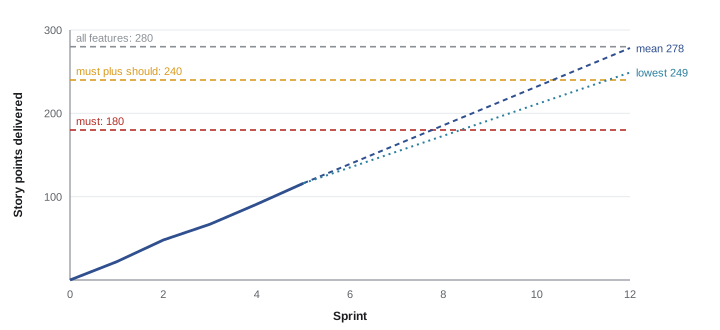
The code below shows a typical agile progress forecast. Ridgeline Water's customer portal is built in two-week sprints with a fixed end date. The must-have features total 180 story points, and the scope tolerance allows should-have and could-have features to be dropped, but not must-haves. From the velocity of the sprints so far, the code forecasts how many points will be delivered by the end date and whether the must-haves are at risk.
import statistics
velocities = [22, 26, 19, 24, 25]            # points per sprint so far
sprints_total, sprints_done = 12, len(velocities)
done = sum(velocities)
backlog = {"must": 180, "should": 60, "could": 40}
remaining_sprints = sprints_total - sprints_done
v_mean = statistics.mean(velocities)
v_low = min(velocities)
fc_mean = done + v_mean * remaining_sprints
fc_low = done + v_low * remaining_sprints
print(f"delivered so far {done} points; mean velocity {v_mean:.1f}")
print(f"forecast by end date: {fc_mean:.0f} points (mean), {fc_low:.0f} points (lowest velocity)")
cum = 0
for level, pts in backlog.items():
    cum += pts
    status = "safe" if fc_low >= cum else "at risk" if fc_mean >= cum else "unlikely"
print(f"up to {level:6} {cum:3} points: {status}")delivered so far 116 points; mean velocity 23.2 forecast by end date: 278 points (mean), 249 points (lowest velocity) up to must 180 points: safe up to should 240 points: safe up to could 280 points: unlikely
Five sprints have delivered 116 points, a mean velocity of 23.2. At that rate the team will deliver about 278 points by the end date, and even at its lowest velocity about 249. The must-haves and should-haves are safe even at the lowest velocity, but the full set of could-haves, which would need 280 points, is unlikely: even the mean forecast falls just short. In PRINCE2 terms, the project is within scope tolerance: the board's tolerance allows could-haves to be dropped. The product owner will decide which could-haves to keep, and no exception is needed. If the forecast showed must-haves at risk, scope tolerance would be threatened and the board would need to decide.
Projects within programs and commercial relationships
When a project is part of a program, the program usually sets some of the controls. Its risk management approach may define the scales the project must use; its change control may decide changes that affect other projects; and its reporting may require project highlight reports in a standard format. The project's approaches should refer to the program's rather than duplicating them. In a commercial relationship, the contract shapes the control practices: quality criteria may be contractual acceptance tests, transfer of risk is achieved through contract clauses, changes to scope are contract variations with their own procedure, and progress reports may be contractual deliverables. PRINCE2 7's commercial management approach is where these arrangements are described, and PRIN-120 discussed the customer–supplier relationship that underlies them.
Digital and data
PRINCE2 7 places more emphasis than earlier editions on the use of data and digital technology in project management. In practice this means that registers live in shared tools rather than documents, reports can be generated from live data rather than written, dashboards can show tolerance used in real time, and analysis such as Monte Carlo forecasting is within reach of ordinary projects. It also brings new responsibilities: data quality, version control of plans held in tools, access control, retention of project records and protection of any personal data in registers, such as names in issue logs or customer details in quality records. The digital and data management approach is where a project records how it will handle these.
| Opportunity | Risk to manage | Control |
|---|---|---|
| Highlight reports generated from registers | Garbage in, garbage out: stale statuses give false comfort | Weekly register review; owners confirm their entries |
| Real-time dashboards for the board | Board micromanages within delegated tolerance | Agree that dashboards inform but decisions follow management by exception |
| Forecasting from historical data | Models trusted beyond their assumptions | State assumptions; compare forecasts with actuals at stage boundaries |
| AI assistants drafting reports and risk lists | Plausible but wrong content; confidential data leaving the organization | Human review of all outputs; approved tools only; no sensitive data in public tools |
| Shared registers across suppliers | Personal or commercially sensitive data exposed | Access controls; data minimization; agreed retention |
Personal information in project records is subject to privacy law. In Canada, PIPEDA applies to private-sector organizations in commercial activities, Quebec's Law 25 adds stronger obligations for organizations in that province, and public bodies follow federal or provincial public-sector privacy laws; a municipal utility, for example, is usually covered by its province's municipal privacy legislation. Project registers that name customers or staff should follow the organization's privacy rules on access and retention.
Worked problem
Tailoring for a hybrid project
Ridgeline Water's rollout combines predictive work (installing 57,000 meters across districts) with agile work (developing the customer portal in sprints). How should the control practices be tailored?
Show solution
- Quality: keep factory and field tests for meters with formal records; for the portal, use acceptance criteria per story and a definition of done, with a formal acceptance test before each release.
- Risk: one risk register for the whole project, with portal risks raised from sprint retrospectives by the product owner.
- Issues: formal change control for meter scope and installation; backlog reprioritization within scope tolerance for portal features, with changes beyond tolerance escalated.
- Progress: earned value on installation by district; burn-up charts for the portal; both summarized in one highlight report against stage tolerances.
- Record the tailoring in the project initiation documentation so that the board and assurance know what to expect.
Answer: The two kinds of work keep their natural controls, but they report into one set of stage tolerances, one risk register and one highlight report, so the board sees one project.
Recording tailoring decisions
Tailoring is a decision, and like any decision it should be recorded and approved. PRINCE2 expects the project initiation documentation to explain how the method has been tailored, so that the board, assurance and any auditor can see what the project has chosen to do and why. A short tailoring record is usually enough. It lists each practice, what has been simplified or adapted, the reason, and any compensating control. Recording tailoring has two benefits: it prevents tailoring from becoming an excuse for skipping work, and it gives the next similar project a starting point.
| Practice | Tailoring decision | Reason | Compensating control |
|---|---|---|---|
| Quality | Single-reviewer document reviews for low-risk products | Saves review meetings on routine letters | User assurance samples 1 in 5 reviews |
| Risk | Combined risk and issue log for the portal team | Small agile team; one tool | Weekly export to the project risk register for risks above tolerance |
| Issues | Backlog reprioritization within scope tolerance for portal features | Agile delivery with a product owner | Product owner reports scope changes in each highlight report |
| Progress | Burn-up charts instead of earned value for the portal | Earned value adds little for timeboxed work | Burn-up forecast compared with scope tolerance every sprint |
Tailoring should also be revisited. A practice that was simplified at the start of the project may need more formality when the project grows, when an external supplier joins, or when a near-miss shows that a control was too light. Stage boundaries are the natural point to review the tailoring record alongside the next stage plan.
Common mistakes
MistakeDropping a practice on a small project.
InsteadKeep the essentials of every practice and scale down formality.
MistakeTreating every backlog change in agile delivery as a formal request for change.
InsteadLet the product owner reprioritize within scope tolerance; escalate only beyond it.
MistakeDuplicating a program's controls in each project.
InsteadRefer to the program's approaches and adopt its scales and reporting.
MistakeAssuming dashboards make highlight reports unnecessary.
InsteadDashboards inform; the project manager still interprets, forecasts and asks for guidance.
MistakePutting personal data into registers without considering privacy rules.
InsteadMinimize personal data and follow the organization's privacy and retention rules.
Summary and key terms
- Tailoring adjusts formality, frequency and tools; it does not remove practices.
- Small projects can combine approaches and registers into one page and one log.
- In agile delivery, time and cost are fixed and scope is the main tolerance; quality is built in through acceptance criteria and a definition of done.
- Backlog reprioritization handles most agile changes within scope tolerance.
- Programs and contracts shape a project's controls; refer to them rather than duplicating them.
- PRINCE2 7 emphasizes data and digital tools, recorded in the digital and data management approach.
- Digital tools bring data quality, privacy and over-reliance risks that must be managed.
- Tailoring
- Adapting PRINCE2 to suit the project's context, size, complexity and risk.
- Definition of done
- A team's shared list of conditions a product must meet to be considered complete.
- Velocity
- The amount of work an agile team completes per timebox, often in story points.
- Burn-up chart
- A chart showing cumulative work completed against total scope over time.
- Product owner
- In agile delivery, the person who prioritizes the backlog on behalf of users.
- Commercial management approach
- In PRINCE2 7, the description of how commercial relationships will be managed.
- Scope tolerance
- The permissible variation in what is delivered, often expressed through priorities.
Practice problems
Work each problem on paper first, then reveal the answer to check.
Does tailoring allow a small project to skip risk management?
Show answer
No; it can scale it down, but risks, owners and escalation are still needed.
In agile delivery, which performance target usually carries most of the flexibility?
Show answer
Scope.
How is quality usually built in on agile teams?
Show answer
Acceptance criteria on stories, a definition of done and automated tests.
Who reprioritizes the backlog within scope tolerance?
Show answer
The product owner.
When does an agile scope change need the board?
Show answer
When it would exceed scope tolerance or affect the business case.
Velocities of 20, 24 and 22 with 6 sprints left: forecast additional points at mean velocity?
Show answer
About 132 points.
What should a project in a program do about risk scales?
Show answer
Use the program's scales rather than inventing its own.
Where are contract change procedures described in PRINCE2 7?
Show answer
In the commercial management approach.
Name one risk of AI tools in project reporting.
Show answer
Plausible but wrong content, or confidential data leaving the organization.
Where does a project describe how it will use data and digital tools?
Show answer
In the digital and data management approach.
Lesson quiz · 5 questions
Score 60% or more to complete this lesson.
Create a free account to save your progress, take quizzes and earn a certificate.