
PRIN-131 · Lesson 6 of 12 · 24 min
Change control and the product register
Change is normal on projects. Users learn what they need by seeing early products, regulations change, suppliers find better methods, and defects appear. Change control does not try to stop change. It makes sure that every change to an agreed baseline is assessed, decided by someone with the authority to decide it, and reflected in the plans and records, so that the project never drifts away from what was approved without anyone choosing to let it. This lesson covers baselines, the change authority and change budget, how requests for change and off-specifications are assessed and decided, and how the product register keeps track of every product's status.
Baselines
A baseline is a reference level against which something is monitored and controlled. In PRINCE2, management products such as the business case, project plan, stage plans and product descriptions are baselined once approved, and specialist products are baselined once they have passed their quality checks and been approved. After that, they can be changed only through change control. This is what gives progress reports their meaning: the board can compare actual progress with a plan that has not been quietly rewritten.
| Baseline | Approved by | Changed through | Ridgeline Water example |
|---|---|---|---|
| Business case | Executive, at authorization and stage boundaries | Stage boundary update, exception, or approved change | Pilot business case approved at end of initiation |
| Project plan | Project board | Stage boundary update or exception plan | Five-stage plan, 30 months |
| Stage plan | Project board | Approved change within tolerance, or exception plan | Pilot stage plan: 29 weeks, 1,450 thousand |
| Product description | As defined in the plan, often senior user and senior supplier | Request for change | Alert design: at least 80 % of test customers understand the action |
| Specialist product | Approvers named in the product description | Request for change or off-specification | Approved billing interface design document |
Change authority and the change budget
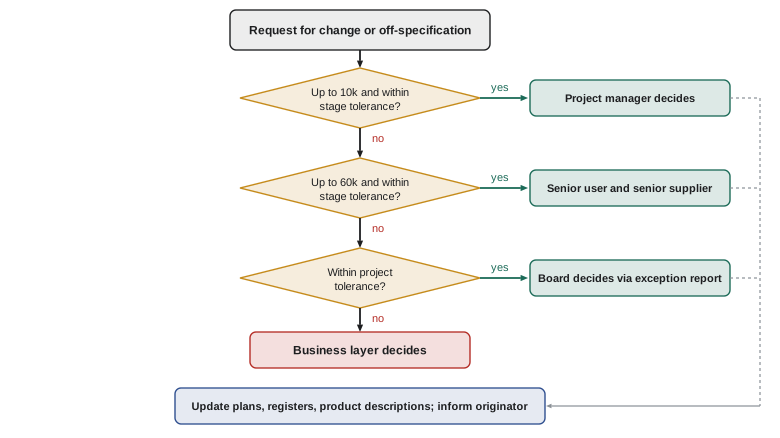
PRIN-130 showed how the board can delegate decisions on changes to a change authority within agreed limits, and set aside a change budget to fund approved changes. The board remains responsible for change, but it does not want to decide every small request, and the project manager should not be able to approve large changes without the board's knowledge. Limits are usually set per change and per stage, and the change authority reports its decisions and the remaining change budget in each highlight report.
| Level | Ridgeline Water pilot limit | Funded from |
|---|---|---|
| Project manager | Up to 10 thousand per change and 50 thousand in total per stage | Change budget |
| Senior user and senior supplier jointly | Up to 60 thousand per change | Change budget, then cost tolerance with board agreement |
| Project board | Anything larger, or anything that would exceed stage tolerance | By exception: revised stage plan or exception plan |
| Business layer | Anything that would exceed project tolerance | Through the board |
The change budget is separate from the cost tolerance and from the risk budget, which lesson 4 described. Keeping them separate lets the board see how much change the users are asking for. If the change budget is used up halfway through a stage, that is useful information: either the requirements were less stable than expected, or the change authority is approving too freely.
Assessing a request for change
A request for change is assessed in the assess and recommend steps of the issue management procedure. The project manager, often with team managers and the relevant assurance roles, estimates the impact of making the change on each of the performance targets and on the business case, and the impact of not making it. The assessment should also consider the change's priority, using the scale in the issue management approach, and any new risks it creates.
| Question | Ridgeline Water: multilingual alert text |
|---|---|
| What is requested and by whom? | Senior user asks for alerts in two additional languages for the pilot district |
| Priority | Should have: about 9 % of pilot households prefer another language |
| Time impact | Translation and testing add 2 weeks to alert design, which has 1 week of float: about 1 week of stage delay |
| Cost impact | 8 thousand for translation, review and testing |
| Scope and quality impact | New quality criterion: translated alerts tested with speakers of each language |
| Benefits impact | Higher response rate in those households improves the leak benefit measurement |
| Risk impact | Reduces risk R2 (alerts ignored); small new risk of translation errors |
| Impact of not making the change | Pilot may understate leak savings and draw complaints |
| Decision level | Within the project manager's 10 thousand limit, but the 1-week delay uses half of the 2-week time tolerance, so the project manager may prefer to consult the board |
Decisions on requests for change and off-specifications
The decision-maker for a request for change may approve it, reject it, defer it to a later stage or ask for more information. For an off-specification, the options are to require the product to be corrected, to grant a concession and accept it as it is, or to defer. If neither the project manager nor the delegated change authority can decide within their limits, or if the change would breach stage tolerance, the decision goes to the board, normally through an exception report. Once decided, the project manager updates the affected plans, product descriptions and registers, and tells the originator.
The code below applies Ridgeline Water's routing rules to a batch of requests in the pilot stage, tracks the project manager's change budget as approvals are made, and shows where each request must go. It assumes each request has been assessed and that the project manager would approve those within his or her authority.
pm_limit, joint_limit = 10, 60     # thousand per change
pm_budget = 50                       # thousand per stage at PM level
time_tol_left = 2.0                  # weeks of stage time tolerance unused
requests = [  # id, description, cost (thousand), schedule effect (weeks)
    ("RFC-1", "Monthly bills in pilot district", 6, 0.0),
    ("RFC-2", "Alerts in two more languages", 8, 1.0),
    ("RFC-3", "Zero-use welfare alert", 14, 0.5),
    ("RFC-4", "Relocate 40 meters from flooded pits", 9, 0.0),
    ("RFC-5", "Add second pilot district", 310, 6.0),
    ("RFC-6", "Update portal logo to new brand", 4, 0.0),
]
for rid, text, cost, weeks in requests:
    within_time = weeks <= time_tol_left
    if cost <= pm_limit and cost <= pm_budget and within_time:
        route = "project manager approves"
        pm_budget -= cost; time_tol_left -= weeks
    elif cost <= joint_limit and within_time:
        route = "senior user and senior supplier"
    else:
        route = "project board (exception report)"
    print(f"{rid} {text:38} {cost:4}k {weeks:3.1f}w -> {route}")
print(f"PM change budget left {pm_budget}k; time tolerance left {time_tol_left:.1f} weeks")RFC-1 Monthly bills in pilot district 6k 0.0w -> project manager approves RFC-2 Alerts in two more languages 8k 1.0w -> project manager approves RFC-3 Zero-use welfare alert 14k 0.5w -> senior user and senior supplier RFC-4 Relocate 40 meters from flooded pits 9k 0.0w -> project manager approves RFC-5 Add second pilot district 310k 6.0w -> project board (exception report) RFC-6 Update portal logo to new brand 4k 0.0w -> project manager approves PM change budget left 23k; time tolerance left 1.0 weeks
The project manager approves four requests costing 27 thousand, leaving 23 thousand of the change budget, and the language change alone has used one week of the two-week time tolerance. The welfare alert, at 14 thousand, exceeds the project manager's limit and goes to the senior user and senior supplier. Adding a second pilot district, at 310 thousand and six weeks, is far beyond any delegated limit and would breach stage tolerance, so it goes to the board. The model also shows a subtle point: approving small changes one at a time can consume tolerance that the board might have wanted to keep for risks, which is why change approvals and remaining tolerance are both reported in highlight reports.
Change control in PRINCE2 and in IT service management
Students who know ITIL sometimes confuse PRINCE2 change control with ITIL change enablement. They address different baselines. PRINCE2 change control protects the project's baselines: its plans, business case and product descriptions. ITIL change enablement, covered in ITIL-140, protects live services and infrastructure from harmful changes, assessing risk and scheduling deployments. A project that delivers into live IT services must use both: the project board approves a change to the scope of the billing interface, and the utility's change authority for IT services approves the date and method of deploying the interface into the live billing system.
| Aspect | PRINCE2 change control | ITIL change enablement |
|---|---|---|
| What it protects | Project baselines: business case, plans, product descriptions | Live services, infrastructure and configuration |
| Who decides | Change authority, project board or business layer | Change authority for the service, often a change advisory group |
| Typical question | Should the project's scope, time or cost change? | Is it safe to deploy this change into production now? |
| Lifespan | Ends when the project closes | Continues for the life of the service |
Configuration management and the product register
Change control depends on knowing exactly which version of each product is current and what state it is in. This is configuration management: identifying products, controlling their versions, recording their status and verifying that records match reality. Earlier editions of PRINCE2 used configuration item records and a product status account for this. PRINCE2 7 simplifies the records into a product register, held in the project log, which tracks each product's status from identification through development, quality checking and approval to handover and acceptance.
| Field | Purpose | Example |
|---|---|---|
| Product identifier and title | Unique identification | P-07 Billing interface |
| Version | Which version is current | v1.3 |
| Status | Where the product is in its life | In quality check |
| Owner or producer | Who is responsible for it | IT development lead |
| Related products and items | Dependencies and relationships | Depends on P-05 Head-end configured |
| Quality and issue references | Links to quality register and issue register entries | Q-014; I-06 |
| Planned and actual dates | For progress tracking | Approval planned week 21; forecast week 24 |
The product register is useful well beyond change control. Before a stage boundary, the project manager can list every product planned for the stage and its status, which shows at a glance what is approved, what is late and what has open issues. At closure it supports confirmation that every product has been handed over and accepted. The code below produces that kind of summary for the pilot stage products.
order = ["identified", "in development", "in quality check", "approved", "handed over"]
products = [
    # id, title, status, planned approval week, forecast week, open issues
    ("P-03", "Pilot radio network", "approved", 12, 12, 1),
    ("P-04", "Meters installed", "in development", 20, 22, 2),
    ("P-05", "Head-end configured", "approved", 11, 13, 0),
    ("P-07", "Billing interface", "in quality check", 21, 24, 1),
    ("P-08", "Alert design", "in development", 19, 23, 1),
    ("P-09", "Customer communications", "approved", 18, 18, 0),
    ("P-10", "Pilot measurement report", "identified", 29, 29, 0),
]
for pid, title, status, plan, fc, iss in sorted(products, key=lambda x: order.index(x[2])):
    late = fc - plan
    print(f"{pid} {title:26} {status:17} {'+' + str(late) + 'w' if late else 'on time':8} open issues {iss}")
approved = sum(1 for p in products if p[2] in ("approved", "handed over"))
print(f"approved {approved} of {len(products)}; late {sum(1 for p in products if p[4] > p[3])}")P-10 Pilot measurement report identified on time open issues 0 P-04 Meters installed in development +2w open issues 2 P-08 Alert design in development +4w open issues 1 P-07 Billing interface in quality check +3w open issues 1 P-03 Pilot radio network approved on time open issues 1 P-05 Head-end configured approved +2w open issues 0 P-09 Customer communications approved on time open issues 0 approved 3 of 7; late 4
Three of seven products are approved; four are late against their planned approval dates, with the billing interface forecast three weeks late and alert design four weeks late. The radio network is approved but still has an open issue, the coverage off-specification from lesson 5, which shows that approval and closure of issues are separate: the network may have been approved with a concession pending, and the register makes that visible.
Common mistakes
MistakeChanging a baselined plan or product description without going through change control.
InsteadAssess and decide every change to a baseline at the right level, then update the records.
MistakePaying for changes from the risk budget or cost tolerance.
InsteadFund approved changes from the change budget; escalate if it is exhausted.
MistakeApproving many small changes without watching their combined effect on tolerance.
InsteadTrack cumulative change cost and schedule effect, and report them in highlight reports.
MistakeConfusing PRINCE2 change control with ITIL change enablement.
InsteadUse project change control for project baselines and service change processes for live services.
MistakeLosing track of which version of a product was approved.
InsteadUse the product register to record versions, status and links to quality and issue records.
Summary and key terms
- Baselines are approved reference points that can be changed only through change control.
- The change authority decides changes within delegated limits, funded from the change budget.
- Requests for change are assessed against every performance target, the business case and risks, and against not making the change.
- Decision options include approve, reject, defer or ask for more information; off-specifications may be corrected or accepted by concession.
- Changes that would breach stage tolerance go to the board through an exception report.
- PRINCE2 change control protects project baselines; ITIL change enablement protects live services.
- PRINCE2 7 tracks product status in the product register within the project log.
- Baseline
- An approved reference against which a product or plan is monitored and controlled.
- Change control
- The procedure ensuring that changes to baselines are identified, assessed and approved or rejected.
- Change authority
- A person or group delegated by the board to decide on changes within agreed limits.
- Change budget
- Money set aside to fund approved requests for change.
- Configuration management
- Identifying, controlling, recording and verifying products and their versions.
- Product register
- In PRINCE2 7, the record of each product's identity, version and status.
- Defer
- A decision to postpone consideration of a change to a later point.
- Change enablement
- The ITIL practice for managing changes to live services.
Practice problems
Work each problem on paper first, then reveal the answer to check.
When does a product become a baseline?
Show answer
When it has been approved.
What are the four decision options for a request for change?
Show answer
Approve, reject, defer or ask for more information.
What options exist for an off-specification?
Show answer
Correct it, grant a concession, or defer.
What funds approved changes?
Show answer
The change budget.
Where is a change sent if it would exceed stage tolerance?
Show answer
To the project board, normally through an exception report.
What does the product register record?
Show answer
Each product's identity, version, status, owner, relationships and dates.
Which records did the product register replace?
Show answer
Configuration item records and the product status account of earlier editions.
Why assess the impact of not making a change?
Show answer
Because rejecting a change also has consequences for benefits, risks or stakeholders.
How does ITIL change enablement differ from PRINCE2 change control?
Show answer
It protects live services rather than project baselines.
Why report remaining change budget in highlight reports?
Show answer
So the board can see how much change is being requested and approved.
Lesson quiz · 5 questions
Score 60% or more to complete this lesson.
Create a free account to save your progress, take quizzes and earn a certificate.