
PHYS-481 · Lesson 8 of 12 · 23 min
Radio propagation and the ionosphere: plasma frequency, skywave and GNSS delays
A shortwave broadcast from Europe can be heard in Winnipeg at night, an amateur radio operator can talk to Australia on a few hundred watts, and an aircraft over the Arctic can keep in touch with ground stations thousands of kilometres away. All of these depend on the ionosphere reflecting radio waves. The same ionosphere delays the signals from navigation satellites by several metres, an error that receivers must correct to give accurate positions. PHYS-382 showed that a plasma reflects waves below its plasma frequency and transmits waves above it. This lesson applies that result to the real ionosphere: how ionosondes measure it, how waves bend on oblique paths, what sets the maximum usable frequency for a radio link, why there is a skip zone, and how dual-frequency receivers remove the ionospheric delay from GNSS positions.
The refractive index of the ionosphere
For waves well above the electron collision frequency and ignoring the Earth's magnetic field, the cold-plasma refractive index from PHYS-382 is
with \(n_e\) in electrons per cubic metre. Equivalently \(f_p^2 = 80.6\,n_e\) in SI units. The index is less than one, so the phase velocity exceeds \(c\), while the group velocity, \(v_g = c\,n\), is less than \(c\); information still travels slower than light. When \(f < f_p\), \(n^2 < 0\), the wave cannot propagate, and it reflects. The Earth's magnetic field splits each wave into two characteristic modes, ordinary and extraordinary, with slightly different reflection heights; for the purposes of this lesson the ordinary mode, which obeys the formula above, is enough.
Vertical sounding
An ionosonde sends pulses straight up at a sweep of frequencies and times the echoes. A pulse at frequency \(f\) rises until it reaches the height where \(f_p = f\), and reflects. As \(f\) increases, the reflection point rises, until \(f\) exceeds the peak plasma frequency of a layer, called its critical frequency \(f_oE\), \(f_oF1\) or \(f_oF2\), and the pulse passes through that layer to the next or escapes into space. The critical frequency gives the peak density directly:
Because the group velocity slows as the wave nears reflection, the measured echo delay gives a virtual height, the height the reflection would have if the pulse travelled at \(c\) all the way. The virtual height is always greater than the true height, and inverting an ionogram to find the true electron density profile is a standard numerical problem. The first such soundings were made in 1925 by Gregory Breit and Merle Tuve at the Carnegie Institution in Washington, and by Edward Appleton and Miles Barnett in England, who measured the height of the layer by sweeping a BBC transmitter's frequency and watching interference with the ground wave.
Oblique propagation and the secant law
A wave launched at an angle travels obliquely and refracts gradually as it enters the ionosphere, bending back toward the ground. By Snell's law in a horizontally stratified medium, \(n\sin\phi = \sin\phi_0\), where \(\phi_0\) is the angle of incidence from the vertical at the base of the layer. The ray turns horizontal, and returns, where \(n = \sin\phi_0\), that is, where \(1 - f_p^2/f^2 = \sin^2\phi_0\), so \(f_p = f\cos\phi_0\). A wave of frequency \(f\) at oblique incidence is therefore reflected by the same plasma density as a vertical wave of frequency \(f\cos\phi_0\). Inverting this gives the secant law: the highest frequency that a layer with critical frequency \(f_o\) can return over a path with incidence angle \(\phi_0\) is
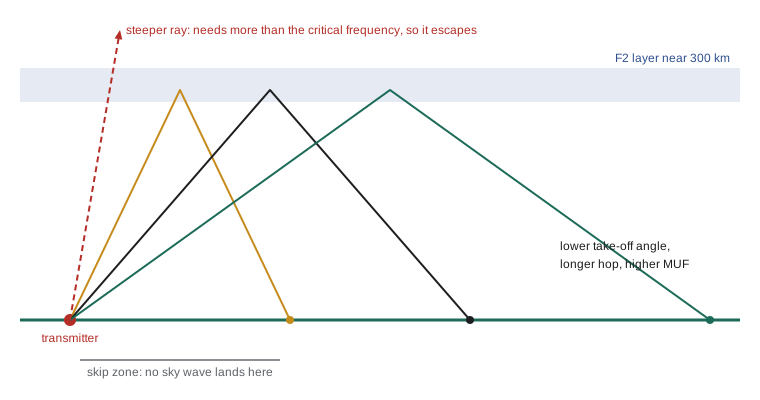
This maximum usable frequency grows as the path becomes more oblique, so long paths can use much higher frequencies than the critical frequency. On a curved Earth the incidence angle at the layer is limited even for a ray leaving the ground horizontally, so the MUF reaches a maximum of about three times \(f_oF2\) for the longest single hop.
The program below converts several critical frequencies into densities, computes the MUF and the take-off elevation for one-hop paths over a spherical Earth with reflection at 300 km, finds the longest single hop, and then turns to the ionospheric delay of GNSS signals.
import math
# Ionosonde: a vertical echo returns from where f = f_p, so f_p^2 = 80.6 n (f in Hz, n per m^3)
for layer, fo in [("E (noon)", 3.5e6), ("F2 quiet night", 4.0e6), ("F2 noon", 9.0e6), ("F2 solar maximum noon", 13.0e6)]:
    print(f"{layer:24s} critical frequency {fo / 1e6:5.1f} MHz -> peak density {fo**2 / 80.6:.2e} per m^3")

# Maximum usable frequency on a flat-Earth secant law, and with a curved Earth
RE = 6371.0
def muf(fo, h, ground_range):
    theta = ground_range / 2 / RE                       # half of the central angle
    ax, ay = RE * math.sin(theta), RE * math.cos(theta)  # transmitter; reflection point at (0, RE + h)
    vx, vy = -ax, RE + h - ay
    phi = math.atan2(RE * math.sin(theta), vy)          # incidence angle at the layer, from the vertical
    elev = math.degrees(math.asin((vx * math.sin(theta) + vy * math.cos(theta)) / math.hypot(vx, vy)))
    return fo / math.cos(phi), elev
fo, h = 9.0, 300.0
print(f"F2 layer at {h:.0f} km with foF2 = {fo} MHz")
for d in (0.01, 500, 1000, 2000, 3000, 3800):
    m, elev = muf(fo, h, d)
    print(f"  ground range {d:6.0f} km: MUF {m:5.1f} MHz, take-off elevation {elev:5.1f} deg")
# Longest one-hop path: ray leaves tangent to the ground
dmax = 2 * RE * math.acos(RE / (RE + h))
print(f"longest single hop (zero elevation) = {dmax:.0f} km")

# GNSS: group delay of 40.3 TEC / f^2 (in m); 1 TECU = 1e16 electrons per m^2
f1, f2 = 1575.42e6, 1227.60e6
print(f"1 TECU delays the L1 signal by {40.3e16 / f1**2:.3f} m and L2 by {40.3e16 / f2**2:.3f} m")
for tec in (10, 50, 150):
    d1 = 40.3 * tec * 1e16 / f1**2
    print(f"vertical TEC {tec:3d} TECU: L1 delay {d1:5.2f} m")
# The ionosphere-free combination removes the first-order delay
true_range = 22000e3; tec = 60e16
P1 = true_range + 40.3 * tec / f1**2
P2 = true_range + 40.3 * tec / f2**2
P_if = (f1**2 * P1 - f2**2 * P2) / (f1**2 - f2**2)
print(f"ionosphere-free combination error: {P_if - true_range:.2e} m; TEC recovered {(P2 - P1) * f1**2 * f2**2 / (40.3 * (f1**2 - f2**2)) / 1e16:.1f} TECU")
# Slant paths cross more ionosphere: thin-shell mapping at 350 km
for elev in (90, 30, 10):
    z = math.asin(RE / (RE + 350) * math.cos(math.radians(elev)))
print(f"elevation {elev:2d} deg: slant factor {1 / math.cos(z):.2f}")E (noon) critical frequency 3.5 MHz -> peak density 1.52e+11 per m^3 F2 quiet night critical frequency 4.0 MHz -> peak density 1.99e+11 per m^3 F2 noon critical frequency 9.0 MHz -> peak density 1.00e+12 per m^3 F2 solar maximum noon critical frequency 13.0 MHz -> peak density 2.10e+12 per m^3 F2 layer at 300 km with foF2 = 9.0 MHz ground range 0 km: MUF 9.0 MHz, take-off elevation 90.0 deg ground range 500 km: MUF 11.6 MHz, take-off elevation 48.4 deg ground range 1000 km: MUF 16.7 MHz, take-off elevation 28.1 deg ground range 2000 km: MUF 25.3 MHz, take-off elevation 11.8 deg ground range 3000 km: MUF 29.5 MHz, take-off elevation 4.3 deg ground range 3800 km: MUF 30.4 MHz, take-off elevation 0.2 deg longest single hop (zero elevation) = 3836 km 1 TECU delays the L1 signal by 0.162 m and L2 by 0.267 m vertical TEC 10 TECU: L1 delay 1.62 m vertical TEC 50 TECU: L1 delay 8.12 m vertical TEC 150 TECU: L1 delay 24.36 m ionosphere-free combination error: -3.73e-09 m; TEC recovered 60.0 TECU elevation 90 deg: slant factor 1.00 elevation 30 deg: slant factor 1.75 elevation 10 deg: slant factor 2.79
A noon F2 critical frequency of 9 MHz corresponds to a peak density of \(10^{12}\) per m\(^3\). With the reflection at 300 km, a 1000 km path has a MUF of about 17 MHz and a 3000 km path about 30 MHz, about 3.3 times the critical frequency; the longest single hop, with the ray leaving the ground horizontally, is about 3800 km. Beyond that distance a signal must make two or more hops, reflecting from the ground or sea in between. Radio operators choose a frequency a little below the MUF: high enough to suffer little D-region absorption, which falls roughly as \(1/f^2\), but below the MUF so that the signal is returned. The lowest usable frequency, set by absorption, and the MUF bracket the useful band, which shifts upward by day and in solar maximum years and downward at night and at solar minimum.
The skip zone
If the operating frequency is above the critical frequency, steep rays penetrate the layer and escape. Only rays below some elevation are reflected, and these land beyond a minimum distance, the skip distance. Between the end of the ground wave, which is absorbed within tens of kilometres at shortwave frequencies, and the skip distance lies a zone where nothing is heard. A listener 300 km from a station may hear nothing while one 1500 km away hears it clearly. The skip distance increases with frequency and shrinks as the critical frequency rises.
Communication at high latitudes
High-frequency radio remains important in the North, where satellite coverage of geostationary communications satellites is poor above about 75 to 80 degrees latitude because the satellites sit low on the southern horizon. Aircraft on polar routes between North America and Asia rely on shortwave radio for part of their flights. The high-latitude ionosphere, however, is the most disturbed. Energetic protons from solar eruptions enter the polar atmosphere along open magnetic field lines and ionize the D region over the whole polar cap, absorbing shortwave signals for days in an event called polar cap absorption. Riometers, receivers that measure the absorption of cosmic radio noise, are operated across northern Canada and Alaska to monitor it. During storms, the auroral zone adds patchy absorption and irregular structures that scatter signals. Lesson 12 describes how airlines reroute flights when these effects are forecast.
Total electron content and GNSS delays
Global navigation satellite systems such as GPS, GLONASS, Galileo and BeiDou transmit at frequencies near 1.2 to 1.6 GHz, far above any ionospheric plasma frequency, so the signals pass through. They are slowed, though. To first order in \(f_p^2/f^2\), the group delay of a signal crossing the ionosphere, expressed as an extra path length, is
where the total electron content TEC is the number of electrons in a column of 1 m\(^2\) cross-section along the path, conventionally measured in TEC units of \(10^{16}\) electrons per m\(^2\). At the GPS L1 frequency of 1575.42 MHz, one TEC unit delays the signal by 0.16 m. Vertical TEC ranges from a few units at night near solar minimum to more than 100 units in the daytime equatorial crests near solar maximum, and storms can push it higher, so the vertical delay ranges from under a metre to more than 20 m. Slant paths to low satellites cross more ionosphere: the program's thin-shell mapping shows a factor of nearly three at 10 degrees elevation.
Because the delay depends on \(1/f^2\), measuring the same signal at two frequencies removes it. If \(P_1\) and \(P_2\) are the measured pseudoranges at \(f_1\) and \(f_2\), the ionosphere-free combination
cancels the first-order delay exactly, as the program confirms, and the difference \(P_2 - P_1\) gives the TEC itself. Networks of thousands of dual-frequency receivers now produce maps of TEC every few minutes. Single-frequency receivers, such as those in most phones, must instead use a broadcast model of the ionosphere, which removes only about half of the delay, leaving errors of a few metres. Precision users such as surveyors and farmers using real-time kinematic positioning, which reaches centimetre accuracy, depend on nearby reference stations that see nearly the same ionosphere; when steep TEC gradients and small-scale irregularities appear during storms, as in May 2024, that assumption fails, and positions degrade or the receivers lose lock.
Scintillation
Small-scale irregularities in the ionosphere, from metres to kilometres across, scatter radio waves and make received signals fluctuate rapidly in amplitude and phase, much as turbulence in the air makes stars twinkle. This scintillation is strongest after sunset near the magnetic equator, where plasma bubbles rise through the F region, and in the auroral zone and polar cap during disturbed conditions. It can cause GNSS receivers to lose lock and degrade satellite communications. Canada operates a network of GNSS receivers across the North that measure scintillation to study the high-latitude ionosphere and to warn users.
Worked problem
Choosing a frequency for a link
At noon the F2 critical frequency is 7 MHz and the reflection height is 300 km. A station wants to reach a receiver 2000 km away. Using the program's curved-Earth result that the MUF over 2000 km is about 2.8 times \(f_oF2\), choose a frequency.
Show solution
- MUF \(\approx 2.8\times7 = 19.6\) MHz (the program gives 25.3 MHz for \(f_o = 9\) MHz, a ratio of 2.81).
- Operators use about 85 % of the MUF for reliability, the optimum working frequency: \(0.85\times19.6 \approx 16.7\) MHz.
- The take-off elevation, from the program, is about 12°, so a low-angle antenna is needed.
- A frequency near 17 MHz, such as the 15 MHz broadcast band, would work; a 7 MHz signal would also reach but would suffer about six times more D-region absorption.
Answer: About 16 to 17 MHz, launched at about 12° elevation.
Common mistakes
MistakeThinking the ionosphere reflects all radio waves.
InsteadIt reflects only below the plasma frequency at vertical incidence, or below the MUF on oblique paths.
MistakeTreating the virtual height from an ionosonde as the true reflection height.
InsteadSlowing of the group velocity near reflection makes the virtual height larger.
MistakeAssuming a station heard far away can always be heard nearby.
InsteadThe skip zone leaves a gap between the ground wave and the first sky-wave landing.
MistakeIgnoring the ionosphere for GNSS because the signals pass through it.
InsteadThey are delayed by metres; dual-frequency combinations or models must correct for it.
MistakeSaying the phase velocity above \(c\) in the ionosphere violates relativity.
InsteadSignals travel at the group velocity, which is below \(c\).
Summary and key terms
- The ionospheric refractive index is \(n^2 = 1 - f_p^2/f^2\) with \(f_p^2 = 80.6\,n_e\).
- An ionosonde's critical frequency gives the peak density, \(n_e = f_o^2/80.6\).
- Oblique paths obey the secant law \(\mathrm{MUF} = f_o\sec\phi_0\); on a curved Earth the MUF reaches about three times \(f_oF2\) and one hop reaches about 3800 km.
- Steep rays escape above the critical frequency, leaving a skip zone.
- GNSS signals are delayed by \(40.3\,\mathrm{TEC}/f^2\); dual-frequency combinations remove the delay and measure TEC.
- critical frequency
- The highest frequency reflected at vertical incidence by an ionospheric layer.
- virtual height
- The reflection height inferred from echo delay assuming propagation at the speed of light.
- maximum usable frequency
- The highest frequency the ionosphere returns over a given path.
- skip zone
- The region between the end of the ground wave and the nearest sky-wave landing, where a signal is not received.
- total electron content
- The number of electrons in a unit-area column along a path, measured in units of 10^16 per m^2.
- scintillation
- Rapid fluctuations of a radio signal caused by small-scale ionospheric irregularities.
Practice problems
Work each problem on paper first, then reveal the answer to check.
Find the plasma frequency for \(n_e = 5\times10^{11}\) per m\(^3\).
Show answer
\(f_p = \sqrt{80.6\times5\times10^{11}} \approx 6.3\) MHz.
Using the flat secant law, what is the MUF for \(f_o = 8\) MHz at 70° incidence?
Show answer
\(8/\cos70° = 23.4\) MHz.
How much does a TEC of 30 units delay a signal at 1227.6 MHz (GPS L2)?
Show answer
\(40.3\times30\times10^{16}/(1.2276\times10^9)^2 \approx 8.0\) m.
Why does the MUF fall at night?
Show answer
Without production the F2 density decreases, so \(f_oF2\) and hence the MUF drop.
A ray leaves the ground at 30° elevation and reflects at 250 km. Estimate the flat-Earth hop length.
Show answer
\(2\times250/\tan30° \approx 866\) km.
Why do single-frequency phone receivers have larger ionospheric errors than surveying receivers?
Show answer
They rely on a broadcast model that removes only about half the delay, while dual-frequency receivers measure and cancel it.
Lesson quiz · 5 questions
Score 60% or more to complete this lesson.
Create a free account to save your progress, take quizzes and earn a certificate.