
PHYS-481 · Lesson 2 of 12 · 23 min
Atmospheric structure: hydrostatic balance, scale height and lapse rates
The air pressure on a mountaintop is lower than at sea level, and the air is colder. Both facts are so familiar that they seem to need no explanation, but the reasons are different, and the second one does not hold everywhere: above about 11 km the temperature stops falling, and higher still it rises again. This lesson builds the vertical structure of the atmosphere from two ingredients. The first is hydrostatic balance, the statement that each layer of air is held up by the pressure difference across it. Combined with the ideal gas law it gives the exponential fall of pressure with height and the scale height that measures how fast it falls. The second is the temperature profile, which is set by where the atmosphere absorbs energy and how that energy is carried away. Together they explain the layers named on every textbook diagram, and they let us compute the pressure and density at any height.
Hydrostatic balance
Consider a thin horizontal slab of air with area \(A\), thickness \(dz\) and density \(\rho\). Its weight is \(\rho g A\,dz\). For it to remain at rest, the pressure on its lower face must exceed the pressure on its upper face by exactly enough to support it:
This is the hydrostatic equation. It holds extremely well for large-scale motions in the atmosphere, because vertical accelerations of air are tiny compared with \(g\) except inside strong thunderstorm updrafts. Integrating it from a height \(z\) to the top of the atmosphere, where the pressure is zero, gives \(p(z) = \int_z^\infty \rho g\,dz'\): the pressure at any height is the weight of the air above, per unit area. That is why a barometer works, and why the pressure at 5.5 km is about half the sea-level value: half of the atmosphere's mass lies below that height.
The ideal gas law and the scale height
Air at atmospheric pressures behaves very nearly as an ideal gas. Written per unit mass,
where \(M = 0.02897\) kg/mol is the mean molar mass of dry air. Substituting \(\rho = p/(R_d T)\) into the hydrostatic equation gives
The length \(H\) is the scale height. If the temperature were constant, the pressure would fall exactly exponentially, \(p = p_0 e^{-z/H}\), dropping by a factor \(e\) every \(H\). For \(T = 288\) K, \(H = 287 \times 288/9.81 \approx 8.4\) km; for the cold upper troposphere at 220 K, \(H \approx 6.4\) km. The scale height has a simple physical meaning: it is the height through which a molecule must be lifted to gain potential energy \(mgH\) equal to the thermal energy \(k_BT\). Hot gas, or gas of light molecules, has a larger scale height and extends farther. In the thermosphere, above about 100 km, the gases no longer mix and each one takes its own scale height, so light atomic oxygen, helium and finally hydrogen dominate in turn with increasing altitude.
When temperature varies with height, the integral becomes \(\ln(p/p_0) = -\int_0^z dz'/H(z')\), so the pressure at any level depends on the mean temperature of the layer below it. This is the basis of the hypsometric equation used by meteorologists: the thickness of the layer between two pressure surfaces, such as 1000 and 500 hPa, is proportional to the mean temperature of that layer. Warm air columns are thick and cold ones are thin, and that difference in thickness, as lesson 4 shows, drives the winds of the upper troposphere.
The temperature profile and its layers
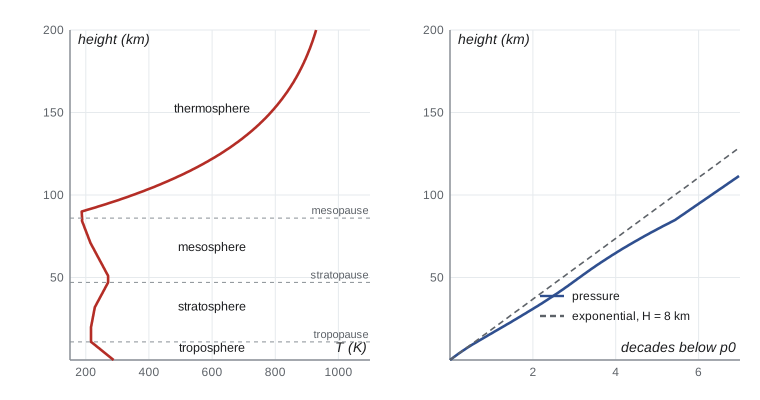
The temperature profile has four layers, each named for where temperature changes direction. In the troposphere, from the ground to the tropopause at about 8 km near the poles and 16 to 18 km in the tropics, temperature falls with height, on average by about 6.5 K/km. The ground is warmed by sunlight and the air is heated from below, mostly by convection and by the release of latent heat when water vapor condenses. Lesson 3 explains why heating from below produces a falling temperature and sets its rate.
In the stratosphere, from the tropopause to about 50 km, temperature rises with height. The heat source is ozone, which absorbs ultraviolet sunlight between about 200 and 300 nm. Ozone is most concentrated near 20 to 25 km, but the heating per unit mass is greatest higher up, where the air is thin and each molecule receives more ultraviolet. Warm air above cold air is very stable, so vertical mixing in the stratosphere is slow; volcanic aerosols injected there stay for a year or two, while particles in the troposphere rain out in about a week.
In the mesosphere, from about 50 to 85 km, temperature falls again as ozone heating fades and carbon dioxide radiates heat to space. The mesopause near 85 to 90 km is the coldest place in the atmosphere; in the summer polar mesosphere it can fall below 130 K, cold enough for noctilucent clouds of ice to form. Above the mesopause lies the thermosphere, heated by the absorption of extreme ultraviolet and X-ray photons that ionize and dissociate oxygen and nitrogen. The gas there is so thin that it conducts heat poorly and radiates weakly, so its temperature rises to between about 700 K near solar minimum and 1500 K or more near solar maximum. The heat content is tiny, however: a thermometer placed there would read far colder, because it would radiate away much more energy than it receives from the sparse gas.
The standard atmosphere
Engineers and meteorologists use a standard atmosphere, an idealized profile agreed by international bodies, to calibrate altimeters and compare aircraft performance. The 1976 United States Standard Atmosphere, identical below 32 km to the International Civil Aviation Organization standard, specifies sea-level values of 288.15 K and 1013.25 hPa and a sequence of layers with constant lapse rates: 6.5 K/km to 11 km, isothermal to 20 km, then warming at 1.0 and 2.8 K/km to 47 km, isothermal to 51 km, and cooling at 2.8 and 2.0 K/km to about 86 km. Within each layer the hydrostatic equation can be integrated exactly. For a layer with constant lapse rate \(\Gamma\), \(T = T_b - \Gamma(z - z_b)\) and
The program below implements these formulas layer by layer, tabulates temperature, pressure and scale height, compares the result with a single exponential, finds the height below which half the mass lies, and uses the Clausius–Clapeyron relation to show how the boiling point of water falls with altitude.
import math
# Layers of the 1976 standard atmosphere (geopotential height in km, lapse rate in K/km)
layers = [(0, -6.5), (11, 0.0), (20, 1.0), (32, 2.8), (47, 0.0), (51, -2.8), (71, -2.0), (84.852, None)]
g0 = 9.80665; R = 287.053; T0 = 288.15; p0 = 101325.0

def standard(h):
    """Temperature (K) and pressure (Pa) at geopotential height h in km."""
    T, p = T0, p0
    for (hb, lr), (ht, _) in zip(layers, layers[1:]):
        top = min(h, ht); dz = (top - hb) * 1000
        if lr == 0:
            p *= math.exp(-g0 * dz / (R * T))
        else:
            Tn = T + lr / 1000 * dz
            p *= (Tn / T) ** (-g0 / (R * lr / 1000))
            T = Tn
        if h <= ht: return T, p
    return T, p

print(" h (km)   T (K)    p (hPa)    p/p0     scale height (km)")
for h in (0, 1, 5, 8.85, 11, 20, 32, 47, 51, 71, 84):
    T, p = standard(h)
    H = R * T / g0 / 1000
    print(f"{h:6.2f}  {T:7.2f}  {p / 100:10.4f}  {p / p0:8.5f}   {H:6.2f}")

# Compare with a single isothermal exponential using H = 8 km
H = 8.0
for h in (5, 11, 20, 32):
    print(f"isothermal estimate at {h} km: {math.exp(-h / H):.4f}  standard: {standard(h)[1] / p0:.4f}")

# Half the mass of the air lies below the height where p = p0/2
lo, hi = 0.0, 11.0
for _ in range(60):
    mid = (lo + hi) / 2
    if standard(mid)[1] > p0 / 2: lo = mid
    else: hi = mid
print(f"half of the atmosphere's mass lies below {lo:.2f} km")

# Water boils at a lower temperature where pressure is lower (Clausius-Clapeyron)
L = 2.26e6; Rv = 461.5; Tb0 = 373.15
for h in (0, 1.0, 3.0, 8.85):
    p = standard(h)[1]
    Tb = 1 / (1 / Tb0 - Rv / L * math.log(p / p0))
print(f"boiling point at {h} km: {Tb - 273.15:.1f} C")h (km) T (K) p (hPa) p/p0 scale height (km) 0.00 288.15 1013.2500 1.00000 8.43 1.00 281.65 898.7457 0.88699 8.24 5.00 255.65 540.1990 0.53313 7.48 8.85 230.62 314.3467 0.31024 6.75 11.00 216.65 226.3206 0.22336 6.34 20.00 216.65 54.7488 0.05403 6.34 32.00 228.65 8.6802 0.00857 6.69 47.00 270.65 1.1091 0.00109 7.92 51.00 270.65 0.6694 0.00066 7.92 71.00 214.65 0.0396 0.00004 6.28 84.00 188.65 0.0044 0.00000 5.52 isothermal estimate at 5 km: 0.5353 standard: 0.5331 isothermal estimate at 11 km: 0.2528 standard: 0.2234 isothermal estimate at 20 km: 0.0821 standard: 0.0540 isothermal estimate at 32 km: 0.0183 standard: 0.0086 half of the atmosphere's mass lies below 5.48 km boiling point at 0 km: 100.0 C boiling point at 1.0 km: 96.6 C boiling point at 3.0 km: 89.8 C boiling point at 8.85 km: 69.4 C
The table reproduces the published standard: 226.3 hPa at the tropopause at 11 km, 54.7 hPa at 20 km and about 1.1 hPa at the stratopause. At the height of Mount Everest, 8.85 km, the pressure is 314 hPa, under a third of sea level, which is why climbers use bottled oxygen. A single exponential with \(H = 8\) km is accurate to about 2 % at 5 km but overestimates the pressure by a factor of about two at 32 km, because the real lower stratosphere is colder than 288 K and its scale height is smaller. Half the atmosphere's mass lies below 5.48 km. The boiling point of water falls to about 90 °C at 3 km, which is why cooking times are longer at high altitude.
Density, number density and mean free path
Density follows from the ideal gas law: at sea level \(\rho = p/(R_dT) = 101\,325/(287\times288.15) \approx 1.225\) kg/m\(^3\), and the number density is \(n = p/(k_BT) \approx 2.55\times10^{25}\) m\(^{-3}\). The mean free path of a molecule, the average distance between collisions, is \(\lambda \approx 1/(\sqrt{2}\,n\sigma)\) with a collision cross-section \(\sigma \approx 4\times10^{-19}\) m\(^2\), giving about 70 nm at sea level. Because \(\lambda\) is inversely proportional to density, it grows to about a centimetre near 85 km, tens of metres near 150 km and more than a kilometre above about 300 km. When the mean free path exceeds the scale height, near 500 km, a molecule moving upward fast enough can escape without another collision. This level marks the base of the exosphere, from which light atoms, mostly hydrogen, leak slowly into space.
The large mean free path also explains the separation of gases with height. Below the turbopause, near 100 km, turbulent mixing keeps the composition uniform, about 78 % nitrogen and 21 % oxygen by volume. Above it, molecular diffusion is faster than mixing, and each species settles into its own scale height. Ultraviolet light also dissociates molecular oxygen above about 100 km, so atomic oxygen, with half the mass and twice the scale height of \(\mathrm{O_2}\), becomes the dominant species from about 200 to 600 km. This atomic oxygen is the main source of the ionosphere's F layer and, when excited, of the aurora's green and red light.
Lapse rates and what sets them
The rate at which temperature falls with height, \(\Gamma = -dT/dz\), is called the lapse rate. Three different lapse rates are easily confused. The environmental lapse rate is the actual rate measured by a weather balloon at a given time and place; it averages 6.5 K/km in the troposphere but varies from day to day and can even be negative in an inversion, where temperature rises with height. The dry adiabatic lapse rate, \(g/c_p \approx 9.8\) K/km, is the rate at which an unsaturated parcel of air cools when lifted without exchanging heat. The moist adiabatic lapse rate, between about 3.5 and 9 K/km, is the rate at which a saturated parcel cools while its water vapor condenses and releases latent heat. Lesson 3 derives the adiabatic rates and shows how comparing them with the environmental lapse rate determines whether the air is stable or prone to convection. The observed average of 6.5 K/km is close to the moist adiabatic rate of the mid-troposphere, because convection, much of it moist, keeps adjusting the troposphere toward it.
Inversions are common over the Prairies and the northern plains in winter. On a clear, calm night the snow-covered ground radiates heat to space and cools the air in contact with it, while the air a few hundred metres up stays warmer. The resulting surface inversion traps pollution and fog, and can make the temperature at the airport ten or more degrees colder than at the top of a nearby tower. Inversions also bend sound and radio waves downward, letting distant sounds carry on cold winter evenings.
Worked problem
Pressure at the top of a mountain
Assume an isothermal atmosphere at 270 K. Estimate the pressure at the summit of Denali, 6190 m, and compare it with the standard atmosphere.
Show solution
- Scale height: \(H = R_dT/g = 287\times270/9.81 \approx 7.90\) km.
- Pressure ratio: \(p/p_0 = e^{-6.19/7.90} = e^{-0.784} \approx 0.457\).
- So \(p \approx 0.457\times1013 \approx 463\) hPa.
- The standard atmosphere, which cools with height, gives about 460 hPa at 6.19 km, almost the same. The real summit pressure is lower than either, by tens of hectopascals, because the subarctic troposphere is colder and its air column more compressed.
Answer: About 460 hPa, under half of sea-level pressure; the mountain's high latitude makes the real value lower still.
Common mistakes
MistakeSaying the air is colder on mountains because it is farther from the Sun.
InsteadThe difference in distance is negligible; the troposphere is heated from below and rising air cools as it expands.
MistakeUsing a single scale height of 8 km at all altitudes.
Instead\(H = R_dT/g\) varies with temperature and, above 100 km, with molecular mass.
MistakeExpecting the temperature to keep falling all the way up.
InsteadAbsorption of ultraviolet by ozone and of extreme ultraviolet in the thermosphere creates temperature maxima at about 50 km and above 200 km.
MistakeConfusing the environmental lapse rate with the adiabatic lapse rates.
InsteadThe first is measured; the others describe how a lifted parcel cools.
MistakeThinking a thermosphere temperature of 1000 K would feel hot.
InsteadThe gas is so thin that it delivers almost no heat; the high temperature describes molecular speeds, not heat content.
Summary and key terms
- Hydrostatic balance, \(dp/dz = -\rho g\), means the pressure at any level is the weight of the air above per unit area.
- With the ideal gas law it gives \(dp/p = -dz/H\) with scale height \(H = R_dT/g\), about 8 km near the surface.
- Temperature falls through the troposphere, rises through the ozone-heated stratosphere, falls through the mesosphere and rises steeply in the thermosphere.
- The standard atmosphere integrates hydrostatic balance through layers of constant lapse rate; half the mass lies below 5.5 km.
- Above about 100 km the gases separate by molecular mass and atomic oxygen dominates; above about 500 km atoms can escape.
- hydrostatic balance
- The balance between the vertical pressure gradient and gravity, dp/dz = -rho g.
- scale height
- The height over which pressure falls by a factor e in an isothermal atmosphere, H = R T/g.
- lapse rate
- The rate of decrease of temperature with height.
- tropopause
- The boundary between the troposphere and the stratosphere, where temperature stops falling with height.
- inversion
- A layer in which temperature increases with height.
- turbopause
- The level, near 100 km, above which the gases separate by molecular mass instead of being mixed.
Practice problems
Work each problem on paper first, then reveal the answer to check.
What is the scale height at the mesopause, where \(T \approx 187\) K?
Show answer
\(H = 287\times187/9.55 \approx 5.6\) km, using \(g = 9.81\times(6371/6456)^2 \approx 9.55\) m/s\(^2\) at 85 km.
By what factor does pressure fall between 20 and 32 km in the standard atmosphere?
Show answer
\(54.75/8.68 \approx 6.3\).
Compute the air density at 11 km in the standard atmosphere.
Show answer
\(\rho = 22\,632/(287.05\times216.65) \approx 0.364\) kg/m\(^3\), about 30 % of the sea-level value.
The 1000 to 500 hPa thickness is 5400 m. What is the mean temperature of the layer?
Show answer
\(\Delta z = (R_d\bar{T}/g)\ln 2\), so \(\bar{T} = 5400\times9.81/(287\times0.693) \approx 266\) K.
Why does helium dominate over atomic oxygen near 1000 km?
Show answer
Above the turbopause each gas has its own scale height \(k_BT/mg\); helium's is four times that of atomic oxygen, so its density falls much more slowly.
Explain why a winter surface inversion forms on a clear, calm night.
Show answer
The ground radiates efficiently to space and cools the air touching it, while there is no wind to mix warmer air down from above.
Lesson quiz · 5 questions
Score 60% or more to complete this lesson.
Create a free account to save your progress, take quizzes and earn a certificate.