
PHYS-481 · Lesson 5 of 12 · 23 min
Radiative transfer: absorption, emission and the greenhouse effect
The Earth exchanges energy with space only by radiation. Sunlight comes in, mostly at wavelengths between 0.2 and 4 µm, and infrared radiation goes out, mostly between 4 and 100 µm. Because the two bands barely overlap, the atmosphere can treat them very differently: it is largely transparent to sunlight but largely opaque to the infrared emitted by the surface. That asymmetry is the greenhouse effect. PHYS-261 built a one-layer model in which a single absorbing sheet warms the surface. This lesson replaces the sheet with a continuous absorbing and emitting atmosphere. It develops Beer–Lambert absorption, the Schwarzschild equation of radiative transfer, the gray-atmosphere solution, and the reason the greenhouse effect depends on the atmosphere being colder at the height from which it radiates to space than at the surface.
Two separate spectra
A blackbody at temperature \(T\) emits a spectrum described by Planck's law, with total flux \(\sigma T^4\) and a peak wavelength given by Wien's law, \(\lambda_{\max} = b/T\) with \(b = 2.898\times10^{-3}\) m K. The Sun's photosphere, at 5772 K, peaks near 0.5 µm in the green; the Earth, radiating at about 255 K, peaks near 11 µm. The program below integrates the Planck function to show that 99 % of sunlight lies below 4 µm while only 0.04 % of the Earth's emission does. This clean separation is why climate scientists speak of shortwave and longwave radiation as two distinct streams.
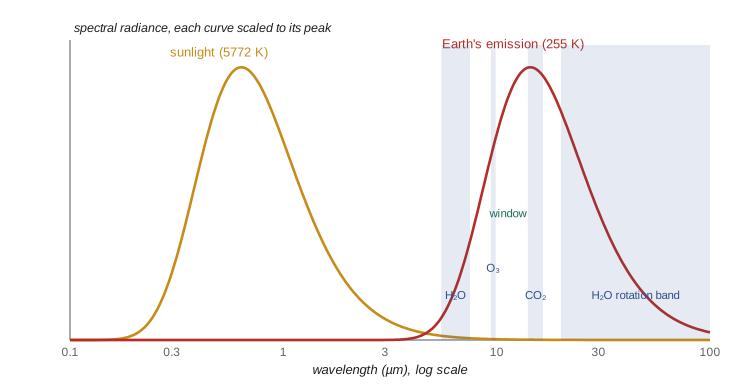
Gas molecules absorb radiation at wavelengths that match their quantum transitions. Molecules of nitrogen and oxygen, which are symmetric diatomic molecules with no electric dipole moment, have no vibration–rotation bands in the thermal infrared, so the main constituents of air are almost transparent there. Water vapor, carbon dioxide, ozone, methane and nitrous oxide have bending and stretching vibrations that change their dipole moments, and they absorb strongly. Carbon dioxide's bending mode produces a broad band centred at 15 µm, right next to the peak of the Earth's emission. Water vapor absorbs at 6.3 µm and throughout the far infrared beyond about 20 µm through its pure rotation lines. Between about 8 and 13 µm lies the atmospheric window, interrupted only by ozone near 9.6 µm, through which much of the surface's radiation escapes directly to space in dry, clear air. Weather satellites use this window to measure surface and cloud-top temperatures.
Absorption: the Beer–Lambert law
Radiation of intensity \(I\) crossing a thin layer \(ds\) of an absorbing gas loses a fraction proportional to the amount of absorber: \(dI = -k\rho_a I\,ds\), where \(\rho_a\) is the absorber density and \(k\) the mass absorption coefficient at that wavelength. Defining the optical depth \(d\tau = k\rho_a\,ds\) gives
A layer of optical depth 1 transmits \(e^{-1} = 37\) % of the beam; optical depth 3 transmits 5 %. In the centre of the 15 µm band, carbon dioxide has an optical depth of thousands through the whole atmosphere, so that band is completely saturated near the surface. That fact is sometimes taken to mean that adding more carbon dioxide can have no effect. The argument is wrong for two reasons. First, the band has wings where the optical depth is near 1, and these widen as carbon dioxide increases. Second, and more important, what matters is not whether surface radiation is absorbed but the height from which radiation finally escapes to space, which rises as the absorber increases. The next sections make this precise.
Emission: the Schwarzschild equation
An absorbing gas also emits. Kirchhoff's law states that in local thermodynamic equilibrium, a good approximation below about 60 km where collisions are frequent, a layer that absorbs a fraction \(d\tau\) of a beam emits the same fraction of the blackbody intensity \(B_\lambda(T)\) at its own temperature. The change in intensity along a ray is then
This is the Schwarzschild equation, published by Karl Schwarzschild in 1906 for the solar atmosphere. Radiation crossing a layer relaxes toward the local Planck intensity: if the beam is brighter than the layer it loses energy, and if dimmer it gains. Its formal solution for radiation leaving the top of the atmosphere at optical depth zero, looking down through an atmosphere of total optical depth \(\tau_s\), is
The first term is surface radiation that survives the trip; the second is emission from each layer, weighted by the fraction that escapes. The weighting function \(e^{-\tau}\) peaks near \(\tau = 1\), so radiation at a given wavelength reaches space mostly from the level where the optical depth measured from the top is about one. Where the gas is opaque, that level is high and cold; in the window it is the warm surface.
The gray atmosphere
A useful idealization is a gray atmosphere, in which the absorption coefficient for longwave radiation is the same at all wavelengths and sunlight passes straight through. Approximating the angular distribution of radiation by upward and downward streams, the Eddington approximation, and requiring radiative equilibrium, meaning that each layer emits exactly as much as it absorbs, gives the temperature profile
where \(T_e\) is the emission temperature and \(\tau\) is measured down from the top. The temperature equals \(T_e\) at \(\tau = 2/3\): the effective radiating level. The air at the top is colder, at \(T_e/2^{1/4} \approx 214\) K, and the air near the ground is warmer. The deeper the atmosphere in optical depth, the higher the ground temperature. The program below computes this profile and finds that a total longwave optical depth of about 1.5 gives a surface air temperature of 288 K. It also repeats the layer models: \(n\) opaque layers give \(T_s = T_e(n + 1)^{1/4}\), and a single layer of infrared emissivity \(\varepsilon\) gives \(T_s = T_e\big(2/(2 - \varepsilon)\big)^{1/4}\), so \(\varepsilon = 0.77\) reproduces the observed surface temperature.
import math
sigma = 5.670374419e-8; h = 6.62607015e-34; c = 2.99792458e8; k = 1.380649e-23
b = 2.897771955e-3
for name, T in [("Sun's photosphere", 5772.0), ("Earth's emission", 255.0), ("Earth's surface", 288.0)]:
    print(f"{name:18s} T = {T:6.0f} K, Wien peak {b / T * 1e6:7.2f} um, flux {sigma * T**4:10.4g} W/m^2")

# Fraction of each blackbody spectrum below 4 um (Planck integral by Simpson's rule)
def planck(lam, T):
    x = h * c / (lam * k * T)
    if x > 700: return 0.0
    return 2 * h * c**2 / lam**5 / (math.exp(x) - 1)
def frac_below(T, cut, n=4000):
    lo, hi = 0.05e-6, cut; s = 0.0
    dx = (hi - lo) / n
    for i in range(n + 1):
        w = 1 if i in (0, n) else (4 if i % 2 else 2)
        s += w * planck(lo + i * dx, T)
    return math.pi * s * dx / 3 / (sigma * T**4)
print(f"fraction of sunlight below 4 um: {frac_below(5772, 4e-6):.3f}")
print(f"fraction of 255 K emission below 4 um: {frac_below(255, 4e-6):.5f}")

# Beer-Lambert: transmission through a uniform absorber
for tau in (0.1, 1.0, 3.0):
    print(f"optical depth {tau}: transmitted fraction {math.exp(-tau):.3f}")

# Gray atmosphere in radiative equilibrium (Eddington): T^4(tau) = (3/4) Te^4 (tau + 2/3)
Te = 255.0
for tau_s in (0.0, 0.5, 1.0, 1.5, 2.0, 4.0):
    Tg = (0.75 * Te**4 * (tau_s + 2 / 3)) ** 0.25
    print(f"total longwave optical depth {tau_s:3.1f}: air temperature at the ground {Tg:6.1f} K")
tau_needed = (288.0 / Te) ** 4 / 0.75 - 2 / 3
print(f"optical depth giving 288 K at the ground: {tau_needed:.2f}")

# Layer models: n opaque layers, and one partly absorbing layer of emissivity e
for n in (1, 2, 3):
    print(f"{n} fully absorbing layer(s): surface {Te * (n + 1) ** 0.25:.1f} K")
for e in (0.5, 0.77, 0.9):
    print(f"one layer of longwave emissivity {e}: surface {Te * (2 / (2 - e)) ** 0.25:.1f} K")
e_needed = 2 - 2 * (Te / 288.0) ** 4
print(f"emissivity giving a 288 K surface: {e_needed:.3f}")Sun's photosphere T = 5772 K, Wien peak 0.50 um, flux 6.294e+07 W/m^2 Earth's emission T = 255 K, Wien peak 11.36 um, flux 239.8 W/m^2 Earth's surface T = 288 K, Wien peak 10.06 um, flux 390.1 W/m^2 fraction of sunlight below 4 um: 0.990 fraction of 255 K emission below 4 um: 0.00040 optical depth 0.1: transmitted fraction 0.905 optical depth 1.0: transmitted fraction 0.368 optical depth 3.0: transmitted fraction 0.050 total longwave optical depth 0.0: air temperature at the ground 214.4 K total longwave optical depth 0.5: air temperature at the ground 246.6 K total longwave optical depth 1.0: air temperature at the ground 269.6 K total longwave optical depth 1.5: air temperature at the ground 287.9 K total longwave optical depth 2.0: air temperature at the ground 303.2 K total longwave optical depth 4.0: air temperature at the ground 348.8 K optical depth giving 288 K at the ground: 1.50 1 fully absorbing layer(s): surface 303.2 K 2 fully absorbing layer(s): surface 335.6 K 3 fully absorbing layer(s): surface 360.6 K one layer of longwave emissivity 0.5: surface 274.0 K one layer of longwave emissivity 0.77: surface 288.0 K one layer of longwave emissivity 0.9: surface 296.1 K emissivity giving a 288 K surface: 0.771
The gray model overestimates the surface temperature for larger optical depths because it ignores convection. In a purely radiative atmosphere the lapse rate near the ground would be much steeper than the dry adiabatic rate, and as lesson 3 showed, such a layer overturns. Manabe and Wetherald's 1967 radiative–convective model fixed this by letting radiation set the profile wherever the result was stable and imposing a lapse rate of 6.5 K/km wherever it was not. With real spectroscopic data and water vapor held at fixed relative humidity, their model reproduced the observed temperature profile and gave a warming of about 2.3 K for doubled carbon dioxide.
Why the greenhouse effect needs a lapse rate
The essential mechanism can be stated without any equations. The planet must emit, on average, about 240 W/m\(^2\) to space to balance the absorbed sunlight. That emission comes mostly from the level where the atmosphere becomes transparent looking upward, the effective emission height, roughly 5 to 6 km on average. The temperature at that level must be about 255 K. Below it, the temperature rises toward the ground at roughly the lapse rate of about 6.5 K/km, so the surface is warmer than 255 K by approximately the lapse rate times the emission height: \(6.5\times5 \approx 33\) K. Adding greenhouse gases makes the atmosphere more opaque and raises the emission height. At the new, higher level the air is colder, so the planet emits less than it absorbs until the whole troposphere, and the surface with it, warms enough that the new emission level is again at 255 K. If the atmosphere were isothermal, raising the emission height would change nothing, and there would be no greenhouse effect at all.
The same reasoning explains why increasing carbon dioxide cools the stratosphere. Above the tropopause, temperature increases with height, so raising the emission level there makes the emission warmer, and the stratosphere loses more energy than before. Observations since the 1980s show the stratosphere cooling while the troposphere warms, a fingerprint that distinguishes greenhouse warming from an increase in sunlight, which would warm both.
Measuring the spectrum from space
Satellites that measure the outgoing infrared spectrum see the greenhouse effect directly. In the window near 10 µm they see the warm surface, at brightness temperatures of 280 to 300 K over the tropics. In the centre of the 15 µm carbon dioxide band they see the cold upper troposphere and lower stratosphere at about 220 K, a deep notch in the spectrum. Over Antarctica in winter, where the surface is colder than the air above it, the notch inverts into a spike. Comparisons of spectra measured in 1970 by the IRIS instrument on Nimbus 4 and in 1997 by IMG on the Japanese ADEOS satellite showed the outgoing radiation decreasing in the carbon dioxide and methane bands, direct evidence of the changing greenhouse effect.
Clouds and aerosols
Clouds act on both streams. Their droplets reflect sunlight strongly, cooling the planet, and they absorb and emit infrared almost like blackbodies, warming it. Which effect wins depends on cloud height. Low clouds, such as marine stratocumulus, are nearly as warm as the surface, so their infrared effect is small and their reflection dominates: they cool. High, thin cirrus clouds are cold and emit weakly to space while letting much sunlight through: they warm. On average, clouds reflect about 47 W/m\(^2\) more sunlight than they would without them and trap about 28 W/m\(^2\) of infrared, a net cooling of about 19 W/m\(^2\), five times the forcing from doubled carbon dioxide. Small changes in cloud cover therefore matter a great deal, which is why clouds dominate the uncertainty in climate sensitivity, as lesson 6 shows. Aerosols from pollution, volcanoes and wildfires scatter sunlight and change cloud brightness; the smoke from the record Canadian wildfire season of 2023 reduced the sunlight reaching the ground across much of North America for weeks.
Worked problem
Emission height and surface temperature
Suppose increasing carbon dioxide raises the effective emission height by 150 m while the lapse rate stays at 6.5 K/km. Estimate the eventual surface warming.
Show solution
- Once balance is restored, the temperature at the new emission level must again be about 255 K.
- The surface is warmer than the emission level by the lapse rate times the emission height.
- Raising that height by 0.15 km adds \(6.5\times0.15 \approx 1.0\) K to the surface temperature.
- This is close to the no-feedback warming of about 1.2 K for doubled carbon dioxide found in lesson 6; feedbacks then amplify it.
Answer: About 1 K, before feedbacks.
Common mistakes
MistakeSaying greenhouse gases trap sunlight.
InsteadThey absorb and emit infrared; the atmosphere is mostly transparent to sunlight.
MistakeArguing that a saturated carbon dioxide band means more carbon dioxide has no effect.
InsteadThe emission height rises and the band wings widen; the effect grows logarithmically, not to zero.
MistakeIgnoring emission when applying Beer–Lambert to the atmosphere.
InsteadThe air both absorbs and emits; the Schwarzschild equation includes both.
MistakeThinking the greenhouse effect would work in an isothermal atmosphere.
InsteadIt requires the emitting level to be colder than the surface.
MistakeTreating all clouds as warming or all as cooling.
InsteadLow clouds cool through reflection; high thin clouds warm through infrared trapping.
Summary and key terms
- Sunlight (99 % below 4 µm) and Earth emission (peaking near 11 µm) occupy separate spectral bands.
- Water vapor, carbon dioxide and ozone absorb in the infrared; the window from 8 to 13 µm lets surface radiation escape.
- The Schwarzschild equation \(dI/d\tau = -I + B(T)\) describes absorption and emission; radiation escapes from near \(\tau \approx 1\).
- A gray atmosphere in radiative equilibrium has \(T^4 = \tfrac34T_e^4(\tau + \tfrac23)\); an optical depth of about 1.5 gives a 288 K surface.
- The greenhouse effect requires a temperature decrease with height; raising the emission height warms the surface and cools the stratosphere.
- optical depth
- The dimensionless measure of absorption along a path; a beam is reduced by e^-tau.
- Beer–Lambert law
- Exponential attenuation of a beam with optical depth.
- Schwarzschild equation
- The equation of radiative transfer for an absorbing and emitting medium in local thermodynamic equilibrium.
- atmospheric window
- The wavelength range from about 8 to 13 µm where the clear atmosphere is relatively transparent to infrared.
- gray atmosphere
- An idealized atmosphere with the same longwave absorption coefficient at all wavelengths.
- effective emission height
- The average height from which the Earth's outgoing infrared escapes to space.
Practice problems
Work each problem on paper first, then reveal the answer to check.
What fraction of a beam passes through a layer of optical depth 0.5?
Show answer
\(e^{-0.5} = 0.61\).
Find the Wien peak wavelength for a forest fire at 1200 K.
Show answer
\(2.898\times10^{-3}/1200 = 2.4\) µm, in the near infrared.
Using the gray model, what is the air temperature at the top of the atmosphere?
Show answer
\(T_e(1/2)^{1/4} = 255\times0.841 \approx 214\) K.
Two opaque layers give what surface temperature?
Show answer
\(255\times3^{1/4} \approx 336\) K, far too warm; real layers are partly transparent and convection limits the lapse rate.
Why is nitrogen not a greenhouse gas?
Show answer
The symmetric \(\mathrm{N_2}\) molecule has no dipole moment and its vibration does not create one, so it has no infrared vibration–rotation bands.
Why does the outgoing spectrum over the winter Antarctic plateau show a spike at 15 µm instead of a notch?
Show answer
There the surface is colder than the air above it, so emission from the higher, warmer level in the carbon dioxide band is brighter than the surface emission.
Lesson quiz · 5 questions
Score 60% or more to complete this lesson.
Create a free account to save your progress, take quizzes and earn a certificate.