
PHYS-450 · Lesson 9 of 12 · 23 min
Gravitational waves: linearized gravity, sources and detection
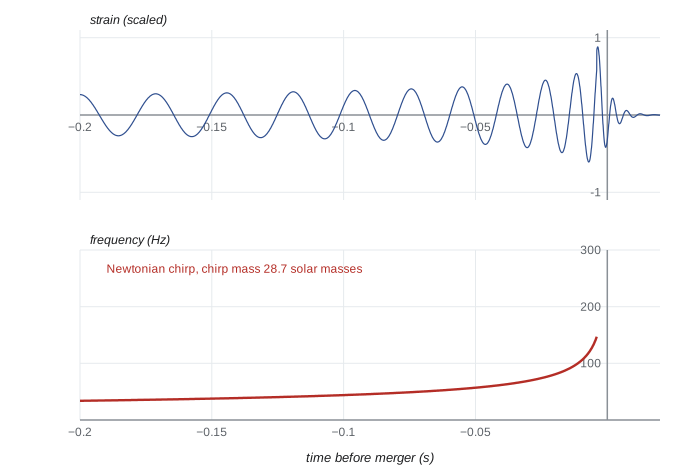
On 14 September 2015 at 09:50:45 UTC, the two detectors of the Laser Interferometer Gravitational-Wave Observatory, LIGO, in Hanford, Washington, and Livingston, Louisiana, recorded a signal that rose in frequency and amplitude over a fifth of a second and then stopped. It was the final orbits and merger of two black holes of about 36 and 29 solar masses, 1.3 billion light-years away. In the last fraction of a second the merger radiated three solar masses of energy as ripples in spacetime, a peak power greater than that of all the stars in the observable universe combined. By the time the ripples reached Earth they stretched and squeezed each 4 km arm of the detectors by about a thousandth of the width of a proton. This lesson shows how the Einstein equation predicts such waves, what produces them, and how they are detected, from LIGO's kilometre arms to pulsar timing arrays spanning the galaxy.
Linearized gravity and the wave equation
Far from any strong source, spacetime is nearly flat, and we can write the metric as Minkowski plus a small perturbation: \(g_{\mu\nu} = \eta_{\mu\nu} + h_{\mu\nu}\) with \(|h_{\mu\nu}| \ll 1\). Keeping only terms linear in \(h\), the Einstein equation becomes a linear equation, much as the field equations of electromagnetism are linear. The coordinate freedom of general relativity is like the gauge freedom of electromagnetism, and choosing a convenient gauge, the Lorenz gauge, brings the equation to a familiar form. Define the trace-reversed perturbation \(\bar{h}_{\mu\nu} = h_{\mu\nu} - \frac{1}{2}\eta_{\mu\nu}h\); then
In vacuum, \(\Box\bar{h}_{\mu\nu} = 0\): the perturbation obeys the wave equation, and gravitational disturbances propagate at the speed of light. This settles the first crack in Newtonian gravity from lesson 1. If the Sun were suddenly moved, the change in its field would spread outward at \(c\), reaching the Earth after eight minutes. In 2017 a gravitational-wave signal from merging neutron stars, GW170817, arrived 1.7 seconds before a burst of gamma rays from the same event, after a journey of 130 million years. The two speeds agree to about one part in \(10^{15}\).
Plane-wave solutions have ten components at first sight, but the gauge conditions and the residual coordinate freedom remove all but two. In the transverse-traceless gauge, for a wave travelling along \(z\), the only nonzero components are \(h_{xx} = -h_{yy} = h_+\) and \(h_{xy} = h_{yx} = h_\times\), the plus and cross polarizations. The wave is transverse, like light, but its polarizations are tensorial: the cross pattern is the plus pattern rotated by 45 degrees, not 90. This reflects the spin-2 nature of the graviton, the hypothetical quantum of the gravitational field.
What a gravitational wave does
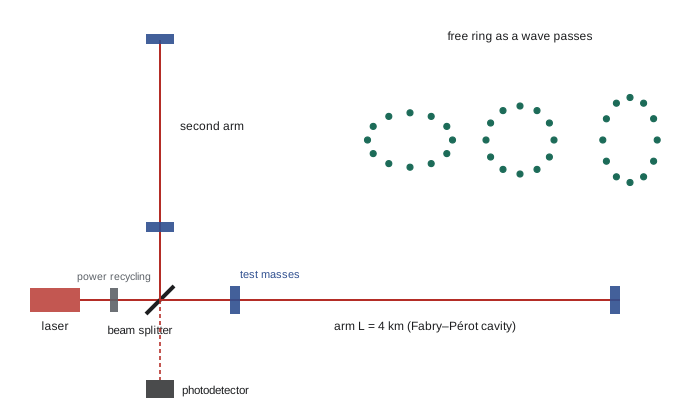
A passing wave does not push particles around; in the transverse-traceless coordinates free particles stay at fixed coordinate positions. What changes is the proper distance between them. For a plus-polarized wave, two free masses separated by \(L\) along \(x\) have proper separation \(L(1 + \frac{1}{2}h_+)\), and two along \(y\) have \(L(1 - \frac{1}{2}h_+)\). A ring of free particles in the \(xy\) plane is stretched into an ellipse along \(x\) while squeezed along \(y\), then half a cycle later the reverse. This is the geodesic deviation of lesson 5 in a wave: the Weyl curvature of the wave produces an oscillating tidal field. The fractional length change is \(\Delta L/L = h/2\), and the strain \(h\) of waves reaching Earth from astrophysical sources is at most about \(10^{-21}\).
Sources: the quadrupole formula
In electromagnetism the leading radiation comes from a changing electric dipole moment. Gravity has no dipole radiation: the mass dipole moment of an isolated system is its total mass times its centre of mass position, and conservation of momentum keeps the centre of mass moving uniformly. The leading gravitational radiation comes from a changing mass quadrupole moment \(Q_{ij}\). Einstein derived the radiated power in 1918:
where the dots are time derivatives and the indices are summed. The factor \(G/c^5 = 2.8 \times 10^{-53}\) W⁻¹ s² makes laboratory sources hopeless: a steel beam of 500 tonnes spun as fast as it can without flying apart radiates about \(10^{-29}\) W. Only astronomical masses moving at a sizeable fraction of light speed produce detectable waves. A spherically symmetric collapse produces none at all, as Birkhoff's theorem in lesson 6 required.
For two masses \(m_1\) and \(m_2\) in a circular orbit of separation \(a\) and angular frequency \(\omega\), the quadrupole formula gives
The waves have twice the orbital frequency, because the quadrupole pattern repeats every half orbit. As the binary loses energy, the orbit shrinks and the frequency rises; this runaway is the chirp. Combining the power with Kepler's law, the gravitational-wave frequency \(f\) evolves as
The combination \(\mathcal{M}\), the chirp mass, is what the rate of frequency change measures directly. Integrating gives the time remaining before merger from a frequency \(f\): \(\tau = \frac{5}{256}(G\mathcal{M}/c^3)^{-5/3}(\pi f)^{-8/3}\). The strain amplitude at distance \(D\) is \(h \approx \frac{4}{D}(G\mathcal{M}/c^2)^{5/3}(\pi f/c)^{2/3}\). Measuring the frequency, its rate of change and the amplitude therefore gives the chirp mass and the distance: binary mergers are standard sirens, a fact that lesson 12 returns to for the Hubble tension.
import math
G, c, Msun = 6.674e-11, 2.998e8, 1.989e30
Mpc = 3.086e22
def chirp_mass(m1, m2): return (m1 * m2) ** 0.6 / (m1 + m2) ** 0.2
def time_to_merge(f, Mc):
    tc = G * Mc / c**3
    return 5 / 256 * tc ** (-5/3) * (math.pi * f) ** (-8/3)
def fdot(f, Mc):
    tc = G * Mc / c**3
    return 96 / 5 * math.pi ** (8/3) * tc ** (5/3) * f ** (11/3)
def strain(f, Mc, D):
    return 4 / D * (G * Mc / c**2) ** (5/3) * (math.pi * f / c) ** (2/3)
# GW150914: 35.6 and 30.6 solar masses at 440 Mpc
m1, m2, D = 35.6 * Msun, 30.6 * Msun, 440 * Mpc
Mc = chirp_mass(m1, m2)
print(f"chirp mass {Mc/Msun:.1f} solar masses")
for f in (35, 50, 100, 150):
    print(f"f = {f:4d} Hz: df/dt = {fdot(f, Mc):8.1f} Hz/s, time to merger {time_to_merge(f, Mc)*1e3:7.1f} ms, h = {strain(f, Mc, D):.2e}")
# recover the chirp mass from a "measured" df/dt at 75 Hz
f, fd = 75.0, fdot(75.0, Mc)
Mc_rec = (fd / (96/5 * math.pi**(8/3) * f**(11/3))) ** (3/5) * c**3 / G
print(f"from f = {f} Hz and df/dt = {fd:.0f} Hz/s: chirp mass {Mc_rec/Msun:.2f} solar masses")
# arm-length change in a 4 km LIGO arm at peak strain 1e-21
print(f"4 km arm changes by {0.5e-21*4e3:.1e} m (a proton is about 1.7e-15 m across)")
# GW170817: two neutron stars of 1.46 and 1.27 Msun at 40 Mpc, time in band from 24 Hz
Mc2 = chirp_mass(1.46 * Msun, 1.27 * Msun)
print(f"GW170817: chirp mass {Mc2/Msun:.3f}, time from 24 Hz to merger {time_to_merge(24, Mc2):.0f} s")chirp mass 28.7 solar masses f = 35 Hz: df/dt = 71.6 Hz/s, time to merger 183.3 ms, h = 7.79e-22 f = 50 Hz: df/dt = 264.9 Hz/s, time to merger 70.8 ms, h = 9.88e-22 f = 100 Hz: df/dt = 3363.5 Hz/s, time to merger 11.1 ms, h = 1.57e-21 f = 150 Hz: df/dt = 14875.3 Hz/s, time to merger 3.8 ms, h = 2.05e-21 from f = 75.0 Hz and df/dt = 1171 Hz/s: chirp mass 28.72 solar masses 4 km arm changes by 2.0e-18 m (a proton is about 1.7e-15 m across) GW170817: chirp mass 1.185, time from 24 Hz to merger 102 s
The heavy black holes of GW150914 sweep through LIGO's band in a fraction of a second; the light neutron stars of GW170817 stayed in the band for about 100 seconds and thousands of orbits, which is why that signal could be timed so precisely. The Newtonian formulas break down in the last few orbits, where the orbital speed approaches half the speed of light. There, accurate waveforms come from post-Newtonian expansions to high order, from numerical relativity simulations of the merger, and from perturbation theory for the ringdown, in which the newly formed Kerr black hole settles down by emitting waves at its characteristic quasinormal frequencies, determined by its mass and spin alone.
The first indirect detection: the Hulse–Taylor pulsar
Gravitational waves were first seen indirectly. In 1974 Russell Hulse and Joseph Taylor discovered PSR B1913+16, a pulsar in a 7.75 hour orbit around another neutron star. A pulsar is an excellent clock, and timing its pulses over decades revealed that the orbit is shrinking: the orbital period decreases by about 76 microseconds per year, so that the two stars will merge in about 300 million years. The quadrupole formula, generalized to the binary's eccentric orbit, predicts exactly this decay. The cumulative shift in the time of periastron, the moment of closest approach, now amounts to more than 40 seconds and agrees with general relativity to within about two parts in a thousand. Hulse and Taylor received the 1993 Nobel Prize. The double pulsar PSR J0737−3039, discovered in 2003, in which both neutron stars are seen as pulsars, has since provided even more stringent tests.
import math
G, c, Msun = 6.674e-11, 2.998e8, 1.989e30
# Peters-Mathews period derivative for an eccentric binary
def Pdot(m1, m2, Pb, e):
    M = m1 + m2
    f_e = (1 + 73/24*e**2 + 37/96*e**4) / (1 - e**2) ** 3.5
    return -192 * math.pi / 5 * (2 * math.pi * G / (c**3 * Pb)) ** (5/3) * m1 * m2 / M ** (1/3) * f_e
m1, m2 = 1.438 * Msun, 1.390 * Msun
Pb, e = 0.322997 * 86400, 0.6171
pd = Pdot(m1, m2, Pb, e)
print(f"Hulse-Taylor predicted dPb/dt = {pd:.3e} s/s  (observed, after a galactic correction, -2.40e-12)")
print(f"period shrinks by {abs(pd)*3.156e7*1e6:.1f} microseconds per year")
# cumulative periastron time shift after T years: (1/2) (Pdot/Pb) T^2 in seconds
for years in (10, 30, 50):
    T = years * 3.156e7
print(f"after {years} years the periastron arrives {0.5*abs(pd)/Pb*T**2:.1f} s early")Hulse-Taylor predicted dPb/dt = -2.402e-12 s/s (observed, after a galactic correction, -2.40e-12) period shrinks by 75.8 microseconds per year after 10 years the periastron arrives 4.3 s early after 30 years the periastron arrives 38.6 s early after 50 years the periastron arrives 107.2 s early
Detecting gravitational waves
A laser interferometer measures the difference in length between two perpendicular arms. Light from a laser is split, sent down each arm, reflected by mirrors hung as pendulums so that they are free to move along the arm, and recombined. A passing wave lengthens one arm while shortening the other, shifting the interference pattern. To make the tiny strain measurable, LIGO's arms are 4 km long; the light bounces back and forth about 280 times in Fabry–Pérot cavities, making the effective arm length over 1000 km; power recycling builds up hundreds of kilowatts of laser power in the arms; the mirrors are 40 kg fused-silica test masses suspended from quadruple pendulums in an ultra-high vacuum; and squeezed states of light reduce quantum noise below the standard limit. The detectors are sensitive from about 20 Hz to a few kilohertz, limited at low frequency by seismic and thermal noise and at high frequency by photon shot noise.
LIGO's two sites, 3,002 km apart, allow coincident detections and a rough sky position from the arrival-time difference, at most 10 ms. Virgo, near Pisa in Italy, joined in 2017, making triangulation possible: GW170817 was localized to 28 square degrees, small enough for telescopes to find the kilonova, the glow of radioactive heavy elements, including gold and platinum, forged in the neutron-star collision. Japan's KAGRA, built underground and with cryogenic mirrors, joined in 2020, and LIGO-India is under construction. By the end of 2025 the network had reported around three hundred candidate mergers of black holes and neutron stars. In January 2025 it recorded GW250114, a black-hole merger so loud that the ringdown could be analysed in detail, confirming Hawking's area theorem and the Kerr nature of the final black hole with far greater confidence than GW150914 had.
Other frequency bands require other instruments. The Laser Interferometer Space Antenna, LISA, adopted by the European Space Agency in 2024 for launch in the 2030s, will fly three spacecraft in a triangle with 2.5 million km arms, sensitive to millihertz waves from supermassive black-hole mergers, from stellar-mass objects spiralling into them, and from tens of thousands of compact white-dwarf binaries in the Milky Way. At still lower frequencies, nanohertz waves with periods of years, pulsar timing arrays monitor dozens of millisecond pulsars as a galaxy-sized detector. In June 2023 the North American NANOGrav collaboration, together with European, Australian, Chinese and Indian arrays, reported evidence for a background of such waves, showing the characteristic Hellings–Downs correlation between pulsars at different angular separations. The likely source is the combined signal of supermassive black-hole binaries throughout the universe.
What the waves have taught us
Gravitational waves have opened a new kind of astronomy. They show that black holes of 10 to 150 solar masses are common, some in a mass range that stellar-evolution theory struggled to explain. The waveforms agree with general relativity's predictions for the strong-field merger and the ringdown, and the absence of dispersion bounds the graviton's mass below about \(10^{-23}\) eV/\(c^2\). GW170817 showed that neutron-star mergers make short gamma-ray bursts and a large share of the universe's heavy elements, and its near-simultaneous arrival with gamma rays eliminated whole classes of alternative theories of gravity and dark energy that predicted waves travelling at speeds different from light. Combined with the redshift of its host galaxy, NGC 4993, it gave the first standard-siren measurement of the Hubble constant, \(70^{+12}_{-8}\) km/s/Mpc.
Worked problem
A neutron-star binary in the Milky Way
Two neutron stars of 1.4 solar masses each orbit with a period of 1 hour. What gravitational-wave frequency do they emit, and how long until they merge?
Show solution
- Wave frequency is twice the orbital frequency: \(f = 2/3600\) s \(= 5.6 \times 10^{-4}\) Hz, in LISA's band.
- Chirp mass: \(\mathcal{M} = (1.4^2)^{0.6}/(2.8)^{0.2}\,M_\odot = 1.22\,M_\odot\); \(G\mathcal{M}/c^3 = 6.0 \times 10^{-6}\) s.
- \(\tau = \frac{5}{256}(6.0 \times 10^{-6})^{-5/3}(\pi \times 5.6 \times 10^{-4})^{-8/3}\) s.
- \((6.0 \times 10^{-6})^{-5/3} = 5.7 \times 10^{8}\); \((1.75 \times 10^{-3})^{-8/3} = 2.3 \times 10^{7}\); \(\tau \approx 0.0195 \times 1.3 \times 10^{16}\) s \(\approx 2.6 \times 10^{14}\) s.
Answer: About \(5.6 \times 10^{-4}\) Hz, and roughly 8 million years to merger.
Common mistakes
MistakeThinking gravitational waves push test masses along.
InsteadThey change the proper distances between free masses transverse to the propagation direction; in TT coordinates the masses stay put.
MistakeExpecting dipole gravitational radiation like electromagnetic dipole radiation.
InsteadMomentum conservation forbids it; the leading radiation is quadrupolar.
MistakeConfusing orbital frequency with wave frequency for a binary.
InsteadThe dominant wave frequency is twice the orbital frequency.
MistakeBelieving a spherical supernova must radiate gravitational waves.
InsteadSpherical collapse radiates none; only asymmetric motion produces waves.
Summary and key terms
- Linearizing the Einstein equation gives \(\Box\bar{h}_{\mu\nu} = -16\pi G T_{\mu\nu}/c^4\): waves travel at \(c\), confirmed to \(10^{-15}\) by GW170817.
- Gravitational waves are transverse with two tensor polarizations, plus and cross, related by a 45° rotation.
- A wave of strain \(h\) changes proper lengths by \(\Delta L/L = h/2\); astrophysical strains reaching Earth are about \(10^{-21}\) or less.
- Radiation is quadrupolar; binaries chirp with \(df/dt \propto \mathcal{M}^{5/3}f^{11/3}\), and the chirp mass is measured directly.
- The Hulse–Taylor pulsar's orbital decay matches general relativity to two parts in a thousand.
- Ground interferometers, the planned LISA and pulsar timing arrays cover audio, millihertz and nanohertz bands; a nanohertz background was reported in 2023.
- Strain
- The fractional change in proper length produced by a gravitational wave.
- Transverse-traceless gauge
- Coordinates in which a plane wave has only two components, the plus and cross polarizations.
- Quadrupole formula
- Einstein's 1918 result for the power radiated by a changing mass quadrupole moment.
- Chirp mass
- \(\mathcal{M} = (m_1m_2)^{3/5}/(m_1 + m_2)^{1/5}\), determined by the rate of frequency increase.
- Ringdown
- The damped oscillation of a newly formed black hole at its quasinormal frequencies.
- Standard siren
- A binary merger whose distance follows directly from its waveform.
Practice problems
Work each problem on paper first, then reveal the answer to check.
A wave of strain 1e-21 passes a 4 km arm. By how much does the arm change length?
Show answer
\(\Delta L = hL/2 = 2 \times 10^{-18}\) m.
What is the chirp mass of two 10 solar-mass black holes?
Show answer
\((100)^{0.6}/(20)^{0.2} = 15.85/1.82 = 8.7\,M_\odot\).
Why do neutron-star binaries spend longer in LIGO's band than black-hole binaries?
Show answer
The time to merger scales as \(\mathcal{M}^{-5/3}\); smaller chirp masses sweep through the band more slowly.
The Earth orbits the Sun. Estimate the gravitational-wave power using the circular-orbit formula.
Show answer
\(\frac{32}{5}G^4(M_\odot m_\oplus)^2(M_\odot)/(c^5a^5) \approx 200\) W.
GW170817 arrived 1.7 s before the gamma rays after travelling 130 million light-years. Bound the fractional difference between the speeds.
Show answer
\(1.7/(1.3 \times 10^8 \times 3.16 \times 10^7) \approx 4 \times 10^{-16}\), of order \(10^{-15}\).
Lesson quiz · 5 questions
Score 60% or more to complete this lesson.
Create a free account to save your progress, take quizzes and earn a certificate.