
PHYS-450 · Lesson 7 of 12 · 23 min
Classic tests: perihelion precession, light bending, Shapiro delay and redshift
A physical theory earns trust by surviving tests it could have failed. General relativity was confronted almost at once with three, which Einstein himself proposed: the anomalous perihelion advance of Mercury, the bending of starlight by the Sun, and the gravitational redshift of light. A fourth, the delay of radar signals passing the Sun, was proposed by Irwin Shapiro in 1964 and became the most precise of the solar-system tests. This lesson derives each prediction from the Schwarzschild geometry of lesson 6 and describes how it was measured. It ends with the parametrized post-Newtonian framework that physicists use to compare general relativity with its rivals, and with the bounds that today's experiments place on them.
Perihelion precession
Start from the orbit equation of lesson 6, with \(u = 1/r\):
Without the last term, the solution is the Kepler ellipse \(u_0 = (1 + e\cos\phi)/p\), with semi-latus rectum \(p = \tilde{L}^2/GM = a(1 - e^2)\). The relativistic term is small, so substitute \(u_0\) into it to get a first correction \(u_1\) satisfying
The constant and \(\cos^2\phi\) terms on the right produce small, bounded changes in the size and shape of the orbit. The middle term is different: it drives the oscillator \(u_1'' + u_1\) at its own natural frequency, and resonance gives a secular solution \(u_1 \supset (3GMe/c^2p^2)\,\phi\sin\phi\), growing with \(\phi\). Combined with the Kepler solution, this is just the first-order expansion of
The orbit is an ellipse that does not quite close. Perihelion recurs when \((1 - \delta)\phi = 2\pi\), so each orbit the perihelion advances by
For Mercury, with \(a = 5.79 \times 10^{10}\) m and \(e = 0.2056\), this is \(5.02 \times 10^{-7}\) rad per orbit. Mercury completes 415 orbits per century, so the advance is 43.0 arcseconds per century, the number lesson 6 obtained by direct numerical integration. The observed anomaly, after subtracting the effects of the other planets and of the slight flattening of the Sun, is \(42.98 \pm 0.04\) arcseconds per century. Venus, Earth and the asteroid Icarus show smaller relativistic advances, also in agreement. Binary pulsars provide a dramatic extension: in the Hulse–Taylor pulsar, two neutron stars orbit each other every 7.75 hours and the periastron advances by 4.2 degrees per year, about thirty-five thousand times Mercury's rate.
import math
G, c, Msun = 6.674e-11, 2.998e8, 1.989e30
planets = [   # name, semi-major axis (AU), eccentricity, period (days)
    ("Mercury", 0.3871, 0.2056, 87.969),
    ("Venus",   0.7233, 0.0068, 224.70),
    ("Earth",   1.0000, 0.0167, 365.256),
    ("Mars",    1.5237, 0.0934, 686.98),
    ("Icarus",  1.0779, 0.8270, 408.8),
]
AU = 1.496e11
print("body      advance per orbit (rad)   arcsec per century")
for name, a, e, P in planets:
    d = 6 * math.pi * G * Msun / (c**2 * a * AU * (1 - e * e))
    per_century = d * (36525 / P) * 180 / math.pi * 3600
    print(f"{name:8s}  {d:12.3e}             {per_century:8.2f}")
# Hulse-Taylor binary pulsar: total mass 2.83 Msun, a = 1.95e9 m, e = 0.617, P = 7.752 h
M, a, e, P = 2.828 * Msun, 1.950e9, 0.6171, 7.752 * 3600
d = 6 * math.pi * G * M / (c**2 * a * (1 - e * e))
print(f"Hulse-Taylor periastron advance: {d*180/math.pi*(365.25*86400/P):.2f} degrees per year")body advance per orbit (rad) arcsec per century Mercury 5.020e-07 42.99 Venus 2.573e-07 8.63 Earth 1.861e-07 3.84 Mars 1.232e-07 1.35 Icarus 5.462e-07 10.07 Hulse-Taylor periastron advance: 4.22 degrees per year
The bending of light
For light, the geodesic equation with an affine parameter gives the same orbit equation but without the \(GM/\tilde{L}^2\) term, because a photon has no rest mass:
Without gravity the solution is a straight line, \(u_0 = \sin\phi/b\), passing the mass at closest distance \(b\), the impact parameter. Substituting \(u_0\) into the right side gives \(u_1'' + u_1 = (3GM/c^2b^2)\sin^2\phi\), whose solution is \(u_1 = (GM/c^2b^2)(1 + \cos^2\phi)\). The ray recedes to infinity where \(u = u_0 + u_1 = 0\). Near \(\phi = 0\) this requires \(\phi/b + 2GM/c^2b^2 \approx 0\), so \(\phi \approx -2GM/c^2b\), and by symmetry the same angle appears at the other end. The ray comes in from \(\phi \approx -\alpha/2\) and leaves at \(\phi \approx \pi + \alpha/2\), with total deflection
For a ray grazing the Sun's limb, \(b = R_\odot = 6.96 \times 10^8\) m and \(\alpha = 8.49 \times 10^{-6}\) rad \(= 1.75\) arcseconds. This is twice the value obtained from the equivalence principle in lesson 3. The extra half comes from the spatial part of the metric: in the weak-field form, \(g_{00}\) and \(g_{ij}\) each contribute \(2GM/c^2b\). A slow body feels only \(g_{00}\); light, moving as fast through space as through time, feels both equally. Measuring light bending is therefore a direct measurement of the curvature of space.
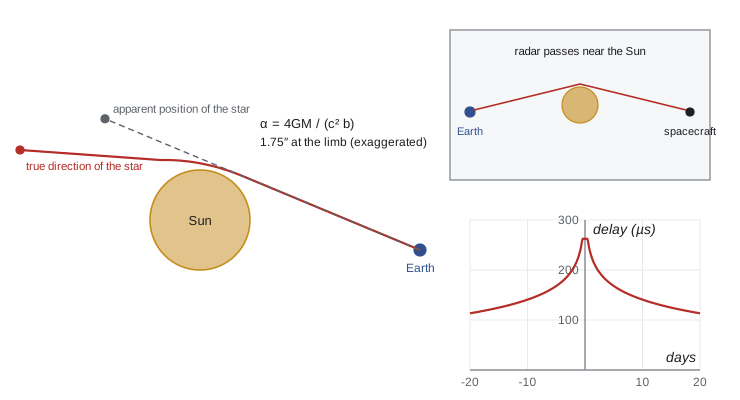
The code below checks the formula by integrating the exact null geodesic equation for a ray passing the Sun at several impact parameters, starting far away and following it until it has passed and receded again. It also shows how the deflection grows at small impact parameters near a black hole, where the first-order formula fails and light can wind around the photon sphere.
import math
def deflection(b, M=1.0, phi_max=3.6, n=200000):
    """Integrate u'' = -u + 3 M u^2 (units G = c = 1) for an incoming ray with impact parameter b.
    Start at u = 0 heading in; return the total deflection angle (rad) when u returns to 0."""
    u, du = 0.0, 1.0 / b              # du/dphi = 1/b at infinity for a straight line
    h = phi_max / n
    f = lambda u: -u + 3 * M * u * u
    phi = 0.0
    while True:
        k1u, k1v = du, f(u)
        k2u, k2v = du + h/2*k1v, f(u + h/2*k1u)
        k3u, k3v = du + h/2*k2v, f(u + h/2*k2u)
        k4u, k4v = du + h*k3v, f(u + h*k3u)
        u_new = u + h/6*(k1u + 2*k2u + 2*k3u + k4u)
        du = du + h/6*(k1v + 2*k2v + 2*k3v + k4v)
        phi += h
        if u_new <= 0 and phi > 1.0:
            phi -= h * u_new / (u_new - u)          # interpolate to u = 0
            return phi - math.pi
        if u_new > 1 / (2 * M):                    # crossed the horizon: captured
            return None
        u = u_new
# the Sun in geometrized units: M = 1476.6 m, b = solar radius
M_sun, R_sun = 1476.6, 6.957e8
a = deflection(R_sun / M_sun)                       # use units of M so numbers stay moderate
print(f"Sun's limb: {a:.4e} rad = {a*206265:.3f} arcsec; formula 4M/b = {4*M_sun/R_sun*206265:.3f} arcsec")
print(" b/M   numerical (deg)   4M/b (deg)")
for bM in (100, 30, 10, 6, 5.3):
    a = deflection(bM, phi_max=12.0, n=400000)
    print(f"{bM:5.1f}   {math.degrees(a):12.2f}   {math.degrees(4/bM):10.2f}")
print("critical impact parameter sqrt(27) M =", round(math.sqrt(27), 3), "M: rays with smaller b are captured")Sun's limb: 8.4899e-06 rad = 1.751 arcsec; formula 4M/b = 1.751 arcsec b/M numerical (deg) 4M/b (deg) 100.0 2.36 2.29 30.0 8.49 7.64 10.0 33.83 22.92 6.0 98.51 38.20 5.3 203.85 43.24 critical impact parameter sqrt(27) M = 5.196 M: rays with smaller b are captured
At the Sun the numerical and analytic results agree to many digits. Near a black hole, at ten times \(M\), the true deflection is already about half again as large as the formula gives, and at \(b = 5.3M\), just outside the critical value \(\sqrt{27}M \approx 5.196M\), the ray swings through more than 200 degrees, leaving roughly back the way it came. Rays even closer to the critical value wind around the hole any number of times before escaping. Rays with smaller impact parameters are captured. The bright ring in the Event Horizon Telescope images is light that has skimmed this critical orbit.
The 1919 eclipse expeditions measured star positions on photographic plates at Sobral in Brazil and on the island of Príncipe, finding 1.98 ± 0.16 and 1.61 ± 0.40 arcseconds. These numbers, though rough, ruled out the Newtonian half value. Later eclipse measurements were not much better, but radio interferometry transformed the test: quasars pass near the Sun every year, and very long baseline interferometry measures their apparent positions to tens of microarcseconds. Analyses of millions of such measurements confirm the general relativity value to about one part in ten thousand. ESA's Gaia satellite must correct the position of every star it measures for light bending by the Sun, which amounts to milliarcseconds even 90 degrees from the Sun, and by the planets.
Light bending by galaxies and clusters of galaxies, gravitational lensing, is now an everyday astronomical tool. A massive cluster can produce multiple images and luminous arcs of background galaxies, and an exact alignment produces an Einstein ring. Lensing maps of the mass in clusters reveal far more mass than the visible galaxies and gas contain, one of the pillars of the evidence for dark matter in lesson 12. Microlensing by stars, a brief brightening of a background star as a foreground star passes in front of it, has found hundreds of exoplanets.
The Shapiro delay
Light passing a mass is not only bent; it is delayed. In the weak-field metric, a light ray satisfies \(0 = -(1 + 2\Phi/c^2)c^2dt^2 + (1 - 2\Phi/c^2)dx^2\), so its coordinate speed is \(dx/dt = c(1 + 2\Phi/c^2)\), slower than \(c\) where \(\Phi < 0\). Integrating along a nearly straight path from the Earth at distance \(r_E\) past the Sun to a planet or spacecraft at distance \(r_P\), with closest approach \(b\), gives an extra one-way delay
For a radar signal sent from Earth to a spacecraft beyond the Sun and back, grazing the Sun's limb, the round-trip delay is about 250 microseconds, a tiny addition to a round trip of more than two hours, but easily measured with modern radio timing. Shapiro proposed the test in 1964 and measured it by bouncing radar off Venus and Mercury in 1968. The most precise version came in 2002, when the Cassini spacecraft on its way to Saturn passed behind the Sun. Its radio link, at frequencies high enough that the solar corona's effect could be removed, measured the delay and confirmed general relativity's spatial curvature parameter to about two parts in a hundred thousand.
import math
G, c, Msun, AU, Rsun = 6.674e-11, 2.998e8, 1.989e30, 1.496e11, 6.957e8
def shapiro_round_trip(rE, rP, b):
    return 2 * (2 * G * Msun / c**3) * math.log(4 * rE * rP / b**2)
rE, rP = 1.0 * AU, 8.43 * AU                      # Earth and Cassini near Saturn, 2002
print("closest approach (solar radii)   extra round-trip delay (microseconds)")
for b_R in (1.6, 2, 5, 10, 30, 100):
    print(f"{b_R:10.1f}                        {shapiro_round_trip(rE, rP, b_R*Rsun)*1e6:8.1f}")
# the delay changes as the line of sight sweeps past the Sun: Doppler-like frequency shift
# b(t) = b0 + v t with v about the Sun's apparent motion relative to the line of sight
v = 2 * math.pi * AU / (365.25 * 86400)          # Earth's orbital speed, roughly
b0 = 1.6 * Rsun
dt = 3600.0
for hours in (1, 6, 24):
    t = hours * 3600.0
    d1 = shapiro_round_trip(rE, rP, b0 + v * t)
    d2 = shapiro_round_trip(rE, rP, b0 + v * (t + dt))
print(f"{hours:3d} h after closest approach: fractional frequency shift {abs(d2 - d1)/dt:.2e}")closest approach (solar radii) extra round-trip delay (microseconds)
1.6 262.5
2.0 253.7
5.0 217.6
10.0 190.2
30.0 146.9
100.0 99.5
1 h after closest approach: fractional frequency shift 9.22e-10
6 h after closest approach: fractional frequency shift 6.49e-10
24 h after closest approach: fractional frequency shift 3.14e-10Cassini did not measure the delay directly; it measured the fractional frequency shift of its radio signal caused by the changing delay as the line of sight moved past the Sun, a shift of order \(10^{-9}\) near closest approach that its stable oscillators and multiple radio frequencies could track to about \(10^{-14}\).
Gravitational redshift
Lesson 3 derived the gravitational redshift from the equivalence principle; the Schwarzschild metric makes it exact. Light emitted by a static source at radius \(r_e\) and received far away has \(1 + z = 1/\sqrt{1 - r_s/r_e}\). Walter Adams measured the redshift of light from the white dwarf Sirius B in 1925, though his result turned out to be contaminated by light from Sirius A; modern measurements with the Hubble Space Telescope give an equivalent velocity of about 80 km/s, in agreement with theory. The Pound–Rebka experiment and Gravity Probe A measured the redshift on Earth, and in 2018 two Galileo navigation satellites, accidentally launched into elliptical orbits, became laboratories: their clocks sped up and slowed down by the predicted amounts as they climbed and fell, confirming the redshift to about three parts in a hundred thousand. Today's best laboratory tests compare optical clocks whose heights differ by a few centimetres, and in 2022 a group at JILA in Boulder resolved the redshift across a single cloud of atoms only a millimetre tall.
The parametrized post-Newtonian framework
Many alternative theories of gravity agree with Newton in the weak-field limit but differ from general relativity at the next order. To compare them, Kenneth Nordtvedt, Clifford Will and others developed the parametrized post-Newtonian framework, which writes the weak-field metric with adjustable coefficients. The two most important are \(\gamma\), which measures how much space curvature a unit mass produces, and \(\beta\), which measures how nonlinear the superposition of gravity is. In general relativity both equal one. The classic tests depend on them in different combinations: light bending and the Shapiro delay are proportional to \((1 + \gamma)/2\), and the perihelion advance to \((2 + 2\gamma - \beta)/3\).
Every test agrees with general relativity. The Brans–Dicke theory, the best known scalar-tensor rival, predicts \(\gamma = (1 + \omega)/(2 + \omega)\) for a coupling parameter \(\omega\); Cassini requires \(\omega > 40{,}000\), so the scalar field, if it exists, is extremely weakly coupled. In the strong-field regime the binary pulsars and gravitational-wave observations of lesson 9 extend the tests far beyond what the solar system can reach.
Worked problem
Light bending by Jupiter
How much does Jupiter bend light from a quasar that grazes its limb? (\(M = 1.90 \times 10^{27}\) kg, radius 71,500 km.)
Show solution
- \(GM/c^2 = 6.674 \times 10^{-11} \times 1.90 \times 10^{27}/(8.99 \times 10^{16}) = 1.41\) m.
- \(\alpha = 4GM/(c^2b) = 4 \times 1.41/7.15 \times 10^7 = 7.9 \times 10^{-8}\) rad.
- Convert: \(7.9 \times 10^{-8} \times 206{,}265 = 0.016\) arcseconds = 16 milliarcseconds.
Answer: About 16 milliarcseconds; it was measured with VLBI in 2002 when Jupiter passed in front of a quasar.
Common mistakes
MistakeThinking the equivalence principle gives the full light deflection.
InsteadIt gives half; the other half comes from the curvature of space, \(g_{ij}\).
MistakeAttributing all of Mercury's 574″ per century to relativity.
InsteadAbout 531″ come from the other planets; relativity accounts for the 43″ residual.
MistakeTreating the Shapiro delay as light slowing down locally.
InsteadLocally light always moves at c; the delay reflects the coordinate speed and the extra proper distance in curved space.
MistakeUsing the weak-field deflection formula near a black hole.
InsteadIt fails close to the photon sphere; rays with \(b < \sqrt{27}GM/c^2\) are captured.
Summary and key terms
- Perturbing the orbit equation gives a perihelion advance \(6\pi GM/(c^2a(1 - e^2))\) per orbit: 43.0″ per century for Mercury.
- Light passing a mass at impact parameter \(b\) is deflected by \(4GM/(c^2b)\), 1.75″ at the Sun\'s limb, twice the equivalence-principle value.
- Gravitational lensing by galaxies and clusters maps their mass; microlensing finds planets.
- Radar signals passing the Sun are delayed by \((2GM/c^3)\ln(4r_Er_P/b^2)\) each way; Cassini confirmed it to about \(2 \times 10^{-5}\).
- Gravitational redshift has been measured from white dwarfs, towers, rockets, navigation satellites and optical clocks.
- The PPN parameters \(\gamma\) and \(\beta\) equal one in general relativity; all tests agree to about \(10^{-4}\) or better.
- Perihelion advance
- The slow rotation of an orbit's closest point; relativity adds 43″ per century for Mercury.
- Impact parameter
- The closest distance a straight-line ray would pass to the mass.
- Gravitational lensing
- The bending of light by mass, producing distorted, multiple or magnified images.
- Shapiro delay
- The extra light travel time through a gravitational potential.
- PPN parameters
- Coefficients such as \(\gamma\) and \(\beta\) that parametrize weak-field gravity theories.
Practice problems
Work each problem on paper first, then reveal the answer to check.
Compute the relativistic perihelion advance of the Earth in arcseconds per century.
Show answer
About 3.8″ per century from \(6\pi GM/(c^2a(1 - e^2))\) with 100 orbits per century.
What is the deflection of light grazing a white dwarf of 0.6 solar masses and radius 8,700 km?
Show answer
\(4 \times 0.886\) km/8700 km \(= 4.1 \times 10^{-4}\) rad, about 84″.
By what factor does the Shapiro delay change if the closest approach doubles?
Show answer
The logarithm decreases by \(2\ln 2\); the round trip drops by \(2 \times (2GM/c^3) \times 2\ln 2 \approx 27\) µs whatever the starting distance.
A theory has \(\gamma = 0\). What light deflection does it predict at the Sun's limb?
Show answer
\((1 + 0)/2 \times 1.75 = 0.875\), the equivalence-principle value; ruled out.
Why could the 1919 eclipse test not have been done with an ordinary daytime photograph?
Show answer
The Sun's glare hides stars near its limb; only during totality are they visible.
Lesson quiz · 5 questions
Score 60% or more to complete this lesson.
Create a free account to save your progress, take quizzes and earn a certificate.