
PHYS-450 · Lesson 5 of 12 · 25 min
Tensors, curvature and the Einstein field equations
Lesson 4 gave the first half of Wheeler's sentence: spacetime tells matter how to move, through the geodesic equation. This lesson gives the second half: matter tells spacetime how to curve, through the Einstein field equation. To write it we need three ideas. Tensors are the objects whose equations hold in every coordinate system. The Riemann curvature tensor measures curvature in a way that, unlike the Christoffel symbols, cannot be removed by a change of coordinates; physically it is the tidal field. The stress-energy tensor describes the energy, momentum and pressure of matter. The field equation sets a particular combination of curvature equal to the stress-energy, with a constant fixed by requiring Newtonian gravity in the weak-field limit. The mathematics is heavier than in earlier lessons, but the ideas are the ones already met: tides, geodesics and the Newtonian potential.
Tensors in one page
A scalar is a number that every observer agrees on, such as the proper time along a worldline or the rest mass of a particle. A vector \(V^\mu\) has components that change between coordinate systems by the chain rule, \(V'^\mu = (\partial x'^\mu/\partial x^\nu)V^\nu\), like the coordinate differentials \(dx^\mu\). A covector \(W_\mu\), such as the gradient of a scalar \(\partial_\mu f\), changes with the inverse factor, \(W'_\mu = (\partial x^\nu/\partial x'^\mu)W_\nu\), so that \(W_\mu V^\mu\) is a scalar. A tensor of higher rank has one such factor for each index: the metric \(g_{\mu\nu}\) is a tensor with two lower indices, and its inverse \(g^{\mu\nu}\), defined by \(g^{\mu\lambda}g_{\lambda\nu} = \delta^\mu_\nu\), has two upper indices. Indices are raised and lowered with the metric.
The reason for this bookkeeping is a single powerful fact. If a tensor equation such as \(A_{\mu\nu} = B_{\mu\nu}\) holds in one coordinate system, it holds in all of them, because both sides transform in the same way. This is the principle of general covariance: the laws of physics should be written as tensor equations, so that no coordinate system is privileged. Combined with the equivalence principle, it gives a recipe for gravity's effect on any physics. Take the special-relativistic law in an inertial frame, replace \(\eta_{\mu\nu}\) by \(g_{\mu\nu}\) and ordinary derivatives \(\partial_\mu\) by covariant derivatives \(\nabla_\mu\), and the result is the law in curved spacetime. Applied to a free particle, \(du^\mu/d\tau = 0\) becomes \(u^\nu\nabla_\nu u^\mu = 0\), which is the geodesic equation. Applied to energy conservation, \(\partial_\mu T^{\mu\nu} = 0\) becomes \(\nabla_\mu T^{\mu\nu} = 0\).
Curvature: the Riemann tensor
How can curvature be detected? On a sphere, parallel transport a vector around a small closed loop and it returns rotated, by an angle equal to the curvature times the enclosed area. In flat space it returns unchanged. The Riemann tensor captures this in every direction at once. For an infinitesimal loop spanned by displacements \(A^\mu\) and \(B^\nu\), a transported vector \(V^\rho\) changes by \(\delta V^\rho = -R^\rho{}_{\sigma\mu\nu}V^\sigma A^\mu B^\nu\), where
The Riemann tensor is built from the Christoffel symbols and their first derivatives, so from the metric and its first and second derivatives. Unlike the Christoffel symbols it is a genuine tensor: if it vanishes in one coordinate system it vanishes in all, and a spacetime is flat exactly when its Riemann tensor is zero everywhere. It has symmetries, \(R_{\rho\sigma\mu\nu} = -R_{\sigma\rho\mu\nu} = -R_{\rho\sigma\nu\mu} = R_{\mu\nu\rho\sigma}\) and a cyclic identity, that reduce its number of independent components to one in two dimensions, six in three and twenty in four. For a sphere of radius \(a\), the single component is \(R_{\theta\phi\theta\phi} = a^2\sin^2\theta\), and the Gaussian curvature of MATH-430 is \(K = R_{\theta\phi\theta\phi}/\det g = 1/a^2\).
Curvature is tides: geodesic deviation
The physical meaning of the Riemann tensor is tidal acceleration. Consider two nearby freely falling particles with separation vector \(\xi^\mu\). Each follows a geodesic, and their separation changes according to the geodesic deviation equation
where \(u^\mu\) is their four-velocity and \(D/d\tau\) the covariant derivative along the worldline. In flat spacetime the right side vanishes and the separation grows at most linearly. In curved spacetime nearby free bodies accelerate relative to each other in proportion to their separation. Compare Newtonian gravity: two particles at positions \(\vec{x}\) and \(\vec{x} + \vec{\xi}\) have relative acceleration \(\ddot{\xi}^i = -(\partial_i\partial_j\Phi)\xi^j\), the tidal tensor. The two agree when
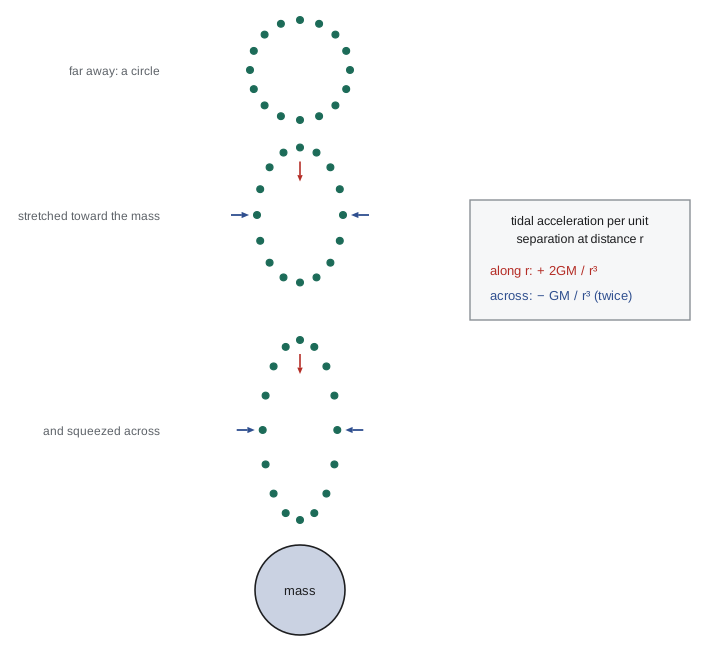
The Riemann tensor is the relativistic tidal field. Outside a spherical mass the Newtonian tidal tensor stretches along the radial direction by \(2GM/r^3\) per unit separation and squeezes in the two transverse directions by \(GM/r^3\) each. Its trace, the sum \(-2 + 1 + 1\) times \(GM/r^3\), is zero, which is Laplace's equation \(\nabla^2\Phi = 0\) in empty space. A ring of free particles falling toward a mass is stretched into an ellipse pointing at the mass and squeezed sideways. This is why the Moon raises two tidal bulges on the Earth, and why an astronaut falling into a stellar-mass black hole would be stretched lengthwise and compressed sideways long before reaching the horizon.
G, c, Msun = 6.674e-11, 2.998e8, 1.989e30
def tidal(M, r, L=2.0):
    """Head-to-foot tidal acceleration (m/s^2) across a body of length L at distance r."""
    return 2 * G * M * L / r**3
cases = [("Earth's surface", 5.972e24, 6.371e6),
         ("Moon on the Earth (whole Earth)", 7.35e22, 3.84e8),
         ("10 solar-mass hole at 1000 km", 10*Msun, 1.0e6),
         ("10 solar-mass hole at its horizon", 10*Msun, 2*G*10*Msun/c**2),
         ("Sgr A* (4.3 million) at its horizon", 4.3e6*Msun, 2*G*4.3e6*Msun/c**2)]
for name, M, r in cases:
    L = 1.2742e7 if "whole Earth" in name else 2.0
    print(f"{name:38s} {tidal(M, r, L):10.3e} m/s^2 over {L:.3g} m")
# where does a 2 m astronaut feel 100 g of stretching near a 10 solar-mass hole?
M = 10 * Msun
r = (2 * G * M * 2.0 / (100 * 9.81)) ** (1/3)
print(f"100 g of stretching at r = {r/1e3:.0f} km; horizon at {2*G*M/c**2/1e3:.1f} km")Earth's surface 6.165e-06 m/s^2 over 2 m Moon on the Earth (whole Earth) 2.208e-06 m/s^2 over 1.27e+07 m 10 solar-mass hole at 1000 km 5.310e+03 m/s^2 over 2 m 10 solar-mass hole at its horizon 2.060e+08 m/s^2 over 2 m Sgr A* (4.3 million) at its horizon 1.114e-03 m/s^2 over 2 m 100 g of stretching at r = 1756 km; horizon at 29.5 km
Across a person at the Earth's surface the tidal stretching is about \(6 \times 10^{-6}\) m/s², one part in a million of the Earth's surface gravity. Near a black hole of ten solar masses it reaches about 100 times the Earth's surface gravity at a distance of about 1,800 km and more than 500 times at 1,000 km, far outside the 30 km horizon: a falling astronaut would be torn apart, a fate astrophysicists call spaghettification. At the horizon of the 4.3 million solar mass black hole in the middle of the Milky Way, the tidal stretching across a person is only about \(10^{-3}\) m/s², about one ten-thousandth of the Earth's surface gravity; nothing special would be felt on crossing it. The strength of tides at a horizon scales as \(1/M^2\), so bigger black holes are gentler.
Ricci tensor, Ricci scalar and Einstein tensor
Contracting the Riemann tensor on its first and third indices gives the Ricci tensor \(R_{\mu\nu} = R^\lambda{}_{\mu\lambda\nu}\), and contracting again with the metric gives the Ricci scalar \(R = g^{\mu\nu}R_{\mu\nu}\). The Ricci tensor has a direct geometric meaning: it measures how a small ball of freely falling test particles, initially at rest relative to each other, changes its volume. The part of the Riemann tensor left over, the Weyl tensor, describes shape changes without volume change, the stretching and squeezing of tides and of gravitational waves. In empty space around a mass the Ricci tensor vanishes and only the Weyl part survives: the ball of particles is distorted but keeps its volume, the relativistic version of the trace-free Newtonian tidal tensor.
The combination that enters the field equations is the Einstein tensor
Its key property follows from an identity of the Riemann tensor called the Bianchi identity: the Einstein tensor has zero covariant divergence, \(\nabla^\mu G_{\mu\nu} = 0\), for every metric. This is exactly the property needed to match the conservation of energy and momentum of matter.
Stress-energy
In Newtonian gravity the source is mass density. In relativity mass is a form of energy, and energy density is one component of a tensor that also contains momentum density, energy flux and pressure. The stress-energy tensor \(T^{\mu\nu}\) is defined so that \(T^{00}\) is energy density, \(T^{0i}c\) the energy flux, \(T^{i0}/c\) the momentum density and \(T^{ij}\) the flux of the \(i\) component of momentum in the \(j\) direction, the stress. For a perfect fluid with energy density \(\rho c^2\), pressure \(p\) and four-velocity \(u^\mu\),
In the fluid's rest frame this is diagonal with entries \((\rho c^2, p, p, p)\). Dust, pressureless matter such as galaxies on cosmic scales, has \(p = 0\). Radiation has \(p = \rho c^2/3\). The vacuum energy of lesson 10, if it exists, has \(p = -\rho c^2\). Local conservation of energy and momentum is \(\nabla_\mu T^{\mu\nu} = 0\). In general relativity pressure gravitates as well as energy density: the active gravitational mass density of a fluid is \(\rho + 3p/c^2\). For ordinary matter the correction is tiny, but inside neutron stars it matters, and a negative pressure, as in dark energy, can make gravity repulsive.
The Einstein field equation
We now look for an equation of the form curvature equals source, a tensor equation with two indices on each side, reducing to Newton's \(\nabla^2\Phi = 4\pi G\rho\) for weak fields. Conservation demands that the curvature side be divergence free, which the Einstein tensor is. The result, presented by Einstein on 25 November 1915, is
The constant \(8\pi G/c^4\) is fixed by the Newtonian limit. For a static weak field sourced by slowly moving dust, the 00 component of the equation reduces, after some algebra, to \(R_{00} \approx \nabla^2\Phi/c^2\) on one side and \(4\pi G\rho/c^2\) on the other: Newton's equation for the potential. In empty space \(T_{\mu\nu} = 0\), and taking the trace shows that the field equation becomes simply \(R_{\mu\nu} = 0\). These ten coupled nonlinear partial differential equations for the ten metric components are the whole of classical gravity. Four of them are constraints, consistent with the freedom to choose four coordinates, so the equations determine six independent functions, of which two correspond to the two polarizations of gravitational waves.
The constant is very small: \(8\pi G/c^4 = 2.08 \times 10^{-43}\) per newton. Spacetime is extremely stiff. Producing a curvature radius of 1 km requires an energy density of order \(c^4/(8\pi G \times 10^6 \text{ m}^2) \approx 5 \times 10^{36}\) J/m³, about a hundred times the energy density inside a neutron star. That is why gravity is so weak in the laboratory and why only astronomical masses curve spacetime noticeably.
Einstein later added a term \(\Lambda g_{\mu\nu}\) to the left side, the cosmological constant, which is also divergence free and so allowed. He introduced it in 1917 to permit a static universe and abandoned it after Hubble's discovery of expansion. It returned in 1998, when distant supernovae showed that the expansion is accelerating; lessons 10 and 12 take it up. Moved to the right side, \(\Lambda\) acts like a fluid with negative pressure equal to minus its energy density.
import math
# Gaussian curvature and Ricci scalar of a sphere of radius a, from a numerical Riemann component
a = 2.0
def g(th): return (a*a, (a*math.sin(th))**2)         # diagonal metric (g_thth, g_phph)
def gamma(th):
    gt, gp = g(th)
    dgp = 2 * a * a * math.sin(th) * math.cos(th)    # d g_phph / d theta
    return -0.5 * dgp / gt, 0.5 * dgp / gp           # Gamma^th_phph, Gamma^ph_thph
th, h = 0.9, 1e-5
G1, G2 = gamma(th)
dG1 = (gamma(th + h)[0] - gamma(th - h)[0]) / (2*h)  # d Gamma^th_phph / d theta
# R^th_{ph th ph} = d_th Gamma^th_phph - Gamma^th_phph Gamma^ph_thph (other terms vanish here)
R_up = dG1 - G1 * G2
R_down = g(th)[0] * R_up                              # R_{th ph th ph}
K = R_down / (g(th)[0] * g(th)[1])
print("Gaussian curvature K =", round(K, 6), " expected 1/a^2 =", 1/a**2)
print("Ricci scalar R = 2K =", round(2*K, 6))
# how stiff is spacetime?
G, c = 6.674e-11, 2.998e8
k = 8 * math.pi * G / c**4
print(f"8 pi G / c^4 = {k:.3e} per newton")
for Rc, label in ((1.5e11, "1 AU"), (1e3, "1 km"), (1.0, "1 m")):
    print(f"energy density for curvature radius {label:5s}: {1/(k*Rc**2):.2e} J/m^3")
rho_ns = 4e17                                        # neutron star density, kg/m^3
print(f"neutron star energy density: {rho_ns*c**2:.1e} J/m^3")Gaussian curvature K = 0.25 expected 1/a^2 = 0.25 Ricci scalar R = 2K = 0.5 8 pi G / c^4 = 2.076e-43 per newton energy density for curvature radius 1 AU : 2.14e+20 J/m^3 energy density for curvature radius 1 km : 4.82e+36 J/m^3 energy density for curvature radius 1 m : 4.82e+42 J/m^3 neutron star energy density: 3.6e+34 J/m^3
Why this equation?
Several arguments lead to the field equation. The one given above, divergence-free curvature with the right Newtonian limit, is Einstein's. Hilbert's route, the same month, was a variational principle: the Einstein–Hilbert action \(S = \frac{c^4}{16\pi G}\int R\sqrt{-g}\,d^4x\) plus the action of matter, varied with respect to the metric, gives exactly the field equation. This is the gravitational analogue of PHYS-344's principle of stationary action, and it is the starting point for most modern attempts at quantum gravity. A theorem of David Lovelock (1971) shows that in four dimensions the Einstein tensor and the cosmological term are the only divergence-free tensors built from the metric and its first two derivatives. Given general covariance, the equivalence principle and second-order equations, general relativity is essentially unique.
The nonlinearity of the equations deserves a word. In electromagnetism two waves pass through each other unchanged, because Maxwell's equations are linear. Gravity is different: gravitational field energy itself gravitates, so the field of two masses is not exactly the sum of their separate fields. This nonlinearity makes exact solutions rare and precious. The Schwarzschild solution of 1916, the Kerr solution of 1963 and the cosmological solutions of Friedmann and Lemaître are among the few known, and the merger of two black holes could only be computed on supercomputers, a feat first achieved by Frans Pretorius in 2005 after decades of effort.
Worked problem
The Newtonian limit in one line
Show that the 00 component of the vacuum field equation, \(R_{00} = 0\), reduces to Laplace's equation for the weak-field metric of a static source.
Show solution
- For a static weak field the dominant Christoffel symbols are \(\Gamma^i_{00} = \partial_i\Phi/c^2\).
- In \(R_{00} = \partial_\lambda\Gamma^\lambda_{00} - \partial_0\Gamma^\lambda_{\lambda 0} + \Gamma\Gamma\) terms, time derivatives vanish and the products of \(\Gamma\)s are second order in \(\Phi\).
- So \(R_{00} \approx \partial_i\Gamma^i_{00} = \nabla^2\Phi/c^2\).
- Setting \(R_{00} = 0\) gives \(\nabla^2\Phi = 0\), Laplace's equation for the potential outside a mass.
Answer: \(R_{00} \approx \nabla^2\Phi/c^2\); with a source, the field equation gives \(\nabla^2\Phi = 4\pi G\rho\), fixing the constant \(8\pi G/c^4\).
Common mistakes
MistakeCalling the Christoffel symbols the curvature.
InsteadCurvature is the Riemann tensor; Christoffel symbols can be made zero at any point by a coordinate choice.
MistakeThinking that empty space is flat because \(T_{\mu\nu} = 0\).
InsteadIn vacuum the Ricci tensor vanishes, but the Weyl part of the Riemann tensor, the tidal field, does not.
MistakeBelieving only mass density gravitates.
InsteadPressure and stress gravitate too: the active density is \(\rho + 3p/c^2\), and negative pressure can repel.
MistakeExpecting black-hole tides to be strongest at the horizon of the biggest holes.
InsteadHorizon tides scale as \(1/M^2\); supermassive holes have gentle horizons, stellar ones lethal tides outside the horizon.
Summary and key terms
- Tensor equations hold in every coordinate system; laws in curved spacetime follow by replacing the flat metric and derivatives with curved ones.
- The Riemann tensor measures curvature through parallel transport around loops and through geodesic deviation; it is the relativistic tidal field.
- The Ricci tensor measures volume changes of a ball of free particles; the Weyl tensor measures trace-free shape changes, nonzero even in vacuum.
- The stress-energy tensor contains energy density, momentum, energy flux and stress; for a perfect fluid it is \((\rho + p/c^2)u^\mu u^\nu + p g^{\mu\nu}\).
- The Einstein field equation \(G_{\mu\nu} = 8\pi G T_{\mu\nu}/c^4\) reduces to \(\nabla^2\Phi = 4\pi G\rho\) for weak fields; in vacuum \(R_{\mu\nu} = 0\).
- Spacetime is stiff: \(8\pi G/c^4 = 2.1 \times 10^{-43}\) N⁻¹.
- Tensor
- A quantity whose components transform by one chain-rule factor per index; tensor equations are coordinate independent.
- Riemann tensor
- The curvature tensor built from the metric and its first two derivatives; zero exactly when spacetime is flat.
- Geodesic deviation
- The relative acceleration of nearby geodesics, given by the Riemann tensor.
- Ricci tensor
- The contraction of the Riemann tensor; zero in vacuum.
- Einstein tensor
- \(G_{\mu\nu} = R_{\mu\nu} - \tfrac{1}{2}Rg_{\mu\nu}\), divergence free by the Bianchi identity.
- Stress-energy tensor
- \(T^{\mu\nu}\), the source of gravity: energy, momentum and stress of matter and fields.
Practice problems
Work each problem on paper first, then reveal the answer to check.
How many independent components does the Riemann tensor have in four dimensions, and how many does the Ricci tensor have?
Show answer
Twenty and ten.
What is the Ricci scalar of a sphere of radius 6,371 km?
Show answer
\(R = 2/a^2 = 4.9 \times 10^{-14}\) m⁻².
A ball of free particles falls through empty space near the Sun. Does its volume change at first order? Does its shape?
Show answer
Its volume does not (Ricci = 0 in vacuum); its shape does, stretching toward the Sun and squeezing across.
For radiation, what is the active gravitational density in terms of the energy density?
Show answer
\(\rho + 3p/c^2 = \rho + \rho = 2\rho\): radiation gravitates twice as strongly as dust of the same energy density.
At what distance from a black hole of 10 solar masses does a 2 m astronaut feel a tidal stretch of 100 Earth gravities?
Show answer
Solve \(2GM \times 2/r^3 = 981\): \(r \approx 1{,}760\) km, about sixty times the horizon radius.
Lesson quiz · 5 questions
Score 60% or more to complete this lesson.
Create a free account to save your progress, take quizzes and earn a certificate.