
PHYS-450 · Lesson 11 of 12 · 22 min
Cosmology II: the hot Big Bang, nucleosynthesis and the cosmic microwave background
Run the expansion backward and the universe becomes denser and hotter. The radiation temperature scales as \(T \propto 1/a\), because each photon's wavelength shrinks with the scale factor; today's 2.725 K microwave background was 3,000 K at redshift 1,100 and ten billion kelvins about a second after the expansion began. At these temperatures matter and radiation were in close contact, and the physics of the early universe is the thermal and nuclear physics of PHYS-261 and PHYS-271, with the Friedmann equation setting the clock. This lesson follows that history: the radiation-dominated era, the formation of light elements in the first minutes, the release of the microwave background at 380,000 years, and what the tiny variations in that background reveal. Its success, predicting abundances and spectra from known physics to high precision, is what turned the Big Bang from a hypothesis into the foundation of modern cosmology.
Temperature and time in the radiation era
In the early universe radiation dominated the Friedmann equation. With \(\rho_r \propto a^{-4}\) and a flat universe, \(a \propto t^{1/2}\) and \(H = 1/(2t)\). The radiation energy density is \(\rho_r c^2 = g_* \frac{\pi^2}{30}\frac{(k_BT)^4}{(\hbar c)^3}\), where \(g_*\) counts the effective number of relativistic species: 2 for photons, 7/8 times 2 for each species of electron and positron, and so on. Combining with \(H^2 = 8\pi G\rho_r/3\) gives the relation between temperature and time,
When the temperature was 1 MeV, about \(10^{10}\) K, with photons, electrons, positrons and three species of neutrinos present (\(g_* = 10.75\)), the universe was about 0.7 seconds old. A rough rule of thumb is that the temperature in MeV is one over the square root of the age in seconds. Earlier still lie the epochs of particle physics: quarks bound into protons and neutrons at about 150 MeV, ten microseconds after the beginning; the electroweak transition at about 100 GeV, ten picoseconds. Lesson 12 discusses what may have come even earlier.
Neutrinos decouple, and neutrons freeze out
At temperatures above a few MeV, weak interactions such as \(n + \nu_e \longleftrightarrow p + e^-\) converted neutrons and protons rapidly into one another, keeping them in thermal equilibrium. The equilibrium ratio follows from the Boltzmann factor with the mass difference \(Q = (m_n - m_p)c^2 = 1.293\) MeV:
The weak reaction rate falls as \(T^5\), while the expansion rate falls only as \(T^2\). Below about 0.8 MeV, at an age of about one second, the reactions could no longer keep up with the expansion and the ratio froze at \(n/p \approx e^{-1.293/0.8} \approx 1/5\). The same weak interactions also kept neutrinos coupled to the plasma; they decoupled at about 1 MeV and have travelled freely ever since, forming a cosmic neutrino background now at 1.95 K. After freeze-out the free neutrons decayed with their mean life of 879 seconds, reducing the ratio further until nuclei could form and lock them up.
Big Bang nucleosynthesis
Protons and neutrons combine into deuterium, \(p + n \to d + \gamma\), releasing 2.22 MeV. At high temperatures any deuterium is promptly broken apart again by energetic photons. Because there are about 1.6 billion photons for every baryon, even when the average photon energy has fallen well below 2.22 MeV the rare photons in the high-energy tail of the blackbody spectrum are numerous enough to destroy deuterium. This deuterium bottleneck lasts until the temperature falls to about 0.07 MeV, three to four minutes after the beginning. By then decay has lowered \(n/p\) to about 1/7. Deuterium then forms, and almost immediately almost all of it is converted into helium-4, the most tightly bound light nucleus. If every surviving neutron ends up in helium, which has two neutrons and two protons, the helium mass fraction is
Observations of helium in the oldest, most chemically primitive gas clouds give \(Y_p = 0.245\), in agreement. Small amounts of deuterium, helium-3 and lithium-7 survive, with abundances that depend on the baryon density: more baryons mean faster burning to helium and less leftover deuterium. Measurements of deuterium in gas clouds seen against distant quasars, about 25 deuterium atoms per million hydrogen atoms, fix the baryon density at \(\Omega_b h^2 = 0.022\), in striking agreement with the independent value from the microwave background. Nothing heavier than lithium forms in significant amounts, because there are no stable nuclei of mass 5 or 8 to serve as stepping stones; every heavier element was made later, in stars and stellar explosions. The one persistent discrepancy is lithium-7, observed in old stars at about a third of the predicted abundance, a puzzle that may lie in stellar physics rather than cosmology.
Nucleosynthesis also counts neutrinos. Each additional relativistic species would raise \(g_*\), speed up the expansion, freeze out more neutrons and raise the helium abundance. Before laboratory experiments at CERN's LEP collider in 1989 established that there are exactly three light neutrino species, cosmologists had already argued from the helium abundance that there could be no more than about four.
import math
Q = 1.293                       # neutron-proton mass difference (MeV)
tau_n = 879.4                   # neutron mean life (s)
def time_from_T(T_MeV, gstar=10.75):
    return 2.42 / math.sqrt(gstar) / T_MeV**2       # seconds
# freeze-out near 0.8 MeV, then free decay until deuterium forms near 0.07 MeV
T_f = 0.8
np_f = math.exp(-Q / T_f)
t_f = time_from_T(T_f)
T_d = 0.07
t_d = time_from_T(T_d, gstar=3.36)                    # after electron-positron annihilation
np_d = np_f * math.exp(-(t_d - t_f) / tau_n) / (1 + np_f * (1 - math.exp(-(t_d - t_f) / tau_n)))
Y = 2 * np_d / (1 + np_d)
print(f"freeze-out: T = {T_f} MeV at t = {t_f:.2f} s, n/p = {np_f:.3f} (about 1/{1/np_f:.1f})")
print(f"deuterium bottleneck breaks at T = {T_d} MeV, t = {t_d:.0f} s, n/p = {np_d:.3f} (about 1/{1/np_d:.1f})")
print(f"helium-4 mass fraction Y_p = {Y:.3f}   (observed 0.245)")
# sensitivity to an extra neutrino species: g* rises from 10.75 to 12.5 at freeze-out
# freeze-out temperature scales roughly as g*^(1/6)
T_f2 = T_f * (12.5 / 10.75) ** (1/6)
np_f2 = math.exp(-Q / T_f2)
np_d2 = np_f2 * math.exp(-(t_d - time_from_T(T_f2, 12.5)) / tau_n)
print(f"with a fourth neutrino: Y_p rises to about {2*np_d2/(1+np_d2):.3f}")freeze-out: T = 0.8 MeV at t = 1.15 s, n/p = 0.199 (about 1/5.0) deuterium bottleneck breaks at T = 0.07 MeV, t = 269 s, n/p = 0.139 (about 1/7.2) helium-4 mass fraction Y_p = 0.244 (observed 0.245) with a fourth neutrino: Y_p rises to about 0.264
This simple calculation, with no nuclear reaction network at all, lands close to the observed 0.245; detailed codes that follow dozens of reactions reproduce it to better than one part in a hundred. The sensitivity to an extra neutrino species is the same order as the full calculation gives, about 0.013 per species.
Recombination and the last scattering surface
For the next 380,000 years the universe was a plasma of nuclei, electrons and photons, opaque because photons scattered constantly off free electrons. As it cooled, electrons combined with protons to form neutral hydrogen. The Saha equation of PHYS-430, applied with the baryon-to-photon ratio \(\eta = 6.1 \times 10^{-10}\), gives the fraction of hydrogen that is ionized at each temperature. Because photons outnumber baryons so heavily, recombination happens not at the temperature where \(k_BT\) equals the 13.6 eV ionization energy, about 158,000 K, but much later, near 3,000 K, when \(k_BT\) is only about 0.26 eV. Once the electrons were bound, the photons stopped scattering and travelled freely. The last scattering surface, at redshift about 1,090, is the most distant thing we can see with light. Its photons, stretched by a factor of 1,090, are the cosmic microwave background.
import math
me_c2 = 0.511e6                 # eV
kB = 8.617e-5                   # eV/K
B = 13.6                        # hydrogen ionization energy (eV)
eta = 6.1e-10                   # baryons per photon
zeta3 = 1.20206
def ionized_fraction(T):
    """Saha equation for hydrogen: x^2/(1-x) = S."""
    kT = kB * T
    S = (1 / (4 * math.sqrt(2) * zeta3 / math.sqrt(math.pi) * eta)) * (me_c2 / kT) ** 1.5 * math.exp(-B / kT)
    return (-S + math.sqrt(S * S + 4 * S)) / 2
T = 6000.0
while ionized_fraction(T) > 0.5:
    T -= 1.0
print(f"half of the hydrogen is neutral at T = {T:.0f} K, k_B T = {kB*T:.3f} eV, z = {T/2.725 - 1:.0f}")
for T in (5000, 4000, 3500, 3000, 2500):
    print(f"T = {T} K (z = {T/2.725-1:5.0f}): ionized fraction {ionized_fraction(T):.4f}")
print(f"temperature where k_B T equals 13.6 eV: {B/kB:,.0f} K")half of the hydrogen is neutral at T = 3760 K, k_B T = 0.324 eV, z = 1379 T = 5000 K (z = 1834): ionized fraction 0.9999 T = 4000 K (z = 1467): ionized fraction 0.8668 T = 3500 K (z = 1283): ionized fraction 0.1449 T = 3000 K (z = 1100): ionized fraction 0.0041 T = 2500 K (z = 916): ionized fraction 0.0000 temperature where k_B T equals 13.6 eV: 157,828 K
Saha equilibrium puts the midpoint of recombination near 3,760 K and redshift 1,380. The real process lags behind equilibrium, because the photons released when electrons drop into the ground state can ionize other atoms, and the detailed calculation by P. J. E. Peebles and others in 1968 puts last scattering at redshift about 1,090, a temperature near 2,970 K. Peebles shared the 2019 Nobel Prize in Physics for his theoretical discoveries in physical cosmology.
The microwave background
Arno Penzias and Robert Wilson found the background by accident in 1965, as an excess antenna temperature of about 3.5 K, the same in every direction, in a horn antenna at Bell Laboratories in Holmdel, New Jersey. Down the road at Princeton, Robert Dicke, Peebles and colleagues had predicted such radiation and were building an instrument to find it. Penzias and Wilson received the 1978 Nobel Prize. In 1990 the FIRAS instrument on NASA's COBE satellite measured the spectrum as a blackbody at 2.725 K with deviations of less than 50 parts per million, the most perfect blackbody ever measured in nature. Only a hot, dense, opaque early phase in thermal equilibrium can produce such a spectrum; the alternatives, such as starlight scattered by dust, cannot.
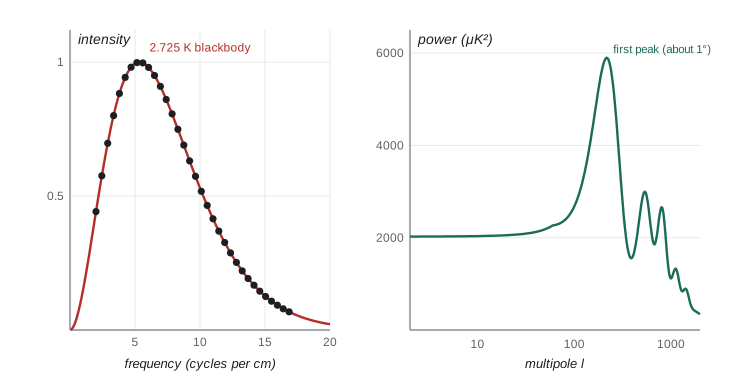
The background is not perfectly uniform. After the 3.35 mK dipole caused by our own motion at 370 km/s relative to it is removed, the remaining variations are about 18 microkelvins, one part in 100,000. COBE's DMR instrument detected them in 1992; George Smoot and John Mather shared the 2006 Nobel Prize for COBE. These variations are the imprint of tiny density fluctuations in the early universe, the seeds from which gravity later built galaxies and clusters.
The pattern of the variations carries remarkable information. Before recombination, photons and baryons formed a single fluid with pressure, from the photons, and inertia, from both. In regions that were slightly overdense, gravity compressed the fluid and pressure pushed back, setting up sound waves, acoustic oscillations, with a sound speed near \(c/\sqrt{3}\). At recombination the oscillations froze, and the sky shows the snapshot. Regions that had just completed half an oscillation, maximally compressed, form the first peak in the angular power spectrum. The sound horizon at that time, the distance sound could travel in 380,000 years, about 150 Mpc in comoving units, subtends about one degree on the sky. That angle measures the geometry of space: in a positively curved universe it would look larger, in a negatively curved one smaller. The observed angle shows that space is flat to within about half a part in a hundred.
The relative heights of the peaks measure the contents. Baryons add inertia that enhances the compressions relative to rarefactions, so the ratio of the first to the second peak measures \(\Omega_b h^2\), giving 0.0224 in agreement with nucleosynthesis. Dark matter, which feels gravity but not pressure, deepens the gravitational wells and sets the third peak. The fine detail of the spectrum, measured by WMAP from 2001 and by ESA's Planck satellite from 2009 to 2013, fits the six-parameter \(\Lambda\)CDM model with exquisite precision: baryon density, dark matter density, a parameter equivalent to \(\Omega_\Lambda\), the amplitude and slope of the primordial fluctuations, and the optical depth from later reionization. The same acoustic scale is seen in the clustering of galaxies, as baryon acoustic oscillations, a standard ruler that surveys such as DESI use to trace the expansion history.
Worked problem
How hot was the universe at last scattering, and how old?
Last scattering occurred at \(z = 1{,}090\). What was the temperature then, and roughly how old was the universe, given that in \(\Lambda\)CDM the matter era with \(a \propto t^{2/3}\) applies approximately?
Show solution
- \(T = 2.725 \times (1 + z) = 2.725 \times 1091 = 2{,}973\) K.
- In a matter-dominated flat universe \(t = \frac{2}{3}H^{-1}\) with \(H = H_0\sqrt{\Omega_m}(1 + z)^{3/2}\) at early times.
- \(H = 67.4\sqrt{0.315} \times 1091^{1.5} = 67.4 \times 0.561 \times 36{,}040 = 1.36 \times 10^6\) km/s/Mpc; \(1/H = 7.2 \times 10^5\) years.
- \(t \approx \tfrac{2}{3} \times 7.2 \times 10^5 = 4.8 \times 10^5\) years; including radiation, which was still about a quarter of the density, lowers this to about 3.8 \(\times 10^5\) years.
Answer: About 2,970 K, and roughly 380,000 years after the Big Bang.
Common mistakes
MistakeThinking recombination happened at the temperature corresponding to 13.6 eV.
InsteadThe huge photon-to-baryon ratio keeps hydrogen ionized until about 3,000 K, about 0.26 eV.
MistakeSaying the Big Bang made all the elements.
InsteadIt made hydrogen, helium and traces of deuterium, helium-3 and lithium; heavier elements come from stars.
MistakeBelieving the microwave background comes from a particular place in space.
InsteadIt fills all of space; we see the last scattering surface as a shell around us at redshift about 1,090.
MistakeTreating the CMB dipole as a primordial feature.
InsteadIt is a Doppler effect from our motion at about 370 km/s relative to the background.
Summary and key terms
- Temperature falls as \(1/a\); in the radiation era \(a \propto t^{1/2}\) and \(t \approx 2.4\text{ s}\,g_*^{-1/2}(1\text{ MeV}/k_BT)^2\).
- Neutron-proton conversion froze out near 0.8 MeV at one second with n/p about 1/5; decay lowered it to about 1/7 by the time deuterium survived.
- Almost all neutrons ended in helium: \(Y_p \approx 0.25\), observed 0.245; deuterium fixes \(\Omega_b h^2 \approx 0.022\).
- Recombination near 3,000 K at z about 1,090, delayed by the billion-to-one photon excess, released the microwave background.
- The CMB is a 2.725 K blackbody to 50 parts per million, with 18 µK fluctuations.
- Acoustic peaks show flat space and measure baryon and dark matter densities, in agreement with nucleosynthesis.
- Freeze-out
- The moment when a reaction becomes slower than the expansion and abundances stop changing.
- Deuterium bottleneck
- The delay in nucleosynthesis until photons can no longer break apart deuterium.
- Recombination
- The binding of electrons to nuclei that made the universe transparent.
- Last scattering surface
- The shell from which the microwave background photons last scattered, at z near 1,090.
- Acoustic peaks
- Maxima in the CMB angular power spectrum from sound waves in the early photon-baryon fluid.
- Baryon-to-photon ratio
- \(\eta \approx 6.1 \times 10^{-10}\), the number of baryons per photon.
Practice problems
Work each problem on paper first, then reveal the answer to check.
What was the temperature of the microwave background when the universe was one tenth of its present size?
Show answer
27.25 K.
Estimate the age of the universe when the temperature was 0.1 MeV (take g* = 3.36).
Show answer
\(2.4/\sqrt{3.36} \times 100 \approx 130\) s, about two minutes.
If n/p were 1/6 when nucleosynthesis began, what helium mass fraction would result?
Show answer
\(2(1/6)/(7/6) = 0.286\).
Why are there no elements heavier than lithium from the Big Bang in significant amounts?
Show answer
There are no stable nuclei of mass 5 or 8, and the universe cooled and thinned too quickly for three-body reactions like the triple-alpha process.
The first acoustic peak subtends about one degree. What would a smaller observed angle imply about spatial curvature?
Show answer
Negative (open) curvature: geodesics diverge, making the same physical size subtend a smaller angle.
Lesson quiz · 5 questions
Score 60% or more to complete this lesson.
Create a free account to save your progress, take quizzes and earn a certificate.