
PHYS-450 · Lesson 3 of 12 · 23 min
The equivalence principle and gravitational time dilation
The road to general relativity begins with a single observation that every child can make: things fall. A hammer and a feather dropped together on the Moon by the Apollo 15 astronaut David Scott in 1971 hit the ground at the same instant. Every object, whatever its mass, composition or internal energy, falls with the same acceleration in the same gravitational field. Einstein turned this observation into a principle, and the principle into a set of predictions that can be derived without any of the mathematics of curved spacetime: clocks run slow in gravitational wells, light is redshifted climbing out of them, and light bends as it passes massive bodies. This lesson develops these predictions and the experiments that confirmed them.
The weak equivalence principle
The weak equivalence principle states that the trajectory of a freely falling test body depends only on its initial position and velocity, not on its mass or what it is made of. In Newtonian language it is the statement that inertial mass equals gravitational mass, \(m_I = m_G\), so that the mass cancels in \(m_I \vec{a} = m_G \vec{g}\). Tests of this principle are among the most precise experiments in physics. They are usually quoted as the Eötvös parameter
the fractional difference in the free-fall accelerations of two bodies. Eötvös reached \(\eta \sim 10^{-9}\) around 1908 using a torsion balance that compared the pull of the Earth on different materials with the centrifugal effect of its rotation. The Eöt-Wash group at the University of Washington pushed torsion-balance tests below \(10^{-13}\) in the 2000s, and the French MICROSCOPE satellite, comparing titanium and platinum alloy cylinders in orbit from 2016 to 2018, found \(\eta\) consistent with zero at the level of about \(10^{-15}\). Lunar laser ranging, which bounces laser pulses off reflectors left by Apollo astronauts, tests a stronger version: the Earth and Moon fall toward the Sun with the same acceleration even though the Earth's gravitational binding energy is a larger fraction of its mass. Gravity couples to all forms of energy alike, including gravitational energy itself.
Einstein's elevator
Einstein's thought experiment makes the principle vivid. Imagine a windowless laboratory. In the first case it sits at rest on the surface of the Earth. Dropped objects fall at 9.8 m/s², and a person stands with their usual weight on the floor. In the second case the laboratory is in deep space, far from any mass, but a rocket accelerates it at 9.8 m/s². Released objects stay where they are in an inertial frame while the floor rushes up to meet them, so to the occupants they appear to fall at 9.8 m/s². The occupants feel pressed to the floor with their usual weight. No mechanical experiment inside the closed laboratory can tell the two situations apart.
In the third case the laboratory falls freely toward the Earth, or orbits it, as the International Space Station does. Everything inside floats; released objects stay put, and astronauts feel no weight. In the fourth case the laboratory drifts in deep space with no rocket. Everything floats there too. Again the two situations are indistinguishable from inside. A freely falling laboratory is, locally, an inertial frame in which special relativity holds.
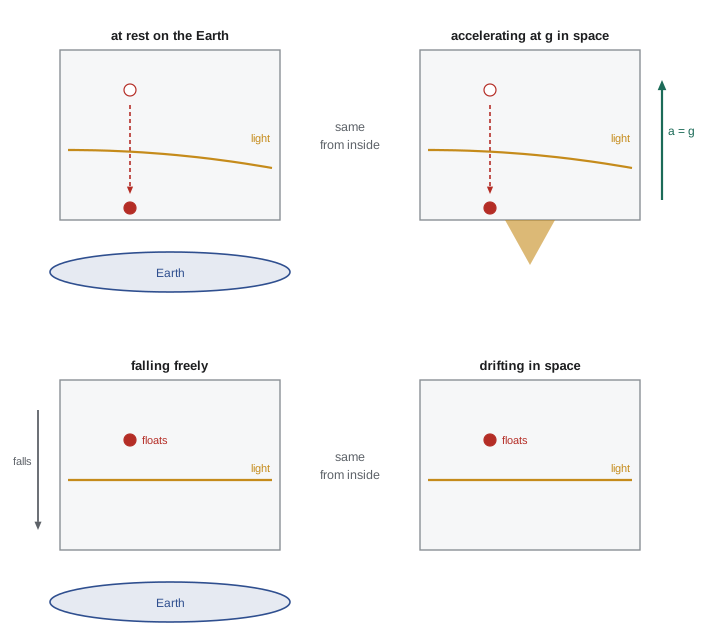
Einstein's equivalence principle extends this to all of physics, not just mechanics: in a small enough freely falling laboratory, all the laws of physics, including electromagnetism and quantum mechanics, take their special-relativistic form. The words small enough matter. A real gravitational field is not uniform. In a large freely falling laboratory above the Earth, two balls released at opposite ends fall toward the Earth's middle along lines that converge, and they slowly drift together; two balls released one above the other drift apart, because the lower one is pulled slightly harder. These tidal effects cannot be removed by any choice of frame. They are the real gravitational field, and in general relativity they are the curvature of spacetime. The equivalence principle holds only to the extent that tidal effects can be neglected over the region and time of the experiment.
Light bends
Consider a light pulse crossing the accelerating laboratory horizontally. In an inertial frame the light travels in a straight line, but the laboratory accelerates upward while it crosses, so relative to the walls the light follows a slightly curved path that bends toward the floor. By the equivalence principle, light crossing a laboratory at rest on the Earth must bend downward in the same way. For a laboratory 10 m wide the drop is minute: the light takes \(t = 3.3 \times 10^{-8}\) s to cross, and it falls \(\frac{1}{2} g t^2 \approx 5 \times 10^{-15}\) m, a hundredth of the size of an atomic nucleus. But near the Sun, over the much longer path of a ray grazing its limb, the bending becomes measurable. This argument, applied naively, gives exactly the Newtonian prediction of 0.87 arcseconds that Einstein made in 1911. The full theory gives twice as much, because space as well as time is curved; lesson 7 derives the factor of two.
Clocks run slow in gravitational wells
The most important consequence of the equivalence principle is gravitational time dilation. Put a light source at the floor of the accelerating laboratory and a detector at the ceiling, a height \(h\) above. A pulse emitted from the floor takes time \(t \approx h/c\) to reach the ceiling. During that time the ceiling has gained speed \(\Delta v = g t = g h/c\) away from the source, so the detector sees the light Doppler shifted to a lower frequency:
By the equivalence principle, the same redshift must occur in a laboratory at rest on the Earth: light climbing out of a gravitational field loses frequency. Light sent downward gains frequency, a blueshift. Now think of the light source as a clock, each wave crest a tick. If the observer at the ceiling receives fewer crests per second than the floor emits, and no crests are lost on the way, then from the ceiling's point of view the floor clock runs slow. Clocks lower in a gravitational field run slower than clocks higher up, by the fraction \(g h/c^2\). For larger height differences the general result, valid in any static weak field with Newtonian potential \(\Phi\), is
where \(t\) is the time of a reference clock far away where \(\Phi = 0\) and \(\Phi = -GM/r\) is negative near a mass. A clock at the surface of the Sun runs slow by about two parts in a million; on the surface of a neutron star by about twenty parts in a hundred. This is not an effect on clocks as machines but on time itself. Every physical process, from atomic oscillations to a human heartbeat, runs at the local proper time.
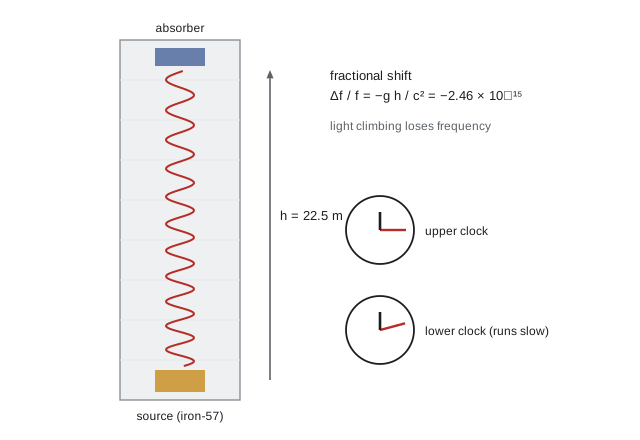
In 1959 Robert Pound and Glen Rebka measured this redshift directly in the Jefferson Physical Laboratory tower at Harvard, using gamma rays from iron-57 travelling 22.5 m. The predicted shift, \(g h/c^2 = 2.46 \times 10^{-15}\), is absurdly small, but the newly discovered Mössbauer effect made the emission and absorption lines of iron-57 nuclei in a crystal sharp enough to detect it. They compensated the shift by moving the source slowly with a loudspeaker cone and found the predicted value within about ten parts in a hundred; by 1964 Pound and Joseph Snider had reached one part in a hundred. In 1976 the Gravity Probe A rocket carried a hydrogen maser clock to 10,000 km altitude and confirmed the effect to about seven parts in a hundred thousand.
GPS: both effects at once
Satellite navigation is the everyday test. A GPS satellite orbits at radius \(r = 26{,}560\) km, about 20,200 km above the surface. Two effects change its clock rate relative to a clock on the ground. Gravitational time dilation makes it run fast because it sits higher in the Earth's potential; special-relativistic time dilation makes it run slow because it moves at about 3.9 km/s. The ground clock also moves, with the Earth's rotation, but at only 0.46 km/s at the equator. Adding the fractional rate differences:
import math
G, c = 6.674e-11, 2.998e8
GM = 3.986004e14          # Earth's GM (m^3/s^2)
R_e = 6.371e6             # mean radius (m)
r_gps = 2.656e7           # GPS orbital radius (m)
day = 86400.0
v_sat = math.sqrt(GM / r_gps)              # circular orbital speed
v_gnd = 2 * math.pi * R_e / 86164.1        # equator, sidereal day
grav = GM / c**2 * (1 / R_e - 1 / r_gps)   # fractional rate gain from height
kin = (v_sat**2 - v_gnd**2) / (2 * c**2)   # fractional rate loss from speed
print(f"orbital speed {v_sat/1e3:.3f} km/s, ground speed {v_gnd:.0f} m/s")
print(f"gravitational: +{grav*day*1e6:.2f} microseconds per day")
print(f"velocity:      -{kin*day*1e6:.2f} microseconds per day")
net = grav - kin
print(f"net:           +{net*day*1e6:.2f} microseconds per day  (fraction {net:.3e})")
print(f"range error if ignored for a day: {net*day*c/1e3:.1f} km")
# Pound-Rebka and a 33 cm clock comparison
g = 9.81
for h, label in ((22.5, "Harvard tower 22.5 m"), (0.33, "optical clocks 0.33 m")):
print(f"{label}: g h / c^2 = {g*h/c**2:.3e}")orbital speed 3.874 km/s, ground speed 465 m/s gravitational: +45.72 microseconds per day velocity: -7.11 microseconds per day net: +38.61 microseconds per day (fraction 4.468e-10) range error if ignored for a day: 11.6 km Harvard tower 22.5 m: g h / c^2 = 2.456e-15 optical clocks 0.33 m: g h / c^2 = 3.602e-17
The gravitational term, about 45.7 microseconds per day, dominates the velocity term of about 7.1 microseconds per day. The net 38.6 microseconds per day is a fractional rate of \(4.47 \times 10^{-10}\). The satellites' atomic clocks are therefore set before launch to tick at 10.22999999543 MHz instead of 10.23 MHz, so that they run at the right rate once in orbit. Small residual effects from the slight eccentricity of each orbit are corrected in the receiver. Without these corrections, positions would drift by kilometres per day. MATH-430's capstone obtained essentially the same number, quoted there as 38.5 microseconds with slightly different reference values, from the curvature of the Schwarzschild geometry; here it came from two pieces of physics that Einstein had in hand by 1907.
Accelerated observers and horizons
The equivalence principle connects gravity to acceleration so closely that the accelerated observers of lesson 2 can be read as observers in a gravitational field. A family of observers in flat spacetime, each with a constant proper acceleration chosen so that their separations stay fixed, forms a rigid laboratory, but observers lower in the laboratory must accelerate harder than those higher up: the proper acceleration of an observer at distance \(X\) from the common horizon is \(c^2/X\). These Rindler observers see clocks below them running slow and clocks above running fast, exactly as in a gravitational field. And they all share a horizon at \(X = 0\): light sent from beyond it never reaches them. The horizon of a black hole, seen by observers hovering just outside it, looks locally like this Rindler horizon. The analogy is the starting point for Unruh's 1976 discovery that accelerated observers see a thermal glow, and for Hawking's discovery that black holes radiate, both of which appear in lesson 8.
How far can the equivalence principle take us?
Remarkably far. Gravitational time dilation, gravitational redshift, the bending of light at the Newtonian value and the local equivalence of gravity and acceleration all follow without field equations. The principle also tells us what kind of theory gravity must be. Because every body falls alike, there is a family of preferred worldlines, the free-fall worldlines, that is the same for all matter; it is natural to identify them with geodesics of the spacetime geometry. Because free fall is locally inertial, the geometry must look locally like Minkowski spacetime: at every point there are coordinates in which the metric is \(\eta_{\mu\nu}\) and its first derivatives vanish. And because tidal effects cannot be removed, the geometry must be curved. What the equivalence principle cannot tell us is how matter determines the curvature. That requires the Einstein field equation of lesson 5.
The time dilation formula also hints at how geometry encodes Newtonian gravity. Write the proper time of a slowly moving clock in a weak static field as \(d\tau^2 \approx (1 + 2\Phi/c^2)\,dt^2 - dx^2/c^2\). Lesson 4 will show that the path of greatest proper time through such a spacetime satisfies \(\ddot{\vec{x}} = -\nabla \Phi\), Newton's law of gravity. A falling apple maximizes its proper time by lingering where time runs fast, higher up, and then dropping quickly through the region where time runs slow. Newtonian gravity is, to an excellent approximation, the warping of time.
Worked problem
Clocks on a mountain
A clock is taken from sea level to an observatory at 4,200 m on Mauna Kea and left for one year. How much time does it gain relative to an identical clock at sea level? Ignore the rotation of the Earth.
Show solution
- Fractional rate difference: \(gh/c^2 = 9.81 \times 4200/(2.998 \times 10^8)^2 = 4.58 \times 10^{-13}\).
- One year is \(3.156 \times 10^7\) s.
- Gain: \(4.58 \times 10^{-13} \times 3.156 \times 10^7 = 1.45 \times 10^{-5}\) s.
Answer: About 14 microseconds per year, easily measured with modern atomic clocks; in 1971 Hafele and Keating saw effects of this size by flying caesium clocks around the world.
Common mistakes
MistakeThinking gravitational time dilation is caused by the clocks being squeezed or affected mechanically.
InsteadEvery process, atomic or biological, runs at the local proper time; it is time itself that runs at different rates.
MistakeSaying the equivalence principle holds everywhere in a gravitational field.
InsteadIt holds only locally: over larger regions, tidal effects reveal real curvature that no choice of frame removes.
MistakeGetting the sign of the GPS correction backwards.
InsteadThe higher satellite clock runs fast by gravity (about +45.7 µs/day) and slow by speed (about −7.1 µs/day), for a net gain of about +38.6 µs/day.
MistakeAssuming the equivalence-principle bending of light is the full answer.
InsteadIt gives 0.87″ at the Sun's limb; the curvature of space doubles this to 1.75″.
Summary and key terms
- All bodies fall alike; the Eötvös parameter \(\eta\) is now constrained below about \(10^{-15}\).
- In a small freely falling laboratory the laws of physics are those of special relativity; a uniform field is locally indistinguishable from acceleration.
- Tidal effects, the relative acceleration of nearby free bodies, cannot be removed and are the signature of curvature.
- Light climbing a height \(h\) is redshifted by \(\Delta f/f = -gh/c^2\); clocks lower in a potential run slow by \(\Phi/c^2\).
- Pound and Rebka measured the redshift over 22.5 m in 1959; Gravity Probe A confirmed it in 1976.
- GPS clocks gain about 45.7 µs/day from height and lose about 7.1 µs/day from speed, a net +38.6 µs/day.
- Weak equivalence principle
- Free-fall trajectories are independent of a body's mass and composition.
- Einstein equivalence principle
- In a local freely falling frame, all non-gravitational physics obeys special relativity.
- Tidal acceleration
- Relative acceleration of nearby freely falling bodies; the physical content of curvature.
- Gravitational redshift
- The decrease in frequency of light climbing out of a gravitational potential well.
- Mössbauer effect
- Recoil-free emission and absorption of gamma rays by nuclei in a crystal, giving extremely sharp lines.
Practice problems
Work each problem on paper first, then reveal the answer to check.
By what fraction is light from the surface of the Sun redshifted when it reaches a distant observer?
Show answer
\(GM_\odot/(R_\odot c^2) = 1.477 \text{ km}/696{,}000 \text{ km} = 2.1 \times 10^{-6}\).
A clock on the top floor of a 300 m building is compared with one on the ground floor for a day. Which runs fast, and by how much?
Show answer
The top clock, by \(9.81 \times 300/c^2 \times 86{,}400 \approx 2.8\) ns per day.
Why does the International Space Station not feel gravity even though gravity there is about nine tenths as strong as on the ground?
Show answer
It is in free fall; a freely falling frame is locally inertial, so everything inside floats.
In a freely falling elevator 100 m tall, a ball at the top and one at the bottom start at rest relative to each other. What do they do?
Show answer
They drift apart slowly, because the lower one is pulled slightly harder; this is a tidal effect.
Light from a white dwarf of 0.6 solar masses and radius 8,700 km is redshifted by what fraction? Express it as an equivalent Doppler speed.
Show answer
\(GM/Rc^2 = 0.6 \times 1.477/8700 = 1.0 \times 10^{-4}\), equivalent to about 31 km/s.
Lesson quiz · 5 questions
Score 60% or more to complete this lesson.
Create a free account to save your progress, take quizzes and earn a certificate.