
PHYS-373 · Lesson 4 of 12 · 21 min
Identical particles: bosons, fermions and the Pauli exclusion principle
Classical physics allows us, at least in principle, to follow every particle along its trajectory. Two billiard balls may look the same, but we can always say which is which by watching them. Quantum mechanics removes that possibility. Particles do not have trajectories, only wave functions that spread and overlap, and two electrons are identical in a stronger sense than any two manufactured objects: they have exactly the same mass, charge and spin, and no measurement can ever distinguish one from the other. This lesson shows that taking indistinguishability seriously leads to one of the most consequential rules in physics. Every particle is either a boson, whose many-particle wave functions are symmetric under exchange, or a fermion, whose wave functions are antisymmetric. Fermions obey the Pauli exclusion principle, and from it follow the structure of atoms, the rigidity of solids and the existence of chemistry.
Two-particle wave functions
For two particles, the wave function depends on both sets of coordinates, \(\psi(\mathbf r_1, \mathbf r_2)\), and \(|\psi(\mathbf r_1, \mathbf r_2)|^2\,d^3r_1\,d^3r_2\) is the probability of finding particle 1 in \(d^3r_1\) and particle 2 in \(d^3r_2\) at the same time. If the particles do not interact and one is in state \(\psi_a\) and the other in \(\psi_b\), the natural guess is the product
This is correct for distinguishable particles, such as an electron and a proton. For identical particles it makes a claim we cannot back up: that particle 1 is the one in state \(a\). Since nothing distinguishes particle 1 from particle 2, the probability density must be unchanged when we swap the labels: \(|\psi(\mathbf r_1, \mathbf r_2)|^2 = |\psi(\mathbf r_2, \mathbf r_1)|^2\). Define the exchange operator \(P\) by \(P\psi(\mathbf r_1, \mathbf r_2) = \psi(\mathbf r_2, \mathbf r_1)\). Because the Hamiltonian of identical particles is symmetric in their labels, \(P\) commutes with \(H\), and stationary states can be chosen as eigenstates of \(P\). Since \(P^2 = 1\), its eigenvalues are \(\pm1\). Experiment shows that nature uses each possibility, but never mixes them for a given kind of particle:
Particles whose states are symmetric, with the plus sign, are bosons; those with the minus sign are fermions. The symmetrization postulate says that every state of identical bosons is symmetric under exchange of any pair and every state of identical fermions is antisymmetric, and that these properties are preserved by time evolution.
The spin–statistics connection
Which particles are which? The rule is simple and universal: particles with integer spin are bosons, and particles with half-integer spin are fermions. Electrons, protons, neutrons, quarks and neutrinos, all with spin one-half, are fermions; photons (spin 1), gluons, the W and Z, the Higgs boson (spin 0) and pions are bosons. Composite particles follow the same rule according to their total spin: a helium-4 atom, with two protons, two neutrons and two electrons, has integer spin and is a boson, while helium-3, with one neutron fewer, is a fermion. The difference makes liquid helium-4 a superfluid below 2.17 K, while helium-3 needs to be cooled about a thousand times further, below a few millikelvin, before its atoms pair up and it too becomes superfluid.
In nonrelativistic quantum mechanics the connection between spin and statistics is simply a postulate. Its explanation lies in relativistic quantum field theory, where Markus Fierz (1939) and Wolfgang Pauli (1940) showed that quantizing half-integer-spin fields with the boson rule, or integer-spin fields with the fermion rule, would violate causality or make the energy unbounded below. The sign change of a spinor under a rotation by \(2\pi\), seen in lesson 2, is a hint: exchanging two particles is topologically related to rotating one of them by a full turn.
The Pauli exclusion principle
Suppose two fermions are in the same state, \(\psi_a = \psi_b\). Then the antisymmetric combination is
There is no such state. Two identical fermions cannot occupy the same single-particle state. This is the Pauli exclusion principle, which Pauli proposed in 1925 to explain the shell structure of atoms, before the symmetrization rule was understood. Here a single-particle state includes spin: two electrons can share the same spatial orbital if one is spin up and the other spin down. More generally, for \(N\) fermions in single-particle states \(\psi_1, \dots, \psi_N\), the antisymmetric wave function is the Slater determinant, introduced by John Slater in 1929:
where each argument stands for the position and spin of one particle. Exchanging two particles exchanges two rows and flips the sign of the determinant; putting two particles in the same state makes two columns equal and the determinant zero. Bosons have no such restriction. Any number of them may share a state, and in fact the symmetric combination makes multiple occupation more likely than for distinguishable particles, which is the root of stimulated emission in lasers and of Bose–Einstein condensation.
Spin and space together
For electrons the total wave function, space times spin, must be antisymmetric. With two electrons, lesson 3 showed that the spin states split into a symmetric triplet and an antisymmetric singlet. So there are two ways to make the total antisymmetric:
A symmetric spatial wave function goes with the antisymmetric spin singlet, and an antisymmetric spatial wave function with the symmetric triplet. This pairing has dramatic consequences even when the Hamiltonian contains no spin at all. Because the spatial wave functions differ, so do the electrostatic repulsion energies, and the energy of a two-electron state depends on the total spin. Lesson 5 shows how this splits helium into two families of levels.
The exchange force
Symmetrization changes where identical particles are likely to be found relative to each other. Take two particles that do not interact at all, in single-particle states \(a\) and \(b\) in one dimension, and compute the expected squared separation \(\langle(x_1 - x_2)^2\rangle\). Expanding the square and using the orthonormality of \(\psi_a\) and \(\psi_b\) gives
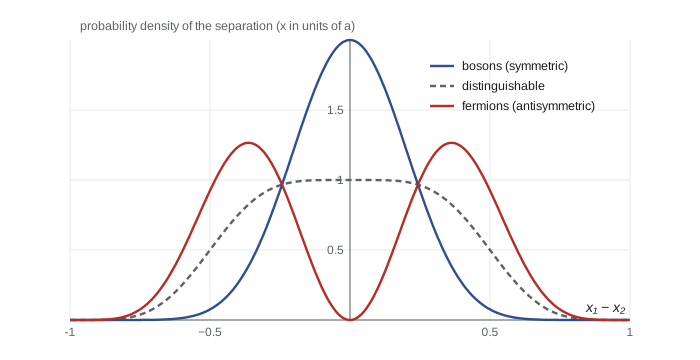
The first three terms are what distinguishable particles would give. The last term, present only when the two wave functions overlap, brings symmetric pairs closer together and pushes antisymmetric pairs apart. It acts as though there were a force of attraction between identical bosons and of repulsion between identical fermions (in the same spin state), although no force appears in the Hamiltonian. This apparent interaction is called the exchange force. It is a purely geometric consequence of the symmetry requirement. The program below checks the formula by direct numerical integration for two particles in an infinite well, one in the ground state and one in the first excited state.
import math
a = 1.0
def psi(n, x): return math.sqrt(2 / a) * math.sin(n * math.pi * x / a)

N = 400
h = a / N
xs = [(i + 0.5) * h for i in range(N)]

def moments(kind, n=1, m=2):
    """<(x1 - x2)^2> and the probability that both are in the left half, for two particles in states n and m."""
    norm = sep2 = left = 0.0
    for x1 in xs:
        for x2 in xs:
            d = psi(n, x1) * psi(m, x2); e = psi(m, x1) * psi(n, x2)
            if kind == 'distinguishable': p = d * d
            elif kind == 'boson': p = 0.5 * (d + e) ** 2
            else: p = 0.5 * (d - e) ** 2
            norm += p; sep2 += p * (x1 - x2) ** 2
            if x1 < a / 2 and x2 < a / 2: left += p
    return norm * h * h, sep2 / norm, left / norm

print("Two particles in an infinite well (width a = 1), one in n = 1 and one in n = 2")
for kind in ('distinguishable', 'boson', 'fermion'):
    nrm, s2, left = moments(kind)
    print(f"  {kind:15s} norm {nrm:.4f}   rms separation {math.sqrt(s2):.4f} a   P(both in left half) {left:.4f}")

# exact formulas: <(x1-x2)^2> = <x^2>_n + <x^2>_m - 2<x>_n<x>_m -/+ 2|<x>_nm|^2
xnm = -8 * a * 1 * 2 / (math.pi ** 2 * (1 - 4) ** 2)         # <1|x|2> for the infinite well
x2n = lambda n: a * a * (1 / 3 - 1 / (2 * n * n * math.pi ** 2))
base = x2n(1) + x2n(2) - 2 * (a / 2) ** 2
print(f"  exact rms: distinguishable {math.sqrt(base):.4f}, boson {math.sqrt(base - 2 * xnm ** 2):.4f}, fermion {math.sqrt(base + 2 * xnm ** 2):.4f}")
print()
# two fermions in the same state: the antisymmetric combination vanishes everywhere
worst = max(abs(psi(1, x1) * psi(1, x2) - psi(1, x2) * psi(1, x1)) for x1 in xs[::40] for x2 in xs[::40])
print(f"antisymmetric wave function with both fermions in n = 1: largest value {worst:.1e}")Two particles in an infinite well (width a = 1), one in n = 1 and one in n = 2 distinguishable norm 1.0000 rms separation 0.3215 a P(both in left half) 0.2500 boson norm 1.0000 rms separation 0.1961 a P(both in left half) 0.4301 fermion norm 1.0000 rms separation 0.4102 a P(both in left half) 0.0699 exact rms: distinguishable 0.3215, boson 0.1961, fermion 0.4102 antisymmetric wave function with both fermions in n = 1: largest value 0.0e+00
The root mean square separation is \(0.32a\) for distinguishable particles, \(0.20a\) for bosons and \(0.41a\) for fermions, in agreement with the exact formula. Bosons are found together in the left half of the well 43 times in 100, compared with 25 for independent particles; fermions only 7 times in 100. And the antisymmetric wave function with both fermions in the ground state is identically zero, the exclusion principle in numerical form.
Why matter is stable and solid
The exclusion principle explains why matter takes up space. An atom's electrons cannot all crowd into the lowest orbital; each additional pair must go into a higher, larger orbital, so atoms have sizes of order an ångström whatever their atomic number. When two atoms are pushed together, their electron clouds overlap and the exclusion principle forces electrons into higher-energy states, producing the strong short-range repulsion that keeps solids from collapsing. Freeman Dyson and Andrew Lenard proved in 1967 that ordinary matter would collapse without it: the total energy of a collection of charged particles with bosonic electrons would decrease faster than in proportion to their number. With fermionic electrons the energy is proportional to the number of particles, which is what lets bulk matter exist with a stable density. In white dwarf stars the same principle supports a whole star against gravity; Subrahmanyan Chandrasekhar showed in 1931 that this support fails above about 1.4 solar masses.
Bosons together
For bosons the effect runs the other way. When \(N\) bosons are already in a state, the probability of adding one more to that state is enhanced by a factor \(N + 1\) compared with what distinguishable particles would give. For photons this is stimulated emission, the principle of the laser, predicted by Einstein in 1917. For massive bosons cooled until their de Broglie wavelength exceeds their spacing, a macroscopic fraction collapses into the single lowest state. Satyendra Nath Bose worked out the statistics of photons in 1924 and Einstein extended it to atoms, predicting the condensate that Eric Cornell, Carl Wieman and Wolfgang Ketterle first produced in 1995, sharing the Nobel Prize in 2001. Photon bunching was seen directly by Robert Hanbury Brown and Richard Twiss in 1956, and the corresponding antibunching of fermions was later observed with electrons and with neutral helium-3 atoms.
Worked problem
Three electrons in a one-dimensional box
Three noninteracting electrons are placed in an infinite well of width \(a\). What is the ground-state energy, in units of \(E_1 = \pi^2\hbar^2/2ma^2\), and how would it differ for three spinless bosons?
Show solution
- Each spatial level \(n\) holds two electrons, one with each spin.
- The lowest arrangement puts two electrons in \(n = 1\) and one in \(n = 2\): \(E = 2E_1 + 4E_1 = 6E_1\).
- For bosons there is no restriction, and all three occupy \(n = 1\): \(E = 3E_1\).
- For three spinless fermions each would need its own level: \(E = (1 + 4 + 9)E_1 = 14E_1\).
Answer: \(6E_1\) for electrons, \(3E_1\) for spinless bosons and \(14E_1\) for spinless fermions. Spin lets two electrons share each orbital, which is why chemistry works with pairs of electrons.
Common mistakes
MistakeWriting a product wave function for identical particles.
InsteadIt must be symmetrized for bosons or antisymmetrized for fermions.
MistakeThinking the exclusion principle forbids two electrons in the same orbital.
InsteadIt forbids the same complete state; one spin up and one spin down can share an orbital.
MistakeTreating the exchange force as an extra term in the Hamiltonian.
InsteadIt is an effect of the symmetry of the wave function, not a potential.
MistakeAssuming any atom with an even number of particles is a fermion or boson at random.
InsteadTotal spin decides: an even number of spin one-half constituents gives integer spin and a boson.
MistakeRequiring the spatial wave function of two electrons to be antisymmetric.
InsteadOnly the total, space times spin, must be antisymmetric; the singlet allows a symmetric spatial part.
Summary and key terms
- Identical particles are indistinguishable in principle, so their wave functions must be symmetric or antisymmetric under exchange.
- Integer-spin particles are bosons with symmetric states; half-integer-spin particles are fermions with antisymmetric states.
- Antisymmetry gives the Pauli exclusion principle and the Slater determinant for \(N\) fermions.
- For two electrons, symmetric spatial states pair with the spin singlet and antisymmetric spatial states with the triplet.
- The exchange force pulls identical bosons together and pushes identical fermions apart; it underlies lasers, condensates and the stability of matter.
- Boson
- A particle of integer spin, whose many-particle states are symmetric under exchange.
- Fermion
- A particle of half-integer spin, whose many-particle states are antisymmetric under exchange.
- Exchange operator
- The operator \(P\) that swaps the labels of two identical particles.
- Slater determinant
- The determinant of single-particle states that gives an antisymmetric \(N\)-fermion wave function.
- Exchange force
- The apparent attraction or repulsion produced by symmetrization alone.
Practice problems
Work each problem on paper first, then reveal the answer to check.
Is a deuterium atom (one proton, one neutron, one electron) a boson or a fermion?
Show answer
Three spin one-half constituents give half-integer total spin: a fermion.
Two noninteracting identical spinless bosons are in an infinite well. What is the ground-state wave function?
Show answer
\(\psi_1(x_1)\psi_1(x_2)\), which is already symmetric.
Show that the Slater determinant for two particles reproduces \(\psi_{-}\).
Show answer
\(\tfrac{1}{\sqrt2}[\psi_a(1)\psi_b(2) - \psi_b(1)\psi_a(2)]\).
For two electrons in the same spatial orbital, what must the spin state be?
Show answer
The singlet, since the spatial part is symmetric.
Using the program's results, by what factor does the probability of both particles being in the left half change from fermions to bosons?
Show answer
From 0.070 to 0.430, a factor of about 6.
Lesson quiz · 5 questions
Score 60% or more to complete this lesson.
Create a free account to save your progress, take quizzes and earn a certificate.