
PHYS-373 · Lesson 2 of 12 · 23 min
Spin one-half: Pauli matrices, Stern–Gerlach and spinors
PHYS-372 derived the spectrum of angular momentum from nothing but the commutation relations \([L_x, L_y] = i\hbar L_z\) and their cyclic permutations. The ladder-operator argument showed that the eigenvalues of \(L^2\) are \(\hbar^2 \ell(\ell+1)\) and those of \(L_z\) are \(m\hbar\), with \(m\) running from \(-\ell\) to \(\ell\) in integer steps, and that \(\ell\) must be either an integer or a half-integer. For orbital angular momentum, the requirement that the wave function \(e^{im\phi}\) be single-valued under a full turn of \(\phi\) ruled out the half-integers. This lesson takes up the solutions that were set aside. Nature uses them: the electron, proton, neutron and every quark carry an intrinsic angular momentum with quantum number \(s = \tfrac12\). This spin is not the rotation of anything; it is a property of the particle as basic as its charge or mass.
The discovery of spin
Spin was found before it was understood. The Stern–Gerlach experiment of 1922 split a beam of silver atoms into two, a result that orbital angular momentum, with its odd number \(2\ell + 1\) of \(m\) values, could not explain. Spectroscopists had meanwhile found that many lines, including the yellow sodium D line, are doublets, and that atoms in magnetic fields often split into even numbers of components, the anomalous Zeeman effect. In 1925 Samuel Goudsmit and George Uhlenbeck, two young physicists in Leiden, proposed that the electron has an intrinsic angular momentum of \(\hbar/2\) and an associated magnetic moment. Wolfgang Pauli, who had just introduced a fourth quantum number to explain the periodic table, was at first critical but in 1927 gave spin its modern mathematical form with the matrices that bear his name. In 1928 Paul Dirac's relativistic equation for the electron produced spin automatically, together with the correct magnetic moment, which made spin a consequence of combining quantum mechanics with special relativity.
Spin states and spinors
For spin one-half, \(s = \tfrac12\) and \(m_s = \pm\tfrac12\), so there are exactly two basis states: spin up, \(|{\uparrow}\rangle = |\tfrac12, \tfrac12\rangle\), and spin down, \(|{\downarrow}\rangle = |\tfrac12, -\tfrac12\rangle\). Every spin state is a superposition of these. It is convenient to write the state as a two-component column vector called a spinor:
The spin operators are then 2 by 2 matrices. The matrix for \(S_z\) is diagonal with entries \(\pm\hbar/2\), because the basis states are its eigenvectors. The matrices for \(S_x\) and \(S_y\) follow from the ladder operators \(S_\pm = S_x \pm iS_y\), using the general result \(S_+|s, m\rangle = \hbar\sqrt{s(s+1) - m(m+1)}\,|s, m+1\rangle\). For \(s = \tfrac12\), \(S_+\chi_- = \hbar\chi_+\) and \(S_+\chi_+ = 0\), so \(S_+\) has a single entry \(\hbar\) in the upper right corner and \(S_-\) its transpose. Adding and subtracting gives all three components as \(\mathbf S = (\hbar/2)\boldsymbol\sigma\), with the Pauli matrices
The Pauli matrices have a compact algebra that makes spin calculations quick. Each squares to the identity, \(\sigma_x^2 = \sigma_y^2 = \sigma_z^2 = 1\); different ones anticommute, \(\sigma_x\sigma_z + \sigma_z\sigma_x = 0\); and their product follows the cyclic rule \(\sigma_x\sigma_y = i\sigma_z\). All of this is summarized in one identity:
Multiplying the commutator by \((\hbar/2)^2\) gives \([S_x, S_y] = i\hbar S_z\), so the spin matrices satisfy exactly the angular momentum algebra, as they must. And \(S^2 = (\hbar^2/4)(\sigma_x^2 + \sigma_y^2 + \sigma_z^2) = \tfrac34\hbar^2\), which is \(\hbar^2 s(s+1)\) with \(s = \tfrac12\). Every spin one-half state has the same total spin; only its orientation varies. A useful consequence of the identity is that for any vectors \(\mathbf a\) and \(\mathbf b\), \((\boldsymbol\sigma\cdot\mathbf a)(\boldsymbol\sigma\cdot\mathbf b) = \mathbf a\cdot\mathbf b + i\boldsymbol\sigma\cdot(\mathbf a \times \mathbf b)\). In particular \((\boldsymbol\sigma\cdot\hat{\mathbf n})^2 = 1\) for a unit vector, so the spin component along any direction has eigenvalues \(\pm\hbar/2\), exactly as Stern and Gerlach found.
Spin along an arbitrary direction
The component of spin along a unit vector \(\hat{\mathbf n} = (\sin\theta\cos\phi, \sin\theta\sin\phi, \cos\theta)\) is \(S_n = (\hbar/2)\,\boldsymbol\sigma\cdot\hat{\mathbf n}\). Solving the 2 by 2 eigenvalue problem gives the eigenvector with eigenvalue \(+\hbar/2\):
This formula contains the whole geometry of spin one-half. Every normalized spinor, up to an overall phase that has no physical meaning, can be written in this form for some \(\theta\) and \(\phi\). In other words, every spin state is spin up along some direction. The pair of angles places the state on the surface of a sphere, the Bloch sphere, with spin up along \(z\) at the north pole, spin down at the south pole, and the \(x\) and \(y\) eigenstates around the equator. The expectation value of the spin vector points along \(\hat{\mathbf n}\) with length \(\hbar/2\).
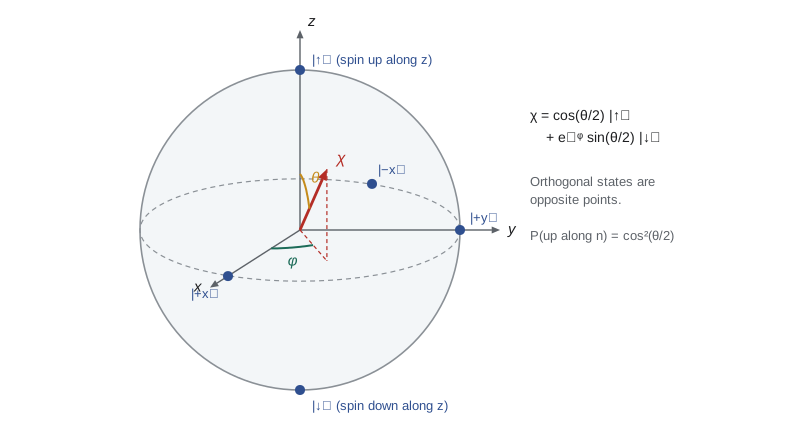
The picture has a striking feature: states that are orthogonal in the vector space, such as up and down, are opposite points on the sphere, 180 degrees apart rather than 90. The half-angles \(\theta/2\) in the spinor are the reason. They also give the probability rule for sequential Stern–Gerlach measurements. If an atom is spin up along \(z\) and we measure along a direction at angle \(\theta\), the probability of finding it up along the new direction is \(|\langle\chi_+^{(n)}|\chi_+\rangle|^2 = \cos^2(\theta/2)\). At \(\theta = 90\) degrees this is one half, as in the three-magnet experiment of PHYS-372; at \(\theta = 60\) degrees it is three quarters.
Magnetic moment and the Larmor precession
A spinning charged particle has a magnetic moment proportional to its spin, \(\boldsymbol\mu = \gamma\mathbf S\), where \(\gamma\) is the gyromagnetic ratio. For the electron, \(\boldsymbol\mu = -g\,(e/2m_e)\,\mathbf S\) with \(g \approx 2.0023\); the negative sign means the moment points opposite to the spin. Dirac's equation predicts \(g = 2\) exactly, and the small excess, the anomalous magnetic moment first calculated by Julian Schwinger in 1948 as \(\alpha/2\pi\), is one of the great successes of quantum electrodynamics. In a magnetic field \(\mathbf B\) the energy is \(H = -\boldsymbol\mu\cdot\mathbf B\). For a field along \(z\) and an electron this is \(H = \omega S_z\) with \(\omega = g e B/2m_e\), the Larmor frequency.
The time evolution is easy because the energy eigenstates are \(\chi_\pm\) with energies \(\pm\hbar\omega/2\). A spin that starts pointing along \(+x\), the state \((\chi_+ + \chi_-)/\sqrt2\), evolves into
The expectation value of the spin precesses around the field at angular frequency \(\omega\), exactly like a classical gyroscope or a compass needle with angular momentum. This is a special case of Ehrenfest's theorem: for any spin in a uniform field, \(d\langle\mathbf S\rangle/dt = \gamma\langle\mathbf S\rangle\times\mathbf B\), the classical equation of motion for a magnetic moment. For an electron the Larmor frequency is 28.0 GHz per tesla; for a proton, whose moment is about 660 times smaller, it is 42.58 MHz per tesla, the frequency at which an MRI scanner listens. Lesson 12 develops this into the theory of magnetic resonance.
A rotation by 360 degrees
Spin one-half has a property with no classical counterpart. The operator that rotates a state by angle \(\varphi\) about the \(z\) axis is \(U = e^{-i\varphi S_z/\hbar}\), which for spin one-half is the diagonal matrix with entries \(e^{\mp i\varphi/2}\). For \(\varphi = 2\pi\), a full turn, both entries equal \(-1\): the spinor changes sign. Only after a rotation by \(4\pi\) does it return to itself. Because an overall sign does not change any probability, a single spin rotated by 360 degrees is physically unchanged. But if a beam is split, one half rotated by 360 degrees and the halves recombined, the sign shows up as interference. Experiments with neutron interferometers in 1975, by Helmut Rauch's group in Vienna and Samuel Werner's group in the United States, observed exactly this, a direct demonstration that spinors are not ordinary vectors. The sign is also the root of the difference between fermions and bosons in lesson 4.
Computing with spinors
The program below checks the Pauli algebra numerically, computes Stern–Gerlach probabilities for measurement along tilted axes, follows the Larmor precession of an electron spin in a 0.1 tesla field using the exact time evolution, and applies a 360-degree rotation to a spinor.
import cmath, math

def mat(a, b, c, d): return [[a, b], [c, d]]
def mul(A, B): return [[sum(A[i][k] * B[k][j] for k in range(2)) for j in range(2)] for i in range(2)]
def add(A, B, s=1): return [[A[i][j] + s * B[i][j] for j in range(2)] for i in range(2)]
def scal(c, A): return [[c * A[i][j] for j in range(2)] for i in range(2)]
def show(A): return '[' + ', '.join('[' + ', '.join(f'{z.real:+.0f}{z.imag:+.0f}i' for z in r) + ']' for r in A) + ']'
I2 = mat(1, 0, 0, 1)
sx = mat(0, 1, 1, 0); sy = mat(0, -1j, 1j, 0); sz = mat(1, 0, 0, -1)
print("Pauli algebra checks")
print("  sx sy - sy sx =", show(add(mul(sx, sy), mul(sy, sx), -1)), " (should be 2i sz)")
print("  sx^2 =", show(mul(sx, sx)), " sx sz + sz sx =", show(add(mul(sx, sz), mul(sz, sx))))

def apply(A, v): return [A[0][0] * v[0] + A[0][1] * v[1], A[1][0] * v[0] + A[1][1] * v[1]]
def expect(A, v): w = apply(A, v); return (v[0].conjugate() * w[0] + v[1].conjugate() * w[1]).real

def up_along(theta, phi):
    """Spinor of spin up along the direction (theta, phi)."""
    return [complex(math.cos(theta / 2)), cmath.exp(1j * phi) * math.sin(theta / 2)]

print()
print("Stern-Gerlach: atoms prepared spin up along z, measured along an axis at angle theta")
for deg in (0, 30, 60, 90, 120, 180):
    t = math.radians(deg)
    a = up_along(t, 0.0)
    amp = a[0].conjugate() * 1 + a[1].conjugate() * 0
    print(f"  theta = {deg:3d} deg   P(up) = {abs(amp) ** 2:.4f}   cos^2(theta/2) = {math.cos(t / 2) ** 2:.4f}")

# Larmor precession of an electron: H = +omega Sz (moment opposite to spin), start along +x
gamma_e = 1.76085963e11          # electron gyromagnetic ratio magnitude, rad per second per tesla
B = 0.10                          # tesla
w = gamma_e * B
print()
print(f"Larmor precession of an electron spin in B = {B} T: omega = {w:.3e} rad/s, f = {w / 2 / math.pi / 1e9:.3f} GHz")
for k in range(5):
    t = k * (2 * math.pi / w) / 8
    chi = [cmath.exp(-1j * w * t / 2) / math.sqrt(2), cmath.exp(1j * w * t / 2) / math.sqrt(2)]
    print(f"  t = {t * 1e12:6.2f} ps   <Sx> = {0.5 * expect(sx, chi):+.4f}   <Sy> = {0.5 * expect(sy, chi):+.4f}   <Sz> = {0.5 * expect(sz, chi):+.4f}  (hbar)")

# rotation by 2 pi about z multiplies a spinor by -1
U = mat(cmath.exp(-1j * math.pi), 0, 0, cmath.exp(1j * math.pi))
print()
print("rotation by 360 degrees about z: up spinor ->", [f"{z.real:+.3f}" for z in apply(U, [1 + 0j, 0j])])Pauli algebra checks sx sy - sy sx = [[+0+2i, +0+0i], [+0+0i, +0-2i]] (should be 2i sz) sx^2 = [[+1+0i, +0+0i], [+0+0i, +1+0i]] sx sz + sz sx = [[+0+0i, +0+0i], [+0+0i, +0+0i]] Stern-Gerlach: atoms prepared spin up along z, measured along an axis at angle theta theta = 0 deg P(up) = 1.0000 cos^2(theta/2) = 1.0000 theta = 30 deg P(up) = 0.9330 cos^2(theta/2) = 0.9330 theta = 60 deg P(up) = 0.7500 cos^2(theta/2) = 0.7500 theta = 90 deg P(up) = 0.5000 cos^2(theta/2) = 0.5000 theta = 120 deg P(up) = 0.2500 cos^2(theta/2) = 0.2500 theta = 180 deg P(up) = 0.0000 cos^2(theta/2) = 0.0000 Larmor precession of an electron spin in B = 0.1 T: omega = 1.761e+10 rad/s, f = 2.802 GHz t = 0.00 ps <Sx> = +0.5000 <Sy> = +0.0000 <Sz> = +0.0000 (hbar) t = 44.60 ps <Sx> = +0.3536 <Sy> = +0.3536 <Sz> = +0.0000 (hbar) t = 89.21 ps <Sx> = +0.0000 <Sy> = +0.5000 <Sz> = +0.0000 (hbar) t = 133.81 ps <Sx> = -0.3536 <Sy> = +0.3536 <Sz> = +0.0000 (hbar) t = 178.41 ps <Sx> = -0.5000 <Sy> = +0.0000 <Sz> = +0.0000 (hbar) rotation by 360 degrees about z: up spinor -> ['-1.000', '+0.000']
The probability column reproduces \(\cos^2(\theta/2)\) exactly, and the precession table shows \(\langle\mathbf S\rangle\) turning a quarter circle in 89 picoseconds, a quarter of the Larmor period at 2.8 GHz. The final line is the minus sign of the full rotation.
Spin and space together
A real electron has both a spatial wave function and a spin. Its complete state is a two-component wave function, \(\Psi(\mathbf r, t) = \psi_+(\mathbf r, t)\chi_+ + \psi_-(\mathbf r, t)\chi_-\), where \(|\psi_+|^2\) is the probability density for finding the electron at \(\mathbf r\) with spin up. When the Hamiltonian does not involve spin, as in the PHYS-372 hydrogen atom, the two components evolve independently and every energy level simply acquires a twofold spin degeneracy: hydrogen's level \(n\) holds \(2n^2\) states, not \(n^2\). When the Hamiltonian couples spin and space, as the spin–orbit interaction does, the spin and orbital motions must be treated together, which is the subject of lessons 3 and 7. In the Stern–Gerlach magnet the field gradient couples the spin to the atom's position: the force \(\nabla(\boldsymbol\mu\cdot\mathbf B)\) pushes the up and down components in opposite directions, entangling spin with position so that measuring where the atom lands measures its spin.
Worked problem
Spin measurement after precession
An electron starts spin up along \(x\) in a field \(B = 0.10\) T along \(z\). At what earliest time is the probability of finding it spin up along \(y\) equal to one?
Show solution
- The spin direction precesses in the \(xy\) plane: \(\langle S_x\rangle = (\hbar/2)\cos\omega t\), \(\langle S_y\rangle = (\hbar/2)\sin\omega t\).
- The state is spin up along \(y\) when it has turned 90 degrees, \(\omega t = \pi/2\).
- With \(\omega = 1.761 \times 10^{10}\) rad/s, \(t = \pi/(2\omega) = 8.92 \times 10^{-11}\) s.
Answer: After about 89 ps the spin points along \(+y\) and a \(y\) measurement gives up with certainty, matching the third line of the program's precession table.
Common mistakes
MistakePicturing spin as a small ball rotating about an axis.
InsteadAn electron would need a surface speed far above \(c\); spin is intrinsic angular momentum with no classical model.
MistakeThinking orthogonal spin states point at right angles.
InsteadOrthogonal spin one-half states point in opposite directions on the Bloch sphere.
MistakeUsing \(\cos^2\theta\) for the probability of a tilted measurement.
InsteadThe probability is \(\cos^2(\theta/2)\), from the half-angles in the spinor.
MistakeForgetting that the electron's magnetic moment is opposite to its spin.
Instead\(\boldsymbol\mu = -g(e/2m_e)\mathbf S\); the sign matters for which state has lower energy in a field.
MistakeConcluding that a 360-degree rotation has no effect at all.
InsteadIt multiplies a spinor by \(-1\), which is invisible alone but observable in interference.
Summary and key terms
- Spin one-half has two basis states and is described by two-component spinors.
- \(\mathbf S = (\hbar/2)\boldsymbol\sigma\), and the Pauli matrices satisfy \(\sigma_j\sigma_k = \delta_{jk} + i\epsilon_{jkl}\sigma_l\).
- Every spin state is spin up along some direction, a point on the Bloch sphere; tilted measurements give \(\cos^2(\theta/2)\).
- In a magnetic field the spin precesses at the Larmor frequency, 28.0 GHz per tesla for an electron and 42.58 MHz per tesla for a proton.
- A rotation by \(2\pi\) multiplies a spinor by \(-1\), confirmed by neutron interferometry.
- Spinor
- A two-component column vector representing a spin one-half state.
- Pauli matrices
- The three 2 by 2 matrices \(\sigma_x, \sigma_y, \sigma_z\) with \(\mathbf S = (\hbar/2)\boldsymbol\sigma\).
- Bloch sphere
- The sphere of directions representing all pure spin one-half states.
- Gyromagnetic ratio
- The constant \(\gamma\) in \(\boldsymbol\mu = \gamma\mathbf S\).
- Larmor frequency
- The precession frequency \(\omega = |\gamma| B\) of a spin in a magnetic field.
Practice problems
Work each problem on paper first, then reveal the answer to check.
Verify that \(\sigma_y\sigma_z = i\sigma_x\) by multiplying the matrices.
Show answer
\(\sigma_y\sigma_z\) has entries \(0, i, i, 0\), which is \(i\sigma_x\).
Find the eigenvectors of \(S_y\).
Show answer
\((1, i)/\sqrt2\) with \(+\hbar/2\) and \((1, -i)/\sqrt2\) with \(-\hbar/2\).
An atom is spin up along \(z\). What is the probability of spin down along a direction 120 degrees from \(z\)?
Show answer
\(\sin^2(60^\circ) = 3/4\).
Compute \(\langle S_x\rangle\) for \(\chi = (3/5, 4/5)\).
Show answer
\((\hbar/2)(2ab) = (\hbar/2)(24/25) = 0.48\hbar\).
What magnetic field gives a proton Larmor frequency of 128 MHz, as in a typical clinical scanner?
Show answer
\(128/42.58 = 3.0\) T.
Lesson quiz · 5 questions
Score 60% or more to complete this lesson.
Create a free account to save your progress, take quizzes and earn a certificate.