
PHOT-320 · Lesson 10 of 12 · 28 min
Law for photojournalists in Canada
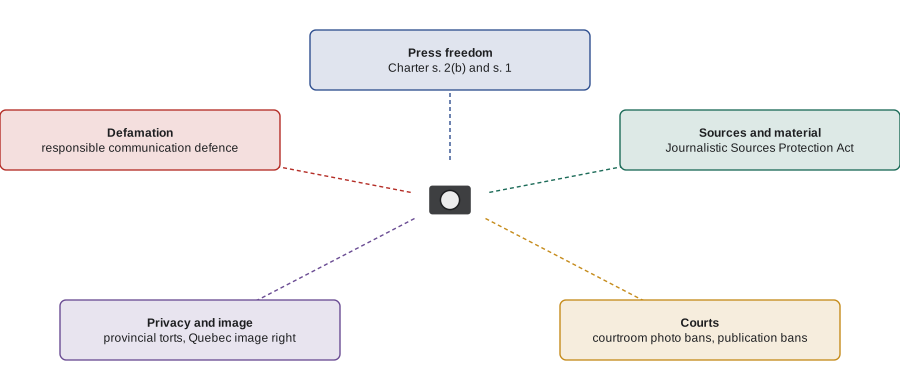
Photojournalists work at the edge of the law more often than most journalists. They go to places where police are active, photograph people who do not want to be photographed, cover courts and protests, protect confidential sources and publish images that can harm reputations. This lesson outlines the Canadian law that matters most for news photography: press freedom under the Charter, access and police interaction, protection of sources and journalistic material, publication bans and courts, privacy, image rights, defamation and copyright. PHOT-230 covered the basics of photographing in public.
Freedom of the press under the Charter
Section 2(b) of the Canadian Charter of Rights and Freedoms protects freedom of thought, belief, opinion and expression, including freedom of the press and other media of communication. Courts have held that gathering news, not just publishing it, has some protection. But Charter rights are subject to section 1, which allows reasonable limits prescribed by law that can be demonstrably justified in a free and democratic society. Courts balance press freedom against other interests, such as fair trials, privacy and public safety. The Charter applies to governments, including police, not to private property owners or individuals.
Access to scenes, events and public places
In Canada, anyone may generally photograph what can be seen from a public place, and journalists have no greater right of access than the public. Emergency services may set perimeters, and failing to follow lawful directions can lead to charges. The key offence is obstructing a peace officer under section 129 of the Criminal Code, which applies to wilfully obstructing an officer in the execution of their duty. Simply photographing police from a safe distance is not obstruction, but crossing a perimeter, refusing a lawful order to move or physically interfering can be. Injunction orders, such as those issued in disputes over pipelines and logging, can also create exclusion zones; courts have recognized that journalists covering such sites play a distinct role, but enforcement has led to arrests.
Canadian journalists have been arrested while covering protests and police operations. In 2016 a journalist covering a protest at the Muskrat Falls hydro project in Newfoundland and Labrador was charged under an injunction; the charges were later dropped and the province's Court of Appeal in 2019 recognized the importance of the journalist's role. In 2021 the RCMP arrested two journalists, including a photojournalist, covering a pipeline dispute on Wet'suwet'en territory in British Columbia; they were released and charges were not pursued. Press freedom groups such as the Canadian Association of Journalists and Canadian Journalists for Free Expression have called for clearer protections, and arrests and threats at protests continue to be reported.
| Situation | General position in Canada |
|---|---|
| Photographing police in public | Generally lawful if you do not obstruct |
| Order to move back from a perimeter | Comply if lawful; challenge later |
| Officer demands you delete images | No general power to force deletion; ask for a supervisor |
| Seizure of camera or phone | Generally needs a warrant; special rules apply to journalists |
| Injunction exclusion zone | May apply to journalists; courts weigh press role |
Recording police and seizure of material
No Canadian statute expressly guarantees a right to record police, but recording officers performing public duties in public places is generally lawful, and police services' policies typically acknowledge it. Officers have no general power to order you to delete images or to seize your camera without lawful authority. Searches of a journalist's material are governed by the Criminal Code's special provisions, described below, as well as the Charter's protection against unreasonable search and seizure in section 8. If an officer seizes equipment, do not resist physically; record the officer's name and badge number and contact your editor and lawyer.
Protecting sources and journalistic material
Canada adopted the Journalistic Sources Protection Act in 2017. It added section 39.1 to the Canada Evidence Act, allowing journalists to object to disclosing information or documents that could identify a confidential source. A court may order disclosure only if the information cannot be obtained by other reasonable means and the public interest in the administration of justice outweighs the public interest in protecting the source. The Supreme Court of Canada applied the law in Denis v. Côté in 2019. The Act also added sections 488.01 and 488.02 to the Criminal Code, so that search warrants and production orders relating to journalists can be issued only by a superior court judge, and seized material must be sealed so the journalist can challenge disclosure.
The protection is not absolute. In R. v. Vice Media Canada Inc. in 2018, decided before the new law applied, the Supreme Court upheld a production order requiring a journalist to hand over communications with a source who was publicly known. Photographers' unpublished images of crimes or protests are sometimes sought by police. The safest practice is to consider what you hold, protect it securely, and consult your organization's lawyer immediately if police ask for it.
Courts and publication bans
Canadian courts are generally open, but photography and recording inside courtrooms are usually prohibited, and many provinces also ban photography in courthouses or their precincts; Ontario's Courts of Justice Act, for example, prohibits photographs in courtrooms and court buildings without permission. Photographers therefore work outside courthouses, often in designated areas. Publication bans are common and binding on everyone. Some are mandatory, such as bans protecting the identity of complainants in sexual offence cases under section 486.4 of the Criminal Code when requested, and the Youth Criminal Justice Act prohibits publishing information that would identify a young person dealt with under the Act, with limited exceptions. Others are discretionary, decided under the test from the Dagenais and Mentuck cases, which weighs the risk to the administration of justice against freedom of expression. Breaching a ban can be contempt of court or an offence, and it applies to photographs that identify a protected person, even indirectly.
Privacy
Canada's privacy law for photographers is a patchwork. British Columbia, Saskatchewan, Manitoba and Newfoundland and Labrador have statutes creating a tort of violation of privacy. Ontario courts recognized intrusion upon seclusion in Jones v. Tsige in 2012 and later public disclosure of private facts. Quebec's Civil Code protects the right to privacy and to one's image, discussed below. Federal and provincial data protection laws such as PIPEDA generally exempt journalistic activities. In practice, photographing people in public for news is lawful, but intruding into private places, such as photographing through windows with a long lens, or publishing highly private images with no public interest can lead to liability. Criminal Code offences on voyeurism and non-consensual distribution of intimate images also apply.
Image rights in Quebec
Quebec gives people stronger control over their image than the rest of Canada. Under articles 3, 35 and 36 of the Civil Code of Québec, using a person's image without consent can violate their privacy. In Aubry v. Éditions Vice-Versa in 1998, the Supreme Court of Canada held a magazine liable for publishing a photograph of a young woman sitting in a doorway in Montreal without her consent, even though the photograph was taken in public. The Court said the right to one's image can give way to the public's right to information, for example when a person is involved in a newsworthy event, is a public figure, or appears incidentally in a crowd. News photographers in Quebec therefore need to consider whether a picture of an identifiable person serves a news purpose. Common law provinces recognize the narrower tort of appropriation of personality, which mainly concerns commercial use.
Defamation
A photograph combined with a caption or headline can defame someone by lowering their reputation, for example by implying a person is a criminal when they are a bystander. Canadian defamation law is more favourable to plaintiffs than US law: the plaintiff need not prove the publisher was careless, and the defences must be proved by the defendant. Defences include truth, also called justification, fair comment on matters of public interest, and responsible communication on matters of public interest, recognized by the Supreme Court in Grant v. Torstar in 2009, which protects journalists who diligently try to verify allegations. Ontario, British Columbia and Quebec have anti-SLAPP laws that allow courts to dismiss early lawsuits that target expression on matters of public interest. Careful captions and attribution are the best protection.
Copyright
Under Canada's Copyright Act, since 2012 the photographer is the first owner of copyright in a photograph unless it is made in the course of employment, in which case the employer owns it unless agreed otherwise. Freelancers therefore usually own their news photographs and license them. Copyright lasts for the life of the author plus 70 years. Fair dealing allows use for purposes including news reporting, criticism and review, with attribution, but it does not let publishers take freelancers' or witnesses' photographs from social media without permission. Moral rights protect the photographer's right to be credited and to the integrity of the work. PHOT-302 covered licensing in detail.
Borders and devices
Canada Border Services Agency officers can examine goods, including electronic devices, at the border. Courts have questioned whether unrestricted searches of personal devices are consistent with the Charter; in R. v. Canfield in 2020 the Alberta Court of Appeal held that the customs power, as applied to personal electronic devices, was unconstitutional without a threshold of suspicion, and Parliament has considered amendments. Journalists crossing borders should minimize sensitive material on devices, use encryption and know that refusing a search can lead to devices being detained. Travelling to the United States, US rules also apply.
Worked problem
Can this picture be published?
You photograph a 16-year-old being arrested at a protest in Toronto. Later the youth is charged with assault. Your editor asks whether the photo, which shows the youth's face, can be published.
Show solution
- The Youth Criminal Justice Act prohibits publishing information that identifies a young person dealt with under the Act.
- The photo shows the youth's face, so it identifies them; publication would breach the Act.
- Options: publish a frame where the youth cannot be identified, blur the face consistently and check that clothing and context do not identify them, or do not publish.
- Consult the organization's lawyer before publishing any identifying detail.
Answer: No, not with the face visible. Publishing would breach the Youth Criminal Justice Act. A non-identifying frame or no picture is the safe choice.
Worked problem
Estimating exposure to a legal claim
A caption wrongly identifies a bystander at a crime scene as a suspect. The publication corrects it within 2 hours, but by then the image has been viewed about 50,000 times. Name the main legal risk and the steps that reduce it.
Show solution
- Main risk: defamation, because the caption falsely implies the bystander is a criminal.
- Canadian law presumes falsity and damage once publication of a defamatory statement is shown; the publisher must prove a defence.
- Reduce the risk: correct and apologize promptly and prominently, contact the person, update all versions and syndication partners, and notify the organization's lawyer and insurer.
- Prevent it: never identify people as suspects without official confirmation and attribution.
Answer: The main risk is a defamation claim. A fast, clear correction and apology reduce damages, but prevention through careful, attributed captions is far better.
Practical legal habits
Keep the phone number of your organization's lawyer, or a press freedom hotline, saved and easy to reach. Write down the facts of any police encounter as soon as possible afterwards, including times, names and badge numbers. Store sensitive material securely and think about what you carry into protests and across borders. When in doubt about publication, ask before you publish, not after.
Common mistakes
MistakeAssuming a press card gives special rights at scenes.
InsteadJournalists generally have the public's rights; follow lawful directions and challenge later.
MistakePublishing an identifiable photo of a young person charged under the YCJA.
InsteadUse a non-identifying frame or do not publish.
MistakePhotographing inside a courtroom or court building.
InsteadWork in designated areas outside; check local court rules.
MistakeDeleting images because an officer demands it.
InsteadPolitely decline, ask for a supervisor, and contact your editor and lawyer.
MistakeCaptioning a person as a suspect on the word of a bystander.
InsteadIdentify suspects only with official confirmation and attribution.
Summary and key terms
- Charter section 2(b) protects press freedom, subject to reasonable limits under section 1.
- Journalists have the public's access rights; obstruction under section 129 is the key risk.
- The Journalistic Sources Protection Act protects confidential sources and requires superior court warrants for journalists' material.
- Courtroom photography is generally banned, and publication bans, including under the YCJA, bind everyone.
- Privacy torts vary by province, and Quebec protects the right to one's image under Aubry.
- Defamation favours plaintiffs; truth, fair comment and responsible communication are key defences.
- Photographers own copyright unless employed; fair dealing does not permit taking others' images freely.
Practice problems
Work each problem on paper first, then reveal the answer to check.
What Charter section protects press freedom?
Show answer
Section 2(b).
Which Criminal Code offence is the main risk at police scenes?
Show answer
Obstructing a peace officer under section 129.
What did the Journalistic Sources Protection Act add to the Canada Evidence Act?
Show answer
Section 39.1, allowing journalists to object to disclosing source-identifying information.
Who must issue a search warrant for a journalist's material?
Show answer
A superior court judge, under sections 488.01 and 488.02.
Can you photograph inside an Ontario courtroom?
Show answer
No, not without permission; the Courts of Justice Act prohibits it.
What did Aubry decide?
Show answer
That publishing an identifiable person's image without consent can violate Quebec privacy rights, subject to the public's right to information.
Name the defamation defence recognized in Grant v. Torstar.
Show answer
Responsible communication on matters of public interest.
Who owns copyright in a freelancer's photo in Canada?
Show answer
The photographer, unless agreed otherwise.
Can an officer make you delete images?
Show answer
There is no general power to force deletion; decline politely and contact your editor.
Name two provinces with statutory privacy torts.
Show answer
Any two of British Columbia, Saskatchewan, Manitoba and Newfoundland and Labrador.
Lesson quiz · 5 questions
Score 60% or more to complete this lesson.
Create a free account to save your progress, take quizzes and earn a certificate.