
PHOT-320 · Lesson 8 of 12 · 29 min
Captions, accuracy and corrections
A news photograph without an accurate caption is incomplete and can be dangerous. The caption tells the audience who and what they are seeing, where and when it happened, and why it matters. It also limits how the image can be misused. Many of the worst errors in photojournalism are caption errors: the wrong name, the wrong place, a guess presented as fact. This lesson covers how to write captions to professional standards, how to verify information including images from others, and how news organizations correct mistakes.
What a caption does
A caption, also called a cutline, has three jobs. It identifies: names, places, dates and the event. It explains: what is happening and why it matters, adding information the picture cannot show. And it frames: it signals how the image should be understood, for example by noting that a scene was a re-enactment for a portrait or that an image comes from a handout. Readers often read captions before the story, so a caption should stand alone, giving enough context to understand the picture without reading the article.
Wire-service captions follow a standard structure. The first sentence describes what is happening in the picture, in the present tense, and identifies people from left to right where needed, with the place and date. The second sentence gives background in the past tense. Then come the credit and, in the file's metadata, the copyright and source.
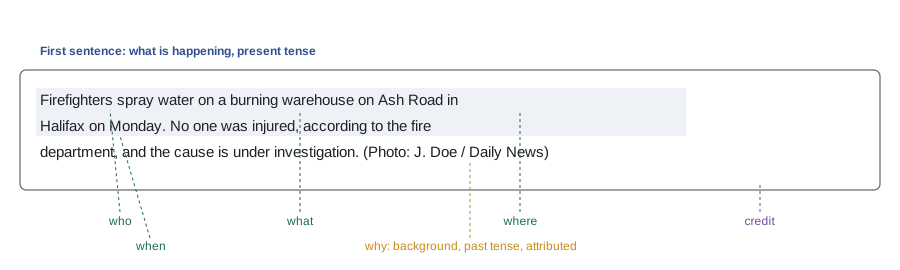
The five Ws and accuracy
Every news caption should answer who, what, where and when, and usually why or how. Who: full names with correct spelling, and titles or descriptions where needed. What: the action shown, described accurately and without exaggeration. Where: a specific place, including city and province or state. When: the date, and in breaking news sometimes the time. Why: the context that makes the picture news.
Accuracy rules are strict. Spell names as the person spells them; ask and check. Identify people only when you are sure; if you are not, say so or leave the identification out. Do not describe emotions or motives you cannot know: a person may look angry, but the caption should say what they did or said, or attribute the description. Do not repeat claims as fact; attribute them to their source. Check numbers against official sources and attribute them.
| Weak caption | Problem | Better |
|---|---|---|
| A furious protester attacks police. | Assumes emotion and intent; attack may be inaccurate | A protester pushes a police officer's shield during a march on Main Street on Saturday. |
| Firefighters battle the blaze. | No place, date or names; cliché | Firefighters spray water on a burning warehouse on Ash Road in Halifax on Monday. |
| Smith celebrates. | Which Smith? Celebrates what? | Jordan Smith of the Stingrays celebrates his overtime goal against the Comets on Friday. |
| Hundreds died in the flood. | Unattributed number | At least 12 people died, according to provincial officials. |
Style guides
Captions follow the publication's style guide. In Canada, most news organizations use The Canadian Press Stylebook and Caps and Spelling, which use Canadian spelling and conventions such as province abbreviations in datelines. In the United States, most follow the AP Stylebook, with American spelling and state abbreviations in AP style. Both cover titles, numbers, dates, ages and sensitive terminology, and both are updated regularly, for example with guidance on describing gender identity, disability, mental illness, suicide and race. Using the right terms respectfully is part of accuracy.
| Point | Canadian Press style | AP style |
|---|---|---|
| Spelling | Canadian, following Caps and Spelling | American, following Webster's New World College Dictionary |
| Place | City, province where needed | City, state where needed |
| Dates | Day of week for dates within a week | Day of week for dates within a week |
| Ages | Figures: 6-year-old girl | Figures: 6-year-old girl |
| Updates | Yearly print edition and online updates | Online updates and yearly print edition |
Gathering information in the field
Collect caption information while you shoot, not afterwards. Carry a notebook or use a voice memo. Ask people for their names, the spelling, their age if relevant, and where they are from. Photograph name tags, signs and documents as aids, but confirm details directly. Record the names and titles of officials. Note the exact location, using a map pin if necessary. At large events, collect information about the event from organizers or press releases, but verify claims.
When people decline to give their names, respect that, and describe them generically or not at all. For children, follow your publication's policy, which usually requires a parent's or guardian's permission for identification in non-news situations.
Scoring a caption
A simple checklist helps photographers and editors check captions quickly before transmission.
Worked problem
Scoring caption completeness
Score this caption out of 6, one point each for who, what, where, when, why and a correct credit: "Firefighters work at the scene of a fire on Tuesday. The cause is under investigation. (Photo: J. Doe)"
Show solution
- Who: firefighters is generic but acceptable; no named people are required. 1 point.
- What: work at the scene of a fire. 1 point, though vague.
- Where: missing; no address, city or province or state. 0 points.
- When: Tuesday. 1 point.
- Why: the cause is under investigation, partial context. Half a point.
- Credit: present, but the organization is missing. Half a point.
- Total: 4 out of 6.
Answer: 4 out of 6. Adding the address and city, a specific description of the building and what the firefighters are doing, and the full credit would bring it to 6.
Verifying images and information from others
Photojournalists and photo editors increasingly handle images they did not make: user-generated content, handouts from governments, companies and police, and images circulating on social media. Verification asks four questions: Is the image what it claims to be? Is it from the place and time claimed? Who made it, and do they agree to its use? Has it been altered?
Techniques include contacting the creator directly and asking for the original file and other images from the same time; checking metadata when available; reverse image searches to find earlier appearances; comparing landmarks, signs, terrain and street layouts with maps and satellite images; checking weather records; and checking the sun's position and shadows against the claimed time. Organizations such as First Draft, which became part of other projects, and newsroom verification teams have published guides to these methods.
Worked problem
Checking a claimed time with shadows
A photo claims to show a protest at noon in a city where the sun's elevation at noon on that date was about 60 degrees. A 1.8 m tall person in the photo casts a shadow that appears roughly as long as the person is tall. Is the claim plausible?
Show solution
- Shadow length \( L = h / \tan(\text{elevation}) \).
- At 60 degrees: \( L = 1.8 / \tan 60^\circ = 1.8 / 1.73 \approx 1.0 \) m.
- A shadow about as long as the person (1.8 m) implies \( \tan(\text{elevation}) \approx 1 \), an elevation of about 45 degrees.
- Near the claimed date, the sun would reach 45 degrees at mid-morning or mid-afternoon, not noon.
Answer: The shadow suggests the photo was taken two to three hours from noon, or on a different date. The claim needs more checking; it does not prove the photo is fake, but it shows a mismatch to investigate.
Handout images, from police, governments, militaries, companies and campaigns, should be labelled as such in the credit and caption, for example handout or provided by. They may be selected or staged to serve the provider's purpose. News organizations should state when they could not independently verify an image.
Corrections
Mistakes happen. What matters is how quickly and openly they are fixed. News organizations publish corrections policies and correct errors in captions just as in text: changing the online version with a note explaining the correction, publishing a correction in print, and, for wire services, sending a corrected caption or a kill notice to subscribers. A kill notice tells subscribers to remove an image entirely, used when a picture is found to be manipulated, staged, wrongly identified in a damaging way or legally problematic.
Photographers should report their own mistakes to the desk immediately. Hiding an error, or hoping no one notices, breaks trust far more than the error itself. Keep notes and originals so that errors can be traced and understood. Many publications have ombudspeople or standards editors who handle complaints and corrections.
Worked problem
How far does an error travel?
A wire service distributes a picture with a wrong name to 300 subscribers. Within an hour, 40 percent have published it online, and each of those posts is shared an average of 250 times. The correction goes out an hour later. Roughly how many shares carry the wrong name before the correction?
Show solution
- Subscribers who published: 300 × 0.4 = 120.
- Shares: 120 × 250 = 30,000.
- Most shares will never be updated even after the correction.
Answer: About 30,000 shares within an hour. A minute spent confirming a name before transmission saves far more effort than a correction afterwards.
Captions for different platforms
The same image may appear in print, on a website, in an app and on social media, and each needs a caption that works in its context. A social media post may show only a few words before a reader clicks, so the key facts should come first. Alt text, which describes an image for people who use screen readers, is different from a caption: it describes what the image shows visually, while the caption explains the news. Many newsrooms now write both. Never let a shortened platform caption drop the attribution or context that keeps the image from being misread.
Sensitive language in captions
Words matter as much in captions as in stories. Describe people by what is relevant to the story, not by race, religion, disability or other characteristics unless they are pertinent. Use the terms people use for themselves where possible, and follow your stylebook's current guidance, for example on how to refer to Indigenous peoples, to people who use drugs, or to deaths by suicide, where many guides advise avoiding the phrase committed suicide. Avoid words that judge, such as admitted or claimed, when a neutral word such as said is accurate.
A final check before transmission
Before sending, read each caption against the picture. Check that people are identified in the right order, that the place and date match the metadata, that names are spelled the same way in every caption of the set, and that every number and claim is attributed. A thirty-second check prevents most caption errors.
Captions in long-form stories
In picture stories and essays, captions can be longer and more narrative than wire captions, adding detail that deepens the reader's understanding of each image. They still need the same accuracy: names, places and dates checked, and claims attributed. Some publications place a short introductory text before the images and keep individual captions brief; others write fuller captions that together tell the story. Whatever the approach, each caption should make sense if the image is shared on its own, because that is how many people will encounter it.
Common mistakes
MistakeDescribing emotions or motives you cannot know.
InsteadDescribe actions and attribute characterizations.
MistakeGuessing at a name or a spelling.
InsteadAsk, check and confirm, or leave it out.
MistakeWriting captions after the shoot from memory.
InsteadGather information while shooting, in notes or voice memos.
MistakePublishing handout images as if they were your own coverage.
InsteadLabel handouts clearly in the caption and credit.
MistakeHiding a caption error to avoid embarrassment.
InsteadReport it to the desk immediately so it can be corrected.
Summary and key terms
- Captions identify, explain and frame news photographs, and should stand alone.
- Wire style: first sentence present tense describing the picture; second sentence past tense for background.
- Answer who, what, where, when and why accurately; attribute claims and numbers.
- Follow The Canadian Press or AP style, including guidance on respectful terminology.
- Gather caption information in the field and respect people who decline to be named.
- Verify images from others through creators, metadata, reverse search, maps, weather and shadows.
- Correct errors quickly and openly; report your own mistakes immediately.
Practice problems
Work each problem on paper first, then reveal the answer to check.
What tense does the first sentence of a wire caption use?
Show answer
Present tense.
What does the second sentence of a wire caption usually give?
Show answer
Background in the past tense.
Rewrite 'An angry man shouts' more accurately.
Show answer
Describe the action and attribute, for example 'A man shouts during the meeting' or quote what he said.
Which stylebook do most Canadian news organizations use?
Show answer
The Canadian Press Stylebook.
How should a handout image be labelled?
Show answer
As a handout or provided by the source, in the caption and credit.
Shadow of a 2 m pole at 45 degrees elevation?
Show answer
2 / tan 45 = 2 m.
Name three verification techniques.
Show answer
Any three of contacting the creator, metadata, reverse search, map comparison, weather records, shadows.
When is a kill notice used?
Show answer
When an image must be removed entirely, for example if manipulated or seriously wrong.
A caption scores who, what, when but no where or why. Score out of 5?
Show answer
3 out of 5.
What should you do if you discover your own caption error?
Show answer
Tell the desk immediately.
Lesson quiz · 5 questions
Score 60% or more to complete this lesson.
Create a free account to save your progress, take quizzes and earn a certificate.