
PHOT-320 · Lesson 10 of 12 · 27 min
Law for photojournalists in the US
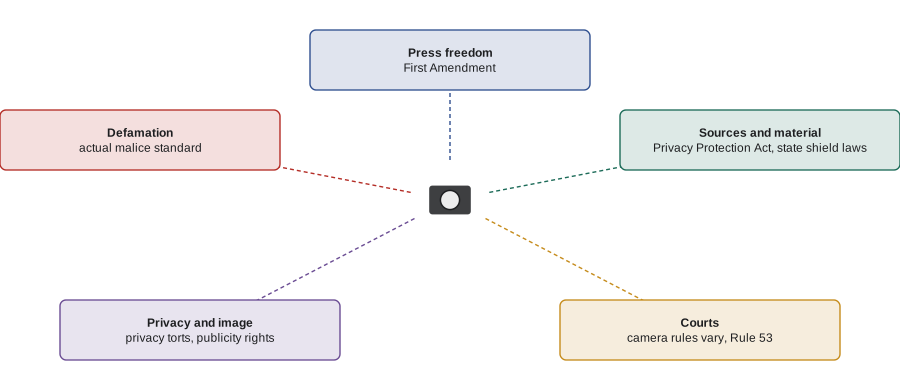
Photojournalists work at the edge of the law more often than most journalists. They go to places where police are active, photograph people who do not want to be photographed, cover courts and protests, protect confidential sources and publish images that can harm reputations. This lesson outlines the US law that matters most for news photography: the First Amendment, access and police interaction, the right to record police, protection of sources and newsrooms, courts, privacy, publicity rights, defamation and copyright. PHOT-230 covered the basics of photographing in public.
The First Amendment
The First Amendment to the US Constitution prohibits the government from abridging freedom of speech or of the press. Courts have recognized that gathering information, including photographing and recording in public places, is protected expression, though the protection is not unlimited. Governments may impose reasonable time, place and manner restrictions that are content-neutral, narrowly tailored and leave open other channels. The First Amendment restrains governments, including police, not private property owners or individuals. In general, the press has the same rights as the public, not special privileges.
Access to scenes, events and public places
In the United States, anyone may generally photograph what can be seen from a public place, and journalists usually have no greater right of access than the public. Police may set perimeters and give lawful dispersal orders, and failing to obey can lead to arrest for offenses such as obstruction, failure to disperse or disorderly conduct under state law. Many police departments have policies recognizing journalists' role at protests, and some states have passed laws exempting journalists from dispersal orders in certain situations, for example California's 2021 law allowing credentialed journalists to remain in closed areas at protests. Courts have issued injunctions protecting journalists from police force at protests after past abuses.
US journalists are arrested and detained at protests every year. The US Press Freedom Tracker, run by the Freedom of the Press Foundation, has documented hundreds of arrests and assaults on journalists, with peaks during the 2020 protests after the killing of George Floyd and in later protests over immigration enforcement. Most charges against journalists are later dropped, but arrests still interrupt coverage, can lead to seized equipment and can deter reporting. Professional groups such as the NPPA, the Reporters Committee for Freedom of the Press and the Society of Professional Journalists provide guidance and legal support.
| Situation | General position in the US |
|---|---|
| Recording police in public | Protected by most federal appeals courts that have ruled |
| Dispersal order at a protest | Comply if lawful unless a state exemption applies; challenge later |
| Officer demands you delete images | No general power to force deletion; ask for a supervisor |
| Seizure of camera or phone | Generally needs a warrant; the Privacy Protection Act limits newsroom searches |
| Closed areas at protests | Some states, such as California, exempt credentialed journalists |
The right to record police
Most federal appeals courts that have considered the question, including the First Circuit in Glik v. Cunniffe in 2011 and the Third Circuit in Fields v. City of Philadelphia in 2017, have held that the First Amendment protects recording police officers performing their duties in public, subject to reasonable restrictions. Laws that tried to limit recording, such as Arizona's 2022 law banning recording within eight feet of police activity, have been blocked by courts. Officers generally cannot order you to delete images or seize your camera without a warrant or a recognized exception. If equipment is seized, do not resist physically; record names and badge numbers and contact your editor and lawyer.
Protecting sources and journalistic material
There is no federal shield law in the United States. In Branzburg v. Hayes in 1972 the Supreme Court held that the First Amendment does not give journalists a general privilege to refuse to testify before a grand jury, although some lower courts recognize a qualified privilege. Most states protect journalists through shield laws or court decisions; Wyoming is usually cited as the only state with neither. The PRESS Act, a proposed federal shield law that would protect journalists' sources and records, passed the House unanimously in January 2024 but stalled in the Senate at the end of that Congress; check its current status. The federal Privacy Protection Act of 1980 limits searches of newsrooms and seizures of journalists' work product and documentary materials, generally requiring a subpoena rather than a search warrant.
The protection is not absolute. Federal prosecutors have subpoenaed journalists' records and testimony in leak investigations, and the Department of Justice's guidelines on obtaining information from the news media have changed several times; check the current version. Unpublished photographs and video of protests and crimes are sometimes sought by subpoena. The safest practice is to consider what you hold, protect it securely, and consult your organization's lawyer immediately if you receive a subpoena or a request from police.
Courts and cameras
US courts vary widely in allowing cameras. Federal criminal courts prohibit photography and broadcasting under Rule 53 of the Federal Rules of Criminal Procedure, and the Supreme Court does not allow cameras. All states permit cameras in at least some state court proceedings, but the rules differ and judges usually have discretion. Prior restraints, court orders forbidding publication, are presumptively unconstitutional under Nebraska Press Association v. Stuart in 1976, and the Supreme Court has held that the press cannot be punished for publishing truthful information lawfully obtained from public records, such as a rape victim's name in Cox Broadcasting v. Cohn in 1975 or a juvenile's name in Smith v. Daily Mail in 1979. Restraint on identifying victims and juveniles is therefore usually a matter of newsroom ethics policy rather than law.
Privacy
US privacy law for photographers rests mainly on four torts recognized in most states: intrusion upon seclusion, public disclosure of private facts, false light and appropriation of name or likeness. Newsworthiness is a strong defense to disclosure claims, and photographing people in public places is generally lawful. Intrusion claims can arise from photographing into private places, such as homes, using long lenses or drones. California's Civil Code section 1708.8, sometimes called the anti-paparazzi law, creates liability for physical or constructive invasion of privacy to capture images of people in personal or family activities. False light claims can arise from misleading captions or juxtapositions. State laws on voyeurism and drones also apply.
Publicity rights
The right of publicity protects people against commercial use of their name or likeness without consent. It is a matter of state law, by statute in some states, such as New York's Civil Rights Law sections 50 and 51 and California's Civil Code section 3344, and by common law in others. Newsworthiness and editorial use are generally protected, so publishing an identifiable person in a news photograph does not violate publicity rights, but using the same photograph in an advertisement can. This is why editorial images are licensed for editorial use only, as Lesson 2 explained.
Defamation
A photograph combined with a caption or headline can defame someone by implying false facts, for example that a bystander was a suspect. US defamation law strongly protects the press. In New York Times v. Sullivan in 1964, the Supreme Court held that public officials must prove actual malice, that the publisher knew a statement was false or recklessly disregarded whether it was, and later cases extended this to public figures. Private individuals must usually prove at least negligence. Truth is a complete defense, and opinion based on disclosed facts is protected. Many states have anti-SLAPP laws allowing early dismissal of suits targeting speech on public issues. Careful captions and attribution are still the best protection.
Copyright
Under the US Copyright Act, the photographer owns the copyright unless the photograph is a work made for hire, which includes work by employees within the scope of their jobs and certain commissioned works under a signed agreement. Freelancers therefore usually own their news photographs and license them. Registration with the Copyright Office is needed before suing for infringement in most cases, and timely registration allows statutory damages and legal fees, so many photojournalists register regularly. Fair use, decided case by case on four factors, may allow some news use, but taking a photographer's or witness's image without permission is a common source of lawsuits. PHOT-302 covered licensing in detail.
Borders and devices
US Customs and Border Protection officers can search electronic devices at the border, including those of journalists. CBP policy distinguishes basic searches from advanced forensic searches, which require reasonable suspicion, and federal appeals courts have disagreed about what the Constitution requires. Journalists have reported being questioned about their work and having devices searched. Minimize sensitive material on devices, use encryption, and consult resources from press freedom groups before traveling. Traveling to Canada, Canadian rules also apply.
Worked problem
Can this picture be published?
You photograph a 16-year-old being arrested at a protest in Chicago. Later the youth is charged with assault. Your editor asks whether the photo, which shows the youth's face, can be published.
Show solution
- No law generally prohibits publishing a lawfully obtained photograph of a juvenile; Smith v. Daily Mail protects truthful publication.
- Most newsrooms have policies against identifying juveniles charged with crimes, except in serious cases.
- Options: follow the policy by using a frame where the youth is not identifiable, or seek a senior editor's decision if there is a strong public interest.
- Consider the harm to a young person whose charge may be dropped, and the permanence of online images.
Answer: Legally it probably can, but most newsrooms' ethics policies say not to identify the juvenile. A non-identifying frame is the usual choice.
Worked problem
Estimating exposure to a legal claim
A caption wrongly identifies a bystander at a crime scene as a suspect. The publication corrects it within 2 hours, but by then the image has been viewed about 50,000 times. Name the main legal risk and the steps that reduce it.
Show solution
- Main risk: defamation and false light, because the caption falsely implies the bystander is a criminal.
- As a private person, the bystander must usually prove at least negligence; a careless caption may meet that standard.
- Reduce the risk: correct and apologize promptly and prominently, contact the person, update all versions and syndication partners, and notify the organization's lawyer and insurer.
- Prevent it: never identify people as suspects without official confirmation and attribution.
Answer: The main risk is a defamation claim. A fast, clear correction and apology reduce damages, but prevention through careful, attributed captions is far better.
Practical legal habits
Keep the phone number of your organization's lawyer, or a press freedom hotline, saved and easy to reach. Write down the facts of any police encounter as soon as possible afterwards, including times, names and badge numbers. Store sensitive material securely and think about what you carry into protests and across borders. When in doubt about publication, ask before you publish, not after.
Common mistakes
MistakeAssuming a press card gives special rights at scenes.
InsteadJournalists generally have the public's rights, plus some state protections; follow lawful orders and challenge later.
MistakeAssuming newsroom juvenile policies are legal requirements.
InsteadMost are ethics policies; follow them and know the law separately.
MistakeAssuming cameras are allowed in every court.
InsteadCheck the court's rules; federal criminal courts ban cameras.
MistakeDeleting images because an officer demands it.
InsteadPolitely decline, ask for a supervisor, and contact your editor and lawyer.
MistakeCaptioning a person as a suspect on the word of a bystander.
InsteadIdentify suspects only with official confirmation and attribution.
Summary and key terms
- The First Amendment protects newsgathering and publishing, subject to reasonable time, place and manner limits.
- Journalists usually have the public's access rights; some states exempt them from dispersal orders.
- There is no federal shield law; most states protect sources, and the Privacy Protection Act limits newsroom searches.
- Court camera rules vary; prior restraints are presumptively unconstitutional, and juvenile restraint is mostly an ethics policy.
- Privacy torts and state publicity rights apply, with strong newsworthiness defenses.
- Actual malice protects reporting on public officials and figures; private plaintiffs must show negligence.
- Photographers own copyright unless work for hire; register regularly and do not rely on fair use to take others' images.
Practice problems
Work each problem on paper first, then reveal the answer to check.
Which case recognized the right to record police in the First Circuit?
Show answer
Glik v. Cunniffe in 2011.
Is there a federal shield law?
Show answer
No; the PRESS Act stalled in the Senate.
What does the Privacy Protection Act do?
Show answer
Limits searches of newsrooms and seizures of journalists' materials.
What did Branzburg v. Hayes decide?
Show answer
That the First Amendment gives no general privilege to refuse grand jury testimony.
Are cameras allowed in federal criminal trials?
Show answer
No, under Rule 53.
What standard did New York Times v. Sullivan set?
Show answer
Actual malice for public officials suing for defamation.
Name the four privacy torts.
Show answer
Intrusion, public disclosure of private facts, false light and appropriation.
Why can't an editorial photo be used in an advertisement?
Show answer
Commercial use can violate the right of publicity.
Can an officer make you delete images?
Show answer
There is no general power to force deletion; decline politely and contact your editor.
Why register copyright promptly?
Show answer
To sue and to claim statutory damages and fees.
Lesson quiz · 5 questions
Score 60% or more to complete this lesson.
Create a free account to save your progress, take quizzes and earn a certificate.