
PHOT-320 · Lesson 1 of 12 · 30 min
What photojournalism is and where it came from
Photojournalism is journalism told mainly through photographs. A photojournalist goes to where events happen, records what is in front of the camera honestly, and gives the audience enough accurate information, in a caption and in context, to understand what they are seeing. The photograph is evidence as well as expression. That double role, part witness and part storyteller, is what separates photojournalism from advertising, portraiture or fine art photography, even when the technical skills overlap.
This course builds on PHOT-230, which covered the basics of photographing people in public and the law of the street. Here the focus is on news work: how stories are chosen, how breaking news and features are covered, how images are edited, captioned and transmitted to deadline, the ethical codes that govern the craft, the law that protects and limits journalists, and the personal safety and trauma issues that come with witnessing other people's worst days. This first lesson defines the field and traces the history that shaped its values.
A working definition
Photojournalism has four defining features. First, it is about real events and real people, not staged or invented scenes. Second, it is timely or newsworthy: the pictures matter because of what they show about the world now, or about a past that still matters. Third, it is accurate: the image and its caption together must not mislead. Fourth, it is published to inform the public, usually through a news organization that takes responsibility for it.
Within the field there are several genres. Spot news or breaking news covers unplanned events such as fires, crashes, storms and protests. General news covers planned events such as elections, court cases and press conferences. Features cover human-interest stories that are less tied to the day's headlines. Sports photography covers games and athletes. Portraiture for news shows the people in a story. The picture story and the photo essay use several images to tell a longer narrative. Documentary photography overlaps with photojournalism but usually works over months or years on a single subject, often for books and exhibitions as well as publications.
| Genre | Typical assignment | Main skill |
|---|---|---|
| Spot news | A house fire or a highway crash | Speed, safety and access |
| General news | A legislature vote or a court appearance | Anticipation in controlled settings |
| Feature | A community garden or a long-time shopkeeper | Observation and rapport |
| Sports | A hockey game or a marathon | Timing, long lenses and knowledge of the game |
| News portrait | A newly elected mayor | Quick lighting and connection |
| Picture story | A family caring for a parent with dementia | Sequencing and trust over time |
Why the photograph carries weight
A news photograph persuades in a way that text often does not. Viewers tend to believe that a camera records what was there, and research on how people read news consistently finds that images draw attention first and are remembered longer than words. That trust is the asset photojournalists protect. Every staged scene, misleading crop or invented caption that comes to light spends some of it, not just for the photographer involved but for the whole profession. The ethical rules covered later in this course exist because the medium's power depends on the audience's belief that the picture is honest.
A photograph also has limits. It shows a slice of time, usually a fraction of a second, from one position, with a frame that excludes most of the scene. It cannot explain causes on its own. The photographer's choices about where to stand, when to press the shutter and what to leave out shape the meaning. Good photojournalists are aware of this and work to make the selection fair, then rely on captions and accompanying reporting to supply what the picture cannot.
Beginnings: from engravings to halftones
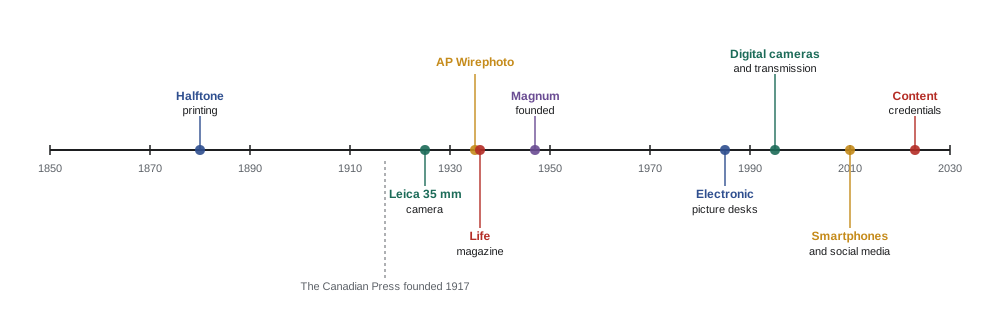
Photographs of news events existed almost as soon as photography itself. In the 1840s and 1850s photographers recorded fires, wars and public gatherings, but the slow processes of the time made action impossible and the images could not be printed directly in newspapers. Publications instead hired engravers to copy photographs by hand onto wood blocks. Roger Fenton's pictures of the Crimean War in 1855 and the photographs of the American Civil War made by teams working for Mathew Brady and Alexander Gardner reached most people this way, filtered through an engraver's hand.
The halftone process, which breaks an image into dots of varying size that a printing press can reproduce, changed that. Newspapers began printing halftone photographs in the 1880s, and by the early twentieth century they were common. Social documentary photographers such as Jacob Riis, who photographed New York tenements in the 1880s and 1890s, and Lewis Hine, who documented child labour for the National Child Labor Committee in the 1900s and 1910s, showed that photographs could drive public debate and reform.
Small cameras and the picture magazines
In the 1920s, small cameras using 35 mm film, led by the Leica introduced in 1925, and fast lenses allowed photographers to work quickly and unobtrusively in available light. Photographers could now capture candid moments rather than posed groups. In Germany, illustrated magazines developed the idea of the picture story, in which several photographs, laid out together with short text, tell a narrative.
Life magazine, launched in the United States in 1936, brought the picture story to a mass audience. At its peak it sold millions of copies a week. Its photographers, including Margaret Bourke-White, whose image of the Fort Peck Dam was on the first cover, and W. Eugene Smith, whose 1948 essay Country Doctor followed a rural physician in Colorado, set the standard for the photo essay. Look, Picture Post in Britain, Paris Match in France and Weekend Magazine in Canada followed similar models. The cooperative agency Magnum Photos, founded in 1947 by Robert Capa, Henri Cartier-Bresson, George Rodger and David Seymour, gave photographers more control over their work and copyright.
In the same period, government projects also produced lasting documentary work. In the United States, the Farm Security Administration hired photographers including Dorothea Lange and Walker Evans to document rural poverty during the Depression; Lange's 1936 portrait of a mother in a pea pickers' camp in California became one of the most reproduced photographs of the century. In Canada, the National Film Board's Still Photography Division, created in 1941, documented the war effort and Canadian life for decades and became an important home for documentary photographers.
The wire services
While magazines told longer stories, wire services moved news pictures fast. The Associated Press, founded in 1846 as a cooperative of US newspapers, launched AP Wirephoto in 1935, sending photographs over telephone lines to member papers across the country on the same day. Other services, including United Press, later United Press International, and Reuters, which added pictures to its news service in the 1980s, built similar networks. Agence France-Presse covers the world from Paris.
In Canada, The Canadian Press was founded in 1917 as a cooperative news agency owned by Canadian newspapers. It distributed news across a vast country with a small population, and its photo service became the backbone of Canadian news photography, supplying pictures to papers that could not afford to send a photographer everywhere. Canadian Press photographs of national events, from royal tours to the 1990 standoff at Kanehsatà:ke and Oka in Quebec, where Shaney Komulainen photographed a soldier and a Mohawk warrior face to face, became part of the country's visual memory.
Wire services shaped the craft in particular ways. They needed photographs that could be understood quickly by editors far away, pictures that would work across many publications, and captions that were accurate, complete and neutral. Their style manuals, including The Canadian Press Stylebook and the AP Stylebook, still influence how captions are written today.
Canadian and American traditions
Canada's photojournalism grew up with a smaller market and a strong role for public institutions and cooperatives. Ted Grant, often called the father of Canadian photojournalism, photographed politics, sport and medicine for decades, and Boris Spremo of the Toronto Star was known for news pictures that combined speed with strong composition. The News Photographers Association of Canada and the National Newspaper Awards recognize Canadian news photography, and Canadian photographers have worked for international agencies in conflicts around the world.
In the United States, a larger market supported many daily papers with staff photographers, the picture magazines, and competition for prizes. The Pulitzer Prize added a photography category in 1942. Joe Rosenthal's photograph of Marines raising the flag on Iwo Jima in 1945, made for the Associated Press, won the prize that same year. The National Press Photographers Association, founded in 1946, created a code of ethics that is still widely used. In 1968 the Pulitzer board split the award into spot news and feature photography; spot news was renamed breaking news photography in 2000.
Iconic images and contested history
Some news photographs become icons that stand for a whole event. The 1972 photograph of children fleeing a napalm attack in Vietnam, known as The Terror of War, is one example. Icons are powerful but also simplified, and their history can be contested. In 2025, after a documentary raised questions about who made The Terror of War, World Press Photo suspended its attribution of the image while the Associated Press, which distributed it, said its own review supported the original credit. The episode shows that photojournalism's history is not fixed: archives, credits and context continue to be examined, and accuracy about the past matters as much as accuracy about the present.
Icons also raise questions about who is seen and who is doing the seeing. For much of the twentieth century, most staff photojournalists at major North American publications were white men, and coverage of Indigenous, Black and other communities often came from outsiders. Organizations on both sides of the border now work to diversify the profession and to involve communities in how they are represented, a theme that returns in the lessons on ethics and on trauma and consent.
The digital transformation
From the 1990s, digital cameras, laptops and satellite phones allowed photographers to transmit images from the field within minutes. Newspapers adopted colour printing in the 1980s and 1990s, and websites from the late 1990s. Smartphones and social media, from about 2010, made almost everyone a potential photographer of news and created new channels for distribution and verification. At the same time, falling advertising revenue led many newspapers in both countries to cut staff photographers, and many professionals now work as freelancers or for wire services and agencies. Lesson 2 examines this ecosystem in detail.
The newest change is the rise of generative AI tools that can create realistic images of events that never happened. That makes provenance, the documented history of an image from capture to publication, more important than ever. Camera makers, news organizations and technology companies have developed standards such as the Coalition for Content Provenance and Authenticity (C2PA) specification, often shown to users as content credentials, so that a viewer can check where an image came from and how it was edited. Lessons 7 and 9 cover these tools and the ethical rules around them.
What makes a photojournalist
The qualities that made great photojournalists in the past still apply. They are curious about people and events. They are prepared, with equipment that works and knowledge of the subject. They can anticipate moments rather than react to them. They are persistent, returning to stories and waiting for pictures. They respect the people they photograph, and they hold themselves to standards of accuracy and honesty even when no one would notice a shortcut. They can also work under pressure, to deadline, often in difficult or dangerous conditions.
Technical skill matters, but it serves these qualities. A sharp, well-exposed photograph that misrepresents an event is a failure; a slightly soft picture that shows something true and important can be a success. The rest of this course develops both the craft and the judgement that photojournalism requires.
Worked problem
Sorting assignments by genre
A newspaper's photo desk has five assignments today: a press conference by the premier or governor, a three-alarm fire that has just been reported, a profile of a retiring teacher, the evening hockey game, and the third instalment of a year-long series on a family farm facing drought. Classify each by genre and identify the main skill each needs.
Show solution
- The press conference is general news: a planned event in a controlled setting, needing anticipation and positioning.
- The fire is spot news: unplanned, needing speed, safety awareness and quick transmission.
- The teacher profile is a feature or news portrait: it needs rapport, a sense of place and a strong portrait.
- The hockey game is sports: it needs timing, long lenses and knowledge of the game to anticipate plays.
- The farm series is a picture story or documentary project: it needs trust, sequencing and long-term access.
Answer: Five assignments, five genres: general news, spot news, feature, sports and picture story. Each needs a different balance of speed, anticipation, rapport and long-term commitment, which is why photo editors assign photographers by strength.
Worked problem
How fast did pictures move?
Estimate how long it took a news photograph to reach a reader in a distant city in three eras: by train and engraving in 1865, by wirephoto in 1945, and by digital transmission in 2025. Use these assumptions: in 1865 an engraving took 10 days to cut and a train journey took 3 days; in 1945 film processing took 1 hour, wirephoto transmission 8 minutes per picture and printing in the next edition up to 12 hours; in 2025 transmission from the field takes 5 minutes and web publication 10 minutes.
Show solution
- 1865: 3 days of travel plus about 10 days of engraving, so roughly 13 days, about two weeks.
- 1945: 1 hour of processing, 8 minutes of transmission and up to 12 hours to the next edition, so roughly 13 hours.
- 2025: about 5 minutes of transmission plus about 10 minutes of editing and publishing, so roughly 15 minutes.
- Each step cut the delay by a factor of about 25 to 50: from about 13 days (312 hours) to 13 hours to a quarter of an hour.
Answer: Roughly two weeks, half a day and a quarter of an hour. Speed has always shaped what photojournalism can do, and today's speed puts heavy pressure on accuracy, because there is less time to check.
Common mistakes
MistakeTreating any photograph of an event as photojournalism.
InsteadPhotojournalism needs real, unstaged events, accurate captions and publication to inform the public.
MistakeAssuming the camera shows the whole truth.
InsteadEvery photo is a selection; captions and reporting supply context the frame cannot.
MistakeLearning the history only through a few famous images.
InsteadStudy how wires, magazines, cooperatives and public institutions shaped everyday practice.
MistakeAssuming iconic credits and captions are settled forever.
InsteadArchives and attributions are re-examined; accuracy about the past matters too.
MistakeValuing technical polish over honesty.
InsteadA true, important picture outranks a perfect one that misleads.
Summary and key terms
- Photojournalism tells true stories mainly through photographs of real events, with accurate captions, published to inform the public.
- Its genres include spot news, general news, features, sports, news portraits and picture stories.
- Halftone printing, small cameras, picture magazines and wire services each changed how news photographs were made and used.
- The Canadian Press, founded in 1917, and US wire services such as the AP built networks that shaped caption style and speed.
- Canadian practice grew around cooperatives and public institutions; US practice around a large commercial market, prizes and the NPPA.
- Digital transmission, smartphones and generative AI have changed the economics and raised the importance of provenance.
- Curiosity, preparation, anticipation, respect and honesty remain the core qualities of the work.
Practice problems
Work each problem on paper first, then reveal the answer to check.
Name the four defining features of photojournalism.
Show answer
Real events, newsworthiness, accuracy and publication to inform the public.
What did the halftone process make possible?
Show answer
Printing photographs directly in newspapers instead of copying them as engravings.
Why did 35 mm cameras change news photography?
Show answer
They allowed quick, candid work in available light.
What was Life magazine known for?
Show answer
Popularizing the picture story and photo essay for a mass audience from 1936.
When was The Canadian Press founded and how was it owned?
Show answer
In 1917, as a cooperative owned by Canadian newspapers.
What did AP Wirephoto do in 1935?
Show answer
Sent photographs over telephone lines to member papers on the same day.
Which genre covers a highway crash that has just happened?
Show answer
Spot news, also called breaking news.
Why is provenance more important today?
Show answer
Generative AI can create realistic images of events that never happened.
Give one limit of a single news photograph.
Show answer
It shows only a fraction of a second from one position and cannot explain causes on its own.
Which US organization, founded in 1946, has a widely used code of ethics?
Show answer
The National Press Photographers Association.
Lesson quiz · 5 questions
Score 60% or more to complete this lesson.
Create a free account to save your progress, take quizzes and earn a certificate.