
PHOT-320 · Lesson 2 of 12 · 28 min
The news ecosystem today: wires, staff and freelance
A news photograph today can reach millions of people within an hour of being made, through channels that did not exist a generation ago. It can also be made by someone with no training and a phone, spread without context, and copied without payment. To work in photojournalism you need to understand who makes news pictures, who distributes and pays for them, and how money and responsibility flow between them. This lesson maps that ecosystem in Canada and the United States.
Who makes news photographs
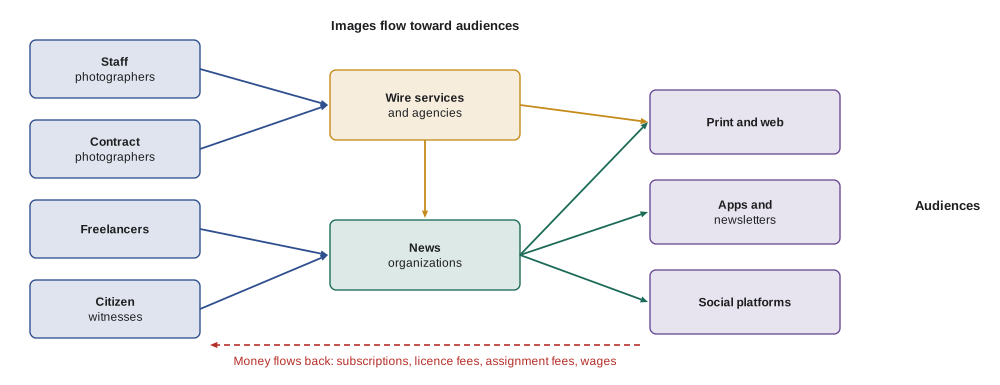
Four groups make most of the news photographs people see. Staff photographers are employees of a news organization: a newspaper, broadcaster, magazine, digital outlet or wire service. They receive a salary and benefits, use equipment that is often supplied or subsidized, and the organization usually owns the copyright in their work. Contract photographers work regularly for one client, often a wire service, under an agreement that may guarantee a number of days or a retainer. Freelancers work for many clients, are paid per assignment or per image, supply their own equipment and insurance, and usually keep the copyright, licensing rights to clients. Finally, citizens and witnesses, people who happen to be present at an event, increasingly supply the first images of breaking news.
The balance has shifted. Staff photography jobs at newspapers in both countries have fallen sharply since the mid-2000s as print advertising revenue collapsed. Many papers that once had five or ten photographers now have one or none and rely on wires, freelancers, reporters with phones and reader submissions. Wire services and large agencies have become more central, and freelancers now produce a large share of original news photography, especially internationally.
| Role | How paid | Who usually owns copyright | Main advantage | Main risk |
|---|---|---|---|---|
| Staff photographer | Salary and benefits | The employer | Stable income, support and backing | Job cuts and little control over use |
| Contract or stringer | Day rate, retainer or per picture | Depends on the contract | Regular work from a main client | Few benefits, uncertain renewal |
| Freelancer | Per assignment or licence fee | Usually the photographer | Independence and rights to the archive | Irregular income, own insurance and gear |
| Citizen witness | Often unpaid or a small fee | The person who took it | Presence at the first moments | No training, verification needed |
Who distributes them
Wire services and agencies are wholesalers of news. A wire service has staff and contract photographers in many places, and sells subscriptions that let news organizations publish its pictures. The Associated Press and Reuters operate globally, as does Agence France-Presse. The Canadian Press is the national news agency in Canada and distributes its own photographers' work alongside images from international partners. Getty Images operates a large news, sport and entertainment service alongside its stock business. Agencies such as Magnum, VII and Panos represent photographers and license their work for editorial and other uses.
Subscribers range from small local papers to national broadcasters and global platforms. A subscription usually gives the right to publish a set number or category of images for editorial use in the subscriber's own products. Wires also license individual images to non-subscribers, and they may share revenue with contributing freelancers.
Publishers include newspapers and their websites, broadcasters' digital operations, magazines, digital-native outlets and newsletters. Platforms such as search engines and social media networks are not publishers in the traditional sense, but they are where many people now see news photographs. Their algorithms decide which images travel, and their terms of service affect how images are shared and credited.
How money flows
News organizations pay for photographs in four main ways. They pay salaries to staff. They pay subscriptions to wire services. They pay assignment fees, usually a day rate or half-day rate plus expenses, to freelancers they commission. And they pay licence fees for individual images, from freelancers, agencies or witnesses. Some organizations also earn money from photographs, by licensing their archives or selling prints and books.
For freelancers, income can come from assignment fees, licence fees for existing pictures, revenue-sharing with an agency that resells their work, grants from foundations and arts councils, book and exhibition projects, teaching and workshops, and commercial or corporate work that subsidizes journalism. Most full-time news freelancers combine several of these streams. Lesson 12 returns to building a sustainable business.
Editorial rates for news work are generally lower than commercial rates for the same time, because publishers have limited budgets and the work is for informing the public rather than selling a product. Rates vary widely by market, publication size and experience, so the figures in this course's examples are illustrative, not quotations. Professional associations publish surveys and guidance on rates; always check current local norms before quoting.
Citizen photographs and user-generated content
When a plane crashes or a protest turns violent, the first pictures often come from bystanders' phones. User-generated content, often called UGC, has given the public access to events that professionals could not reach and has changed history, for example in videos of police encounters. It also creates challenges. The images may be fake, recycled from another event, edited, or taken in a way that put the witness or others in danger. The person who took them owns the copyright and may not have agreed to publication, and they may be traumatized or at risk if identified.
News organizations that use UGC verify it before publication, credit and usually pay the creator, seek permission rather than simply taking images from social media, and consider the creator's safety. Verification techniques, covered in Lesson 8, include contacting the creator directly, checking metadata where available, comparing landmarks, weather and shadows with the claimed place and time, and reverse image searches to find earlier copies.
Platforms, reach and attention
Social platforms reward images that provoke strong reactions, which can favour the dramatic and graphic over the informative. They strip context: a photograph can travel without its caption, and a caption can be replaced by a misleading one. Platform rules on violent or graphic content affect what can be shown. Photographers increasingly publish their own work directly, building audiences on social media and newsletters, but that exposes them to harassment and to the platforms' changing policies.
News organizations have responded by adding context to images, labelling graphic content, embedding provenance information, and in some cases limiting how their images can be reused. Content credentials, discussed in Lesson 7, are one attempt to let provenance travel with an image across platforms, though many platforms still strip metadata when images are uploaded.
Collectives, nonprofits and grants
As traditional jobs have shrunk, photographers have built new structures. Collectives allow photographers to share marketing, administration and editing. Nonprofit newsrooms, funded by donations and foundations, have grown in both countries and often hire photographers for investigative and community projects. Grants from foundations, arts councils and journalism funds support long-term documentary projects. In Canada, provincial and federal arts councils and some journalism funds support photographic projects; in the United States, private foundations play the larger role. Applying for grants requires a clear project proposal, budget and portfolio, skills that are increasingly part of a photojournalist's toolkit.
| Feature | Canada | United States |
|---|---|---|
| National news agency | The Canadian Press | Associated Press (a cooperative) |
| Public support for journalism | Federal labour tax credit for qualifying news organizations, Local Journalism Initiative | Mostly private foundations; public broadcasting funding has been cut |
| Professional association | News Photographers Association of Canada | National Press Photographers Association |
| Main national awards | National Newspaper Awards, Canadian Journalism Foundation | Pulitzer Prizes, Pictures of the Year International |
Responsibility and liability
Who is responsible when a photograph is wrong or unlawful? In general, the publisher takes legal responsibility for what it publishes and the photographer for what they did to get the picture and for the accuracy of their caption. Wire services take responsibility for what they distribute and correct or withdraw images that turn out to be wrong, sending a kill or mandatory removal notice to subscribers. Freelancers should check whether their clients' insurance covers them for claims arising from their work, and many carry their own professional liability insurance. Lesson 10 covers the law.
Editorial standards also flow through the ecosystem. Wire services and major news organizations publish their standards on photo editing, staging and captions, and they apply them to staff and freelancers alike. A freelancer who breaks a client's rules on manipulation can lose not only that client but access to the wires, because the industry is small and word travels.
Editorial versus commercial use
News photographs are licensed for editorial use: to illustrate news, commentary and education. Commercial use, in advertising or to promote a product, generally requires model and property releases, which news photographers do not normally obtain. A wire service image of a crowd at a stadium can illustrate a story about attendance but cannot be used in a beer advertisement without releases from identifiable people and permission from trademark owners. Photographers who license work should state clearly whether a licence is editorial only, and clients should not repurpose editorial images for marketing. PHOT-302 covered licensing in general; the distinction matters especially in news, where releases are rare.
Worked problem
Revenue from a syndicated picture
A freelancer photographs a flood. A wire service licenses one of the pictures to 40 subscribers who are not covered by flat subscriptions, at an average licence fee of $120 per use, and pays contributors 50 percent of net licence revenue after a 10 percent processing deduction. How much does the photographer earn from that image?
Show solution
- Gross licence revenue: 40 × $120 = $4,800.
- Processing deduction of 10 percent: $4,800 × 0.10 = $480, leaving net revenue of $4,320.
- Photographer's share at 50 percent: $4,320 × 0.50 = $2,160.
Answer: About $2,160 from that one image. Most syndicated images earn far less, because few are licensed so widely; revenue sharing rewards the rare picture that travels, so freelancers should not budget on it.
Worked problem
Cost per published picture
A small daily paper is deciding whether to keep a staff photographer. The total cost of the position, including salary, benefits, equipment and vehicle, is $90,000 a year. The photographer produces an average of 6 published pictures a day over 230 working days. Freelance assignments would cost $300 per half day, yielding an average of 3 published pictures each. Compare the cost per published picture.
Show solution
- Staff: 6 × 230 = 1,380 published pictures a year. Cost per picture: $90,000 / 1,380 ≈ $65.
- Freelance: $300 / 3 = $100 per published picture, before expenses.
- To match the staff output with freelancers would cost 1,380 × $100 = $138,000 a year.
Answer: About $65 per picture for staff against $100 for freelancers, if the staff photographer is kept busy. The comparison changes if the paper needs far fewer pictures, which is why many papers with smaller news holes have moved to freelancers and wires.
Reading the ecosystem as a beginner
For a photographer starting out, the practical lesson is to understand where your pictures can go and on what terms before you make them. Ask every new client who will own the images, where they will be published, whether they will be resold through a wire or archive, and what credit you will receive. Keep a simple spreadsheet of clients, rates, rights granted and payment dates, so that patterns, such as a client who always pays late or a contract that quietly asks for all rights, become visible early.
Common mistakes
MistakeAssuming the employer and the freelancer both own the copyright.
InsteadStaff work usually belongs to the employer; freelancers usually keep copyright unless a contract says otherwise.
MistakeTaking a witness's image from social media without asking.
InsteadVerify it, seek permission, credit and pay the creator, and consider their safety.
MistakeSelling an editorial news image for advertising.
InsteadCommercial use needs releases that news photographers rarely have.
MistakeBudgeting on a picture going viral through syndication.
InsteadPlan on assignment fees; treat syndication revenue as a bonus.
MistakeIgnoring a client's editorial standards because you are freelance.
InsteadClients apply their standards to everyone they publish.
Summary and key terms
- News photographs come from staff, contract and freelance photographers and from citizen witnesses.
- Staff jobs have fallen; wires, agencies and freelancers now produce much of the original work.
- Wire services such as The Canadian Press, AP, Reuters and AFP distribute pictures to subscribers.
- Money flows through salaries, subscriptions, assignment fees, licence fees and revenue sharing.
- User-generated content must be verified, permissioned, credited and handled with care for the creator.
- Platforms spread images widely but strip context, which raises the value of captions and provenance.
- Editorial licences do not cover commercial use, which requires releases.
Practice problems
Work each problem on paper first, then reveal the answer to check.
Who usually owns the copyright in a staff photographer's work?
Show answer
The employer.
Name two wire services that operate globally.
Show answer
Any two of the Associated Press, Reuters and Agence France-Presse.
What is the national news agency in Canada?
Show answer
The Canadian Press.
Give two risks of user-generated content.
Show answer
It may be fake or recycled, and the creator may be at risk or not have consented.
What does a kill notice do?
Show answer
It tells subscribers to stop using and remove a picture.
Why can an editorial image not be used in an advertisement?
Show answer
Commercial use needs releases and permissions that news photographers do not usually obtain.
A wire licenses an image 10 times at $150 and pays 50 percent. Photographer's share?
Show answer
10 × $150 × 0.5 = $750, before any deductions.
A staff position costs $80,000 and produces 1,000 published pictures. Cost per picture?
Show answer
$80 per picture.
Name two income streams for a news freelancer other than assignments.
Show answer
Any two of licensing, agency revenue sharing, grants, books, teaching or commercial work.
Why do platforms strip context from images?
Show answer
Images can travel without captions and metadata is often removed on upload.
Lesson quiz · 5 questions
Score 60% or more to complete this lesson.
Create a free account to save your progress, take quizzes and earn a certificate.