
PHOT-320 · Lesson 3 of 12 · 27 min
News values and story selection
Every day far more happens than any news organization can cover. Photo editors and photographers constantly decide what to photograph, which pictures to publish and how prominently. Those decisions rest on news values, a set of criteria journalists use, often without stating them, to judge what matters to an audience. This lesson makes those criteria explicit, shows how they apply to pictures in particular, and examines the biases they can hide.
What makes something news
Scholars and editors have described news values in many ways since the 1960s, when the Norwegian researchers Johan Galtung and Mari Ruge published an influential list. The criteria most often cited are these. Impact: how many people are affected and how seriously. Timeliness: whether it is happening now or newly known. Proximity: how close it is to the audience, geographically or culturally. Prominence: whether well-known people or institutions are involved. Conflict: disagreement, competition or violence. Human interest: emotion, unusual personal stories, children and animals. Novelty: the unexpected or first. Consequence for the future: whether it will change things.
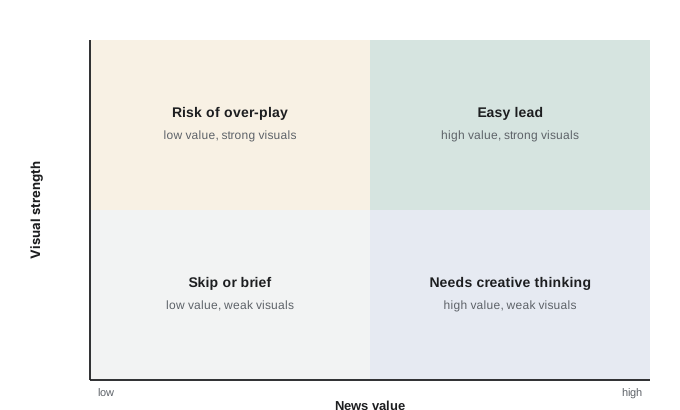
For photographs, additional values apply. Visual impact: whether there is something strong to see. Action and emotion: whether people are doing and feeling something. Access: whether a photographer can get there and be allowed to photograph. Exclusivity: whether this picture is one no one else has. A story with high news value but nothing to see, such as a change in interest rates, is hard to photograph; a minor event with spectacular visuals, such as a small but dramatic fire, can win more space than it deserves.
| News value | Question it asks | Picture example |
|---|---|---|
| Impact | How many are affected, how badly? | A neighbourhood flooded, not a single basement |
| Timeliness | Is it new? | The first light after a storm |
| Proximity | Is it close to our audience? | A local family at a world event |
| Prominence | Are well-known people involved? | A head of government at a disaster site |
| Conflict | Is there disagreement or struggle? | Rival rallies facing each other |
| Human interest | Does it move us? | A reunion at an airport |
| Novelty | Is it unusual? | A moose walking through a downtown core |
| Visual impact | Is there something strong to see? | Smoke filling a skyline |
The photo editor's role
Photo editors manage assignments, choose pictures and argue for them in news meetings. At larger organizations a director of photography sets visual standards; at smaller ones a single editor, or a section editor with no visual training, may make all the decisions. Good photo editors combine news judgement with visual judgement. They ask what the story is, what the reader needs to see to understand it, and which picture does that best, not just which picture is most striking.
The daily cycle at a newspaper or digital outlet begins with a planning meeting where editors list expected stories and assign photographers. Breaking news disrupts the plan, and editors must decide whether to pull a photographer off one assignment to cover another. Later meetings decide which pictures lead the website, the homepage, social channels and the print edition. Each decision weighs news value against what was actually captured.
Planning and anticipating stories
Much news is predictable: elections, budgets, trials, festivals, sports seasons, anniversaries and weather. Planned coverage gives photographers time to research, secure access, scout locations and think of pictures that go beyond the obvious. A photo editor's calendar, or budget in newsroom language, lists these events weeks ahead. Photographers who pitch ideas, rather than wait for assignments, add value: they notice stories in their own communities and propose ways to show them.
A useful planning habit is to ask, for every assignment, what the obvious picture is and what a better picture would be. At a budget announcement, the obvious picture is the minister holding the document; a better one might show the people the budget affects. At a festival, the obvious picture is the main stage; a better one might be the volunteers before dawn. The obvious picture still needs to be made, because editors may need it, but the better one is what readers remember.
Bias, blind spots and who gets covered
News values are not neutral. Proximity and prominence favour the powerful and the nearby. Conflict favours protests over quiet progress, crime over community, and disasters over the long-term conditions that cause them. Human interest can turn individuals into symbols. Studies of news coverage in both countries have found that some communities, including Indigenous peoples, racialized groups, rural residents, people with disabilities and people living in poverty, appear mostly in stories about crime, conflict or suffering and seldom in everyday roles. Photographs can reinforce these patterns even when each individual picture is accurate.
Photojournalists counter this by asking whose stories are missing, building relationships with communities beyond the moments of crisis, and checking their own archives for patterns. Some newsrooms audit their photographs, counting who appears and in what roles. Others involve communities in planning coverage. In Canada, the Truth and Reconciliation Commission's Calls to Action, released in 2015, included calls for journalism education on the history of Indigenous peoples, and many outlets have revised their approaches to covering Indigenous communities. In the United States, newsroom diversity surveys and organizations representing journalists of colour have pushed similar changes.
A related problem is parachute journalism: flying in to cover a crisis without knowledge of the place, then leaving. It often produces pictures that are dramatic but shallow or stereotyped. Working with local photographers, fixers and journalists, and crediting them properly, produces better and fairer coverage.
Photographing stories that are hard to see
Some of the most important stories, such as housing costs, climate change, health policy, inequality and corruption, lack obvious pictures. Approaches that help include finding a person whose life shows the issue, photographing the places where it happens, using portraits with strong environmental context, documenting processes over time, and working with data journalists to pair pictures with graphics. The aim is to make the abstract concrete without exaggerating. A single dramatic image of a flooded house can stand for climate change, but it can also mislead if the flood had little to do with long-term trends; captions and accompanying reporting must keep the connection honest.
Selecting pictures for publication
Once pictures exist, editors choose among them. Criteria include news value, accuracy, technical quality, composition, emotional impact, and appropriateness for the audience and platform. An editor must also think about what the picture says beyond the facts: whether it fairly represents the event, whether it dignifies or humiliates the people in it, whether it will be read as taking sides. Choosing a picture of one protester throwing a rock at a peaceful march of thousands may be accurate in a narrow sense but misleading about the event as a whole.
Placement matters too. A picture on the homepage or front page signals importance. Size, cropping and the headline beside it change how it is read. Editors should consider the full package: picture, caption, headline and story together.
| Criterion | Question |
|---|---|
| Accuracy | Does it show what happened, without misleading? |
| News value | Does it show the most important aspect of the story? |
| Representativeness | Is it typical of the event, or an outlier? |
| Quality | Is it sharp enough, well exposed and well composed for its use? |
| Emotion | Does it connect the viewer to the people involved? |
| Dignity | Does it respect the people shown? |
| Context | Can a caption explain what it shows? |
Weighing news values against harm
News value sometimes conflicts with other values. A picture of a grieving parent has strong human interest but intrudes on private grief. A graphic image of a dead body shows the reality of violence but may traumatize viewers or the victim's family. A picture of a child may be powerful but expose the child to harm. Editors weigh these factors case by case, guided by ethics codes that ask journalists to seek truth and also to minimize harm. Lessons 9 and 11 discuss these decisions in depth, but they start here, in the judgement of what is news.
Worked problem
Scoring competing assignments
A photo desk has one photographer available at 3 p.m. Two events compete: a fire at a vacant warehouse downtown (impact 2, timeliness 5, proximity 5, visual impact 5, access 3) and a court ruling on a local school closure affecting 400 families (impact 5, timeliness 5, proximity 5, visual impact 2, access 2). Each criterion is scored from 1 to 5. Using a simple total, and then weighting impact double, which assignment should get the photographer?
Show solution
- Simple totals: fire 2 + 5 + 5 + 5 + 3 = 20; court ruling 5 + 5 + 5 + 2 + 2 = 19.
- With impact doubled: fire 20 + 2 = 22; ruling 19 + 5 = 24.
- The simple total favours the fire because of its visuals; weighting impact favours the ruling, which affects 400 families.
- A thoughtful desk might send the photographer to the ruling, plan a portrait of affected families, and use a wire or reader picture of the fire.
Answer: The weights decide the outcome. Making the scoring explicit shows that visual drama can outweigh public importance unless impact is given its due.
Worked problem
Auditing a month of coverage
An editor reviews 600 published local photographs from one month. People from a particular neighbourhood appear in 48 pictures: 30 in crime or emergency stories, 10 in sports and 8 in community or business stories. Across all coverage, crime and emergency stories account for 15 percent of photographs. What does the audit show?
Show solution
- Share of the neighbourhood's pictures that are crime or emergency: 30 / 48 = 62.5 percent.
- Share across all coverage: 15 percent.
- The neighbourhood is shown in crime and emergency contexts about 62.5 / 15 ≈ 4.2 times as often as the average.
Answer: The neighbourhood appears mainly through crime and emergencies, at about four times the usual rate. The desk should plan everyday coverage there, such as schools, businesses, culture and sport, and build relationships beyond crisis moments.
Story selection in practice
On a typical day a photo desk might weigh a planned announcement, a breaking incident, a feature idea from a photographer and a long-term project. A useful discipline is to state, in one sentence, what each picture should tell the reader. If that sentence is weak or vague, the assignment probably needs rethinking before anyone leaves the newsroom. If it is strong, the photographer knows what to look for and the editor knows what to expect.
Photographers also contribute to selection through what they file. Sending a short note with the pictures, explaining which frame you think is strongest and why, and flagging anything the editor should know, such as a person who asked not to be identified, helps the desk choose well. Editors value photographers who think about the story, not only the pictures.
News judgement improves with practice and feedback. Compare your selections with what was published, and with how other outlets covered the same event, and ask editors why they chose differently. Over time, the reasons behind good selection become instinctive.
Common mistakes
MistakeLetting the most dramatic picture decide what the story is.
InsteadStart from what matters to the audience, then find the best picture of that.
MistakeCovering some communities only during crises.
InsteadBuild relationships and cover everyday life, achievements and change.
MistakeMaking only the obvious picture at planned events.
InsteadMake the obvious picture, then look for a better one that explains the story.
MistakeChoosing an outlier image that misrepresents the event.
InsteadCheck that the picture is representative, or explain in the caption that it is not.
MistakeIgnoring local photographers and fixers on out-of-town stories.
InsteadWork with and credit people who know the place.
Summary and key terms
- News values include impact, timeliness, proximity, prominence, conflict, human interest, novelty and consequence.
- Photographs add visual impact, action, emotion, access and exclusivity.
- Photo editors balance news judgement and visual judgement in planning and selecting pictures.
- News values carry biases that can leave some communities seen only in crime or crisis.
- Stories that are hard to see need creative, honest approaches such as portraits and processes.
- Choosing a picture means checking accuracy, representativeness, quality, emotion, dignity and context.
- News value must be weighed against harm to subjects and audiences.
Practice problems
Work each problem on paper first, then reveal the answer to check.
Name four general news values.
Show answer
Any four of impact, timeliness, proximity, prominence, conflict, human interest, novelty and consequence.
Name two news values specific to photographs.
Show answer
Any two of visual impact, action, emotion, access and exclusivity.
Why can conflict as a news value be a problem?
Show answer
It favours protests and crime over quiet progress and long-term conditions.
What is parachute journalism?
Show answer
Covering a place briefly without local knowledge or relationships.
Give one approach to photographing an abstract story such as housing costs.
Show answer
Find a person whose life shows the issue, or photograph the places and processes involved.
Why might an accurate photo still mislead?
Show answer
It may be an outlier unrepresentative of the event.
Scores 3, 4, 5 and 2. Total?
Show answer
14.
A community appears in 20 pictures, 12 in crime stories. What share is crime?
Show answer
60 percent.
What is a newsroom budget?
Show answer
The list of planned stories and assignments.
What should you do at a planned event besides the obvious picture?
Show answer
Look for a better picture that explains the story.
Lesson quiz · 5 questions
Score 60% or more to complete this lesson.
Create a free account to save your progress, take quizzes and earn a certificate.