
PHOT-101 · Lesson 3 of 12 · 31 min
Aperture and depth of field
The aperture is the adjustable opening inside the lens. It controls how much light passes, and it has a powerful side effect: it decides how much of the scene in front of and behind the point of focus looks sharp. A wide aperture can isolate a face against a soft, dissolving background; a small one can keep everything sharp from wildflowers at your feet to mountains on the horizon. This lesson explains the f-number scale and why it runs the way it does, depth of field and the factors that control it, how to calculate it and the hyperfocal distance, how sensor size enters through equivalence, the quality of out-of-focus areas, and the limit set by diffraction. VIS-101 introduced depth of field as a tool for creating depth in a composition; here it becomes a setting you control precisely.
The f-number
The size of the aperture is expressed as an f-number N, the focal length divided by the diameter of the opening (the entrance pupil):
So f/2 on a 50 mm lens means an opening 25 mm across, and f/8 means 6.25 mm. Because the f-number is a ratio, the same f-number lets through the same intensity of light on any lens, which is why exposure settings transfer between lenses and cameras. A larger f-number means a smaller opening: f/16 is a small aperture, f/1.4 a wide one. Photographers say "stopping down" for moving to a larger f-number and "opening up" for a smaller one.
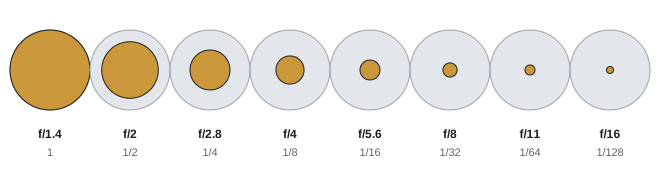
The light admitted depends on the area of the opening, which is proportional to D², so it varies as 1/N². To halve the light (one stop), the area must halve, so the diameter must fall by √2 and the f-number must rise by √2 ≈ 1.414. That is why the standard full-stop sequence looks irregular:
| f-number | 1.4 | 2 | 2.8 | 4 | 5.6 | 8 | 11 | 16 | 22 |
|---|---|---|---|---|---|---|---|---|---|
| Light relative to f/1.4 | 1 | 1/2 | 1/4 | 1/8 | 1/16 | 1/32 | 1/64 | 1/128 | 1/256 |
Every second number doubles (1.4, 2.8, 5.6, 11, 22 and 2, 4, 8, 16), which makes the sequence easy to remember. Most cameras also set apertures in thirds of a stop, such as f/4.5 and f/5 between f/4 and f/5.6. The widest aperture a lens can reach is its maximum aperture, given in its name; a lens with a wide maximum aperture is called fast, because it allows faster shutter speeds in a given light.
Worked problem
Counting stops
A meter suggests 1/250 s at f/11. You want a shallow depth of field at f/2.8. What shutter speed keeps the same exposure?
Show solution
- From f/11 to f/2.8 is four stops wider: f/11 → 8 → 5.6 → 4 → 2.8.
- Four stops more light must be offset by a shutter time 2⁴ = 16 times shorter.
- 1/250 s ÷ 16 = 1/4000 s.
Answer: 1/4000 s at f/2.8. Many cameras' mechanical shutters top out at 1/4000 or 1/8000 s, so in bright sun, very wide apertures may need an electronic shutter, a lower ISO, or a neutral density filter (Lesson 4).
Depth of field
A lens focuses perfectly at one distance only. A point on an object nearer or farther than that distance is imaged not as a point but as a small disc, the circle of confusion. If the disc is small enough, the eye cannot distinguish it from a point at normal viewing size, and the object looks sharp. Depth of field (DOF) is the range of distances, in front of and behind the focus point, within which the blur stays below that acceptable size. It is not a sharp boundary: sharpness falls off gradually on either side of the focused distance.
Depth of field depends on three things:
- Aperture: smaller apertures (larger f-numbers) give more depth of field, because the cone of light from each point is narrower.
- Focus distance: closer subjects give much less depth of field; it shrinks roughly with the square of the distance.
- Focal length and magnification: at the same distance, longer lenses give less depth of field. For the same framing of the subject, the effect of focal length on the depth of field around the subject is small; what changes is how blurred the distant background looks.
At ordinary distances, depth of field extends somewhat farther behind the focus point than in front of it, roughly one-third in front and two-thirds behind; at close-up distances it becomes nearly equal on both sides.
Calculating depth of field
Depth of field can be calculated from the focal length f, f-number N, focus distance s and the acceptable circle of confusion c. A common value of c for full frame is 0.03 mm (about 0.02 mm for APS-C and 0.015 mm for Micro Four Thirds), based on a typical print viewed at a normal distance; demanding work uses smaller values. First compute the hyperfocal distance H, then the near and far limits:
If s is at or beyond H, the far limit is infinity.
Worked problem
Depth of field for a portrait
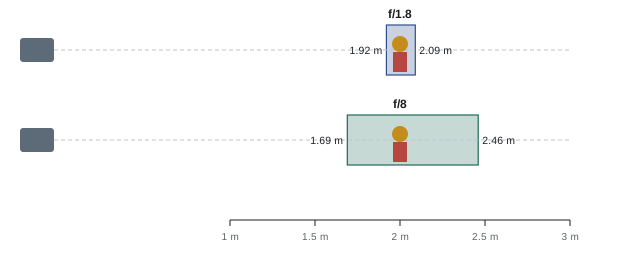
A 50 mm lens on full frame (c = 0.03 mm) is focused on a person 2.0 m away. Find the depth of field at f/1.8 and at f/8.
Show solution
- f/1.8: H = 50²/(1.8 × 0.03) + 50 = 46,350 mm. Near = 2000 × 46,350/(46,350 + 1,950) = 1.92 m; far = 2000 × 46,350/(46,350 − 1,950) = 2.09 m. DOF ≈ 17 cm.
- f/8: H = 50²/(8 × 0.03) + 50 = 10,470 mm. Near = 1.69 m; far = 2.46 m. DOF ≈ 77 cm.
Answer: At f/1.8 only about 17 cm is acceptably sharp, enough for a face if you focus on the near eye but not for two people standing one behind the other; at f/8, about 77 cm. For a group of people in two rows, f/5.6 to f/8 at a few metres is a common choice. Phone and online calculators perform the same calculation.
Tighter framing shrinks depth of field quickly. A head-and-shoulders portrait with an 85 mm lens at f/1.8 from 2.5 m has only about 9 cm of depth of field, less than the distance from the tip of the nose to the ears, which is why focusing precisely on the nearer eye matters so much (Lesson 7). In close-up work it is often only a few millimetres.
The hyperfocal distance
Focusing at the hyperfocal distance H makes everything from H/2 to infinity acceptably sharp, the greatest depth of field possible at that aperture. Landscape photographers use it to keep both a nearby foreground and the distant horizon sharp.
Worked problem
Foreground to horizon
A landscape photographer uses a 24 mm lens on full frame at f/11 (c = 0.03 mm). Where should she focus, and what will be sharp?
Show solution
- H = 24²/(11 × 0.03) + 24 = 1,745 + 24 = 1,769 mm ≈ 1.8 m.
- Focus at about 1.8 m; everything from about 0.9 m to infinity is acceptably sharp.
Answer: Focus at about 1.8 m, not at infinity. Focusing on the horizon would waste half the depth of field behind it, where there is nothing to photograph, and the foreground would be soft. In practice photographers focus a little beyond the calculated hyperfocal distance for a margin of safety at the far end, and check the result by magnifying the image on the camera's screen.
When even the smallest sensible aperture cannot give enough depth of field, as in close-up and product work or a landscape with flowers a few centimetres from the lens, photographers use focus stacking: several frames at different focus distances combined in software, taking the sharp parts of each.
Sensor size and equivalence
For the same framing, angle of view and f-number, a smaller sensor gives more depth of field, because it uses a shorter focal length and the acceptable circle of confusion scales with the sensor. To a good approximation, two cameras give the same framing and depth of field if their focal lengths and their f-numbers are both scaled by the crop factor. A 33 mm lens at f/1.8 on APS-C (crop 1.5) gives about the same picture as a 50 mm lens at f/2.7 on full frame: the depth of field in the example above becomes about 26 cm instead of 17 cm. Phones, with crop factors around 3 to 7 and apertures around f/1.8, have depth of field like f/6 to f/13 on full frame, which is why their "portrait mode" simulates background blur computationally by estimating depth and blurring the background in software, sometimes with errors around hair and glasses.
Equivalence concerns depth of field and framing only. The exposure for a given f-number, shutter speed and ISO is the same on every format.
Bokeh: the quality of blur
Bokeh (from a Japanese word for blur or haze) describes the character of the out-of-focus areas of an image. Lenses differ: some render blurred backgrounds smoothly and creamily, others with harsh edges, "busy" swirls or doubled lines. The shape of the aperture also shows in out-of-focus points of light, such as street lamps behind a portrait: lenses with many rounded aperture blades give circular highlights, while those with few straight blades give polygons when stopped down. The amount of background blur grows with focal length, aperture diameter, and the distance between subject and background relative to subject distance. To make a background melt away, open up, move closer to the subject, use a longer lens and move the subject away from the background.
Worked problem
Simplifying a busy background
A portrait in a park shows distracting branches 3 m behind the subject. Using a 50 mm f/1.8 lens, what could you change to soften them?
Show solution
- Open the aperture fully (f/1.8).
- Move the subject away from the branches, ideally to 10 m or more of open space behind them.
- Step closer for a tighter crop, or switch to an 85 mm lens and step back to keep the framing; the narrower angle of view also includes less background.
Answer: Each change increases the blur of the background relative to the subject. Changing the background, by moving yourself or the subject, is often the most effective change of all, and it costs nothing.
Sharpness, the sweet spot and diffraction
Most lenses are slightly soft at their widest aperture because of optical aberrations, and become sharpest about two to three stops down, often around f/5.6 to f/8: the lens's sweet spot. Stopping down further increases depth of field but eventually reduces sharpness because of diffraction, the spreading of light as it passes through a small opening. The blur disc from diffraction has a diameter of about 2.44λN, where λ is the wavelength of light (about 0.55 µm for green):
- At f/8: 2.44 × 0.55 × 8 ≈ 11 µm.
- At f/16: about 21 µm.
When the diffraction disc grows to several times the pixel pitch (about 4 µm on a 24 MP APS-C sensor, 6 µm on a 24 MP full-frame sensor), fine detail softens across the whole image. This is why landscape photographers often work at f/8 to f/11 rather than f/22, and why very high-resolution cameras show diffraction softening sooner. Like most technical limits, it is a trade-off: a slightly soft image with the foreground in focus is usually better than a crisp one with a blurred foreground.
Cinema lenses are marked in T-stops rather than f-stops: a T-stop measures the light actually transmitted, accounting for losses in the glass, so that exposures match exactly between lenses. For still photography, the difference is small and f-numbers are used.
Common mistakes
MistakeThinking f/16 is a bigger opening than f/4.
InsteadLarger f-numbers mean smaller openings and less light.
MistakeFocusing on infinity for landscapes with a near foreground.
InsteadFocus at or slightly beyond the hyperfocal distance.
MistakeShooting groups in several rows at f/1.8.
InsteadStop down to f/5.6 to f/8 so every row is within the depth of field.
MistakeAlways using the smallest aperture for maximum sharpness.
InsteadDiffraction softens images beyond about f/11; consider focus stacking.
MistakeTrying to blur a background that is right behind the subject.
InsteadIncrease the distance between subject and background.
Summary and key terms
- The f-number N = f/D; light varies as 1/N², so full stops step by √2.
- Full stops: f/1.4, 2, 2.8, 4, 5.6, 8, 11, 16, 22; each halves the light.
- Depth of field grows with larger f-numbers, greater distance and shorter focal length.
- Calculate it from H = f²/(Nc) + f and the near and far limits.
- Focusing at the hyperfocal distance makes everything from H/2 to infinity acceptably sharp.
- Smaller sensors give more depth of field for the same framing and f-number.
- Lenses are sharpest two to three stops down; diffraction softens images at small apertures.
- f-number
- Focal length divided by aperture diameter.
- Stopping down
- Changing to a smaller aperture (larger f-number).
- Fast lens
- A lens with a wide maximum aperture.
- Circle of confusion
- The largest blur disc perceived as a point at normal viewing size.
- Depth of field
- The range of distances that appears acceptably sharp.
- Hyperfocal distance
- The focus distance giving acceptable sharpness from half that distance to infinity.
- Focus stacking
- Combining frames focused at different distances to extend depth of field.
- Equivalence
- Matching framing and depth of field across formats by scaling focal length and f-number.
- Bokeh
- The visual quality of out-of-focus areas.
- Diffraction
- Spreading of light at a small aperture that limits sharpness.
Practice problems
Work each problem on paper first, then reveal the answer to check.
What is the aperture diameter of a 100 mm lens at f/4?
Show answer
25 mm.
How many stops separate f/2 and f/8?
Show answer
Four stops.
Which full stop lies between f/5.6 and f/11?
Show answer
f/8.
A meter reads 1/60 s at f/8. What shutter speed gives the same exposure at f/4?
Show answer
1/250 s (two stops faster).
Name three ways to increase depth of field.
Show answer
Stop down, move farther from the subject, use a shorter focal length (or a smaller sensor).
Find the hyperfocal distance for a 35 mm lens at f/8 on full frame (c = 0.03 mm).
Show answer
35²/(8 × 0.03) + 35 ≈ 5,140 mm ≈ 5.1 m.
If focused at that distance, what is the near limit of sharpness?
Show answer
About 2.6 m.
What full-frame settings match a Micro Four Thirds camera at 25 mm f/1.4 (crop 2.0)?
Show answer
About 50 mm at f/2.8.
Estimate the diffraction blur disc at f/22 for green light.
Show answer
2.44 × 0.55 × 22 ≈ 30 µm.
Give two ways to make a background softer in a portrait.
Show answer
For example: open up, move the subject away from the background, use a longer lens, move closer.
Lesson quiz · 5 questions
Score 60% or more to complete this lesson.
Create a free account to save your progress, take quizzes and earn a certificate.