
PHOT-101 · Lesson 2 of 12 · 28 min
Lenses, focal length and perspective
The lens decides what part of the world reaches the sensor and how it is drawn. Change from a wide-angle lens to a telephoto and the same scene can look spacious or compressed, intimate or distant, dramatic or calm. Yet much of what people attribute to lenses actually comes from where the photographer stands. This lesson explains focal length and angle of view, how sensor size changes them, the real cause of perspective effects, the families of lenses and what each is good for, the difference between primes and zooms, close-up photography, and the optical flaws worth recognizing. The aim is to choose a lens, and a position, for the picture you want rather than out of habit.
Focal length and angle of view
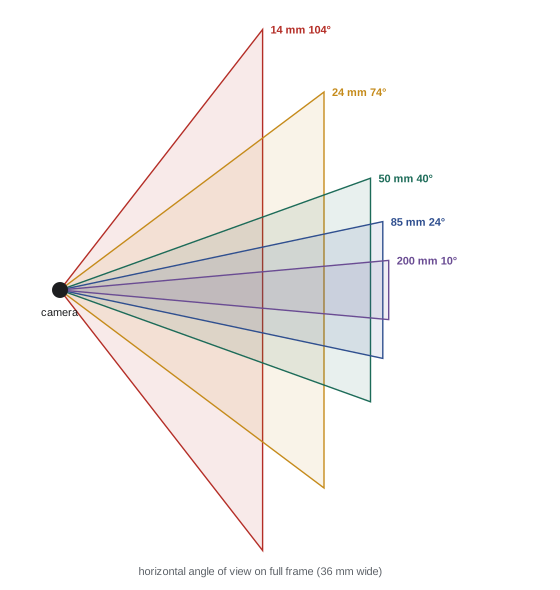
Lesson 1 defined focal length as the distance behind the lens at which distant subjects come into focus. For a given sensor, it determines the angle of view, how much of the scene the camera sees. A short focal length projects a small image of each object, so more of the scene fits on the sensor; a long focal length projects a large image of a small part of the scene. For a sensor of dimension d (width, height or diagonal) and a lens of focal length f focused at a distance, the angle of view is:
| Focal length (full frame) | Diagonal angle of view | Category | Typical uses |
|---|---|---|---|
| 14 mm | 114° | Ultra-wide | Interiors, architecture, dramatic landscapes |
| 24 mm | 84° | Wide | Landscapes, environmental portraits, events |
| 35 mm | 63° | Moderate wide | Street, documentary, everyday |
| 50 mm | 47° | Normal | General use; similar to the eye's central field |
| 85 mm | 29° | Short telephoto | Head-and-shoulders portraits |
| 200 mm | 12° | Telephoto | Sport, events from a distance, compressed landscapes |
| 400 mm | 6° | Super-telephoto | Wildlife, field sports |
A "normal" lens has a focal length close to the diagonal of the sensor, about 43 mm for full frame (50 mm in practice). Pictures from it look natural because their angle of view resembles the part of the scene we attend to, not because the eye has a focal length of 50 mm.
Sensor size and equivalent focal length
The same lens gives a narrower angle of view on a smaller sensor, because the sensor captures only the middle of the image the lens projects. To compare framing across formats, photographers use the full-frame equivalent focal length: the actual focal length multiplied by the crop factor (Lesson 1). A 35 mm lens on an APS-C camera (crop factor 1.5) frames like a 52 mm lens on full frame; a 25 mm lens on Micro Four Thirds (crop 2.0) frames like a 50 mm. Phone makers quote equivalent focal lengths, so a phone main camera described as "24 mm" actually has a lens of about 6 to 7 mm in front of a small sensor.
Equivalence affects only framing (and, as Lesson 3 shows, depth of field). It does not change the lens's actual focal length or its f-number's effect on exposure: f/2.8 gives the same exposure on any format.
Worked problem
Matching framing across formats
A photographer uses an 85 mm lens on full frame for head-and-shoulders portraits. What focal length gives the same framing from the same position on an APS-C camera (crop 1.5) and on Micro Four Thirds (crop 2.0)?
Show solution
- Divide the full-frame focal length by the crop factor.
- APS-C: 85/1.5 = 57 mm, so a 56 mm lens is the usual choice.
- Micro Four Thirds: 85/2.0 = 42.5 mm, so a 42.5 or 45 mm lens.
Answer: About 56 mm on APS-C and 42.5 to 45 mm on Micro Four Thirds. Manufacturers make lenses at exactly these focal lengths for this reason.
Perspective comes from position
Wide-angle lenses are often said to "exaggerate" depth and telephotos to "compress" it. Strictly, perspective, the relative size and position of near and far objects, depends only on where the camera is. From a given spot, a wide-angle picture cropped to the same framing as a telephoto picture shows exactly the same relationships between near and far objects. What differs is how the photographer uses each lens:
- With a wide-angle lens, photographers move close to fill the frame. Nearby objects are then much closer than distant ones, so they look large and the background small and far away: depth seems exaggerated.
- With a telephoto lens, photographers stand far back. Near and far objects are then at similar distances relative to the camera, so their sizes are similar: the background looms close behind the subject, and depth seems compressed.
Worked problem
Why telephotos "compress"
A person stands 2 m in front of a mountain hut that is 50 m behind them. Compare the ratio of the person's distance to the hut's distance when you photograph from 1.5 m with a wide-angle lens and from 15 m with a telephoto.
Show solution
- Image size is proportional to object size divided by distance.
- From 1.5 m: person 1.5 m away, hut 51.5 m away; the hut is drawn at 1.5/51.5 = 1/34 of the scale of the person.
- From 15 m: person 15 m away, hut 65 m away; the hut is drawn at 15/65 = 1/4.3 of the scale.
Answer: From far away, the hut is drawn about eight times larger relative to the person, so it seems to sit just behind them. The telephoto lens is needed only to fill the frame from that distance. Stepping back and zooming in is how photographers make a moon look huge behind a building or a street look crowded.
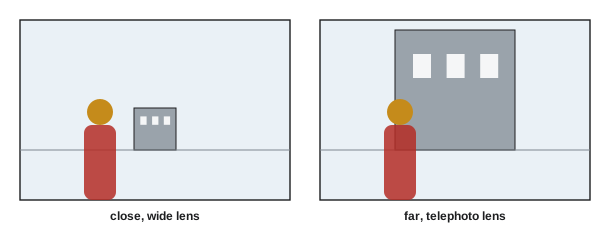
Distance also affects faces. Photographed from 50 cm with a wide lens, a nose is noticeably closer to the camera than the ears, so it looks enlarged and the face distorted, the effect familiar from close-up selfies. From 2 to 3 m with a short telephoto, the proportions look natural, which is why 85 mm and similar lenses are favoured for portraits. Wide lenses also make vertical lines converge when tilted up at buildings (keystoning); keep the camera level, use a tilt-shift lens, or correct it in editing (Lesson 10).
Worked problem
How far away to stand
You want a full-length portrait of a person 1.8 m tall filling the long side of a full-frame sensor (36 mm) in vertical orientation, with a little margin (frame height 2.1 m). How far away should you stand with a 50 mm lens and with an 85 mm lens?
Show solution
- Magnification = sensor dimension/scene dimension = 36 mm/2,100 mm = 0.0171.
- For distant subjects, distance ≈ focal length/magnification.
- 50 mm: 50/0.0171 = 2.9 m. 85 mm: 85/0.0171 = 5.0 m.
Answer: About 2.9 m with a 50 mm lens and 5.0 m with an 85 mm. The longer lens needs more room, which matters in small studios and homes, but gives more natural proportions and a narrower, simpler background.
Prime and zoom lenses
A prime lens has a single focal length; a zoom covers a range, such as 24–70 mm or 70–200 mm. Each has advantages:
- Primes are usually smaller, lighter, sharper and faster (wider maximum aperture, such as f/1.4 or f/1.8) for their cost, which helps in low light and for shallow depth of field. Working with one focal length also trains you to move and to see in that lens's angle of view.
- Zooms are versatile: one lens covers many framings, which suits events, travel and situations where you cannot move or change lenses. Professional zooms with a constant maximum aperture (for example 24–70 mm f/2.8) are excellent but large and costly; consumer zooms are lighter and cheaper with variable, smaller maximum apertures (for example f/3.5–5.6).
A lens's name gives its focal length and maximum aperture: "50 mm f/1.8" or "70–200 mm f/4". Other markings indicate image stabilization, the lens mount and special features such as macro.
Lens families and their uses
Beyond focal length, some lenses are designed for particular jobs:
- Macro lenses focus close enough to reproduce small subjects at life size (1:1 magnification) on the sensor: insects, flowers, products, textures.
- Tilt-shift lenses can shift to correct converging verticals in architecture and tilt the plane of focus, for landscapes sharp from front to back or for a miniature-model effect.
- Fisheye lenses capture 180° or more with strong curved distortion, used for creative and scientific purposes.
- Teleconverters fit between camera and lens to multiply focal length (1.4× or 2×), at the cost of one or two stops of light.
Lens image stabilization (and in-body stabilization, which moves the sensor) counteracts small hand movements, allowing slower handheld shutter speeds (Lesson 4). It does not freeze a moving subject.
Close-up photography
Magnification is the ratio of the size of the image on the sensor to the size of the subject. A typical lens at its closest focus reaches about 0.1 to 0.25×; a macro lens reaches 1×, so a 20 mm insect spans 20 mm on the sensor, more than half the width of a full-frame sensor. Close up, depth of field becomes very shallow (Lesson 3), lighting becomes difficult because the lens and photographer cast shadows, and tiny movements blur the image, so macro photographers use tripods, focus rails and flash, and often combine several frames focused at different distances (focus stacking). Cheaper routes to close-up work include extension tubes, which move a lens farther from the sensor so it focuses closer, and screw-on close-up lenses.
Optical flaws to recognize
No lens is perfect. Recognizing common flaws helps you choose equipment, avoid problems and fix them in editing:
- Softness: images less sharp at the edges than the middle, often worst at the widest aperture; stopping down two stops usually helps (Lesson 3).
- Vignetting: darkening toward the corners, also strongest wide open; it can be corrected or used deliberately.
- Distortion: straight lines bowing outward (barrel distortion, common in wide lenses) or inward (pincushion, common in telephotos); editing software corrects it with lens profiles.
- Chromatic aberration: coloured fringes along high-contrast edges, because the lens focuses different wavelengths slightly differently.
- Flare and ghosting: reduced contrast and bright artefacts when a strong light source is in or near the frame; a lens hood and shading the lens help.
Lens profiles in raw processing software (Lesson 10) correct distortion, vignetting and some chromatic aberration automatically. Phones correct them in processing before you ever see the image.
Common mistakes
MistakeBelieving focal length alone changes perspective.
InsteadPerspective depends on camera position; focal length sets framing.
MistakePhotographing faces close up with a wide lens.
InsteadStand back 2 m or more and use a normal to short telephoto lens.
MistakeComparing focal lengths across formats without the crop factor.
InsteadMultiply by the crop factor to compare framing.
MistakeZooming instead of moving.
InsteadChoose the viewpoint first, then the focal length to frame it.
MistakeShooting into the sun without a hood or shade.
InsteadUse a lens hood and shade the lens to reduce flare.
Summary and key terms
- Focal length sets the angle of view: θ = 2 arctan(d/2f).
- A normal lens is about the sensor diagonal; shorter is wide, longer is telephoto.
- Equivalent focal length = actual focal length × crop factor; f-number exposure is the same on all formats.
- Perspective depends on camera position; wide lenses used close exaggerate depth, telephotos from afar compress it.
- Primes are light, sharp and fast; zooms are versatile.
- Macro, tilt-shift, fisheye lenses and stabilization serve special needs.
- Recognize softness, vignetting, distortion, chromatic aberration and flare.
- Angle of view
- The angular extent of the scene captured by a lens and sensor.
- Normal lens
- A lens whose focal length is close to the sensor diagonal.
- Equivalent focal length
- The full-frame focal length giving the same angle of view.
- Perspective
- The relative size and position of objects, set by camera position.
- Keystoning
- Converging vertical lines from tilting the camera.
- Prime lens
- A lens with a single focal length.
- Zoom lens
- A lens with a variable focal length.
- Magnification
- The ratio of image size on the sensor to subject size.
- Vignetting
- Darkening of the image toward the corners.
- Chromatic aberration
- Coloured fringing from wavelength-dependent focusing.
Practice problems
Work each problem on paper first, then reveal the answer to check.
Find the horizontal angle of view of a 50 mm lens on full frame (width 36 mm).
Show answer
2 arctan(18/50) ≈ 39.6°.
What full-frame focal length matches a 23 mm lens on APS-C (crop 1.5)?
Show answer
About 35 mm.
A phone lens is 6.9 mm with a crop factor of 3.5. What is its equivalent focal length?
Show answer
About 24 mm.
Does stepping back and zooming in change perspective or framing?
Show answer
Stepping back changes perspective; zooming restores the framing.
Why do close selfies make noses look large?
Show answer
The nose is much closer to the camera than the rest of the face at short distances.
How far away must you stand to frame a 1.2 m wide product across the 36 mm width with a 100 mm lens?
Show answer
Magnification 0.03; distance ≈ 100/0.03 ≈ 3.3 m.
Give one advantage of a prime and one of a zoom.
Show answer
Prime: faster and lighter; zoom: versatile framing without changing lenses.
What magnification does a true macro lens reach?
Show answer
1:1 (life size).
Name two lens flaws that are strongest at the widest aperture.
Show answer
Softness and vignetting.
How can converging verticals in architecture be avoided?
Show answer
Keep the camera level, use a tilt-shift lens, or correct in editing.
Lesson quiz · 5 questions
Score 60% or more to complete this lesson.
Create a free account to save your progress, take quizzes and earn a certificate.