
PHOT-101 · Lesson 12 of 12 · 25 min
The photo essay project and critique
A single photograph can be powerful, but many of the most influential works of photography are groups of pictures that together tell a story or explore a theme: the photo essay. Making one draws on everything in this course, from exposure and focus to viewpoint, timing, light, workflow and ethics, and adds new skills: choosing a subject you can access over time, planning coverage, editing ruthlessly, sequencing, writing captions and presenting the result. This final lesson explains what a photo essay is, how to plan and shoot one, how to edit and sequence it, how to write captions, how to critique your own and others' work, and the course project, with a technical checklist and how the project is assessed.
What a photo essay is
A photo essay is a set of photographs, usually with captions and sometimes text, that works as a whole. Essays take two broad forms:
- Narrative essays tell a story with a beginning, middle and end: a day in the life of a nurse, the restoration of a canoe, a family preparing for a wedding, a season on a farm.
- Thematic essays explore an idea through related images that may not form a sequence in time: solitude in the city, the colour of a neighbourhood, how people use one park, traces of industry in a landscape.
The modern photo essay grew up in picture magazines such as LIFE in the mid-twentieth century. W. Eugene Smith's "Country Doctor" (1948), which followed a rural physician in Colorado for weeks, showed how a sequence of images could build character, place and drama. Documentary photographers, photojournalists, and today many social media creators and brand storytellers use the same principles.
Choosing a subject
The best subjects for a first essay are close at hand, accessible repeatedly, and interesting to you. Access matters more than exotic locations: a local bakery that opens at 4 a.m., a community garden, a sports team's season, a grandparent's craft, a building under construction, a bus route, a market. Ask:
- Can I photograph this several times, at different times of day?
- Will the people involved agree, and can I get their consent and releases where needed (Lesson 11)?
- Is there change, activity or emotion to photograph, or a clear idea to explore?
- Can I do it safely?
Write a one-paragraph proposal stating the subject, why it matters to you, what you hope viewers will understand or feel, and how you will get access. A focused question ("How does a small bakery prepare for its busiest day?") makes a stronger essay than a broad topic ("food").
Planning coverage
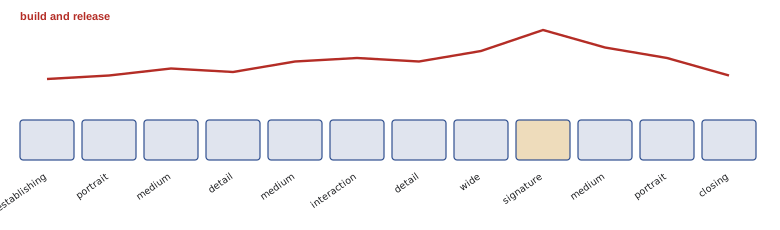
Picture editors have long described the kinds of pictures that make an essay work. A shot list based on them keeps coverage varied:
| Picture type | Purpose | Example (bakery) |
|---|---|---|
| Establishing (wide) shot | Sets the scene and place | The shop from across the street before dawn |
| Medium shots | Show activity and relationships | Two bakers shaping loaves |
| Close-ups and details | Texture, hands, objects, telling details | Flour-dusted hands; a worn wooden peel |
| Portraits | Introduce the people | The owner by the ovens |
| Interaction or relationship | Connection between people | A regular customer and the baker laughing |
| Signature (key) image | Sums up the story | The baker silhouetted against the oven's glow |
| Closing image | Ends the story | Empty shelves and a closed sign at day's end |
Plan the light too (Lesson 9): when is the place at its best, and what light will each part of the story have? Plan technical settings for difficult situations in advance, such as high ISO and fast lenses for dim interiors, a fast shutter for movement, and manual exposure for steady artificial light (Lessons 5 and 6). Be flexible: the plan is a guide, and the most telling pictures often come from things you did not expect.
Shooting
Spend time. Return several times so people get used to you and forget the camera; the most natural pictures usually come after the first hour, or the third visit. Work each scene (Lesson 9), and anticipate moments. Vary focal length, distance and viewpoint so the final edit has variety. Keep notes of names, roles, places and what was happening, which you will need for captions. Check focus and exposure regularly on the screen at magnification, and back up each day (Lesson 10).
Respect the people you photograph throughout: explain what you are doing, ask before photographing sensitive moments, and offer to share pictures. An essay made with its subjects, rather than about them, is usually both more ethical and more revealing.
Editing: choosing the pictures
Editing, in the photo-editor's sense, means selecting, not adjusting. It is where many essays succeed or fail. Typical essays use 8 to 15 pictures chosen from hundreds or thousands. A process that works:
- Cull technical failures and weak frames (Lesson 10).
- Rate the remaining images and gather the strongest candidates, perhaps 40 to 60.
- Print small copies or arrange thumbnails on screen, and group them by type and part of the story.
- Choose the signature image and the opening and closing images.
- Remove duplicates: keep only the best of similar frames, even when you love two.
- Ask whether each picture adds something new; if a picture could be removed without the essay losing anything, remove it.
- Get fresh eyes: another person often sees the essay more clearly than its author, who remembers how hard each picture was to get.
Be honest about weak links. One mediocre picture lowers the reader's opinion of the whole set; ten strong images are better than fifteen uneven ones.
Sequencing
The order of the pictures shapes the experience. Principles of sequencing:
- Open strongly, with an image that establishes the subject or intrigues the viewer.
- Vary pace and scale: alternate wide, medium and close pictures, and busy and quiet ones, as a film alternates shots (VIS-101).
- Build toward a climax, often the signature image, and give the essay a clear ending.
- Pair pictures that speak to each other, through shape, colour, gesture or contrast, especially when they appear side by side in a layout.
- Keep a consistent treatment: similar colour handling or consistent black-and-white toning, so the set looks like one body of work.
Captions and text
Captions turn pictures into documents. A documentary caption answers who, what, where, when and why in one or two sentences, in the present tense for the action in the picture, and adds context the picture cannot show: "Marie Tremblay, 62, shapes the first loaves at 4:15 a.m. at Boulangerie du Coin in Moncton, N.B. She has baked here six days a week for 31 years." Check names and facts with your subjects, and never caption a staged moment as candid (Lesson 11). A short introductory text of 100 to 300 words can set up the story; an artist's statement does the same for a thematic essay, explaining the idea and approach in plain language.
Critique
Critique is how photographers learn: analysing what works and what does not, in your own pictures and in others'. VIS-101 introduced a method for analysing images. For a photo essay, a structured critique asks:
- Story or idea: is the subject clear? What does the essay make you understand or feel?
- Coverage and variety: does it include establishing pictures, people, details and moments? Are there redundant images?
- Individual pictures: are they technically sound (focus, exposure, white balance, sharpness) and well composed? Is the light used well?
- Sequence: does it open and close strongly, and does it hold attention?
- Captions and ethics: are captions accurate and informative? Are the subjects treated with respect?
When giving critique, describe before judging, be specific ("the bright sign at the top left pulls my eye away from the baker's face") rather than vague ("it's busy"), balance strengths and suggestions, and focus on the work, not the person. When receiving critique, listen, ask questions to understand, take notes, and decide afterwards what to act on. You do not have to agree with every comment, but the comments that sting are often the most useful.
Technical checklist
Before submitting, check every picture against this list:
- Focus on the intended point, checked at 100 % (Lesson 7).
- Shutter speed fast enough to avoid unintended blur (Lesson 4).
- Exposure with no unintended clipped highlights and with detail in important shadows (Lesson 6).
- Noise appropriate to the subject and output size (Lesson 5).
- White balance consistent across the set and appropriate to the mood (Lesson 8).
- Horizons level and verticals controlled unless deliberately tilted (Lesson 2).
- Raw processing consistent, with no over-sharpening, halos or over-saturation (Lesson 10).
- Files exported in sRGB at the required size, correctly named, with captions and copyright in the metadata (Lesson 10).
- Releases and permissions on file where needed (Lesson 11).
The course project
Your project is a photo essay of 10 to 12 images on a subject approved by your instructor, photographed over at least three separate sessions. Submit:
- A one-paragraph proposal, early in the term.
- A contact sheet or selection of 40 to 60 candidate images showing your process.
- The final sequenced essay with a title, captions for every image, and an introductory text of 150 to 300 words.
- A technical note listing the camera settings for three of the images and explaining why you chose them.
- A one-page reflection on what you learned, what you would do differently, and how you handled consent and ethics.
The essay is assessed on storytelling and coherence, technical quality, use of light and composition, editing and sequencing, captions and text, and ethical practice. It is also the beginning of a portfolio: many photographers' first strong essays come from subjects within a few kilometres of home.
Worked problem
Tightening an edit
A student's draft essay on a community garden has 16 images: three similar wide shots of the garden, two portraits of the same gardener, a close-up of tomatoes, six medium shots of people weeding, a picture of a watering can, a group portrait at the harvest dinner, and a sunset over the plots. How could it be improved?
Show solution
- Keep the strongest wide shot as the opener; cut the other two.
- Keep the better portrait.
- Six weeding pictures are repetitive: keep the two with the strongest moments, perhaps one of a child and an elder working together.
- The essay lacks a sense of time and change: suggest returning for pictures of planting or of a problem such as drought or pests.
- End with the harvest dinner, which gives the story a climax and resolution, rather than the generic sunset.
Answer: A tighter essay of about 10 images, with a clear arc from spring work to the harvest dinner, says more than 16 with repetition. The new pictures to fill gaps show that editing often reveals what still needs to be photographed.
Continuing to learn
This course has given you control of the camera. PHOT-102 builds on it with light: natural light, reflectors, flash and simple lighting setups. Keep photographing every day, even with a phone; study the work of photographers you admire, in books and exhibitions as well as online; join a club or critique group; and revisit your old pictures to see how your eye has developed. Technical skill becomes automatic with practice, leaving your attention free for what matters most: seeing, and having something to say.
Common mistakes
MistakeChoosing a subject you cannot access repeatedly.
InsteadChoose something close at hand that you can return to.
MistakeShooting only one kind of picture.
InsteadPlan and shoot wide, medium, detail, portrait and interaction images.
MistakeIncluding several similar images because you like them all.
InsteadKeep only the best of each kind; every picture must add something.
MistakeWriting vague or inaccurate captions.
InsteadAnswer who, what, where, when and why, and check facts.
MistakeTaking critique personally.
InsteadListen, ask questions, and decide afterwards what to act on.
Summary and key terms
- A photo essay is a set of images that works as a whole, narrative or thematic.
- Choose an accessible subject you can photograph repeatedly, with consent.
- Plan coverage: establishing, medium, detail, portrait, interaction, signature and closing images.
- Spend time with the subject, work scenes and keep notes for captions.
- Edit ruthlessly and sequence for variety, build and a clear ending.
- Captions answer who, what, where, when and why accurately.
- Critique specifically and constructively; check every image against a technical checklist.
- Photo essay
- A group of photographs, with captions, that tells a story or explores a theme.
- Narrative essay
- An essay with a story unfolding over time.
- Thematic essay
- An essay exploring an idea through related images.
- Establishing shot
- A wide picture that sets the scene.
- Signature image
- The picture that best sums up an essay.
- Editing (selection)
- Choosing which pictures to include.
- Sequencing
- Arranging pictures in an order that shapes the viewer's experience.
- Contact sheet
- A set of small versions of many frames for review.
- Caption
- Text giving the facts and context of a picture.
- Critique
- Structured analysis and evaluation of photographic work.
Practice problems
Work each problem on paper first, then reveal the answer to check.
Give an example of a narrative and a thematic essay topic near you.
Show answer
For example: a day in a local bakery (narrative); solitude in the city (thematic).
Why is access more important than an exotic subject?
Show answer
Repeated access lets you build trust, cover the story and wait for moments.
List five picture types in a shot list.
Show answer
For example: establishing, medium, detail, portrait, interaction, signature, closing.
Why return to a subject several times?
Show answer
People relax, light varies, and the story develops.
What question should you ask of every picture in the edit?
Show answer
Does it add something the others do not?
Name two principles of sequencing.
Show answer
For example: open strongly, vary scale and pace, build to a climax, end clearly.
Write a caption for a picture of a coach talking to a player.
Show answer
For example: "Coach Ana Ruiz talks with goalkeeper Sam Lee, 16, after a 2–1 loss at Riverside Park in Guelph, Ont., on Oct. 18, 2026."
Rephrase "it's too busy" as specific critique.
Show answer
For example: "The parked cars at the right edge compete with the runner; a step left would remove them."
Name four items on the technical checklist.
Show answer
For example: focus, shutter speed, exposure, white balance, level horizons, export settings, releases.
Why include a reflection in the project?
Show answer
To consolidate what you learned and plan improvements, including ethical choices.
Lesson quiz · 5 questions
Score 60% or more to complete this lesson.
Create a free account to save your progress, take quizzes and earn a certificate.