
PET-330 · Lesson 9 of 12 · 20 min
Fracturing fluids and proppants
Two trucks pull onto a pad near the field while Ethan and Tom drive past: one carrying sand, one carrying friction reducer. 'Fluid and sand,' Tom says. 'That's all a frac job is, and it's where most of the money goes. The fluid has to open the fracture and carry the sand; the sand has to hold the fracture open for twenty years under the closure stress. For the 04-22, the rock is tight enough that we need fractures, but not so tight that any sand will do. That makes this lesson matter.'
This lesson covers the fluids used to create fractures and carry proppant, the proppants themselves, how proppant settles and is transported, how a propped fracture's conductivity depends on closure stress, and how dimensionless fracture conductivity balances the fracture against the reservoir.
What the fluid must do
A fracturing fluid must create and widen the fracture, which needs viscosity or high rate; carry proppant into it without letting the grains settle too fast; leak off slowly enough to build fracture volume; flow down the casing with low friction so that surface pressures stay within limits; break down after the job into a thin fluid that flows back easily and leaves little residue; and be compatible with the rock, the formation fluids and the environment. No single fluid does all of these perfectly, so fluid choice is a trade-off.
Fluid families
Slickwater. Water with a small dose of friction reducer, usually a polyacrylamide polymer, plus biocide, scale inhibitor and sometimes surfactant. Its viscosity is close to water's, so it carries proppant poorly and creates narrow fractures, but it is cheap, cleans up easily and, pumped at high rates, carries fine proppant over long distances. Slickwater dominates unconventional fracturing in North America.
Linear gels. Water thickened with guar gum, a natural polymer, or its derivatives, or with synthetic polymers. They have moderate viscosity and better proppant transport than slickwater.
Crosslinked gels. Guar or derivative gels in which borate or metal ions link the polymer chains into a viscous, elastic network. They carry high concentrations of coarse proppant, create wide fractures and have low leak-off, which suits higher-permeability rock and conventional fracturing. Breakers, such as oxidizers or enzymes, are added to break the gel after the job; poorly broken gel leaves residue that reduces fracture conductivity.
Hybrid treatments. A slickwater pad to create a long, complex fracture, followed by a gel stage to carry larger proppant near the wellbore.
High-viscosity friction reducers. Concentrated friction reducers that give some viscosity and better proppant carrying than ordinary slickwater, now widely used in place of linear gels.
Energized fluids and foams. Nitrogen or carbon dioxide added to water-based fluids reduces the water used and helps flowback in low-pressure or water-sensitive reservoirs. They need special equipment and handling. Oil-based fluids and liquefied gases have niche uses in highly water-sensitive rock.
Water sources include fresh surface water, groundwater, and recycled produced and flowback water. Recycling reduces freshwater demand and disposal volumes, but requires friction reducers and other additives that tolerate high salinity. The volumes involved, thousands to tens of thousands of cubic metres per pad, make water planning a major part of the program, covered in lesson 11.
Proppants
Proppants are hard, round particles that hold the fracture open. Natural sand, mostly quartz, is the most common: cheap and widely available. North American operators long used high-quality northern white sand shipped long distances, but since the late 2010s most unconventional jobs have switched to local or in-basin sands, which are less round and weaker but much cheaper to deliver. Resin-coated sand has a thin plastic coating that spreads stress and contains fines from crushed grains; curable coatings can bond grains together to prevent proppant flowback. Ceramic proppants, made from sintered clay or bauxite, are strong and round and keep high conductivity at high stress, at several times the price of sand.
Proppant is sized by sieve meshes: 100 mesh is fine (about 0.15 mm), 40/70 mesh is common in slickwater jobs, and 20/40 or 30/50 are coarser sizes used in gel jobs and higher-conductivity designs. Coarser grains give higher permeability when the pack is intact but crush more easily and are harder to transport.
Proppant transport and settling
A single grain falling through a still fluid settles at a speed given by Stokes' law at low Reynolds number: proportional to the square of the grain diameter and the density difference, and inversely proportional to viscosity.
In slickwater, sand settles quickly and forms a bank along the bottom of the fracture near the wellbore, while high fluid velocity carries some sand farther along. In crosslinked gels, settling is very slow and proppant stays suspended until the fracture closes. Real settling is also affected by grain concentration, which hinders settling, by fracture walls and by the non-Newtonian behaviour of gels, but Stokes' law shows why fluid viscosity matters so much for proppant placement.
Conductivity and closure stress
Fracture conductivity is the product of the propped fracture's permeability and its width, kf·w. It falls as the closure stress acting on the pack rises, because grains crush, rearrange and embed into the fracture faces. Embedment is worst in soft, clay-rich rock. Laboratory tests, such as those in ISO 13503-5 and API standards, measure conductivity against stress for each proppant, and manufacturers publish curves like Figure 1.
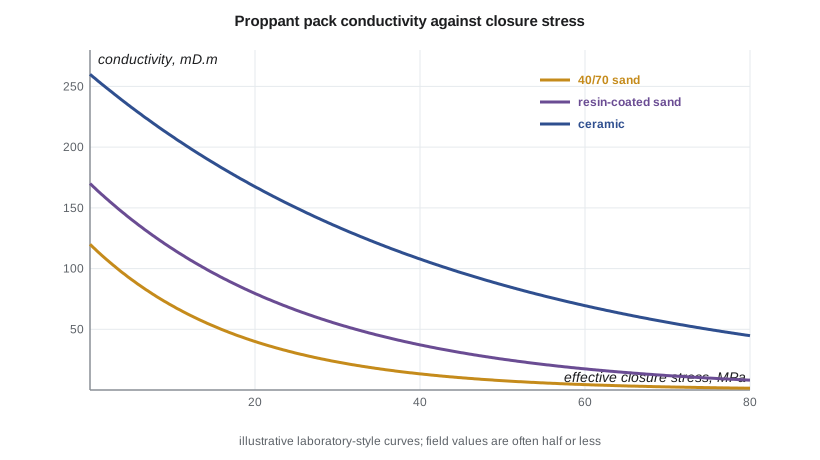
The stress on the proppant is the closure stress minus the flowing pressure in the fracture, so it rises as the well is drawn down and the reservoir depletes. Field conductivity is usually much lower than laboratory values, often by half or more, because of fines, gel residue, non-Darcy flow at high velocities, multiphase flow, cyclic loading and long-term degradation. Designers apply reduction factors to account for these effects.
Dimensionless fracture conductivity
A fracture helps a well most when it carries fluid to the well easily compared with how easily the rock feeds fluid into it. The dimensionless fracture conductivity, CfD, compares the two, where k is the reservoir permeability and xf the fracture half-length.
When CfD is small, below about 1, the fracture is conductivity-limited: the rock delivers more fluid than the fracture can carry, and adding length does little. When CfD is large, above about 10 to 30, the fracture acts as if it had infinite conductivity, and more length helps. Economides and colleagues' unified fracture design showed that, for a fixed volume of proppant, productivity is greatest at an optimum CfD of about 1.6 in reservoirs where the fracture is small compared with the drainage area. The practical message is that in moderate-permeability rock, short, wide, highly conductive fractures are best, while in very tight rock, long fractures with modest conductivity are enough.
A propped fracture can be represented in reservoir calculations by an effective wellbore radius, rw′, and the corresponding negative skin. For high CfD, rw′ approaches xf/2; for lower CfD, it is smaller.
# Proppants and fluids: settling speed, conductivity under closure stress, and dimensionless fracture conductivity
import math
SI = True
g = 9.81
def stokes(d_mm, rho_p, rho_f, mu_pas):          # m/s for a single grain in a Newtonian fluid (creeping flow)
    d = d_mm / 1000.0
    return g * d * d * (rho_p - rho_f) / (18 * mu_pas)
print("settling speed of a single 40/70 sand grain (0.3 mm, 2,650 kg/m3) in water-based fluids:")
for name, mu in (("slickwater", 0.003), ("linear gel", 0.03), ("crosslinked gel", 0.5)):
    v = stokes(0.3, 2650, 1020, mu)
    print(f"   {name:15s} viscosity {mu*1000:6.0f} mPa.s: {v*60:7.2f} m/min" + ("" if SI else f" ({v*60/0.3048:6.2f} ft/min)"))
# conductivity (mD.m) falls with closure stress: illustrative curves for a pack of 1 kg/m2 (about 0.2 lb/ft2)
def cond(kind, stress_mpa):
    base, decay = {"40/70 sand": (120.0, 0.055), "resin-coated sand": (170.0, 0.038), "ceramic": (260.0, 0.022)}[kind]
    return base * math.exp(-decay * stress_mpa)
if SI:   # 03-22 Cardium: closure about 23.2 MPa, minus a flowing bottomhole pressure of 6 MPa
    stress, k, xf, conv, ku = 23.2 - 6.0, 0.5, 100.0, 1.0, "mD.m"   # 03-22 lateral in the tighter flank of the pool
else:    # 3-22H Bakken: closure about 8,040 psi minus 2,500 psi flowing
    stress, k, xf, conv, ku = (8040 - 2500) / 145.0, 0.005, 300 * 0.3048, 1 / 0.3048, "mD.ft"
print(f"effective stress on the proppant about {stress:.1f} MPa; matrix permeability {k} mD; fracture half-length {xf/ (1 if SI else 0.3048):.0f} {'m' if SI else 'ft'}")
for kind in ("40/70 sand", "resin-coated sand", "ceramic"):
    c = cond(kind, stress) * 0.5               # halve lab values for damage, fines, gel residue and non-Darcy flow in the field
    cfd = c / (k * xf)
    rw = 0.10 if SI else 0.25 * 0.3048
    rw_eff = xf / (math.pi / cfd + 2)              # effective wellbore radius of a finite-conductivity fracture (Prats-type approximation)
    s_f = math.log(rw / rw_eff)
    print(f"   {kind:18s} field conductivity {c*conv:6.1f} {ku}; CfD = {cfd:8.2f}; skin about {s_f:+.1f}")
print("CfD near 1 to 2 or higher balances the fracture against the rock; in very tight rock almost any proppant gives a large CfD")settling speed of a single 40/70 sand grain (0.3 mm, 2,650 kg/m3) in water-based fluids: slickwater viscosity 3 mPa.s: 1.60 m/min linear gel viscosity 30 mPa.s: 0.16 m/min crosslinked gel viscosity 500 mPa.s: 0.01 m/min effective stress on the proppant about 17.2 MPa; matrix permeability 0.5 mD; fracture half-length 100 m 40/70 sand field conductivity 23.3 mD.m; CfD = 0.47; skin about -4.7 resin-coated sand field conductivity 44.2 mD.m; CfD = 0.88; skin about -5.2 ceramic field conductivity 89.0 mD.m; CfD = 1.78; skin about -5.6 CfD near 1 to 2 or higher balances the fracture against the rock; in very tight rock almost any proppant gives a large CfD
The results split the two wells clearly. In slickwater, a 40/70 grain settles at about 1.6 m/min, so slickwater places sand mostly near the wellbore unless the rate is high; in crosslinked gel it barely settles. For the 04-22, with about 0.5 mD rock and a 100 m half-length, 40/70 sand gives a CfD of only about 0.5, a conductivity-limited fracture with a skin near −4.7, while ceramic proppant reaches about 1.8, near the optimum, with a skin near −5.6. Tom asks Ethan to compare costs before recommending ceramic: a tail-in of resin-coated sand near the wellbore, where flow converges, may give most of the benefit for much less money.
Proppant flowback and long-term conductivity
After the job, high flow rates can carry proppant out of the fracture into the well, eroding chokes and filling the lateral. Curable resin-coated proppant tail-ins, fibres mixed with the proppant, and gradual flowback reduce this. Over the life of the well, conductivity may also fall because of scale, fines migration and stress cycling during shut-ins. Designers choose proppant strength with the final, depleted stress in mind, not just the initial stress.
Environmental and health aspects of fluids and proppant
Fracturing fluid additives are disclosed to public registries in both countries, as lesson 11 explains. Most additives are used at low concentrations, but they are handled as industrial chemicals with safety data sheets, secondary containment and spill plans. Silica sand creates a dust hazard: breathing fine crystalline silica can cause silicosis, so sand handling equipment uses dust controls, enclosed conveyors and respirators where needed, and occupational limits for respirable crystalline silica apply to workers on the pad.
Worked problem
Dimensionless conductivity and the best use of proppant
A fracture in 1 mD rock has a half-length of 80 m and a field conductivity of 40 mD·m. Find CfD. Would the next dollar be better spent on length or on conductivity?
Show solution
- CfD = 40/(1 × 80) = 0.50.
- CfD is below the optimum of about 1.6, so the fracture is conductivity-limited.
- Spending on stronger or more proppant to raise conductivity, possibly with a shorter fracture, improves productivity more than extra length.
Answer: In moderate-permeability rock, conductivity is worth more than length.
Quality control on location
Fluids and proppant are checked on location as the job is pumped. The water's temperature, salinity and bacteria count are tested before it is used. Samples of the mixed fluid are taken through the job to confirm friction reducer or gel concentration, viscosity, crosslink time and breaker performance. Proppant deliveries are checked for size distribution, roundness and fines content against the specification, because off-specification sand with too many fines lowers conductivity. Densitometers on the blender confirm the proppant concentration going downhole. These checks are routine, inexpensive and easy to skip on a busy pad, which is exactly why the program should require them.
Common mistakes
MistakeUsing laboratory conductivity directly.
InsteadApply field reduction factors for fines, residue, non-Darcy and multiphase flow.
MistakeChoosing ceramic proppant for every well.
InsteadCheck CfD; in very tight rock, sand often gives nearly the same result.
MistakePumping crosslinked gel without an adequate breaker.
InsteadBreak the gel fully so residue does not plug the pack.
MistakeIgnoring proppant stress after depletion.
InsteadDesign for the closure stress minus the lowest expected flowing pressure.
MistakeTreating sand as harmless.
InsteadControl respirable silica dust with engineering controls and protection.
Summary and key terms
- Fluids must open the fracture, carry proppant, leak off slowly, flow with low friction and clean up.
- Slickwater, linear and crosslinked gels, hybrids and energized fluids suit different rocks.
- Sand, resin-coated sand and ceramics trade cost against strength and conductivity.
- Settling speed scales with grain size squared and inversely with viscosity.
- Conductivity falls with closure stress, and field values are far below laboratory values.
- Dimensionless conductivity balances the fracture against the rock; an optimum near 1.6 applies in moderate permeability.
- Slickwater
- Water with friction reducer and few other additives, pumped at high rate.
- Crosslinked gel
- A polymer gel whose chains are linked by ions to give high viscosity and elasticity.
- Breaker
- An additive that degrades gel after the job so it flows back.
- Proppant
- Hard granular material that holds a fracture open.
- Fracture conductivity
- Propped permeability times width, kf·w.
- Dimensionless fracture conductivity (CfD)
- Fracture conductivity divided by reservoir permeability times half-length.
- Embedment
- Pressing of proppant grains into soft fracture faces, reducing width.
Practice problems
Work each problem on paper first, then reveal the answer to check.
Why does slickwater create narrower fractures than crosslinked gel?
Show answer
Width is proportional to net pressure, which rises with viscosity; slickwater has low viscosity.
Why did many unconventional operators switch to local sand?
Show answer
In very tight rock, conductivity matters less, and local sand cuts delivery cost sharply.
What does a CfD of 0.2 tell you?
Show answer
The fracture is conductivity-limited; more conductivity would help more than more length.
Name two causes of field conductivity loss.
Show answer
Fines, gel residue, embedment, non-Darcy flow, multiphase flow and stress cycling.
Lesson quiz · 5 questions
Score 60% or more to complete this lesson.
Create a free account to save your progress, take quizzes and earn a certificate.