
PET-330 · Lesson 6 of 12 · 19 min
Carbonate acidizing and acid fracturing
Carbonates behave differently. Tom's example is the Tamarack 08-31, a water disposal well that injects produced water into the Nisku dolomite, 15 m thick, below the Cardium. Its injectivity has fallen as scale and fines built up near the wall. 'In sandstone, acid cleans the pores,' Tom says. 'In carbonate, acid eats the rock itself. It doesn't just remove damage; it digs new channels. Your job is to make it dig the right ones.'
This lesson explains how acid reacts with limestone and dolomite, why it forms wormholes, how injection rate controls their shape, how carbonate treatments are designed and placed, and when an acid fracture is a better choice than a matrix treatment.
Acid and carbonate rock
Hydrochloric acid reacts quickly and completely with calcite, the mineral of limestone, and somewhat more slowly with dolomite, especially at low temperature. The reactions produce soluble calcium and magnesium chlorides, water and carbon dioxide, so there is no troublesome precipitate as there is with HF in sandstone. Fifteen percent HCl is the common workhorse, with 28 percent used where more dissolving power is needed, and organic acids such as acetic or formic acid, or emulsified and gelled acids, used to slow the reaction in hot wells.
Because the acid dissolves the rock matrix, a carbonate treatment can do more than remove damage: it can create flow paths that bypass the damaged zone entirely and reach well beyond it. Successful carbonate matrix treatments commonly give skins of −2 to −4, which sandstone treatments cannot match.
Wormholes
When acid flows into carbonate, it does not dissolve the rock evenly. Small differences in pore size mean that some paths take more acid, enlarge faster and then take even more. The result is a branching network of narrow channels called wormholes, which can extend from tens of centimetres to several metres from the wellbore. Fluid then flows to the well through the wormholes with almost no resistance, as if the well were larger.
The shape of the wormholes depends on how fast the acid moves through the rock compared with how fast it reacts. Laboratory core floods, which pump acid through carbonate cores at different rates and record the volume needed for the wormholes to break through the far end, show a clear pattern.
At very low injection rates, the acid spends at the face of the core or wellbore and dissolves it uniformly, a process called face dissolution. It uses huge volumes and gives no penetration. At slightly higher rates, the acid forms conical, then branching wormholes. At an optimum rate, it forms a single dominant wormhole that breaks through with the least acid, often one to two pore volumes of the core. At higher rates still, the acid spreads into many small, branched wormholes, using more acid, but the volume rises only slowly with rate.
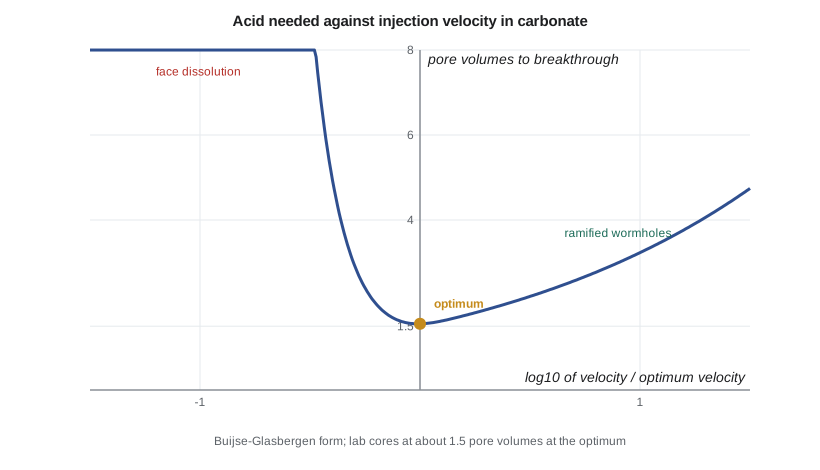
Buijse and Glasbergen described this curve with a simple model that uses the optimum velocity and optimum pore volumes from laboratory tests to estimate how fast the wormhole front advances at any velocity.
In radial flow around a well, the interstitial velocity falls with distance, vi = q/(2π r h φ), so the front slows as it moves out. Field engineers use this to estimate the volume needed to reach a given wormhole length and to choose the rate.
# Carbonate acidizing: wormhole growth from the Buijse-Glasbergen model, stepping outward from the well
import math
SI = True
PVbt_opt, vi_opt_cm = 1.5, 1.0               # lab optimum: pore volumes to breakthrough and interstitial velocity (cm/min)
vi_opt = vi_opt_cm / 100.0                     # m/min
def v_wh(vi):                                  # wormhole front velocity, m/min, for interstitial velocity vi in m/min
    w_eff = vi_opt ** (1 / 3) / PVbt_opt
    w_b = 4.0 / vi_opt ** 2
    return w_eff * vi ** (2 / 3) * (1 - math.exp(-w_b * vi ** 2)) ** 2
if SI:   # Tamarack 08-31 water disposal well in the Nisku dolomite
    h, phi, rw = 15.0, 0.10, 0.10              # m
    rates = [0.005, 0.02, 0.08, 0.3, 1.2, 3.2]   # m3/min of 15% HCl
    target, vol_unit, rate_unit, conv = 1.5, "m3", "m3/min", 1.0
else:    # vertical Mission Canyon oil well (PET-320); work in metres inside, report in field units
    h, phi, rw = 30.0 * 0.3048, 0.12, 0.354 * 0.3048
    rates = [0.05, 0.2, 0.8, 3.0, 10.0, 20.0]  # bbl/min
    target, vol_unit, rate_unit, conv = 5.0 * 0.3048, "bbl", "bbl/min", 0.159
print(f"lab optimum: {PVbt_opt} pore volumes at {vi_opt_cm} cm/min interstitial velocity")
for q in rates:
    qm = q * conv                              # m3/min
    r, vol, dt = rw, 0.0, 0.05                 # minutes per step
    while r < rw + target and vol < (2000 if SI else 2000 * 0.159 * 10):
        vi = qm / (2 * math.pi * r * h * phi)
        r += v_wh(vi) * dt; vol += qm * dt
    s = -math.log(r / rw)
    vshow = vol / conv
    reach = (target / (0.3048 if not SI else 1.0))
    if r < rw + target:
        print(f"rate {q:6.3f} {rate_unit}: wormholes stall near the wall (face dissolution); over {vshow:,.0f} {vol_unit} used without reaching {reach:.1f} {'m' if SI else 'ft'}")
    else:
        print(f"rate {q:6.3f} {rate_unit}: acid to push wormholes {reach:.1f} {'m' if SI else 'ft'} out = {vshow:8.1f} {vol_unit}; skin about {s:+.1f}")
print("very slow injection spends the acid at the face; just above the optimum the volume is smallest, then it rises slowly with rate")lab optimum: 1.5 pore volumes at 1.0 cm/min interstitial velocity rate 0.005 m3/min: wormholes stall near the wall (face dissolution); over 2,000 m3 used without reaching 1.5 m rate 0.020 m3/min: acid to push wormholes 1.5 m out = 734.4 m3; skin about -2.8 rate 0.080 m3/min: acid to push wormholes 1.5 m out = 23.1 m3; skin about -2.8 rate 0.300 m3/min: acid to push wormholes 1.5 m out = 27.0 m3; skin about -2.8 rate 1.200 m3/min: acid to push wormholes 1.5 m out = 42.9 m3; skin about -2.8 rate 3.200 m3/min: acid to push wormholes 1.5 m out = 59.5 m3; skin about -2.8 very slow injection spends the acid at the face; just above the optimum the volume is smallest, then it rises slowly with rate
For the 08-31, injecting very slowly, at 5 litres per minute, the wormholes stall: more than 2,000 m³ would be spent at the wall without reaching 1.5 m. At 0.02 m³/min the job would need over 700 m³. Near 0.08 m³/min the volume falls to about 23 m³, and above that it rises slowly, to about 60 m³ at 3.2 m³/min. Every successful case gives a skin of about −2.8, because the wormholes act like a well 1.6 m in radius. Tom notes that the laboratory optimum comes from small cores, and that field experience suggests the effective optimum is higher, so in practice the job is pumped at the highest rate that stays below fracturing pressure, within the efficient part of the curve.
Retarded and self-diverting acids
In hot wells, plain HCl reacts so fast that it spends near the wellbore. Several systems slow it down. Emulsified acid, with acid droplets inside a continuous oil phase, delays contact between acid and rock. Gelled acid raises viscosity and reduces the reaction rate. Organic acids react more slowly and less completely and are used at high temperatures, often blended with HCl. Self-diverting, viscoelastic or in-situ gelled acids thicken as they spend, temporarily plugging the zones they have treated and pushing fresh acid into others. Chelating agents dissolve carbonates more gently and are used where corrosion or high temperature is a problem.
Placement in carbonates
Carbonate reservoirs are often heterogeneous, with fractures and vugs that can steal the acid. In long intervals, especially open-hole horizontal wells, coiled tubing is used to place acid along the lateral, and diverters such as self-diverting acids, degradable particulates or foam spread the treatment. Multi-stage acid completions with packers and sleeves, similar to the fracturing systems of lesson 1, are common in large carbonate fields. Monitoring the treating pressure shows whether the diverter is working: a pressure rise when the diverter reaches the rock, followed by a fall as acid opens new rock, is the desired pattern.
Acid fracturing
When the rock is tight, wormholes alone cannot reach far enough. An acid fracture pumps above the fracturing pressure: a viscous pad opens a fracture, and acid follows, etching the fracture faces unevenly. When the pressure is released and the fracture closes, the uneven faces hold each other apart, leaving a conductive channel without any proppant. Acid fracturing works best in limestones of moderate hardness where the etching is uneven. In soft or very homogeneous rocks, the faces may close tightly, and in dolomite at low temperature the reaction is too slow; propped fractures are often better there.
The design question is how far live acid travels before it spends. Acid leaks into the fracture faces, creating wormholes that increase fluid loss, and reacts quickly in hot rock, so the etched length is usually much shorter than the fracture length. Gelled or emulsified acids, alternating stages of pad and acid, and cooling of the fracture with the pad all extend the etched length. Etched conductivity is estimated from correlations, such as Nierode and Kruk's, that use the dissolved rock volume and the rock's embedment strength, and it falls as closure stress rises.
Engineers choose between matrix acid, acid fracturing and propped fracturing by permeability, rock hardness, closure stress, temperature and the distance to water. A high-permeability carbonate with damage needs a matrix job; a moderate one may benefit from a short acid fracture; a tight, hard carbonate at high stress may need proppant.
Safety and environment
Carbonate jobs release large volumes of carbon dioxide as the acid reacts, which can lift fluids rapidly during flowback and must be expected in the flowback plan. Spent acid returns contain chlorides, dissolved minerals and possibly hydrogen sulphide. The safety rules of lesson 5 apply: corrosion inhibition, protective equipment, hydrogen sulphide monitoring, pressure testing and disposal of returns in approved facilities.
Evaluation
Carbonate treatments are evaluated like sandstone ones, by production or injectivity and by well tests. Because successful jobs give negative skins, a test that shows a skin near zero after a large carbonate treatment suggests that much of the acid went into fractures or vugs and did not stimulate the matrix where it was needed. Distributed temperature sensing, run on fibre-optic cable or coiled tubing during the treatment, shows where the cold acid entered, and production logs afterward show which intervals contribute.
Worked problem
Effective wellbore radius from wormholes
Wormholes extend 1.5 m beyond a wellbore of radius 0.10 m in a 15 m thick dolomite with ln(re/rw) = 8.3. Treat the wormholed zone as having infinite permeability. Find the skin and the rate gain over an undamaged well.
Show solution
- Effective radius: 0.10 + 1.5 = 1.6 m.
- Skin: s = −ln(1.6/0.10) = −2.77.
- Rate ratio: 8.3/(8.3 − 2.77) = 1.50.
Answer: About 50 percent more than an undamaged well, and much more than the damaged well before treatment.
A carbonate job from start to finish
Ethan writes the outline for the 08-31 treatment. First, a test of the injectivity at a few low rates to measure the starting skin and confirm the fracturing pressure. Second, a small solvent and mutual solvent stage to strip oil from the scale, since the produced water carries traces of crude. Third, the main stage of 15 percent HCl with corrosion inhibitor, iron control and surfactant, pumped down the tubing in three batches separated by a self-diverting acid stage, at the highest rate that keeps the bottomhole pressure below fracturing pressure. Fourth, an overflush of produced water to push the spent acid away. The disposal well does not need flowback, but the spent acid will be monitored at the injection plant. Success will be measured by the new injection pressure at the normal rate and by a falloff test.
Tom reviews it and asks one question: what if the well takes acid at a much lower pressure than expected? Then it may be taking fluid into a natural fracture or a thief zone, and the diverter stages become the most important part of the job. A good carbonate program always has a plan for that surprise.
Common mistakes
MistakeInjecting carbonate acid very slowly to be safe.
InsteadSlow rates spend acid at the face; inject at an efficient rate below fracturing pressure.
MistakeUsing sandstone mud acid in a carbonate.
InsteadUse HCl or retarded acids; HF is unnecessary and forms calcium fluoride.
MistakeAssuming acid fractures work in every carbonate.
InsteadSoft, homogeneous or slow-reacting rock may need proppant instead.
MistakeIgnoring carbon dioxide during flowback.
InsteadPlan for gas that lifts fluids rapidly and for the separation equipment.
MistakeLetting fractures and vugs take all the acid.
InsteadUse diversion and monitor where the acid goes.
Summary and key terms
- HCl dissolves limestone and dolomite with soluble products, so carbonate treatments can stimulate beyond damage.
- Acid forms wormholes whose shape depends on injection velocity relative to reaction rate.
- Too slow gives face dissolution; an optimum uses the least acid; faster rates branch the wormholes.
- Retarded, emulsified, gelled and self-diverting acids extend reach and placement.
- Acid fracturing etches fracture faces to leave conductivity without proppant.
- Treatment choice depends on permeability, hardness, stress, temperature and nearby water.
- Wormhole
- A narrow, branching channel dissolved by acid in carbonate rock.
- Face dissolution
- Uniform dissolution of the rock face at low injection rates.
- Optimum injection velocity
- The velocity at which wormholes break through with the least acid.
- Retarded acid
- An acid system designed to react more slowly with the rock.
- Acid fracturing
- Fracturing with acid that etches the faces so the fracture stays conductive after closure.
- Etched length
- The distance along a fracture that live acid reaches before it spends.
- Self-diverting acid
- Acid that thickens as it spends, diverting fresh acid to untreated rock.
Practice problems
Work each problem on paper first, then reveal the answer to check.
Why can carbonate treatments reach negative skins that sandstone treatments cannot?
Show answer
Acid dissolves the rock itself and forms wormholes that extend beyond the damaged zone.
What happens if acid is injected too slowly into carbonate?
Show answer
It spends at the face, dissolving it uniformly without penetrating.
Why are acid fractures less effective in soft, homogeneous rock?
Show answer
The faces etch evenly and close tightly, leaving little conductivity.
Name two ways to extend the reach of acid in a hot carbonate.
Show answer
Emulsified or gelled acids, organic acids, and alternating pad and acid stages.
Lesson quiz · 5 questions
Score 60% or more to complete this lesson.
Create a free account to save your progress, take quizzes and earn a certificate.