
PET-330 · Lesson 1 of 12 · 22 min
Completion design and completion types
Ethan Cardinal's next rotation at Prairie Crest puts him on the completions team. His new mentor, Tom Ashworth, has twenty years of fracturing and workover experience and a habit of starting every design meeting with the same question. 'What does the reservoir need, and what do we have to live with for the next thirty years?' On Ethan's first morning Tom hands him two binders: the completion report for the Tamarack 03-22 horizontal well, finished two years ago, and a blank planning sheet for its neighbour, the Tamarack 04-22 horizontal well, which will be drilled next summer in the tighter northern flank of the Cardium. 'Read how we did the first one. By the end of this rotation you'll write the program for the second one.'
This course follows that program from start to finish. It covers the hardware that turns a drilled hole into a producing well, the perforations that connect casing to rock, the damage that drilling and completion leave behind, the acid treatments that remove it, and the hydraulic fractures that make tight rock produce at all. This first lesson sets out what a completion is, the main completion types and the decisions that choose between them.
What a completion does
Drilling, covered in PET-310, ends when the last casing or liner is cemented and the rig moves off. The well is then a steel-lined hole full of drilling or completion fluid, and it produces nothing. The completion is everything that happens between that moment and steady production: running the equipment that will carry the fluids, connecting the wellbore to the reservoir, stimulating the rock if it needs it, cleaning the well up and handing it to the production team.
A good completion does five jobs at once. It provides a safe conduit from the reservoir to surface that can be shut in and controlled at any time. It connects the wellbore to the productive rock and isolates it from zones that should not flow, such as water-bearing layers or a gas cap. It allows the well to be stimulated, now and possibly later. It controls sand and other solids where the rock is weak. And it allows the well to be monitored, repaired and eventually abandoned. Because a well may produce for decades, decisions made in the completion phase are some of the longest-lived in the oilfield.
Completion engineers sit between the drilling engineers, who deliver the hole, and the production and reservoir engineers, who live with the result. They also work closely with service companies, which supply the perforating guns, packers, pumps, fluids and proppant, and whose field engineers run the operations. On a large fracturing job, the operator's completion engineer in the data van is responsible for the program, while the service company's crew runs the pumps; both can stop the job if something looks unsafe.
Lower and upper completion
Completion engineers divide the well in two. The lower completion, also called the sandface or reservoir completion, is the part across the productive interval: open hole, perforated casing, a slotted liner, a screen or a string of fracturing sleeves. The upper completion is everything above it: production tubing, packers, safety valves, landing nipples, gauges and, later, any artificial lift equipment. The lower completion is usually installed once and lives as long as the well; the upper completion can be pulled and replaced in a workover.
Some lower completions are run with the drilling rig, such as an uncemented liner with packers and sleeves; others are installed after the rig leaves, such as perforations shot through cemented casing. Lesson 2 covers the upper completion in detail.
The main completion types
Four broad families cover most wells, and Figure 1 sketches them.
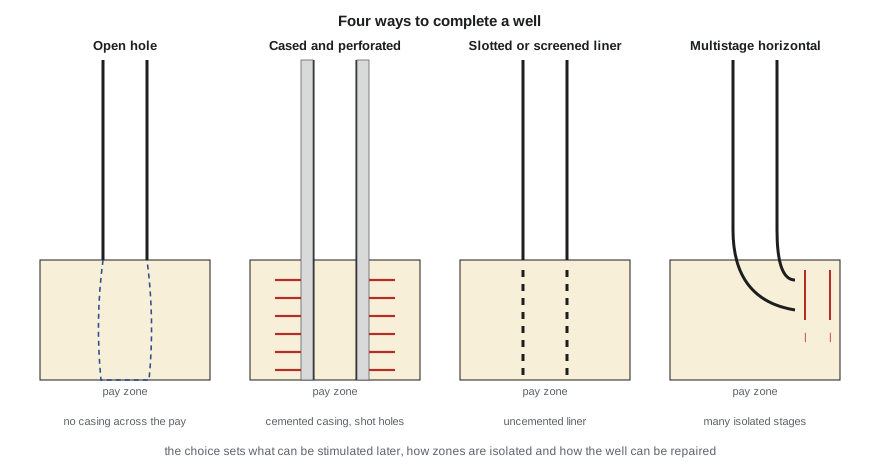
Open hole. Casing is set and cemented on top of the reservoir and the pay zone is left unlined. Open-hole completions give the full wellbore area to flow and no perforation losses, and they are cheap. They work in strong, uniform rock, such as many carbonates, and they are common in horizontal wells that do not need fracturing. Their weaknesses are that zones cannot easily be isolated from one another, water or gas cannot be shut off selectively, and weak rock can collapse.
Cased and perforated. Casing or a liner is run through the pay and cemented, and holes are then shot through the steel and cement into the rock (lesson 3). This is the most flexible completion: the cement isolates zones from each other, the engineer chooses exactly which intervals to open, and layers can be added, squeezed off or stimulated separately later. The price is the extra resistance of the perforations and any cement damage, which a good perforating design keeps small.
Uncemented liners and screens. A slotted or pre-drilled liner, or a wire-wrapped or premium screen, is hung across the pay without cement. In unconsolidated sands the screen, often with a gravel pack around it, holds the sand back while letting fluids through. In stronger rock, a slotted liner simply keeps the hole open. Sand control is a specialist subject of its own; heavy oil wells in particular depend on it, and PET-370 returns to it.
Multistage horizontal completions. In tight rock, a long horizontal well is divided into many short stages that are fractured one after another. Each stage must be isolated from the ones already treated, so that the fluid goes into new rock. Two main methods do this, and they are the backbone of unconventional development.
Plug-and-perf and sliding sleeves
In a plug-and-perf completion, the production casing or liner is cemented through the whole lateral. The first stage, at the toe, is opened with a pressure-actuated sleeve or perforated with guns run on coiled tubing. After it is fractured, a wireline crew pumps a bridge plug and a string of perforating guns down the casing. The plug is set above the first stage, the guns are pulled up and fired to open several short clusters of holes, and the second stage is fractured through those clusters. The cycle repeats toward the heel. When all stages are done, coiled tubing drills out the plugs, unless dissolvable plugs were used.
In a sliding-sleeve completion, the liner is run with ported sleeves built in, one or more per stage. In open-hole versions, swelling or mechanical packers isolate the stages; in cemented versions, the cement does. The sleeves are opened in sequence from toe to heel, either by dropping balls of increasing size that land on seats, or with coiled tubing that shifts each sleeve. Because no wireline trip is needed between stages, a sleeve job pumps much faster.
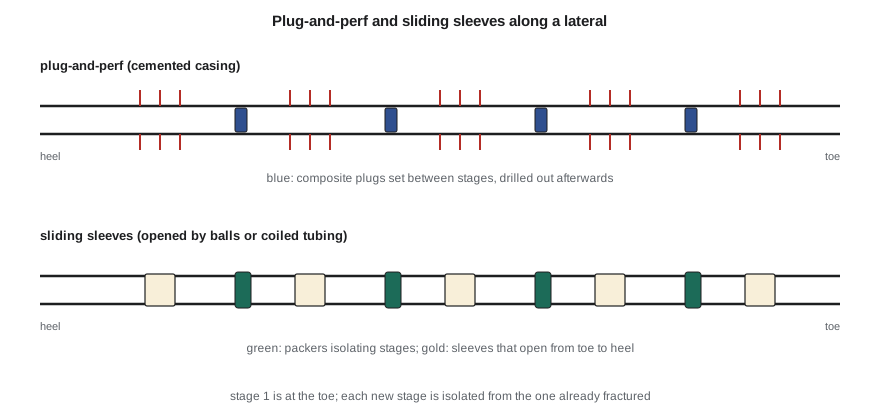
Each method has its supporters. Plug-and-perf gives the engineer complete freedom in where to place clusters, allows many clusters per stage, and leaves a full-bore casing that can be re-entered and refractured. It takes longer and uses many wireline runs, each with the small but real risk of a stuck gun or a misrun plug. Sleeves are faster and use less equipment on location, but their positions are fixed when the liner is run, ball-drop systems limit the number of stages, and the seats can restrict the bore. Many operators use cemented plug-and-perf in their main programs and keep sleeves for specific cases.
# Comparing completion options for a multistage horizontal well
SI = True
if SI:   # 03-22 Cardium horizontal: lateral length in m, costs in thousands of Canadian dollars
    lateral, unit = 1600.0, "m"
    options = {  # name: (stage spacing, hours per stage on location, fixed cost, cost per stage)
        "cemented plug-and-perf":       (80.0, 2.6, 180.0, 21.0),
        "cemented sleeves (coil-run)":  (80.0, 1.4, 260.0, 19.0),
        "open-hole packers and balls":  (100.0, 0.9, 230.0, 17.0),
    }
    spread_rate = 4.2   # frac spread and crew, thousand dollars per hour
else:    # 3-22H Bakken: lateral in ft, costs in thousands of US dollars
    lateral, unit = 9800.0, "ft"
    options = {
        "cemented plug-and-perf":       (245.0, 2.4, 420.0, 44.0),
        "cemented sleeves (coil-run)":  (245.0, 1.5, 610.0, 41.0),
        "open-hole packers and balls":  (300.0, 1.0, 520.0, 36.0),
    }
    spread_rate = 9.5
print(f"lateral length {lateral:,.0f} {unit}")
for name, (spacing, hrs, fixed, per) in options.items():
    n = int(lateral // spacing)
    hours = n * hrs
    cost = fixed + n * per + hours * spread_rate
    print(f"{name:30s} stages {n:3d}  pumping time {hours:5.1f} h  cost {cost:7,.0f} thousand  ({cost/n:5.1f} per stage)")
print("more stages give more fracture contact; the choice also weighs control of where each fracture starts")lateral length 1,600 m cemented plug-and-perf stages 20 pumping time 52.0 h cost 818 thousand ( 40.9 per stage) cemented sleeves (coil-run) stages 20 pumping time 28.0 h cost 758 thousand ( 37.9 per stage) open-hole packers and balls stages 16 pumping time 14.4 h cost 562 thousand ( 35.2 per stage) more stages give more fracture contact; the choice also weighs control of where each fracture starts
For the 03-22, Tom explains, the team chose cemented plug-and-perf with 20 stages of four clusters at about 80 m spacing. The program reproduces the logic: open-hole packers and balls look cheapest, but with only 16 stages and limited control of where each fracture starts, they would have left rock untouched. Sleeves would have saved a day of pumping, but the cemented monobore casing chosen in PET-310 suited plug-and-perf, and Prairie Crest wanted the option to refracture later. Ethan notes that the cost per stage hides the real question: how much extra oil each stage brings. That needs the reservoir and fracture work of later lessons.
Choosing a completion
The choice starts with the reservoir. Permeability decides whether the well needs stimulation at all: a conventional sandstone of tens or hundreds of millidarcies may flow well through perforations alone, while rock of a fraction of a millidarcy needs fractures. Rock strength decides whether sand control is needed. The number and spacing of layers, and the presence of water or gas nearby, decide how much isolation is needed. Pressure and temperature set the ratings of every component, and the fluids decide the metallurgy: hydrogen sulphide and carbon dioxide call for corrosion-resistant materials and special elastomers.
The well itself constrains the choice. The casing program from drilling sets the internal diameter, the pressure the casing can hold during fracturing, and the depth of the cement. A monobore design, in which one casing size runs from surface to toe, is simple and lets tools pass freely. A design with a liner below intermediate casing saves steel but may need a temporary frac string to protect the upper casing from fracturing pressure, as some deep liner completions do.
Operations and economics finish the decision. How many stages can be pumped per day, how much water can be sourced and stored, how far the location is from the service company's base, and what the cost is per stage and per unit of expected recovery all matter. So do later needs: can the well be logged, cleaned out, refractured or converted to injection? An inexpensive completion that cannot be repaired can cost far more over the well's life.
Completion fluids and well preparation
Before any completion work, the wellbore is cleaned and filled with a completion fluid, usually filtered brine whose density gives the required hydrostatic overbalance. Clear brines are used because drilling mud solids would plug perforations and pore throats. Potassium chloride brine is common in water-sensitive sands to keep clays stable; heavier brines based on calcium or sodium bromide are used where higher pressures need more density. The fluid must be compatible with the formation water to avoid scale, and with the elastomers in packers and seals.
The casing is then checked. A gauge ring and junk basket run confirms the internal diameter and recovers debris. A cement bond log, or an ultrasonic log, confirms that cement fills the annulus where isolation is needed; poor cement behind the casing can let fracturing fluid or produced water migrate between zones, and repairing it after the fact is difficult. Finally, the casing and wellhead are pressure tested to at least the highest pressure expected during the completion, which for a fractured well is the surface treating pressure plus a margin. Regulators require records of these tests.
Who regulates completion work
In Alberta, the Alberta Energy Regulator (AER) sets requirements for well integrity, zonal isolation and the reporting of completion and fracturing work. Its Directive 083, Hydraulic Fracturing — Subsurface Integrity, aims to keep wells intact during fracturing, to avoid unintended communication with nearby wells, to protect non-saline aquifers and water wells, and to prevent surface impacts. Directive 059 sets out what drilling and completion data must be filed. Lesson 11 returns to these rules and to the province's management of induced seismicity.
Company standards add to the regulations. Most operators have a well integrity standard that requires at least two independent barriers between the reservoir and the environment at all times: for example, a tubing string with a packer and a safety valve, backed by the casing and wellhead. Every completion procedure is written to keep both barriers in place, and any step that temporarily removes one is planned and approved in advance.
The completion engineer's workflow
Tom gives Ethan the outline he uses for every program. First, gather the inputs: logs, core, stress data, the drilling report, casing and cement records, nearby well performance and the reservoir forecast. Second, set objectives: target rate and recovery, allowable cost, constraints such as water supply and timing. Third, design the lower completion, the stimulation and the upper completion, checking each against the well's pressure ratings. Fourth, plan the operations: equipment, fluids, water, crews, safety and contingency. Fifth, execute, recording everything. Sixth, evaluate the results honestly, because the next well is always better if the last one was studied. The rest of the course follows that order.
Worked problem
Matching a completion type to a reservoir
Three candidate wells: (a) a vertical well in a 60 mD Leduc-type dolomite with water 20 m below the pay; (b) a horizontal well in a 0.3 mD tight sandstone; (c) a vertical well in a weak, unconsolidated sand at 600 m. Suggest a completion type for each.
Show solution
- (a) Good permeability needs no fracture, but nearby water needs control of which interval is open: cased and perforated, with the perforations kept well above the water and a possible acid treatment (lesson 6).
- (b) Tight rock needs fractures and a long contact area: a multistage horizontal completion, probably cemented plug-and-perf.
- (c) Weak sand needs sand control: a cased-hole gravel pack, or a screen, with careful limits on the drawdown.
Answer: Permeability sets the need for stimulation; nearby water sets the need for isolation; rock strength sets the need for sand control.
Common mistakes
MistakeChoosing a completion only by its up-front cost.
InsteadCompare cost per unit of expected recovery and allow for future repairs and refracturing.
MistakeAssuming every horizontal well needs fracturing.
InsteadPermeable rock may produce well through an open hole or simple liner; stimulate only when the rock needs it.
MistakeTreating the casing program as fixed after drilling.
InsteadDesign the completion and casing together, so the casing can hold fracturing pressure and pass the tools.
MistakeSkipping the cement evaluation.
InsteadCheck the cement where isolation matters, before fracturing; repairing it later is far harder.
MistakeLeaving only one barrier in place during a procedure.
InsteadKeep two independent barriers, and plan in advance for any step that removes one.
Summary and key terms
- The completion turns a drilled, cased hole into a safe, producing well and must serve for decades.
- The lower completion sits across the pay; the upper completion carries fluids to surface and can be replaced.
- The main types are open hole, cased and perforated, uncemented liners and screens, and multistage horizontals.
- Plug-and-perf gives flexible cluster placement and full-bore access; sliding sleeves pump faster.
- Reservoir permeability, rock strength, isolation needs, fluids and the casing program drive the choice.
- Completion fluids are clean brines, and the casing and cement are checked and tested before work starts.
- Regulations and company standards require well integrity, zonal isolation and two independent barriers.
- Completion
- The equipment and operations that connect a drilled well to the reservoir and prepare it to produce.
- Lower completion
- The part of the completion across the productive interval.
- Upper completion
- Tubing, packers, valves and other equipment above the lower completion.
- Plug-and-perf
- A multistage method using bridge plugs and perforating guns run on wireline between fractured stages.
- Sliding sleeve
- A ported sleeve built into a liner that is opened by a ball or a shifting tool to treat one stage.
- Monobore
- A well with one casing size from surface to total depth.
- Well barrier
- An independent element, such as tubing with a packer or the casing, that prevents uncontrolled flow.
Practice problems
Work each problem on paper first, then reveal the answer to check.
Why might an operator choose plug-and-perf even though sleeves pump faster?
Show answer
Flexible cluster placement, many clusters per stage, and a full-bore casing that can be re-entered and refractured.
Give two reasons to leave a well cased and perforated instead of open hole.
Show answer
Zonal isolation from water or gas, and the ability to open, close or stimulate layers selectively later.
What does the cement bond log check before fracturing?
Show answer
Whether cement fills the annulus where isolation between zones is needed.
Name three inputs a completion engineer gathers before designing a program.
Show answer
Logs and core, stress data, the drilling and cement records, nearby well performance and the reservoir forecast.
Lesson quiz · 5 questions
Score 60% or more to complete this lesson.
Create a free account to save your progress, take quizzes and earn a certificate.