
PET-330 · Lesson 4 of 12 · 20 min
Formation damage and skin
In the reservoir study of PET-320, Ethan found that the vertical 102/06-14 well produced about 23 m³/d of oil when the rock around it should have given about 37 m³/d, a skin of about +5. Lena's verdict was that the well, not the rock, was the problem, and she suggested an acid job. Now the problem is Ethan's. 'Before you pump acid,' Tom says, 'tell me what the damage is, where it is, and whether acid will dissolve it. Half the acid jobs that fail were pumped at the wrong problem.'
This lesson covers the mechanisms of formation damage, how they are diagnosed, how skin is split into its parts, and how damage is prevented, which is always cheaper than removing it. It connects the skin factor of PET-320 to the physical causes that a completion engineer can control.
What formation damage is
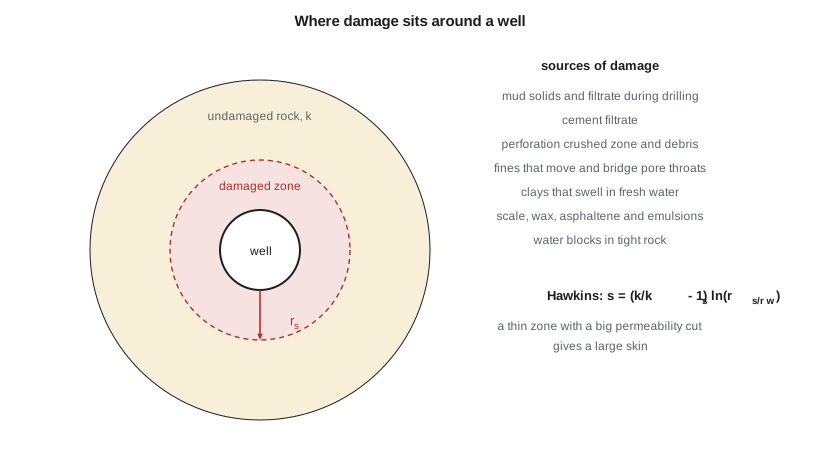
Formation damage is any reduction of permeability near the wellbore caused by drilling, completion, production or intervention. It lowers productivity in producers and injectivity in injectors. Because flow converges toward the well, the rock within a metre or so of the wellbore carries the whole flow at the highest velocity, and even a thin damaged layer there can cut the rate by a third or more. Damage farther out matters far less.
Mechanisms of damage
Drilling mud solids and filtrate. During drilling, the mud pressure exceeds the pore pressure, and mud filtrate flows into the rock while solids build a filter cake on the wall. Fine solids can invade pore throats near the face. The filtrate can change wettability, swell clays, form emulsions with the oil or simply occupy pore space and reduce the relative permeability to oil. Low-fluid-loss, properly sized bridging solids and compatible filtrate chemistry limit this damage, which is why drilling fluid choice matters to completions.
Cement filtrate. Cement slurries lose water as they set, and the filtrate is highly alkaline and rich in calcium. It can precipitate scale or alter clays near the wall. Good fluid-loss control in the slurry limits it.
Perforation damage. Lesson 3 described the crushed zone around each tunnel and the debris left behind, which add to the skin unless underbalance or flow removes them.
Fines migration. Small particles, often kaolinite or illite clays and fine quartz, are loosely attached to pore walls. When the flow velocity exceeds a critical value, or when the water chemistry changes, they detach, move with the flow and bridge at pore throats. Fines migration is typical when a well is put on high rate too quickly, or when fresh water contacts the rock.
Clay swelling and dispersion. Smectite clays absorb water and swell, while other clays disperse into fines when exposed to water that is fresher than the formation brine. Potassium chloride or other clay stabilizers in completion and fracturing fluids reduce this effect.
Scale, wax and asphaltenes. Mixing incompatible waters, or changes in pressure and temperature, precipitate mineral scales such as calcium carbonate, barium sulphate or iron compounds. Cooling of waxy crude below its cloud point deposits paraffin. Pressure drops can make asphaltenes come out of solution. These deposits form in the near-wellbore rock as well as in tubing.
Emulsion and water blocks. Mixing of oil and water-based fluids with fines or surfactants can form viscous emulsions that block pores. In tight, low-pressure rock, water imbibed during drilling or fracturing is held by capillary forces and reduces the relative permeability to gas or oil, a water block that may take months to clean up.
Bacteria and polymer residue. Untreated water carries bacteria that can grow in the rock and generate hydrogen sulphide. Polymer residues from drilling and fracturing fluids that are not fully broken also plug pores and reduce fracture conductivity.
Diagnosing damage
Diagnosis combines several sources. A pressure buildup test (PET-360) measures the skin directly and the permeability-thickness product, so the engineer can tell a damaged well from a poor reservoir. A comparison with offset wells, logs and core shows whether productivity is below what the rock should give. The well's history matters: did the problem appear after a workover, after a change in injection water, or after the rate was raised? Produced fluid and solids samples show scale, fines, emulsions or wax. Laboratory core flood tests with candidate fluids confirm whether a treatment will help and catch incompatibilities before they happen downhole.
Tom asks Ethan to list what they know about the 102/06-14 well. It was drilled with a water-based polymer mud, cemented, and perforated overbalanced with a 90-degree gun at moderate density many years ago. Its skin has been about the same since the first test, with no sudden change. That history points to drilling and completion damage near the wall, not to fines or scale that grew later.
The skin as a sum
A measured skin from a well test is the total of several effects, and only some of them are damage. The general expression adds the damage skin to a perforation skin (lesson 3), a partial penetration skin for wells that open only part of the pay, a deviation skin, which is negative for slanted wells that contact more rock, a non-Darcy rate-dependent skin in gas wells, and any pseudo-skin from fractures or other stimulation.
This matters for treatment design. A matrix acid job can only remove the part caused by soluble damage. It cannot fix a partial penetration skin, which needs more perforations, or a high perforation skin from shallow tunnels, which needs reperforating, possibly with deeper charges.
Hawkins' formula
Hawkins described a simple model: a cylindrical zone of radius rs around the well with reduced permeability ks, surrounded by undamaged rock of permeability k. Comparing the pressure drop through the zone with what it would be with undamaged rock gives the damage skin.
The formula shows two things. A thin zone with a severe permeability cut gives the same skin as a thicker zone with a mild cut, so skin alone cannot tell the engineer which case applies. And if the zone is stimulated so that ks exceeds k, the skin becomes negative, but only modestly, because the logarithm term is small; large negative skins need fractures that reach far beyond the near-wellbore zone.
Flow efficiency, the ratio of actual to ideal productivity, is another way to express damage.
# Formation damage: Hawkins skin, what a skin of +5 means, and the rate that damage removal could recover
import math
SI = True
if SI:   # vertical Cardium well 102/06-14 (PET-320): radii in m, rate in m3/d
    rw, re, k = 0.10, 400.0, 15.0
    q_now, s_meas, unit, ru = 23.0, 5.0, "m", "m3/d"
    zones = [0.15, 0.25, 0.40, 0.60]
else:    # vertical Mission Canyon well (PET-320): radii in ft, rate in STB/d
    rw, re, k = 0.354, 1490.0, 25.0
    q_now, s_meas, unit, ru = 300.0, 5.0, "ft", "STB/d"
    zones = [0.5, 0.8, 1.3, 2.0]
lnr = math.log(re / rw)
print(f"ln(re/rw) = {lnr:.2f}; measured skin {s_meas:+.1f}")
print("damaged-zone radius   permeability ratio ks/k needed to give the measured skin")
for rs in zones:
    x = math.log(rs / rw)                     # Hawkins: s = (k/ks - 1) ln(rs/rw)
    ratio = 1 / (s_meas / x + 1)
    print(f"   {rs:5.2f} {unit}             ks/k = {ratio:.2f}  (permeability cut by {1-ratio:.0%})")
fe = lnr / (lnr + s_meas)
print(f"flow efficiency = {fe:.2f}: the well makes {fe:.0%} of its undamaged rate")
for s_after in (2.0, 0.0, -1.0):
    print(f"   if treatment brings skin to {s_after:+.0f}: rate {q_now*(lnr+s_meas)/(lnr+s_after):6.1f} {ru}")
# skin components: a measured skin is a sum, and only part of it is damage that acid can remove
parts = {"perforation (lesson 3)": 0.8, "partial penetration": 0.6, "drilling and cement filtrate damage": 3.0, "fines and scale": 0.6}
print("one way the measured skin might break down:")
for n, v in parts.items(): print(f"   {n:38s} {v:+.1f}")
print(f" {'total':38s} {sum(parts.values()):+.1f}; removable by matrix treatment about {parts['drilling and cement filtrate damage']+parts['fines and scale']:+.1f}")ln(re/rw) = 8.29; measured skin +5.0
damaged-zone radius permeability ratio ks/k needed to give the measured skin
0.15 m ks/k = 0.08 (permeability cut by 92%)
0.25 m ks/k = 0.15 (permeability cut by 85%)
0.40 m ks/k = 0.22 (permeability cut by 78%)
0.60 m ks/k = 0.26 (permeability cut by 74%)
flow efficiency = 0.62: the well makes 62% of its undamaged rate
if treatment brings skin to +2: rate 29.7 m3/d
if treatment brings skin to +0: rate 36.9 m3/d
if treatment brings skin to -1: rate 41.9 m3/d
one way the measured skin might break down:
perforation (lesson 3) +0.8
partial penetration +0.6
drilling and cement filtrate damage +3.0
fines and scale +0.6
total +5.0; removable by matrix treatment about +3.6For the 102/06-14 well, a skin of +5 could be a 15 cm zone with its permeability cut by about 90 percent, or a 60 cm zone cut by about 70 percent. The flow efficiency is 63 percent. If an acid job removed all the damage-related skin and brought the total to zero, the rate would rise from 23 to about 37 m³/d; a realistic target of +2 gives about 30 m³/d. Breaking the skin into parts shows that roughly +3.6 of the +5 is damage that acid could reach; the rest is geometry from the old 90-degree perforations and partial penetration.
Preventing damage
Preventing damage is the best treatment. The main rules are simple. Drill the pay with a fluid designed for it: minimal invasion, sized bridging solids that form a thin, removable cake, and filtrate compatible with the rock and fluids. Keep the overbalance no higher than well control requires. Use clean, filtered completion brines with clay stabilizers, and check them for compatibility with formation water in the laboratory. Perforate underbalanced where a natural completion is planned. Bring wells on gradually, so velocities do not exceed the critical rate for fines. Treat injection water to remove solids, oxygen and bacteria, and monitor it. In fracturing, choose breakers and fluids that clean up, and flow the well back properly.
Damage prevention is a team effort that crosses departments. The mud engineer, cementer, completion engineer and production operator each make choices that add to or avoid the skin. Tom's rule is that whoever designs a fluid that will touch the pay asks the completion engineer to review it.
When damage is not the problem
Not every low-rate well is damaged. A well may be in poorer rock than its neighbours, it may be drawing from a small or compartmentalized drainage area, its pressure may be depleted, or it may be limited by lift or surface equipment. Treating such a well with acid wastes money and may harm it. Nodal analysis, a well test and a review of the reservoir model come first. Ethan's notes for the 102/06-14 well show a positive skin measured in a buildup test, good kh from offset wells, no depletion beyond the pool average, and no lift limitation. Damage is the right diagnosis.
Worked problem
Is the damage worth treating?
A well with ln(re/rw) = 8.4 has a total skin of +5, of which +3.6 is soluble damage. A matrix treatment costs 60,000 dollars and is expected to remove 80 percent of the soluble damage. The well makes 23 m³/d; the netback is 330 dollars per m³. Estimate the new rate and the payout time.
Show solution
- New skin: 5 − 0.8 × 3.6 = 2.1.
- New rate: 23 × (8.4 + 5)/(8.4 + 2.1) = 23 × 13.4/10.5 = 29.4 m³/d, a gain of 6.4 m³/d.
- Value: 6.4 × 330 = 2,100 dollars per day.
- Payout: 60,000/2,100 ≈ 29 days, before any decline.
Answer: A well-diagnosed damage removal pays out in weeks, which is why matrix treatments are among the cheapest barrels in the business.
Damage in horizontal and fractured wells
Damage matters differently in horizontal wells. A long open-hole lateral exposed to drilling mud for days can carry a damaged layer along its whole length, and the drawdown along the lateral is uneven, so cleanup may be poor near the toe. In fractured wells, the near-wellbore skin of the wellbore itself matters less, because flow enters through the fractures; instead, damage moves into the fracture: gel residue, embedded or crushed proppant, fines from the fracture faces and water blocks along them. Engineers speak of fracture-face skin and choked-fracture skin for these effects. They are controlled by fluid choice, breakers, proppant strength and careful flowback rather than by acid. Ethan notes that his acid work for the vertical wells and his fracture design for the 04-22 attack the same enemy, lost permeability near the flow path, with different tools.
Common mistakes
MistakeTreating every low rate as damage.
InsteadConfirm damage with a well test and compare kh with offsets before treating.
MistakeAssuming acid removes all of the skin.
InsteadSplit the skin into parts; only soluble damage responds to a matrix treatment.
MistakeUsing fresh water in clay-bearing sands.
InsteadUse brines with clay stabilizers compatible with the formation.
MistakePutting a new well on full rate at once.
InsteadRaise rates gradually to stay below the critical velocity for fines.
MistakeIgnoring the drilling fluid when planning a completion.
InsteadReview every fluid that touches the pay for invasion and compatibility.
Summary and key terms
- Formation damage reduces permeability near the wellbore, where flow converges.
- Causes include mud and cement filtrate, perforation debris, fines, clays, scale, wax, emulsions and water blocks.
- Diagnosis combines well tests, offset comparisons, history, samples and core floods.
- Total skin is a sum of damage, perforation, partial penetration, deviation and rate-dependent parts.
- Hawkins' formula links skin to the damaged zone's radius and permeability.
- Prevention through good fluids, gentle operations and compatible chemistry beats removal.
- Formation damage
- A reduction of permeability near the wellbore caused by operations or production.
- Filter cake
- A layer of mud solids deposited on the borehole wall during drilling.
- Fines migration
- Movement and bridging of small particles in pore throats.
- Water block
- Trapped water that reduces relative permeability to oil or gas in tight rock.
- Damage skin
- The part of the total skin caused by reduced permeability near the well.
- Flow efficiency
- The ratio of actual productivity to the productivity with zero skin.
- Critical velocity
- The flow velocity above which fines detach and migrate.
Practice problems
Work each problem on paper first, then reveal the answer to check.
Why does a thin damaged zone matter so much?
Show answer
All flow passes through it at the highest velocity, so the pressure drop there is large.
A buildup test shows skin +6 in a well with only 30 percent of the pay perforated. What part of the skin cannot be removed by acid?
Show answer
The partial penetration skin; more perforations are needed for that.
Name two ways to prevent fines migration.
Show answer
Bring the well on gradually and avoid fresh water; use clay stabilizers.
What two parameters in Hawkins' formula cannot be separated by the skin value alone?
Show answer
The damaged radius and the permeability reduction.
Lesson quiz · 5 questions
Score 60% or more to complete this lesson.
Create a free account to save your progress, take quizzes and earn a certificate.