
PET-330 · Lesson 12 of 12 · 19 min
The completion and stimulation program: capstone
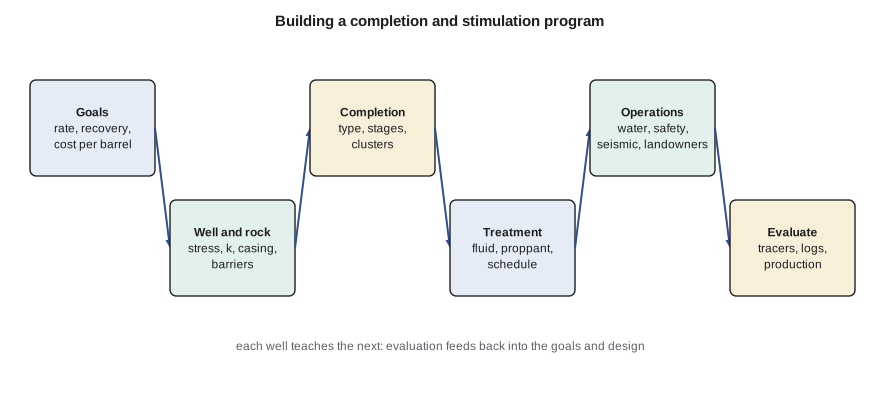
Three months into the rotation, Ethan presents the completion and stimulation program for the Tamarack 04-22 horizontal well to Tom, Lena and the operations manager. It is the program for a horizontal well in the tight northern flank of the Cardium, using everything the team learned from the 03-22 and from the earlier lessons of this course. This lesson walks through his program section by section, the way a real program is written and reviewed.
1. Objectives
The program opens with objectives the whole team can check. For the 04-22: deliver an estimated ultimate recovery of at least 40,000 m³ of oil from a 1,600 m lateral in rock of about 0.5 mD; keep completion cost under about 1.25 million dollars; use at least half recycled or saline water; complete the job with no lost-time injuries, no spills to ground and no seismic event above the amber threshold; and collect the diagnostic data needed to improve the next well.
2. Well and reservoir data
The second section collects what the design rests on. The lateral will be landed in the upper, cleaner Cardium sand at about 1,560 m true vertical depth, drilled along the minimum horizontal stress direction from the regional stress map. The stress model of lesson 7 gives a closure gradient of about 14.9 kPa/m, about 23,200 kPa at the landing depth, to be confirmed by a DFIT in the toe stage. Pore pressure is about 9.0 kPa/m in the depleted flank. The casing is 139.7 mm L-80, 25.30 kg/m, cemented from toe to surface; its burst rating of about 53,400 kPa sets an 80 percent treating pressure limit of about 42,700 kPa. A cement evaluation log is required before perforating. Offset wells within 400 m are identified for monitoring and notification.
3. Completion design
Ethan proposes cemented plug-and-perf with dissolvable plugs, which avoids a coiled tubing drill-out run. He considers two designs. The base case repeats the 03-22: 20 stages of four clusters at about 80 m stage length, 40/70 sand only. The alternative uses 26 stages of four clusters, about 60 m long, with a resin-coated sand tail-in in each stage. Lesson 9 showed that this rock is conductivity-limited with sand alone, so more conductivity near the wellbore should pay. Perforating uses six equal-entry holes per cluster, lesson 10's limited-entry result.
4. Treatment design
Each stage is pumped at 8 m³/min of slickwater with a high-viscosity friction reducer, with a small acid spearhead on the first stages if breakdown is difficult. The schedule has a pad of about a quarter of the stage volume, sand ramped from 30 to 120 kg/m³, and a flush that stops short of the perforations. The base case uses about 260 m³ of fluid and 30 t of proppant per stage. From the stage records of the 03-22, Ethan adds more pad and lowers the final concentration on the four toe stages, which screened out on the first well. The expected surface treating pressure is about 23,300 kPa, well below the limit, and the pumps need about 3,100 kW of hydraulic power.
5. Comparing the designs
# Capstone: comparing two completion designs on cost, recovery and water logistics
SI = True
if SI:   # 03-22 Cardium horizontal; thousand Canadian dollars, m3
    designs = {  # name: (stages, clusters per stage, proppant t, fluid m3, EUR m3 of oil)
        "base: 20 stages x 4 clusters, sand":          (20, 4, 600.0, 5200.0, 36300.0),
        "tighter: 26 stages x 4 clusters, sand + RCS": (26, 4, 830.0, 6800.0, 44500.0),
    }
    cost_fixed, cost_stage, cost_prop, cost_fluid = 180.0, 31.9, 0.16, 0.012     # per stage incl. spread time (lesson 1), per t, per m3
    netback, cu, vu, truck = 0.33, "thousand CAD", "m3", 30.0                       # thousand CAD per m3 of oil; m3 per truck load
else:    # 3-22H Bakken; thousand US dollars, bbl
    designs = {
        "base: 40 stages x 5 clusters, sand":          (40, 5, 10.0e6, 260000.0, 942000.0),
        "tighter: 50 stages x 5 clusters, sand":       (50, 5, 13.0e6, 330000.0, 1040000.0),
    }
    cost_fixed, cost_stage, cost_prop, cost_fluid = 420.0, 66.8, 0.00006, 0.0025   # per stage incl. spread time (lesson 1), per lbm, per bbl
    netback, cu, vu, truck = 0.040, "thousand USD", "bbl", 130.0
base_cost = base_eur = None
for name, (n, c, prop, fluid, eur) in designs.items():
    cost = cost_fixed + n * cost_stage + prop * cost_prop + fluid * cost_fluid
    value = eur * netback
    print(f"{name}")
    print(f"   cost {cost:7,.0f} {cu}; EUR {eur:9,.0f} {vu}; undiscounted net value {value - cost:8,.0f} {cu}; water {fluid:,.0f} {vu} = {fluid/truck:,.0f} truck loads if trucked")
    if base_cost is None: base_cost, base_eur = cost, eur
    else:
        d_cost, d_eur = cost - base_cost, eur - base_eur
        print(f"   extra cost {d_cost:,.0f} {cu} for {d_eur:,.0f} {vu} more oil: {d_cost/d_eur*1000:,.0f} dollars per {vu} added, against a netback of {netback*1000:,.0f}")
print("the recovery uplift is a forecast with wide uncertainty; a pilot on two or three wells tests it before the whole program changes")base: 20 stages x 4 clusters, sand cost 976 thousand CAD; EUR 36,300 m3; undiscounted net value 11,003 thousand CAD; water 5,200 m3 = 173 truck loads if trucked tighter: 26 stages x 4 clusters, sand + RCS cost 1,224 thousand CAD; EUR 44,500 m3; undiscounted net value 13,461 thousand CAD; water 6,800 m3 = 227 truck loads if trucked extra cost 247 thousand CAD for 8,200 m3 more oil: 30 dollars per m3 added, against a netback of 330 the recovery uplift is a forecast with wide uncertainty; a pilot on two or three wells tests it before the whole program changes
The base design costs about 976,000 dollars and is expected to recover about 36,300 m³, matching the 03-22. The alternative costs about 1,224,000 dollars and is forecast to recover about 44,500 m³, 8,200 m³ more for about 247,000 dollars, or about 30 dollars per extra cubic metre, against a netback of about 330 dollars. It also uses about 6,800 m³ of water, about 230 truck loads if trucked. The economics favour the alternative strongly, but the uplift is a forecast from type curves of offset wells, not a certainty. Ethan recommends the alternative, with fiber optics in the well to measure cluster efficiency, so that the next wells can be designed on evidence.
Lena, the reservoir engineer, challenges one assumption: whether the extra recovery is new oil or oil that the neighbouring well would have produced anyway. Ethan agrees that the type-curve uplift may be partly acceleration rather than additional reserves, and adds a sensitivity case in which only half the uplift is real. The alternative still pays, by a smaller margin. This is the kind of question every program should face before approval, because completion designs that look good on paper can take oil from offset wells instead of adding it.
6. Operations plan
The operations section covers the sequence and the people. The well will be completed about two months after rig release. Steps: rig up and pressure test the wellhead and frac tree; run the cement evaluation log; perforate the toe with coiled tubing and run the DFIT; fracture the toe stage; then plug-and-perf the remaining stages, pumping during daylight hours where noise and traffic matter to neighbours; flow back through a sand separator and test separator; and install tubing with a packer and rod pump readiness as described in lesson 2. Water comes from the field's produced water recycling facility and a licensed saline groundwater well, stored in tanks on secondary containment. Sand is delivered by truck from a regional source and stored in enclosed silos with dust control.
7. Safety, environment and stakeholders
The safety plan identifies the main hazards: high pressure in the treating iron, explosives in perforating, hydrogen sulphide during flowback, respirable silica, heavy traffic and lifting. Controls include the exclusion zone around the high-pressure lines, the perforating procedures of lesson 3, gas detection, silica controls and a traffic management plan. The environmental plan covers spill prevention, emissions control with flowback gas routed to sales or a flare, noise screening near two farm homes, and the induced seismicity plan with Prairie Crest's traffic-light thresholds. Regulatory steps include the required notifications to the AER, the offset licensee notifications under Directive 083, the water licence and the fluid disclosure.
8. Evaluation plan
The final section says how the team will know whether the design worked. Fiber optics in the well will show cluster efficiency during the job; tracers by stage group will show contribution along the lateral; offset pressure gauges will record any frac hits; and the first six months of production will be compared with the 03-22 and other offsets using rate-transient analysis normalized for lateral length and proppant. A short report after six months will recommend the design for the following wells.
The review
The operations manager asks the questions every completion engineer should expect. What happens if the DFIT shows higher stress than the model? The rate comes down and the limited-entry design is rechecked. What if a screenout occurs? The stage is flowed back if possible or cleaned out with coiled tubing, and the following stages get more pad. What if a magnitude 2.0 event occurs? The amber response follows, with the plan's reduced-rate stages. What if the well underperforms? The diagnostics will show whether the problem is the rock, the clusters or the proppant, and the next design changes accordingly.
Tom's last comment closes the course. 'You've written a program a field crew can follow and a manager can approve. Remember the order: understand the rock, protect the well, place the fluid and sand where they belong, keep people and the land safe, and measure what you got. Every well you complete teaches you how to complete the next one.'
A checklist for any completion program
Objectives that can be checked. Well and reservoir data: depth, stresses, pore pressure, rock and fluid properties, casing and cement records. Completion type and its justification. Perforating design. Stimulation design: fluids, proppant, schedule, rates, pressures and their limits. Tubing and upper completion. Operations sequence, equipment and logistics. Safety, environment, neighbours and regulatory steps. Cost estimate and economic case with sensitivities. Evaluation and data collection plan. Contingencies.
Worked problem
Is the extra cost justified?
An alternative design costs 250,000 dollars more and is forecast to add 8,000 m³ of oil. If only half the uplift is real, and the netback is 330 dollars per m³, what is the undiscounted gain?
Show solution
- Real uplift: 0.5 × 8,000 = 4,000 m³.
- Value: 4,000 × 330 = 1,320,000 dollars.
- Gain: 1,320,000 − 250,000 = 1,070,000 dollars.
Answer: The design still pays even if half the forecast uplift is lost to interference; discounting and risk would narrow the margin.
Approval and handover
Once approved, the program becomes the reference for everyone involved. The service companies prepare their own detailed procedures and job designs that must match it; any change in the field, such as a lower rate or a different proppant, is recorded with its reason, and changes that affect safety or pressure limits need approval from the engineer in charge. During the job, the operator's completion engineer in the data van checks each stage against the program and decides whether to continue, adjust or stop.
After the job, the completion report records what was actually done: every stage's rate, pressure, volumes, proppant placed, events and observations, the perforation and plug depths, the cost and the safety record. That report is what Ethan read on his first morning, and it is what the next engineer will read before designing the next well. Writing it carefully is the last step of the completion, and one of the most valuable.
Ethan's program is approved with two changes: a lower maximum treating pressure on the first five stages until the DFIT confirms the stress, and an extra offset pressure gauge in the nearest producing well. Both make the program safer and the evaluation better, and both came from the review, which is why programs are reviewed.
Common mistakes
MistakeWriting a program without measurable objectives.
InsteadState targets for recovery, cost, water, safety and data.
MistakeTreating forecast uplift as certain.
InsteadTest sensitivities, including interference with offset wells.
MistakeDesigning to the full pressure rating.
InsteadKeep a margin below the weakest component's rating.
MistakeLeaving evaluation until after the job.
InsteadPlan diagnostics and data collection in the program.
MistakeCopying the last well's design without review.
InsteadUse its records to fix what went wrong, such as toe screenouts.
Summary and key terms
- A completion program states objectives, data, completion and treatment designs, operations, safety, economics and evaluation.
- Design choices follow the rock: conductivity matters in moderate permeability, contact area in very tight rock.
- Pressure limits, limited entry and schedule changes come from the earlier lessons and the last well's records.
- Economics must allow for uncertainty and for interference with neighbouring wells.
- Safety, environment, neighbours and regulation are part of the design, not an afterthought.
- Evaluation closes the loop so each well improves the next.
- Completion program
- The written plan for completing and stimulating a well, approved before work starts.
- Dissolvable plug
- A frac plug that dissolves in well fluids, avoiding a drill-out run.
- Tail-in
- Higher-quality proppant pumped at the end of a stage near the wellbore.
- Type curve
- A typical production profile used to forecast wells of a given design.
- Interference
- Production from one well reducing what a neighbouring well produces.
- Sensitivity case
- An alternative calculation with changed assumptions to test a decision.
- Contingency plan
- A planned response to likely problems, such as screenouts or high pressures.
Practice problems
Work each problem on paper first, then reveal the answer to check.
Why does Ethan add more pad on the toe stages?
Show answer
The toe stages screened out on the previous well; more pad and lower final concentration reduce that risk.
Why does the alternative design add a resin-coated sand tail-in?
Show answer
At about 0.5 mD the fracture is conductivity-limited, so extra conductivity near the wellbore pays.
What question did Lena raise about the forecast uplift?
Show answer
Whether the extra oil is new or would have been produced by neighbouring wells.
Name three items in the evaluation plan.
Show answer
Fiber optics, tracers, offset gauges and normalized production comparison.
Lesson quiz · 5 questions
Score 60% or more to complete this lesson.
Create a free account to save your progress, take quizzes and earn a certificate.