
PET-260 · Lesson 7 of 12 · 19 min
Sampling reservoir fluids
The acquisition team liked Ethan's correlation estimates enough to fund a proper fluid study on the new Cardium pool. Lena hands him the sampling program from a well drilled ten years ago in the main Tamarack Lake pool. 'This sample cost forty thousand dollars and it was useless,' she says. 'The well had been produced below the bubble point for a month before they sampled it. Every number in that PVT report is wrong, and the reservoir model used it for six years. Your job is to make sure the next sample is representative.'
What a representative sample means
A representative sample has the same composition as the fluid in the reservoir, or at least in the part of the reservoir drained by the well. Everything measured in the laboratory, from the bubble point to the viscosity to the equation-of-state model built on the data, depends on that. The two great enemies of representativeness are phase segregation, when a two-phase mixture enters the sampler in the wrong proportions, and contamination, when drilling mud filtrate or other foreign fluids mix with the reservoir fluid. A third problem is natural variation: some reservoirs have composition gradients with depth, or different compositions in different compartments, so a single sample may not represent the whole reservoir.
The key rule follows from the phase diagram. If the pressure anywhere between the reservoir and the sampler falls below the saturation pressure, the fluid splits into two phases. In an oil reservoir, gas comes out of solution near the well; because gas is more mobile, the well produces it preferentially, or the gas stays behind in the rock. Either way, the fluid entering the well is not the reservoir fluid. The same happens in a gas condensate reservoir, where liquid drops out near the well and stays behind. Sampling should therefore be done as early as possible in the life of the field, ideally from the first wells, while reservoir pressure is still above the saturation pressure, and with the well flowing at a low rate so that the drawdown does not drop the near-well pressure below saturation.
Well conditioning
Before sampling, the well must be conditioned. For a new well, this means flowing it long enough to clean up mud filtrate and completion fluids, then reducing the rate in steps until the producing gas-oil ratio is stable. A stable GOR at a low rate is the sign that the fluid entering the well is single-phase reservoir fluid. If the GOR keeps falling as the rate is reduced, free gas may have been produced at the higher rates, and the reservoir may have been damaged by drawing it below the bubble point near the well. In an existing well that has already been produced below saturation, conditioning may take weeks of reduced-rate flow to bring undersaturated fluid back to the wellbore, and sometimes it cannot be done at all.
Downhole sampling with formation testers
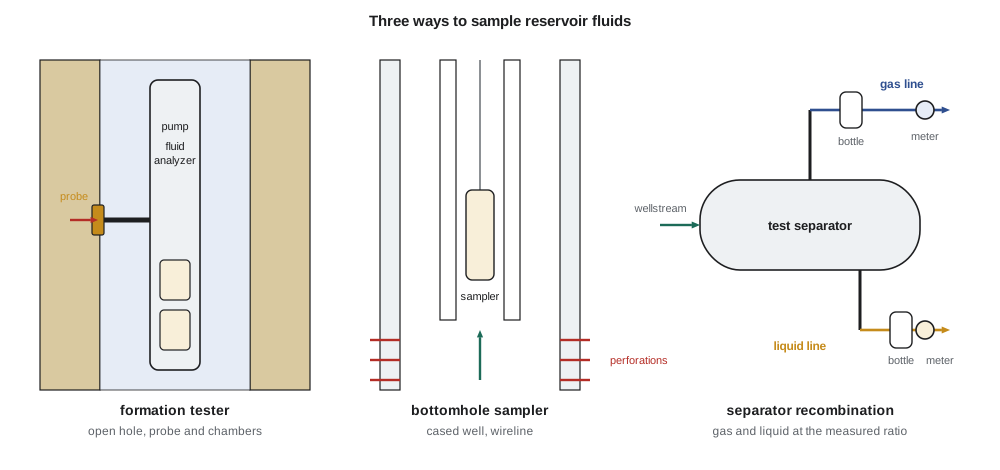
Modern wireline formation testers press a probe or a pair of packers against the borehole wall in the open hole, before casing is set. They pump fluid from the formation through a flowline and an optical fluid analyzer, which monitors contamination, gas-oil ratio, colour and the presence of water or gas in real time. Pumping continues until the contamination from oil-based or water-based mud filtrate falls to an acceptable level, typically below 5 to 10 percent, and then the fluid is diverted into sample chambers. The pumping rate is controlled so that the pressure at the probe stays above saturation pressure; testers measure that pressure continuously.
Formation testers have big advantages. They sample before production starts, so the reservoir is in its original state. They can sample several zones in one run, revealing composition gradients and compartments. Their downhole analyzers give immediate fluid typing at the wellsite. The sample chambers can be kept single-phase by a nitrogen-charged piston that maintains pressure above the reservoir pressure as the chamber cools on the way to surface. The main weakness is contamination with oil-based mud filtrate, which is miscible with reservoir oil and cannot be separated afterwards; laboratories correct for it using the filtrate's known composition, but heavy contamination degrades the sample.
Bottomhole samples in cased wells
In cased and completed wells, bottomhole samplers are run on wireline or slickline to a depth near the perforations while the well flows at a low rate or is shut in. A timer or a signal opens the chamber, which fills with fluid at flowing bottomhole pressure, and then closes. On surface, the opening pressure of each sampler is checked against the expected saturation pressure, and the bubble point of each sample is measured at the wellsite or in the laboratory. Two or more samples whose bubble points agree within a few percent are the usual evidence of a good set. A sample whose bubble point is well below the others has probably lost gas.
Surface sampling and recombination
For gas condensates and for wells where downhole sampling is impractical, samples are taken at the test separator. The separator gas and separator liquid are sampled at the same time, in pressurized cylinders, while the separator rates are measured accurately. In the laboratory, the two samples are recombined in the ratio of the measured gas and liquid rates to recreate the wellstream. Accurate rates are essential: an error of 5 percent in the measured GOR gives an error of a similar size in the recombined composition and in the dew point. The separator must be stable, at constant pressure and temperature, and the liquid level must be steady. Liquid carried over into the gas line, or gas carried under into the liquid line, spoils the recombination.
The recombination calculation converts the measured gas rate per barrel of separator liquid into moles, and the separator liquid into moles using its density and molar mass. The ratio gives the mole fraction of gas in the wellstream, and the wellstream composition is a weighted average of the gas and liquid compositions. Because GOR is usually reported per stock-tank barrel, a shrinkage factor from the separator liquid to the stock tank is needed.
Here Rsep is the separator GOR in scf/STB, s is the shrinkage in stock-tank barrels per separator barrel, ρL is the separator liquid density in lb/ft³, and 379.5 scf/lbmol is the molar volume of gas at 60 °F and 14.696 psia. In SI the equivalent molar volume is 23.645 m³/kmol at 15 °C and 101.325 kPa.
# Recombining separator samples at the producing GOR, and a sampler quality check
SI = True
gor = 820.0                                   # separator GOR, scf per stock-tank barrel... as measured
shrink = 0.92                                 # stock-tank barrels per separator barrel
gas = {'C1': 0.760, 'C2': 0.130, 'C3': 0.065, 'C4': 0.030, 'C5': 0.010, 'C6': 0.005}
liq = {'C1': 0.060, 'C2': 0.050, 'C3': 0.070, 'C4': 0.080, 'C5': 0.060, 'C6': 0.070, 'C7+': 0.610}
M = {'C1': 16.04, 'C2': 30.07, 'C3': 44.10, 'C4': 58.12, 'C5': 72.15, 'C6': 86.18, 'C7+': 210.0}
rho_sep_liq = 46.0                            # separator liquid density, lb/ft3

Ml = sum(z * M[c] for c, z in liq.items())
mol_liq = 5.615 * rho_sep_liq / Ml            # lbmol in one separator barrel of liquid
mol_gas = gor * shrink / 379.5                # lbmol of gas per separator barrel
ng = mol_gas / (mol_gas + mol_liq)
print(f"per separator barrel: {mol_gas:.3f} lbmol gas, {mol_liq:.3f} lbmol liquid, gas mole fraction {ng:.3f}")
print("component  recombined mole %")
for c in M:
    z = ng * gas.get(c, 0) + (1 - ng) * liq.get(c, 0)
    print(f"{c:>6} {100 * z:12.2f}")

# check: a bottomhole sampler should open well above the bubble point
pb_lab, p_open = 2480.0, 2410.0               # laboratory bubble point and sampler opening pressure, psia
ok = p_open > pb_lab
msg = "acceptable" if ok else "suspect: the sample may have flashed and lost gas"
print(f"opening pressure {p_open:.0f} vs bubble point {pb_lab:.0f} psia: {msg}" +
(f" ({p_open * 6.895:,.0f} vs {pb_lab * 6.895:,.0f} kPa)" if SI else ""))per separator barrel: 1.988 lbmol gas, 1.737 lbmol liquid, gas mole fraction 0.534
component recombined mole %
C1 43.35
C2 9.27
C3 6.73
C4 5.33
C5 3.33
C6 3.53
C7+ 28.45
opening pressure 2410 vs bubble point 2480 psia: suspect: the sample may have flashed and lost gas (16,617 vs 17,100 kPa)The recombined wellstream for the old Tamarack Lake test has 43.4 mole percent methane and 28.5 percent heptanes plus. The bottomhole sampler on the same well opened at 16,617 kPa, below the laboratory bubble point of 17,100 kPa. Ethan flags that sample as suspect: the fluid probably flashed in the near-well region or in the tubing before the chamber closed.
Quality control
Laboratories and engineers check samples in several ways before running a full study. Opening pressures and bubble points of replicate samples are compared. Separator gas samples are checked for air contamination by their oxygen and nitrogen content. Separator gas and liquid compositions are checked for equilibrium using the Hoffman plot, which plots log(Ki p) against a characterization factor for each component; components from a separator at equilibrium fall close to a straight line, and scatter suggests a problem. Water content, mud filtrate contamination and the presence of hydrogen sulphide, which can react with metal sampling cylinders, are measured or controlled. Each sample has a chain-of-custody record that follows it from the wellsite to the laboratory.
Worked problem
Recombination ratio
A test separator produces gas at 146 sm³ per m³ of stock-tank oil. The shrinkage from separator liquid to stock tank is 0.92. Separator liquid has density 737 kg/m³ and molar mass 148.7 kg/kmol. Find the moles of gas and liquid per cubic metre of separator liquid and the gas mole fraction in the wellstream.
Show solution
- Gas per m³ of separator liquid = 146 × 0.92 = 134.3 sm³; moles = 134.3/23.645 = 5.68 kmol.
- Liquid moles = 737/148.7 = 4.96 kmol per m³.
- Gas mole fraction = 5.68/(5.68 + 4.96) = 0.534.
Answer: About half the moles in this wellstream arrive as separator gas, even though the liquid carries most of the mass.
Sampling plans and timing
A sampling plan states which wells will be sampled, by which method, at what time, and what tests the laboratory will run. For a new field, a good plan samples the discovery well with a formation tester, takes bottomhole or surface samples during the first production test, and adds samples from appraisal wells across the field to test for compositional variation. The AER requires that operators submit gas and oil analyses for new pools, which are published and can be a valuable check on correlations for nearby wells. For Prairie Crest Energy Ltd.'s acquired pool, Ethan's plan uses the least-produced well, conditions it at three reducing rates, and takes two bottomhole samples and one separator set as a backup.
Sampling in unconventional wells is harder. Horizontal multistage wells flow back fracturing fluid for weeks, and their bottomhole pressure often falls below saturation pressure immediately. Surface sampling at early, stable flowback conditions, with careful rate measurement, is usually the only option. Some operators now sample during the first days of production with dedicated test separators and accept larger uncertainty. Another approach is to sample a nearby vertical pilot well before horizontal development.
Handling and transport
Pressurized sample cylinders contain flammable fluids at high pressure, often with hydrogen sulphide. They are transported as dangerous goods with proper labelling, valve protection and documentation, and they are handled only by trained staff. In the laboratory, samples are restored to single phase by heating to reservoir temperature and agitating at high pressure before any subsample is taken. A sample that is not fully restored gives a low bubble point and the wrong composition.
Common mistakes
MistakeSampling an oil well after it has been produced below its bubble point.
InsteadSample early, at low drawdown, while reservoir pressure is above saturation.
MistakeRecombining separator samples at an unstable or poorly metered GOR.
InsteadStabilize the separator and measure gas and liquid rates carefully during sampling.
MistakeAccepting a single bottomhole sample without a replicate.
InsteadTake two or more samples and compare opening pressures and bubble points.
MistakeIgnoring oil-based mud contamination.
InsteadMonitor contamination while pumping and correct the composition using the filtrate analysis.
Summary and key terms
- A representative sample matches the reservoir fluid; phase segregation and contamination are the main threats.
- Sample early, with the well conditioned at a low, stable rate above saturation pressure near the well.
- Formation testers sample in open hole with real-time contamination monitoring; bottomhole samplers work in cased wells.
- Surface samples are recombined at the measured separator GOR, which must be accurate and stable.
- Quality control compares replicates, opening pressures, bubble points and separator equilibrium.
- Representative sample
- A sample with the same composition as the reservoir fluid it is meant to describe.
- Well conditioning
- Flowing a well at reduced, stable rates to bring single-phase reservoir fluid to the wellbore.
- Formation tester
- A wireline tool that pumps fluid from the formation through a probe and collects samples.
- Recombination
- Mixing separator gas and liquid samples in their measured ratio to recreate the wellstream.
- Opening pressure
- The pressure in a sample chamber when it is first opened at surface.
- Hoffman plot
- A plot used to check that separator gas and liquid compositions are in equilibrium.
Practice problems
Work each problem on paper first, then reveal the answer to check.
Why should drawdown be small when sampling an oil well near its bubble point?
Show answer
Large drawdown drops near-well pressure below the bubble point and the produced fluid is no longer representative.
A separator GOR of 1,000 scf/STB is measured 5 percent high. What happens to the recombined dew or bubble point?
Show answer
It is too high, because too much gas is added in the recombination.
Two bottomhole samples give bubble points of 2,480 and 2,210 psia. Which is suspect?
Show answer
The 2,210 psia sample, which has probably lost gas.
Why is oil-based mud filtrate a bigger problem than water-based filtrate in oil samples?
Show answer
It is miscible with the oil and cannot be separated physically.
Lesson quiz · 5 questions
Score 60% or more to complete this lesson.
Create a free account to save your progress, take quizzes and earn a certificate.