
PET-260 · Lesson 6 of 12 · 19 min
Formation water and gas hydrates
In January, Marcus calls from the Tamarack Lake gas gathering system near Drayton Valley. Pressure at the inlet to a compressor station has been falling for two days, and a pig sent down the line has stuck. 'Hydrates,' he says. 'The methanol pump at the wellsite tripped on Friday night and nobody noticed. It was minus thirty.' Ethan is asked to work out how much methanol the line actually needs, and why the formation water matters as much as the gas.
Why water matters
Almost every reservoir contains water. It fills the smallest pores and coats the grains as connate water, it sits below the hydrocarbons in an aquifer, and it eventually reaches the wells. Its properties enter reservoir engineering in many places: the water formation volume factor and compressibility in material balance, water viscosity in waterflood mobility ratios, water density in pressure gradients and contacts, and water composition in scaling, corrosion and log interpretation. Water is also the essential ingredient of gas hydrates, the ice-like solids that block gas wells and pipelines in cold weather and deep water.
Composition and salinity
Formation waters are brines. Their total dissolved solids range from a few thousand milligrams per litre in shallow formations to more than 300,000 mg/L in some deep basins, nearly ten times the salinity of seawater at about 35,000 mg/L. Sodium and chloride dominate, with calcium, magnesium, potassium, sulphate, bicarbonate and strontium or barium in varying amounts. A water analysis reports each ion, the total dissolved solids, the pH and the resistivity. Engineers use these analyses to identify which zone a produced water came from, to predict mineral scales such as calcium carbonate and barium sulphate when waters are mixed or cooled, and to calculate the water resistivity used in Archie's equation.
Samples must be taken carefully. A water sample contaminated by drilling or completion fluids is worthless for scale prediction, so samples are taken after enough flow to clean up the well, and analyses are checked for an ionic balance between positive and negative charges. In Alberta, the AER requires produced water analyses for disposal and injection approvals, and operators keep them in a basin database.
Physical properties of brine
Brine density rises roughly linearly with salinity, by about 0.7 kg/m³ per 1,000 mg/L of dissolved solids at standard conditions, and falls slightly with temperature. The pressure gradient of fresh water is 0.433 psi/ft (9.79 kPa/m); a typical brine of 85,000 mg/L has a gradient of about 0.46 psi/ft (10.4 kPa/m). These gradients are used with pressure surveys to locate the free water level and the gas-water or oil-water contact, where the water and hydrocarbon gradient lines cross.
The water formation volume factor, Bw, is close to 1. At reservoir conditions it is typically 1.00 to 1.07, the result of two small effects that partly cancel: thermal expansion increases the volume, while compression and the dissolution of a little gas decrease or increase it. Gas solubility in water is low, a few standard cubic metres per cubic metre (around 10 to 20 scf/STB), and falls with salinity. Water compressibility is about 3 × 10⁻⁶ per psi (0.45 × 10⁻⁶ per kPa). Water viscosity falls strongly with temperature, from about 1 mPa·s at 20 °C to about 0.3 mPa·s at 100 °C, and rises with salinity. McCain published convenient correlations for all of these properties, which are adequate for most reservoir work.
Water in natural gas
Gas in a reservoir is in contact with water and is saturated with water vapour at reservoir conditions. As the gas flows up the well and through the gathering system, it cools and its pressure falls. The water content of saturated gas falls with cooling, so liquid water condenses along the way. A gas at 100 °C and 10 MPa can carry several thousand milligrams of water per cubic metre, which is why gas plants dehydrate gas with glycol contactors or molecular sieves before it enters a sales pipeline. Pipeline specifications in both Canada and the United States commonly limit water content to about 65 to 110 mg/m³ (4 to 7 lb per million standard cubic feet). The McKetta-Wehe chart gives the water content of sweet natural gas as a function of temperature and pressure, with corrections for gas gravity and brine salinity.
Gas hydrates
Gas hydrates are crystalline solids in which water molecules form cages held together by hydrogen bonds, with small gas molecules trapped inside. They look like dirty ice or snow, but they can form well above 0 °C when the pressure is high enough. Methane, ethane, propane, isobutane, carbon dioxide and hydrogen sulphide all form hydrates. Molecules larger than butane are too big for the cages. Three structures are known: structure I forms with methane, ethane and carbon dioxide alone; structure II forms when propane or isobutane is present, which is the case for most natural gases; and structure H forms only with certain larger molecules alongside methane.
Hydrates need four conditions: water, hydrate-forming gas, low enough temperature and high enough pressure. Remove any one and they cannot form. For a typical natural gas, the hydrate formation temperature is about 10 °C (50 °F) at 1 MPa (145 psia) and about 20 °C (68 °F) at 10 MPa (1,450 psia). Richer gases with more propane form hydrates at higher temperatures than lean gases. Hydrogen sulphide is a strong hydrate former, so sour gas forms hydrates at higher temperatures still.
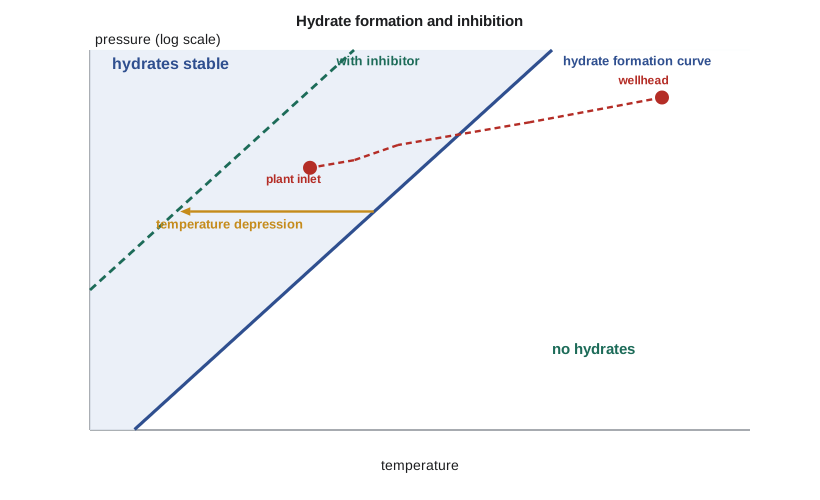
Hydrate plugs are a serious operating hazard as well as a production problem. A plug can be many metres long and can trap high pressure gas behind it. If pressure is relieved on one side only, the plug can move like a projectile down the pipe and rupture it at a bend. Industry practice for removing plugs is therefore to depressurize from both sides where possible, to apply heat carefully and never with an open flame, and to follow written procedures. Preventing hydrates is far safer and cheaper than removing them.
Predicting hydrate conditions
The simplest prediction methods are charts of hydrate formation temperature against pressure for gases of different gravity, developed by Katz in the 1940s. The Katz K-value method treats hydrate formation like a flash with solid-vapour equilibrium ratios, and is more accurate for unusual compositions. Modern practice uses statistical thermodynamic models based on the van der Waals and Platteeuw theory, built into process simulators. All methods should be checked against measured hydrate points where they matter.
Preventing hydrates
Hydrates are prevented by removing one of the four conditions. Dehydration removes the water. Heating keeps the gas above its hydrate temperature, using line heaters at the wellsite or insulated and buried flowlines. Lowering the pressure moves the operating point out of the hydrate region, though this is rarely practical for transport. Thermodynamic inhibitors, such as methanol and monoethylene glycol (MEG), lower the hydrate formation temperature at a given pressure, just as antifreeze lowers the freezing point of water. Low dosage hydrate inhibitors, kinetic inhibitors and anti-agglomerants, work at much lower concentrations by slowing crystal growth or keeping crystals dispersed, and are used where large methanol volumes would be impractical.
The Hammerschmidt equation estimates the temperature depression produced by a given concentration of inhibitor in the free water phase. It is reliable up to about 20 to 25 weight percent methanol; for higher concentrations, the Nielsen-Bucklin equation or a simulator is better. The constant K is about 2,335 for temperatures in °F (1,297 for °C) for both methanol and glycols in common published forms, though some references use a higher value for glycols; these constants are approximate.
Inhibitor injection must allow for losses. Methanol is volatile, so a substantial fraction goes into the gas phase, and some dissolves in any liquid hydrocarbon. Only the methanol in the water phase protects against hydrates. In cold, high-pressure gas, the methanol lost to the gas can exceed the amount in the water. MEG has negligible vapour losses and is often recovered and regenerated in larger systems, while methanol is usually injected once and lost.
# Formation water and hydrate inhibition: Hammerschmidt depression and a methanol rate
SI = True
salinity_ppm = 85000                          # total dissolved solids, mg/L (approximate as ppm)
rho_w = 62.37 * (1 + 0.695e-6 * salinity_ppm) # brine density at standard conditions, lb/ft3 (approximate)
grad = rho_w / 144
print(f"brine density about {rho_w:.2f} lb/ft3, pressure gradient {grad:.3f} psi/ft" +
      (f" ({rho_w * 16.018:.0f} kg/m3, {grad * 22.62:.2f} kPa/m)" if SI else ""))

# Hammerschmidt: temperature depression from a weight % inhibitor in the free water
K = {'methanol': (2335, 32.04), 'MEG': (2700, 62.07)}   # constant for F, molar mass
hydrate_T, flow_T = 64.0, 40.0                # hydrate point at line pressure and coldest flowing temperature, F
need = hydrate_T - flow_T + 5                 # 5 F safety margin
for name, (k, m) in K.items():
    w = 100 * need * m / (k + need * m)       # rearranged Hammerschmidt equation
    d = f"{need:.0f} F" if not SI else f"{need / 1.8:.1f} C"
    print(f"{name}: depression of {d} needs about {w:.1f} wt % in the water phase")

water_bpd = 120.0                             # produced water, bbl/d
w = 100 * need * 32.04 / (2335 + need * 32.04)
meoh = water_bpd * 350 * w / (100 - w)         # lb/d of methanol dissolved in the water
gal = meoh / 6.63
print(f"methanol in water phase: {meoh:,.0f} lb/d, about {gal:,.0f} US gal/d" +
(f" ({gal * 3.785 / 1000:.2f} m3/d)" if SI else "") + " before losses to the gas and condensate")brine density about 66.05 lb/ft3, pressure gradient 0.459 psi/ft (1058 kg/m3, 10.38 kPa/m) methanol: depression of 16.1 C needs about 28.5 wt % in the water phase MEG: depression of 16.1 C needs about 40.0 wt % in the water phase methanol in water phase: 16,713 lb/d, about 2,521 US gal/d (9.54 m3/d) before losses to the gas and condensate
For the Tamarack Lake line, the hydrate temperature at line pressure is 18 °C (64 °F) and the coldest flowing temperature is 4 °C (40 °F). With a 3 °C (5 °F) safety margin, the line needs a depression of about 16 °C. That calls for about 28.5 weight percent methanol in the water phase, or 40 percent MEG. With 19 m³/d of produced water, the methanol dissolved in the water alone is about 9.5 m³/d. Ethan notes that 28.5 percent is near the upper limit of Hammerschmidt's accuracy, and asks Nadia to check the answer with the process simulator, which also estimates the methanol lost to the gas.
Worked problem
Hydrate inhibition with methanol
A flowline needs a hydrate temperature depression of 10 °C. Using K = 1,297 for °C and M = 32.04 for methanol, find the weight percent of methanol needed in the free water.
Show solution
- M ΔT = 32.04 × 10 = 320.4.
- W = 100 × 320.4/(1,297 + 320.4) = 32,040/1,617.4 = 19.8 weight percent.
- Check: ΔT = 1,297 × 19.8/(32.04 × 80.2) = 25,681/2,570 = 10.0 °C.
Answer: The same depression in °C and °F gives the same concentration, as it should. The total injection rate must add the methanol lost to the gas and condensate.
Hydrates in nature
Natural gas hydrates also occur in nature, in permafrost regions and in marine sediments along continental margins, where low temperatures and high water pressures keep them stable. The amount of methane held in these deposits is very large, though estimates vary widely. Research wells, including the Mallik site in the Mackenzie Delta of the Northwest Territories and test wells on the Alaska North Slope, have produced gas from hydrate by depressurization. For reservoir engineers, natural hydrates are also a drilling hazard in deep water and Arctic wells, where warm drilling fluids can destabilize them around the wellbore.
Common mistakes
MistakeAssuming hydrates cannot form above 0 °C (32 °F).
InsteadAt pipeline pressures hydrates form at 10 to 25 °C (50 to 77 °F).
MistakeCalculating inhibitor on the total gas rate instead of the free water.
InsteadOnly inhibitor in the water phase protects; calculate on water, then add losses.
MistakeRelieving pressure on one side of a hydrate plug.
InsteadDepressurize from both sides where possible and follow written procedures.
MistakeUsing Hammerschmidt far beyond about 25 weight percent methanol.
InsteadUse Nielsen-Bucklin or a simulator at high concentrations.
Summary and key terms
- Formation waters are brines whose salinity controls density, viscosity, gas solubility and scaling.
- Bw is close to 1, water compressibility is about 3 × 10⁻⁶ per psi, and water viscosity falls strongly with temperature.
- Gas hydrates need water, hydrate-forming gas, low temperature and high pressure, and can form well above 0 °C.
- Hydrates are prevented by dehydration, heating, pressure control or inhibitors such as methanol and MEG.
- The Hammerschmidt equation estimates inhibitor concentration in the water phase; losses to gas and liquid must be added.
- Connate water
- Water present in the pores since the rock was deposited or filled with hydrocarbons.
- Total dissolved solids
- The mass of dissolved salts per volume of water, usually in mg/L.
- Gas hydrate
- A crystalline solid of water cages containing small gas molecules.
- Thermodynamic inhibitor
- A chemical such as methanol or MEG that lowers the hydrate formation temperature.
- Low dosage hydrate inhibitor
- A kinetic inhibitor or anti-agglomerant effective at low concentration.
- Hammerschmidt equation
- An equation relating hydrate temperature depression to inhibitor weight percent.
Practice problems
Work each problem on paper first, then reveal the answer to check.
A brine has a gradient of 0.46 psi/ft. What is its density in lb/ft³?
Show answer
0.46 × 144 = 66.2 lb/ft³.
Why does propane raise the hydrate formation temperature of a gas?
Show answer
It stabilizes the structure II hydrate, which forms at higher temperatures than structure I.
Find the weight percent MEG (M = 62.07) for a 10 °C depression with K = 1,297.
Show answer
W = 100 × 620.7/(1,297 + 620.7) = 32.4 percent.
List the four conditions needed for hydrate formation.
Show answer
Water, a hydrate-forming gas, low temperature and high pressure.
Lesson quiz · 5 questions
Score 60% or more to complete this lesson.
Create a free account to save your progress, take quizzes and earn a certificate.