
NUC-450 · Lesson 9 of 12 · 21 min
Fast reactors and breeding
Rohan grew up professionally with thermal reactors. CANDU, he likes to say, is the most neutron-economical power reactor ever built, because heavy water wastes so few neutrons. But for the fast reactor chapter he starts Hana somewhere else. “In a CANDU we fight for every tenth of a milli-k. In a fast reactor you have neutrons to spare, and the question becomes what to spend them on: making new fuel, burning old waste, or just running for twenty years without refuelling.”
This lesson explains how the neutron energy spectrum changes the neutron economy of a reactor, why fast reactors can breed more fissile material than they consume, and what conversion ratio, breeding ratio and doubling time mean. It covers the physics and safety characteristics of fast cores, the history of fast reactors, and the ways modern designs use their neutrons, from breeding to long-life cores, at the level of fuel-cycle concepts.
Fissile and fertile nuclides
A fissile nuclide can be split by neutrons of any energy, including slow thermal neutrons. The three of practical importance are uranium-235, which occurs naturally at 0.72 percent of uranium, and plutonium-239 and uranium-233, which are made in reactors. A fertile nuclide cannot sustain a chain reaction itself but becomes fissile after capturing a neutron and undergoing beta decays. Uranium-238, which makes up 99.3 percent of natural uranium, becomes plutonium-239, and thorium-232, the subject of lesson 10, becomes uranium-233.
Every operating reactor converts some fertile material. In a light water reactor about a third of the energy produced late in a fuel cycle comes from fission of plutonium bred in the fuel. The conversion ratio, the rate of production of fissile atoms divided by the rate of their destruction, is about 0.5 to 0.6 for a light water reactor and about 0.8 for a natural uranium CANDU. A reactor with a conversion ratio above 1 is a breeder, and the ratio is then called the breeding ratio.
Why the spectrum matters
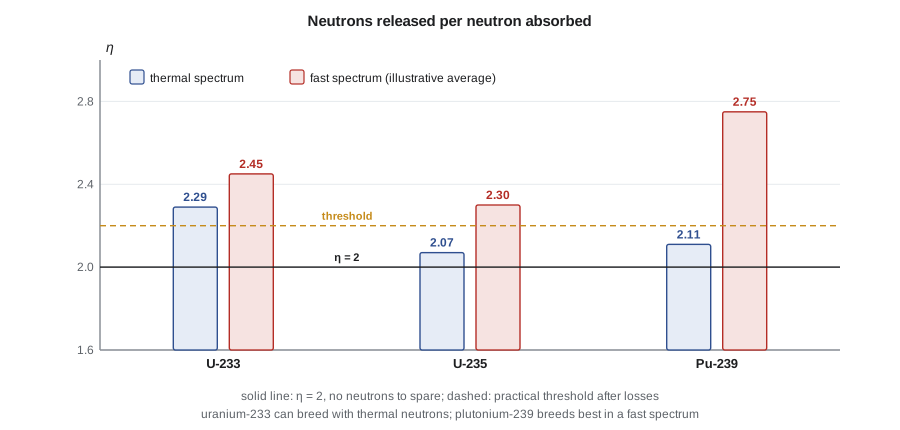
The key quantity is η, the average number of neutrons released per neutron absorbed in the fuel. One of those neutrons must cause the next fission to keep the chain going, and some are lost to leakage and parasitic capture. Whatever is left can be captured in fertile material. Breeding therefore requires η greater than 2 by a comfortable margin.
For thermal neutrons, η is about 2.07 for uranium-235 and 2.11 for plutonium-239, too close to 2 for practical breeding once losses are counted, because at low energy a large share of absorptions in these nuclides are radiative captures rather than fissions. For fast neutrons, the capture-to-fission ratio falls and η for plutonium-239 rises to about 2.7 to 3, leaving several tenths of a neutron per absorption available for breeding. Uranium-233 is the exception: its η of about 2.3 for thermal neutrons makes thermal breeding just possible, which is the basis of the thorium cycle.
# Breeding concepts: neutrons per absorption (eta) in thermal and fast spectra,
# the conversion ratio a neutron budget allows, and simple fissile doubling times.
import math
eta = {  # neutrons released per neutron absorbed in the fuel nuclide (illustrative spectrum averages)
    "U-233":  {"thermal": 2.29, "fast": 2.45},
    "U-235":  {"thermal": 2.07, "fast": 2.30},
    "Pu-239": {"thermal": 2.11, "fast": 2.75}}
losses = {"thermal": 0.25, "fast": 0.20}   # parasitic capture + leakage per absorption in fuel (illustrative)
print(f"{'nuclide':8s}{'spectrum':>9s}{'eta':>6s}{'max CR = eta - 1 - L':>22s}")
for nuc, d in eta.items():
    for sp, e in d.items():
        cr = e - 1 - losses[sp]       # one neutron sustains the chain, the rest can be captured in fertile
        print(f"{nuc:8s}{sp:>9s}{e:6.2f}{cr:22.2f}{'   breeder possible' if cr > 1 else ''}")
# Doubling time: the time to produce a surplus equal to the initial fissile inventory.
def doubling(M0_t, P_GWt, BR, cf=0.85):
    burn = 1.05 * P_GWt * 365 * cf / 1000          # tonnes fissioned per year: about 1.05 kg per GW-day of heat
    gain = (BR - 1) * burn * 1.2                   # fissile absorptions about 1.2 x fissions in a fast spectrum
    simple = M0_t / gain
    return burn, gain, simple, simple * math.log(2)   # compound time if surplus starts new reactors at once
for BR in (1.05, 1.15, 1.30):
    b, g, s, c = doubling(M0_t=4.0, P_GWt=2.5, BR=BR)
    print(f"BR {BR:.2f}: fissile burned {b:.2f} t/y, net gain {g:.3f} t/y, "
          f"simple doubling {s:5.0f} y, compound {c:5.0f} y")
# Uranium utilization: once-through thermal reactors fission well under 1 percent of mined uranium.
print("once-through LWR: about 0.6 % of natural uranium fissioned; multi-recycle fast reactor: well over 50 %")nuclide spectrum eta max CR = eta - 1 - L U-233 thermal 2.29 1.04 breeder possible U-233 fast 2.45 1.25 breeder possible U-235 thermal 2.07 0.82 U-235 fast 2.30 1.10 breeder possible Pu-239 thermal 2.11 0.86 Pu-239 fast 2.75 1.55 breeder possible BR 1.05: fissile burned 0.81 t/y, net gain 0.049 t/y, simple doubling 82 y, compound 57 y BR 1.15: fissile burned 0.81 t/y, net gain 0.147 t/y, simple doubling 27 y, compound 19 y BR 1.30: fissile burned 0.81 t/y, net gain 0.293 t/y, simple doubling 14 y, compound 9 y once-through LWR: about 0.6 % of natural uranium fissioned; multi-recycle fast reactor: well over 50 %
The first table shows why plutonium fuel in a fast spectrum is the classic breeder combination, and why uranium-233 can breed even with thermal neutrons. The doubling time results show the practical side. With a breeding ratio of 1.05, a fast reactor would take most of a century to produce enough surplus fissile material to start another of its kind; at 1.3 it would take about a decade or two. In the 1960s and 1970s, when uranium was expected to become scarce, short doubling times were a central design goal. With uranium plentiful, most modern fast reactor designs aim for a breeding ratio close to 1, or below it, and use their neutrons for other purposes.
Physics of a fast core
A fast reactor has no moderator. Its fuel is packed tightly in a hexagonal lattice of thin pins, typically 6 to 8 mm in diameter, cooled by a liquid metal or gas that slows neutrons very little. The average neutron energy is a few hundred keV. Because cross-sections are small at these energies, a fast core needs a higher concentration of fissile material than a thermal core, about 15 to 20 percent in fuel without a blanket, and it is compact, with very high power density, often 300 kW per litre or more.
Several features shape its safety. The fraction of delayed neutrons from plutonium-239, about 0.0021, is a third of that from uranium-235, so a given reactivity insertion is a larger multiple of β and control margins are tighter. The prompt neutron lifetime is very short, less than a microsecond, so kinetics are dominated by the delayed neutrons as in any reactor, but the margin to prompt criticality is smaller. The Doppler coefficient is negative but weaker than in thermal reactors because there are fewer neutrons at resonance energies. In large sodium-cooled cores the sodium void coefficient can be positive at the centre of the core: if sodium boils or is expelled, the spectrum hardens and fewer neutrons are captured in sodium, raising reactivity. Designers counter this with flatter, pancake-shaped or heterogeneous cores that let neutrons leak more easily when sodium is lost, and by keeping the sodium far below boiling.
Fast reactors can also have strong passive feedback from thermal expansion. When the core heats up, fuel pins, the core support grid and the core lattice expand and the core becomes less reactive. In April 1986 the Experimental Breeder Reactor-II in Idaho demonstrated this by deliberately cutting off coolant pumps, and in a separate test the heat sink, at full power without allowing the control rods to insert. In both tests the reactor shut itself down through inherent feedback with no fuel damage, a result that underpins the passive safety cases of modern metal-fuelled designs.
Breeders, burners and long-life cores
A fast reactor's spare neutrons can be spent in different ways, depending on what surrounds the core and how the fuel is managed. Surrounding the core with blankets of depleted uranium and recycling the fuel makes a breeder, which in principle could use almost all of the uranium-238 that is now stored as enrichment tails, raising the energy extracted from mined uranium by a factor of fifty or more. Removing the blankets and adjusting the core makes a burner, which consumes more fissile and minor actinide material than it produces, an option studied for reducing the long-lived radiotoxicity of used fuel. A fully closed fuel cycle in either mode requires recycling used fuel, a separate industrial step that is subject to international safeguards and lies outside the scope of this course.
A third option is a breed-and-burn or long-life core that runs once-through. Its fertile fuel is converted in place and much of the new fissile material is burned before the fuel is discharged, so that the reactor can operate for many years between refuellings without any recycling. Several current small fast reactor designs follow this approach, aiming for core lives of ten to twenty years.
Experience with fast reactors
The first electricity from nuclear power came from a fast reactor: the Experimental Breeder Reactor-I in Idaho lit four light bulbs in December 1951. Since then about twenty fast reactors have operated worldwide. The record is mixed. EBR-II ran for thirty years and demonstrated metal fuel and passive safety. The Fermi 1 reactor near Detroit suffered a partial fuel melt in 1966 when a piece of metal blocked coolant flow. France's Superphénix, at 1,240 MWe the largest ever built, was closed in 1997 after a troubled history, and Japan's Monju was permanently shut down after a sodium leak in 1995 and years of problems. Russia's BN-600 and BN-800 at Beloyarsk have generated power for decades and are the main evidence that commercial-scale sodium fast reactors can operate reliably. India and China are building or commissioning prototype fast reactors.
Canada has never built a fast reactor, but Hana's chapter notes two connections. NB Power's proposed ARC-100 at Point Lepreau, a 100 MWe sodium-cooled design derived from EBR-II, would run on a long-life metal-fuelled core of about twenty years, and in the United States TerraPower's Natrium plant, licensed for construction in Wyoming in 2026, will operate initially on a once-through HALEU cycle. Neither is a breeder in the original sense: both use the fast spectrum for long fuel life, passive safety and high temperature.
Worked problem
Conversion ratio from a neutron budget
In a fast core, η for the fuel averages 2.60. Per neutron absorbed in fuel, 0.12 neutrons leak and 0.18 are captured in coolant, structure and control materials. Fission of uranium-238 adds 0.15 neutrons per absorption in fuel. What is the maximum conversion ratio if every remaining neutron is captured in uranium-238?
Show solution
- Neutrons available per absorption in fuel: 2.60 + 0.15 = 2.75.
- Subtract one to sustain the chain and the losses: 2.75 − 1 − 0.12 − 0.18 = 1.45.
- Each of these captured in uranium-238 makes one plutonium-239 atom.
Answer: A maximum conversion ratio of about 1.45; real designs achieve less because some capture occurs in fission products and other non-fertile material.
Using fast neutrons for waste
A fast spectrum also changes the fate of the minor actinides, neptunium, americium and curium, which dominate the long-term radiotoxicity of used fuel after the first few centuries. In a thermal reactor these nuclides mostly capture neutrons and become heavier actinides; in a fast spectrum a much larger fraction of absorptions cause fission. That is the basis of proposals to use fast reactors as burners, with fuel containing minor actinides recycled until they are fissioned, reducing the time for used fuel radiotoxicity to fall to that of the original uranium ore from hundreds of thousands of years to a few centuries. Such schemes require advanced recycling and fuel fabrication with highly radioactive materials, and remain at the research and demonstration stage.
Rohan stresses a point for the consortium: none of these fuel-cycle choices is forced by the reactor. A fast reactor can run once-through for decades, like the long-life designs now being licensed, and leave the decision about recycling to a later generation. That flexibility is part of the argument for fast reactors, and it is also why their economics in the near term are judged mainly as power and heat plants rather than as fuel factories.
Common mistakes
MistakeA breeder reactor makes energy from nothing.
InsteadIt converts fertile uranium-238 or thorium-232 into fissile fuel; the energy comes from fission of that fuel.
MistakeFast reactors use fast neutrons because they cause more fissions.
InsteadCross-sections are smaller at high energy; the advantage is a higher η and fewer captures.
MistakeEvery fast reactor is a breeder.
InsteadWhether it breeds depends on blankets, core design and fuel management; many modern designs aim for a ratio near 1.
MistakeFast reactors respond to reactivity like thermal reactors with uranium.
InsteadPlutonium's smaller delayed neutron fraction tightens control margins.
Summary and key terms
- Fertile uranium-238 and thorium-232 become fissile plutonium-239 and uranium-233 by neutron capture and beta decay.
- Breeding needs η well above 2; fast spectra provide it for plutonium, and uranium-233 allows thermal breeding.
- Conversion ratio is fissile production over destruction; above 1 a reactor breeds.
- Doubling time falls sharply as breeding ratio rises; modern designs often aim near 1.
- Fast cores are compact, with small delayed neutron fractions and possible positive sodium void reactivity.
- EBR-II demonstrated passive shutdown without scram in 1986.
- Fissile
- Able to fission with thermal neutrons.
- Fertile
- Converted into a fissile nuclide by neutron capture and decay.
- Eta
- Neutrons produced per neutron absorbed in fuel.
- Conversion ratio
- Rate of fissile production divided by rate of fissile destruction.
- Doubling time
- The time for a breeder to produce surplus fissile material equal to its inventory.
- Sodium void coefficient
- The change in reactivity when sodium is removed from part of the core.
Practice problems
Work each problem on paper first, then reveal the answer to check.
Why is breeding with thermal neutrons impractical for plutonium-239?
Show answer
Its thermal η of about 2.1 leaves too few neutrons after losses.
What is the conversion ratio of a typical light water reactor?
Show answer
About 0.5 to 0.6.
Why can the sodium void coefficient be positive?
Show answer
Removing sodium hardens the spectrum and reduces capture in sodium, raising reactivity in a large core.
What did the 1986 EBR-II tests show?
Show answer
The reactor shut itself down through inherent feedback when cooling was lost without scram.
Why do most new fast reactor designs not aim for short doubling times?
Show answer
Uranium is plentiful, so long fuel life and safety are valued more than rapid breeding.
Lesson quiz · 5 questions
Score 60% or more to complete this lesson.
Create a free account to save your progress, take quizzes and earn a certificate.