
NUC-450 · Lesson 10 of 12 · 19 min
Thorium fuel cycles
Thorium has a devoted following on the internet, and one of the consortium's directors has sent Meridian a stack of articles calling it the fuel that would have made nuclear power safe, cheap and waste-free if only the industry had chosen it. Rohan asks Hana to write the thorium chapter as a careful engineer would. “Thorium is real physics with real advantages,” he says. “Canada studied it in CANDU for decades. But it isn't magic, and the client deserves to know which claims hold up.”
This lesson explains how thorium-232 is converted into fissile uranium-233, the timing of the conversion chain and why protactinium matters, and the properties of thorium fuels. It reviews experience with thorium in water, gas, heavy water and molten salt reactors, and weighs the advantages and disadvantages usually claimed for thorium fuel cycles, at the level of fuel-cycle concepts.
Thorium as a fertile material
Thorium is a silvery actinide metal found mainly in the mineral monazite, a by-product of rare-earth and titanium mining. It is about three to four times as abundant as uranium in the Earth's crust, and almost all natural thorium is the single isotope thorium-232, with a half-life of 14 billion years. Thorium-232 is fertile, not fissile: it cannot sustain a chain reaction on its own. A thorium-fuelled reactor must therefore be started with a fissile driver, uranium-235 or plutonium-239, until enough uranium-233 has been bred to take over.
The conversion follows the chain
Thorium-232's thermal capture cross-section, about 7.4 barns, is nearly three times that of uranium-238, so thorium is a stronger absorber and a more effective fertile material in a thermal spectrum. The resulting uranium-233 has the best η of any fissile nuclide for thermal neutrons, about 2.3, which is why a thorium-uranium-233 cycle is the only practical way to breed with thermal neutrons, as lesson 9 showed.
The protactinium step
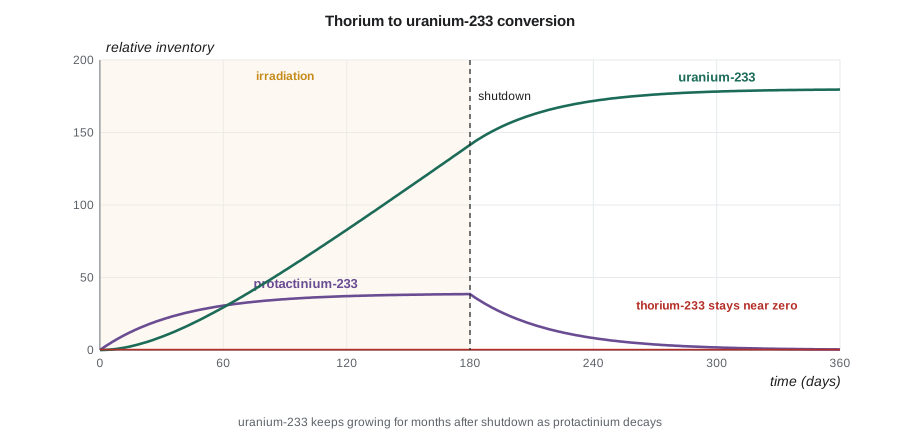
The 27-day half-life of protactinium-233 is the slow step of the chain. While a reactor operates, protactinium builds up toward an equilibrium inventory equal to the capture rate times its mean life of about 39 days, and only then does uranium-233 production keep pace with thorium capture. When the reactor shuts down, the protactinium in the core continues to decay, so the uranium-233 content keeps rising for several months.
# Thorium-232 -> Th-233 -> Pa-233 -> U-233 chain under constant irradiation and after
# shutdown, solved by stepping the Bateman equations (relative units, no burnup of U-233).
import math
half = {"Th233": 21.83 / 60 / 24, "Pa233": 26.98}          # half-lives in days
lam = {k: math.log(2) / v for k, v in half.items()}
R = 1.0                     # Th-232 captures per day (relative units)
dt, t_irr, t_end = 0.001, 180.0, 360.0
th = pa = u = 0.0
t, out = 0.0, []
while t <= t_end + 1e-9:
    if abs(t % 30) < dt / 2 or abs(t % 30 - 30) < dt / 2:
        out.append((round(t), th, pa, u))
    src = R if t < t_irr else 0.0
    d_th = src - lam["Th233"] * th
    d_pa = lam["Th233"] * th - lam["Pa233"] * pa
    d_u = lam["Pa233"] * pa
    th += d_th * dt; pa += d_pa * dt; u += d_u * dt; t += dt
print(f"{'day':>5s}{'Th-233':>9s}{'Pa-233':>9s}{'U-233':>9s}   (irradiation stops at day {t_irr:.0f})")
for d, a, b, c in out:
    print(f"{d:5d}{a:9.3f}{b:9.2f}{c:9.2f}")
print(f"equilibrium Pa-233 during irradiation = R / lambda = {R / lam['Pa233']:.1f} (days of capture)")
# Capture cross-sections at thermal energy: thorium is a better absorber than U-238.
sig = {"Th-232": 7.35, "U-238": 2.68}
print("thermal capture cross-sections (barns): " + ", ".join(f"{k} {v}" for k, v in sig.items()))
print(f"abundance in the Earth's crust: thorium is about 3 to 4 times as common as uranium") day Th-233 Pa-233 U-233 (irradiation stops at day 180)
0 0.000 0.00 0.00
30 0.022 20.90 9.07
60 0.022 30.59 29.39
90 0.022 35.07 54.91
120 0.022 37.14 82.84
150 0.022 38.10 111.88
180 0.022 38.54 141.44
210 0.000 17.84 162.16
240 0.000 8.26 171.74
270 0.000 3.82 176.18
300 0.000 1.77 178.23
330 0.000 0.82 179.18
360 0.000 0.38 179.62
equilibrium Pa-233 during irradiation = R / lambda = 38.9 (days of capture)
thermal capture cross-sections (barns): Th-232 7.35, U-238 2.68
abundance in the Earth's crust: thorium is about 3 to 4 times as common as uraniumThe output shows the three effects that matter in practice. Thorium-233, with a half-life of minutes, never accumulates. Protactinium reaches about 39 days' worth of captures within a few months. And after shutdown the uranium-233 inventory grows by roughly a quarter as the stored protactinium decays. That post-shutdown growth is a real reactivity effect: a thorium core becomes more reactive in the months after it is shut down, the opposite of the familiar xenon behaviour, and shutdown margins must allow for it.
Protactinium also absorbs neutrons. Each protactinium atom that captures a neutron before decaying becomes protactinium-234 and then uranium-234, and a potential fissile atom is lost. The loss grows with neutron flux, so high-flux thermal breeders are penalized. Designs that aim for thermal breeding either operate at moderate flux or, in molten salt concepts, keep protactinium out of the core while it decays; the chemistry involved is a separations question beyond this course.
Properties of thorium fuels
Thorium dioxide is an attractive ceramic fuel. Its melting point, about 3,350 °C, is roughly 500 °C higher than that of uranium dioxide, its thermal conductivity is about 10 to 15 percent higher, so fuel runs cooler, and it is chemically very stable because thorium has only one oxidation state. It releases fission gases less readily and is highly resistant to dissolution, which is helpful for direct disposal of used fuel, though it makes recycling harder. Because thorium-232 lies seven mass units below plutonium-239 and many neutron captures away from it, thorium fuel produces far fewer plutonium and minor actinide atoms than uranium fuel, which lowers the long-term radiotoxicity of the waste for the first few thousand years.
Thorium fuels also produce uranium-232 through side reactions such as (n,2n) on thorium-232 and uranium-233. Its decay chain includes thallium-208, which emits a 2.6 MeV gamma ray. Even tens of parts per million of uranium-232 make bred uranium-233 intensely radioactive within months, so fabricating fuel from it requires shielded, remotely operated facilities. This is usually counted as a cost disadvantage, and sometimes as a proliferation-resistance feature, though uranium-233 is a fissile material and is safeguarded by the IAEA just as plutonium is.
| Claim often made for thorium | Assessment |
|---|---|
| Thorium is more abundant than uranium | True: about 3 to 4 times as common, but uranium is not scarce at present prices |
| Thorium fuel produces less long-lived waste | Partly true: far fewer transuranics, but fission products are similar and U-233 cycles need recycling |
| Thorium reactors cannot melt down | Not a property of thorium: safety depends on the reactor design, not the fertile material |
| Thorium cycles are proliferation-proof | Not true: U-233 is fissile and safeguarded; U-232 adds radiation barriers only |
| Thorium oxide is a better ceramic | True: higher melting point, better conductivity and stability |
| Thorium needs no fissile start-up | Not true: a U-235 or Pu-239 driver is needed until U-233 builds up |
Experience with thorium
Thorium has been used in many reactor types. The Shippingport reactor in Pennsylvania operated from 1977 to 1982 with a light water breeder core of thorium and uranium-233 in movable seed-blanket assemblies, and post-irradiation examination showed it had bred slightly more fissile material than it consumed. The Molten Salt Reactor Experiment at Oak Ridge, which ran from 1965 to 1969, operated on uranium-233 in fluoride salt in 1968, the first reactor to do so. Germany's AVR and THTR-300 pebble-bed reactors and the US Fort St. Vrain high-temperature gas reactor used thorium-uranium fuel in large quantities. India, which has large thorium reserves and limited uranium, has a long-term three-stage plan: heavy water reactors, then fast breeders to make plutonium, then thorium-fuelled reactors.
Canada's own record is substantial. Atomic Energy of Canada Limited and later Canadian Nuclear Laboratories irradiated thorium fuel in research reactors at Chalk River and studied thorium fuel cycles in CANDU reactors for decades. CANDU's excellent neutron economy and on-power refuelling suit thorium well, since a once-through thorium cycle with a small fissile driver can extract energy from both thorium and the bred uranium-233 without recycling. Hana records that these studies concluded thorium was technically feasible in CANDU but not economic while uranium remained cheap, a judgment that has held for most of the industry.
For the consortium, Hana's conclusion is cautious. No commercial thorium-fuelled reactor is likely to be available in North America by the late 2030s, and the reactors that are being licensed use uranium. Thorium remains an option that could matter later, especially in molten salt reactors and in countries with large thorium resources, but it does not change the near-term choice.
Worked problem
Post-shutdown reactivity from protactinium decay
A thorium-fuelled core contains 40 kg of protactinium-233 at shutdown, in equilibrium. Ignoring other changes, how much uranium-233 is produced in the first 30 days after shutdown, and how much in the long run?
Show solution
- Fraction of protactinium decayed in 30 days = 1 − e^(−30 × ln 2 ÷ 27.0) = 1 − e^(−0.770) = 0.537.
- Uranium-233 produced in 30 days ≈ 0.537 × 40 = 21.5 kg (masses are nearly equal).
- In the long run all 40 kg decays to about 40 kg of uranium-233.
Answer: About 21 kg in the first month and 40 kg eventually; the core gains reactivity after shutdown, which the shutdown margin must cover.
Thorium in different reactor types
How well thorium works depends on the reactor. In light water reactors, thorium can replace part of the uranium as a fertile matrix, with uranium-235 or plutonium as the driver. The gains are modest in a once-through cycle because the bred uranium-233 is only partly burned before the fuel is discharged, and the higher thorium capture cross-section requires more fissile driver at the start. In heavy water reactors the excellent neutron economy lets more of the bred uranium-233 be burned in place, and on-power refuelling allows thorium bundles to stay in the core as long as they are useful. In high-temperature gas reactors, thorium oxide in TRISO particles can reach very high burnup and suits the high-temperature, graphite-moderated environment, as the German and US programmes showed.
Molten salt reactors are the setting in which thorium's thermal breeding potential could be fully used. Because the fuel is a liquid, fission products that absorb neutrons, such as xenon, can be removed continuously, and the fuel salt can be adjusted without fabricating new fuel elements. The Oak Ridge programme of the 1960s designed a molten salt breeder reactor on this basis, and several companies and national programmes are developing thorium molten salt designs today. China operates a small thorium molten salt experimental reactor in the Gobi Desert, which reported first criticality in 2023. These designs face the challenges of all molten salt reactors: corrosion and materials qualification, handling of a radioactive liquid fuel, and the chemistry of on-line processing.
Resources and economics
Thorium is abundant, but its supply chain is small. Monazite sands contain several percent thorium oxide, and thorium is currently produced mainly as a by-product of rare-earth extraction, often treated as a waste because there is little demand for it. A thorium fuel cycle would therefore need new mining and refining capacity, new fuel fabrication lines, and, if uranium-233 is to be recycled, shielded remote fabrication. None of these exists at industrial scale today. With uranium resources sufficient for many decades at current use, the economic case for thorium in North America rests mainly on long-term resource security and on the specific advantages of thorium oxide fuel and molten salt designs, rather than on fuel cost.
Rohan suggests one more test for the director's articles: ask what each claimed advantage depends on. Abundance depends on mining and refining capacity that does not yet exist. Lower transuranic production depends on the fuel cycle chosen, and is largest when uranium-233 is recycled. Safety depends on the reactor, whatever its fuel. And thermal breeding depends on a reactor type, the molten salt reactor, that has not operated since 1969. Put that way, thorium is a promising option whose benefits arrive together with a particular reactor technology, and it should be judged alongside that technology rather than on its own.
Common mistakes
MistakeThorium is a fissile fuel.
InsteadThorium-232 is fertile; it must be converted to uranium-233 by neutron capture.
MistakeA thorium core becomes less reactive after shutdown, like xenon build-up.
InsteadProtactinium decay adds uranium-233 and raises reactivity for months.
MistakeUranium-232 contamination makes thorium cycles proliferation-proof.
InsteadIt adds a radiation barrier, but uranium-233 is fissile and safeguarded.
MistakeThorium reactors are inherently safe because of the fuel.
InsteadSafety comes from reactor design and coolant, not from choosing thorium.
Summary and key terms
- Thorium-232 is fertile; neutron capture and two beta decays make fissile uranium-233.
- The 27-day protactinium-233 step delays conversion and raises reactivity after shutdown.
- Uranium-233's thermal η of about 2.3 allows thermal breeding.
- Thorium dioxide has a higher melting point and conductivity than uranium dioxide and makes few transuranics.
- Uranium-232 in bred uranium-233 complicates fuel fabrication.
- Thorium has been used at Shippingport, the MSRE, AVR, THTR and Fort St. Vrain, and studied extensively in CANDU.
- Thorium-232
- The fertile, naturally occurring isotope of thorium.
- Protactinium-233
- The intermediate nuclide with a 27-day half-life in the thorium chain.
- Uranium-233
- The fissile nuclide bred from thorium.
- Uranium-232
- A by-product whose decay chain emits hard gamma rays.
- Fissile driver
- Uranium-235 or plutonium-239 used to start a thorium-fuelled core.
- Seed-blanket core
- A core with fissile seed regions and fertile blanket regions.
Practice problems
Work each problem on paper first, then reveal the answer to check.
Why does thorium need a fissile driver?
Show answer
Thorium-232 is not fissile; uranium-233 must first be bred.
What is the equilibrium protactinium inventory during irradiation?
Show answer
The capture rate times protactinium's mean life of about 39 days.
Why does a thorium core gain reactivity after shutdown?
Show answer
Stored protactinium-233 decays to fissile uranium-233.
Name two advantages of thorium dioxide fuel.
Show answer
Higher melting point and higher thermal conductivity than uranium dioxide.
Why is fuel made from bred uranium-233 hard to fabricate?
Show answer
Uranium-232 decay produces thallium-208, whose 2.6 MeV gammas require shielded remote handling.
Lesson quiz · 5 questions
Score 60% or more to complete this lesson.
Create a free account to save your progress, take quizzes and earn a certificate.