
NUC-450 · Lesson 5 of 12 · 20 min
Fusion materials and blankets
For the materials chapter Ingrid brings in Teodora Vasquez, Meridian's core physicist, who spent years calculating neutron damage to CANDU pressure tubes and calandria tubes. Teodora reads the fusion literature with a fission engineer's eye. “The flux at a fusion first wall isn't extreme,” she tells Hana. “What's different is the energy. Fourteen-MeV neutrons knock atoms further, and they make helium and hydrogen inside the steel. Nothing we have tested in a fission reactor reproduces that properly.”
This lesson describes the environment that surrounds a D-T plasma and the materials that must survive it: the plasma-facing armour, the structural steels of the first wall and blanket, and the shields that protect the magnets. It introduces displacement damage, transmutation and activation, explains why fusion materials cannot yet be fully qualified, and describes the main breeding blanket concepts, which turn neutron energy into heat while producing tritium.
The fusion environment
A D-T plasma bathes its surroundings in three kinds of load. Charged particles and heat that escape the plasma arrive at the divertor and, to a lesser extent, the first wall, giving surface heat fluxes of about 0.5 to 1 MW/m² on the wall and 10 MW/m² or more on divertor targets. Radiation from the plasma adds a further surface load. And 14.1 MeV neutrons pass through the surface and deposit their energy in a volume tens of centimetres deep, carrying 80 percent of the fusion power.
The intensity of the neutron load is expressed as the neutron wall loading, the 14 MeV neutron power crossing a square metre of first wall, in MW/m². ITER's average is about 0.5 MW/m², and a demonstration power plant would see 1 to 2 MW/m² for years. A wall loading of 1 MW/m² corresponds to about 4.4 × 10¹⁷ neutrons per square metre per second at 14 MeV, comparable in flux with the core of a fission reactor, but with an energy several times higher than the average energy of fission neutrons.
Displacement damage and transmutation
When a fast neutron strikes a nucleus in a metal lattice, it knocks the atom out of its site, and that primary knock-on atom displaces many more in a cascade. Damage is counted in displacements per atom (dpa): a dose of 1 dpa means each atom has, on average, been displaced once. Most displaced atoms recombine, but the survivors form vacancies, interstitials and their clusters, which harden and embrittle the material, make it swell and let it creep under stress. In ferritic steels a 1 MW·year/m² wall load produces roughly 10 dpa.
High-energy neutrons also cause nuclear reactions with thresholds of a few MeV, mainly (n,α) and (n,p), which produce helium and hydrogen atoms inside the metal. A 14 MeV spectrum produces about 10 to 15 atomic parts per million of helium per dpa in steel, compared with less than 1 in a fast fission reactor. Helium is insoluble in metals; it collects at grain boundaries and in voids, and at high concentrations makes steel brittle even at high temperature. The combination of displacement damage and helium is the defining problem of fusion materials, and fission reactors cannot reproduce the ratio.
# Neutron wall loading, displacement damage and helium production in the first wall,
# and the lifetime of a steel first wall against an assumed damage limit.
import math
MeV = 1.602e-13
def wall(name, P_fus_MW, R, a, kappa, cf=0.8):
    # surface area of an elliptical-section torus (approximate)
    A = 4 * math.pi ** 2 * R * a * math.sqrt((1 + kappa ** 2) / 2) * cf
    P_n = 0.8 * P_fus_MW                        # 14.1 MeV neutrons carry 80 percent
    Gamma = P_n / A                             # MW/m^2
    flux = Gamma * 1e6 / (14.1 * MeV)           # 14 MeV neutrons per m^2 per s
    return A, Gamma, flux
# Rules of thumb for ferritic-martensitic steel in a D-T spectrum:
DPA_PER_MWYR = 10.0     # dpa per MW*yr/m^2 of 14 MeV neutron wall loading
HE_PER_DPA = 11.0       # appm helium produced per dpa (fission reactors give < 1)
LIMIT_DPA = 50.0        # assumed allowable damage for a first wall of this steel
for name, P, R, a, k in (("ITER (500 MW)", 500, 6.2, 2.0, 1.7),
                         ("Demonstration plant (2000 MW)", 2000, 9.0, 2.9, 1.65),
                         ("Compact pilot (500 MW)", 500, 3.3, 1.1, 1.8)):
    A, G, f = wall(name, P, R, a, k)
    dpa_y = G * DPA_PER_MWYR * 0.8             # 80 percent availability
    print(f"{name}")
    print(f"  wall area {A:5.0f} m2, neutron wall loading {G:.2f} MW/m2, flux {f:.1e} n/m2/s")
    print(f"  damage {dpa_y:4.1f} dpa/yr, helium {dpa_y * HE_PER_DPA:5.0f} appm/yr, "
          f"first wall life {LIMIT_DPA / dpa_y:4.1f} years to {LIMIT_DPA:.0f} dpa")
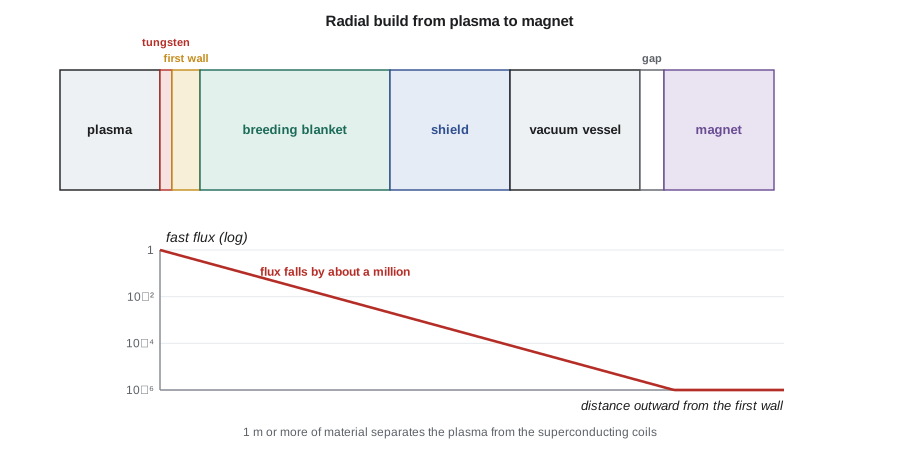
# Attenuation through the radial build: each shield layer cuts fast flux by roughly e^(-x/L)
layers = [("blanket", 0.60, 0.12), ("shield", 0.40, 0.08), ("vacuum vessel", 0.30, 0.10)]
frac = 1.0
for nm, x, L in layers:
    frac *= math.exp(-x / L)
    print(f"after {nm:13s} fast flux fraction {frac:.1e}")
print("superconducting magnets need roughly a million-fold reduction of the first-wall flux")ITER (500 MW) wall area 546 m2, neutron wall loading 0.73 MW/m2, flux 3.2e+17 n/m2/s damage 5.9 dpa/yr, helium 64 appm/yr, first wall life 8.5 years to 50 dpa Demonstration plant (2000 MW) wall area 1125 m2, neutron wall loading 1.42 MW/m2, flux 6.3e+17 n/m2/s damage 11.4 dpa/yr, helium 125 appm/yr, first wall life 4.4 years to 50 dpa Compact pilot (500 MW) wall area 167 m2, neutron wall loading 2.40 MW/m2, flux 1.1e+18 n/m2/s damage 19.2 dpa/yr, helium 211 appm/yr, first wall life 2.6 years to 50 dpa after blanket fast flux fraction 6.7e-03 after shield fast flux fraction 4.5e-05 after vacuum vessel fast flux fraction 2.3e-06 superconducting magnets need roughly a million-fold reduction of the first-wall flux
The output makes Teodora's point concrete. ITER runs in pulses with a small duty factor over its life, so its lifetime fluence is low; the availability assumed here is for comparison only. A demonstration plant at 1.4 MW/m² would reach a 50 dpa first-wall limit in about four to five years and a compact pilot in under three, so the first wall and blanket become replaceable components on a planned schedule, much like a fission core component. The final lines show why fusion plants are thick: roughly a metre or more of blanket, shield and vessel is needed between the plasma and the superconducting magnets.
Plasma-facing materials
The surface facing the plasma must withstand heat, erosion by plasma particles and neutron damage, and must not contaminate the plasma or retain too much tritium. Tungsten is the leading choice: it has the highest melting point of any metal, low sputtering yield and low tritium retention. Its drawbacks are brittleness at low temperature, recrystallization at high temperature and the strong radiation losses it causes if tungsten atoms reach the hot core. Carbon armour, used in many earlier tokamaks, was abandoned for D-T machines because it traps large amounts of tritium in co-deposited layers. ITER originally planned a beryllium first wall with a tungsten divertor; its 2024 baseline changed the first wall to tungsten as well, removing the toxic beryllium and simplifying plasma-wall interactions in a configuration closer to that of a power plant.
Structural materials
The blanket and first-wall structures must keep their strength and toughness under damage, operate hot enough for an efficient thermal cycle, and avoid elements that become highly radioactive. Austenitic stainless steel, the workhorse of fission plants and ITER's vacuum vessel, swells too much and activates through its nickel and molybdenum. Fusion programs have therefore developed reduced-activation ferritic-martensitic steels, such as EUROFER97 in Europe and F82H in Japan, in which elements like nickel, molybdenum and niobium are replaced by tungsten, vanadium and tantalum. Their operating window is roughly 350 to 550 °C, bounded below by irradiation embrittlement and above by loss of creep strength.
Longer-term candidates widen that window. Oxide-dispersion-strengthened steels contain nanometre-scale yttrium oxide particles that trap helium and pin dislocations, allowing operation toward 650 to 700 °C. Silicon carbide composites can operate hotter still with very low activation, and are favoured in some liquid metal and molten salt blanket designs, though their joining and their behaviour under damage are less mature. Vanadium alloys are compatible with liquid lithium but sensitive to hydrogen and oxygen.
| Material | Role | Approximate operating range | Main concerns |
|---|---|---|---|
| Tungsten | armour, divertor targets | up to about 1200 °C at the surface | brittleness, recrystallization, core radiation |
| Reduced-activation ferritic-martensitic steel | first wall and blanket structure | 350 to 550 °C | embrittlement below the range, creep above it |
| Oxide-dispersion-strengthened steel | hotter structures | up to about 650 to 700 °C | fabrication, joining, cost |
| Silicon carbide composite | flow channel inserts, structures | up to about 1000 °C | joining, hermeticity, damage data |
| Copper alloys | heat sinks behind armour | below about 350 °C | loss of strength under irradiation |
The testing gap
Because no source yet produces a fusion neutron spectrum at power plant intensity over a large volume, fusion materials cannot be qualified in the way fission fuels and steels are. Fission reactor irradiations reach high dpa but with too little helium; ion beams can produce damage quickly but only in micrometre-thin layers. The international answer is a dedicated accelerator-driven neutron source, using deuterons on a flowing lithium target to give a 14 MeV-like spectrum. IFMIF-DONES, under construction near Granada in Spain, is the main European facility of this kind, and the United States has studied a similar fusion prototypic neutron source.
Teodora draws a parallel that the consortium's engineers will recognize. Ontario's CANDU fleet operated for decades on pressure tube materials whose irradiation behaviour was understood from surveillance programmes and research at Chalk River, where Canadian Nuclear Laboratories still maintains hot cells and materials expertise. Fusion materials are at an earlier stage: the database is good enough to design a pilot plant, but not to guarantee a commercial component life.
Breeding blankets
The blanket surrounds the plasma behind the first wall and has three jobs: absorb the neutrons and convert their energy into high-temperature heat, breed tritium from lithium, and shield the components outside it. It typically contains a lithium-bearing breeder, a neutron multiplier such as beryllium or lead if the breeder alone cannot reach the required tritium production, a coolant and a structure.
Four families dominate design studies. Helium-cooled pebble bed blankets use lithium orthosilicate or metatitanate ceramic pebbles with beryllium pebbles as multiplier, cooled by helium at about 8 MPa. Water-cooled lithium-lead blankets circulate the eutectic lead-lithium alloy, where lead acts as multiplier, and remove heat with pressurized water at conditions like those of a PWR. Dual-coolant lithium-lead blankets use helium to cool the steel structure and let the lead-lithium itself carry heat at higher temperature, with silicon carbide inserts to reduce magnetohydrodynamic pressure drop. And liquid breeder blankets, such as the molten FLiBe salt planned for the ARC concept, immerse the vacuum vessel in a tank of flowing salt that breeds, cools and shields.
ITER will test several of these concepts as test blanket modules mounted in equatorial ports during its D-T phase, the first time blanket mock-ups will see fusion neutrons. The results will feed demonstration plant designs, but the modules are small and will see only a modest fluence, so they demonstrate breeding and heat extraction rather than lifetime.
Activation and waste
Fusion produces no fission products and no long-lived actinides. Its radioactive waste comes from activated structures and from tritium-contaminated components. With reduced-activation materials, most of this waste decays to levels that could permit recycling or near-surface disposal within about a hundred years, though the volume of activated material can be large because blankets are replaced several times over a plant's life. The choice of materials, and the control of impurities such as niobium, cobalt and nickel down to parts per million, determines the long-term radioactivity.
Worked problem
First-wall replacement interval
A demonstration plant produces 2000 MW of fusion power, has a first wall area of 1100 m² and runs at 75 percent availability. Its steel is assumed to tolerate 60 dpa, and 1 MW·year/m² produces 10 dpa. How often must the first wall be replaced?
Show solution
- Neutron power = 0.8 × 2000 = 1600 MW; wall loading = 1600 ÷ 1100 = 1.45 MW/m².
- Damage per calendar year = 1.45 × 10 × 0.75 = 10.9 dpa.
- Replacement interval = 60 ÷ 10.9 = 5.5 years.
Answer: About every five and a half years; each replacement is a major remote-handling outage.
Common mistakes
MistakeFusion neutrons cause the same damage as fission neutrons at the same dpa.
Instead14 MeV neutrons produce ten or more times as much helium per dpa.
MistakeFusion produces no radioactive waste.
InsteadActivated structures and tritiated components are radioactive; most decays within about a century with low-activation materials.
MistakeFusion materials have been qualified in fission reactors.
InsteadFission spectra cannot reproduce the helium-to-dpa ratio; a dedicated 14 MeV source is needed.
MistakeThe blanket only breeds tritium.
InsteadIt also converts neutron energy to useful heat and shields the magnets.
Summary and key terms
- Neutron wall loading measures the 14 MeV neutron power crossing the first wall; plants need 1 to 2 MW/m².
- Damage is counted in dpa; 14 MeV neutrons also produce helium and hydrogen by transmutation.
- Tungsten is the leading plasma-facing material; ITER's 2024 baseline uses it for the first wall too.
- Reduced-activation ferritic-martensitic steels operate between about 350 and 550 °C.
- A fusion neutron source such as IFMIF-DONES is needed to qualify materials.
- Blankets breed tritium, extract heat and shield; main concepts use ceramic pebbles, lead-lithium or molten salt.
- Neutron wall loading
- Fusion neutron power per unit area of first wall.
- dpa
- Displacements per atom, the measure of radiation damage.
- Transmutation
- Conversion of nuclei into other elements, such as helium production in steel.
- Reduced-activation steel
- A steel whose alloying elements avoid long-lived activation products.
- Breeding blanket
- The component that breeds tritium and converts neutron energy into heat.
- Neutron multiplier
- A material such as beryllium or lead that produces extra neutrons by (n,2n) reactions.
Practice problems
Work each problem on paper first, then reveal the answer to check.
About how many dpa does 1 MW·year/m² produce in steel?
Show answer
About 10.
Why is helium production a special problem for fusion materials?
Show answer
It embrittles steel and fission spectra cannot reproduce the fusion ratio of helium to dpa.
Why was carbon abandoned as armour for D-T machines?
Show answer
It retains large amounts of tritium in co-deposited layers.
What limits the operating window of reduced-activation steels?
Show answer
Irradiation embrittlement at low temperature and creep at high temperature.
What is IFMIF-DONES?
Show answer
An accelerator-driven fusion-like neutron source under construction in Spain for materials testing.
Lesson quiz · 5 questions
Score 60% or more to complete this lesson.
Create a free account to save your progress, take quizzes and earn a certificate.