
NUC-450 · Lesson 2 of 12 · 22 min
Magnetic confinement: tokamaks and stellarators
Ingrid hands Hana a stack of conference papers and a single sheet of her own notes. Across the top she has written: “A plasma is a fluid that conducts electricity and wants to escape in every direction at once.” The second chapter of the options study has to explain to the consortium's engineers how magnetic fields hold a 150-million-degree plasma away from the walls, why the doughnut-shaped tokamak has dominated fusion research for fifty years, and why the twisted stellarator is suddenly attracting private investment.
This lesson explains how charged particles move in magnetic fields, why a simple solenoid or a plain torus cannot confine a plasma, and how tokamaks and stellarators create the twisted field lines that can. It introduces plasma beta, the safety factor, the main operating limits and disruptions, and the empirical scaling laws that designers use to predict confinement in machines not yet built.
Charged particles in a magnetic field
A charged particle in a uniform magnetic field feels a force perpendicular to both its velocity and the field. It moves freely along the field line but gyrates around it in a circle, the Larmor orbit. For a 10 keV deuteron in a 5 T field the gyroradius is a few millimetres; for an electron it is a fraction of a millimetre. A strong field therefore ties particles to field lines, and a plasma with field lines that never leave the vessel could in principle be confined.
The difficulty is the motion along the field. In a straight solenoid particles stream out of the ends. Magnetic mirrors, which pinch the field at each end so that particles with enough sideways motion are reflected, plug the ends only partly; particles moving mostly along the field escape through the loss cone. Bending the solenoid into a torus removes the ends but creates a new problem. The field in a simple torus is stronger on the inside, since the coils are closer together there, and the gradient and curvature of the field make ions drift one way vertically and electrons the other. The resulting charge separation produces an electric field that pushes the whole plasma outward within microseconds.
The cure is to twist the field lines so that each one winds around the torus both the long way, toroidally, and the short way, poloidally. A particle following a twisted line spends time on the top and the bottom, the inside and the outside, so its vertical drifts average out. The field lines trace nested toroidal surfaces, magnetic flux surfaces, and the plasma pressure is constant on each surface and falls from the core to the edge.
The tokamak
The tokamak, developed in the Soviet Union in the 1950s and 1960s, makes the twist with a current in the plasma itself. Large toroidal field coils produce the main field, a few tesla, the long way around. A central solenoid acts as the primary of a transformer, with the plasma ring as a one-turn secondary: ramping the solenoid current drives a plasma current of several mega-amperes, which produces the poloidal field. Outer poloidal field coils shape and position the plasma. The combination gives helical field lines, and the plasma current also heats the plasma ohmically in the early stages of a pulse.
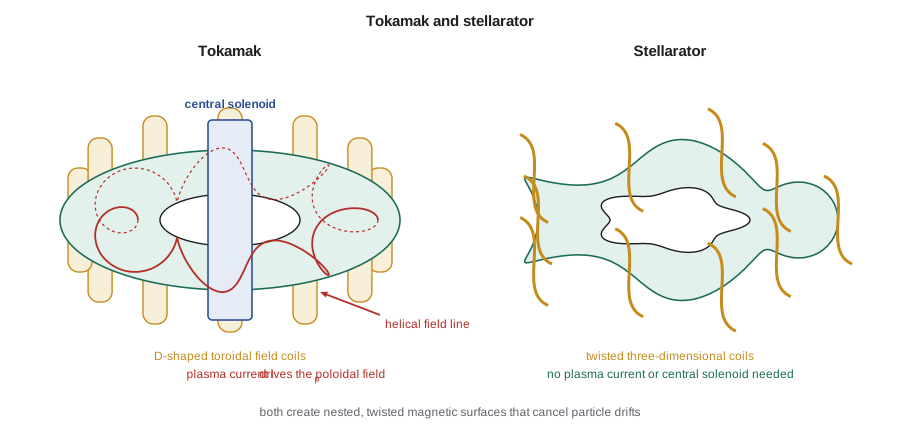
The twist is measured by the safety factor q, the number of times a field line goes around the torus the long way for each time it goes around the short way. Near the edge of a tokamak q is typically 3 to 4, near the axis about 1. Where q is a ratio of small integers, such as 2/1 or 3/2, field lines close on themselves and the plasma becomes vulnerable to tearing instabilities that form magnetic islands. If the edge safety factor falls toward 2, because the current is too high for the field and size, the plasma becomes unstable and can disrupt. This sets the current limit of a tokamak.
Here a and R are the minor and major radii, B_T the toroidal field, I_p the plasma current and κ the elongation of the D-shaped cross-section. Elongating the plasma vertically lets a machine carry more current for the same edge q, which improves confinement, and almost all modern tokamaks are strongly shaped for this reason.
Beta and the operating limits
A magnetic field exerts a pressure B²/2μ₀, about 11 MPa at 5.3 T. The ratio of plasma pressure to magnetic pressure is the plasma beta. Fusion power density scales as the square of plasma pressure, so at fixed beta it scales as the fourth power of the field. That single relationship explains the interest in high-temperature superconducting magnets: doubling the field allows the same fusion power in a plasma volume roughly sixteen times smaller.
Tokamaks operate within three main limits. The current limit, through the edge safety factor, has just been described. The Troyon or beta limit says that beta cannot exceed a value proportional to I_p/(aB), with a coefficient β_N of about 3 to 4 percent·m·T/MA for conventional tokamaks; above it, pressure-driven instabilities called kink and ballooning modes grow. The density limit, found empirically by Martin Greenwald, says that line-averaged density cannot greatly exceed I_p/(πa²) in units of 10²⁰ m⁻³ and mega-amperes; above it, the edge cools by radiation, the current profile contracts and the plasma disrupts.
A disruption is a sudden loss of confinement in which the thermal energy is lost in about a millisecond and the current decays in tens of milliseconds. It deposits heat on the walls, induces large forces on the vessel through eddy and halo currents, and can accelerate electrons to tens of MeV as runaway beams. ITER stores about 350 MJ of thermal energy in its plasma and about 400 MJ in its plasma current, so avoiding and mitigating disruptions, for example with massive shattered pellet injection, is one of its central operational challenges. In a power plant a disruption is an investment protection problem as much as a physics problem.
Confinement and its scaling
Particles and heat leak across flux surfaces much faster than collisions alone would predict, because small-scale turbulence driven by the temperature and density gradients carries them out. Since a first-principles prediction of turbulent transport was out of reach for decades, designers rely on empirical scaling laws fitted to data from dozens of tokamaks. The most widely used is the IPB98(y,2) law for the high-confinement mode, or H-mode, which tokamaks enter above a threshold heating power. In H-mode a narrow transport barrier forms at the edge, the pedestal, and the confinement time roughly doubles compared with the low-confinement mode.
The units are mega-amperes, tesla, megawatts of loss power, 10¹⁹ m⁻³, atomic mass units and metres. The strongest dependences are on size and current, and the negative power of heating power means that confinement degrades as more heating is added. The H-mode also brings edge-localized modes, periodic bursts that release pedestal energy onto the divertor and must be controlled in a large machine.
# Tokamak figures of merit: plasma beta, edge safety factor, Troyon limit and
# the IPB98(y,2) confinement scaling, for ITER-like and compact high-field designs.
import math
mu0 = 4e-7 * math.pi
keV = 1.602e-16                       # joules per keV

def tokamak(name, R, a, kappa, B, I_MA, n20, T_keV, P_loss_MW, M=2.5):
    eps = a / R
    p = 2 * n20 * 1e20 * T_keV * keV          # ions + electrons, equal temperatures (Pa)
    beta = p / (B ** 2 / (2 * mu0))
    # cylindrical estimate of the edge safety factor with elongation
    q = 2 * math.pi * a ** 2 * B * (1 + kappa ** 2) / 2 / (mu0 * R * I_MA * 1e6)
    beta_N = beta * 100 * a * B / I_MA         # normalized beta, percent m T / MA
    n19 = n20 * 10
    tau = 0.0562 * I_MA ** 0.93 * B ** 0.15 * P_loss_MW ** -0.69 * n19 ** 0.41 * M ** 0.19 \
          * R ** 1.97 * eps ** 0.58 * kappa ** 0.78
    vol = 2 * math.pi ** 2 * R * a ** 2 * kappa
    W = 3 * n20 * 1e20 * T_keV * keV * vol / 1e6   # stored energy (MJ)
    print(f"{name}")
    print(f"  volume {vol:6.0f} m3   pressure {p / 1e3:6.0f} kPa   beta {beta:.2%}   beta_N {beta_N:.2f}")
    print(f"  edge safety factor about {q:.1f} (needs to stay above about 2 to avoid disruptions)")
    print(f"  IPB98(y,2) tau_E = {tau:.2f} s; stored energy {W:.0f} MJ; W/P_loss = {W / P_loss_MW:.2f} s")
    print(f"  triple product n T tau = {n20 * 1e20 * T_keV * tau:.1e} keV s/m3")

tokamak("ITER-like (R 6.2 m, 5.3 T, 15 MA)", 6.2, 2.0, 1.7, 5.3, 15.0, 1.0, 9.0, 87.0)
tokamak("Compact high-field (R 1.85 m, 12.2 T, 8.7 MA)", 1.85, 0.57, 1.97, 12.2, 8.7, 3.1, 7.3, 30.0)
# At fixed beta, fusion power density scales as beta^2 B^4: field is worth a lot.
for B in (5.3, 8.0, 12.2):
print(f"relative fusion power density at {B:4.1f} T and equal beta: {(B / 5.3) ** 4:5.1f}")ITER-like (R 6.2 m, 5.3 T, 15 MA) volume 832 m3 pressure 288 kPa beta 2.58% beta_N 1.82 edge safety factor about 2.2 (needs to stay above about 2 to avoid disruptions) IPB98(y,2) tau_E = 3.59 s; stored energy 360 MJ; W/P_loss = 4.14 s triple product n T tau = 3.2e+21 keV s/m3 Compact high-field (R 1.85 m, 12.2 T, 8.7 MA) volume 23 m3 pressure 725 kPa beta 1.22% beta_N 0.98 edge safety factor about 3.0 (needs to stay above about 2 to avoid disruptions) IPB98(y,2) tau_E = 0.82 s; stored energy 25 MJ; W/P_loss = 0.85 s triple product n T tau = 1.9e+21 keV s/m3 relative fusion power density at 5.3 T and equal beta: 1.0 relative fusion power density at 8.0 T and equal beta: 5.2 relative fusion power density at 12.2 T and equal beta: 28.1
The two cases show the trade between size and field. The large machine reaches a confinement time of several seconds at modest field; the compact machine has a confinement time below one second but much higher density and pressure, so the triple products are of the same order. The simple cylindrical estimate of q underestimates the edge safety factor of a strongly shaped plasma; ITER's design value is about 3. Real design studies use full equilibrium codes and fit the scaling with a confinement enhancement factor H, set to 1 in this calculation.
The stellarator
A stellarator, invented by Lyman Spitzer at Princeton in 1951, produces the twist entirely with external coils that are themselves twisted in three dimensions. It needs no plasma current, so it has no current-driven disruptions and no need for a transformer, and it can in principle run continuously. The price is geometric complexity. Early stellarators confined particles poorly because particles trapped in the field ripple drifted out, and the tokamak overtook them in the late 1960s.
Computer optimization changed that. The coil shapes of Wendelstein 7-X, which began operation at the Max Planck Institute for Plasma Physics in Greifswald, Germany, in 2015, were chosen by numerical search to minimize the drift losses and the plasma currents that pressure would otherwise drive. In May 2025, in its OP 2.3 campaign, Wendelstein 7-X sustained a record triple product for long pulses over 43 seconds, refuelled by a pellet injector built by Oak Ridge National Laboratory, and later in the same campaign it turned over 1.8 GJ of energy in a 360-second discharge. Several private companies now design optimized stellarators with high-temperature superconducting coils, betting that the absence of disruptions will matter more than the difficulty of building the coils.
| Feature | Tokamak | Stellarator |
|---|---|---|
| Source of poloidal field | plasma current driven by a solenoid | twisted external coils |
| Steady-state operation | needs non-inductive current drive | natural |
| Disruptions | a major operational risk | no current-driven disruptions |
| Coil geometry | planar D-shaped coils | complex three-dimensional coils |
| Database and design tools | very large, ITER-scale | growing, mainly W7-X and LHD |
| Leading example | ITER, JT-60SA, SPARC under construction | Wendelstein 7-X |
Exhaust: the divertor
Every fusion plant must exhaust heat and helium ash. In a modern tokamak the outer flux surfaces are diverted by coils so that they strike dedicated target plates, the divertor, away from the main plasma. The heat flux in the thin scrape-off layer can exceed 10 MW/m² on the targets, comparable with a rocket nozzle, so designers spread it by tilting the targets and radiating part of the power with injected impurities such as nitrogen or neon before it arrives. ITER's divertor is lined with tungsten, which tolerates high temperatures and erodes slowly. The divertor problem is often listed alongside materials and tritium breeding as the hardest engineering challenge between today's experiments and a power plant.
Hana's draft for the consortium ends the chapter with Ingrid's summary: magnetic confinement has reached triple products within a factor of a few of ignition, the physics basis for a burning plasma is well understood, and the open questions are increasingly engineering ones: magnets, exhaust, materials and fuel.
Worked problem
Fusion power density and magnetic field
A tokamak design operating at beta = 2.5 percent in a 5.3 T field produces 500 MW of fusion power. If the same plasma shape and beta were achieved at 12 T, by what factor could the plasma volume shrink for the same fusion power?
Show solution
- Fusion power density scales with pressure squared, p² ∝ (βB²)², so at fixed beta it scales as B⁴.
- Ratio of power densities: (12/5.3)⁴ = 2.264⁴ ≈ 26.3.
- The same 500 MW needs a volume 26 times smaller, all else being equal.
Answer: About 26 times smaller, which is the logic of compact high-field tokamaks. The neutron and heat loads per square metre of wall rise, because the surface area shrinks more slowly than the volume.
Common mistakes
MistakeA magnetic field confines particles in every direction.
InsteadParticles gyrate across the field but move freely along it; confinement needs closed, twisted field lines.
MistakeHigher heating power always improves confinement.
InsteadConfinement time falls roughly as P^−0.7; more heating raises temperature less than proportionally.
MistakeStellarators are an old idea that failed.
InsteadOptimized stellarators such as Wendelstein 7-X now reach tokamak-class performance for long pulses.
MistakeThe safety factor is a safety margin.
InsteadIt is the field line pitch: toroidal turns per poloidal turn.
Summary and key terms
- Charged particles follow field lines; a twisted toroidal field cancels the drifts that destroy a simple torus.
- A tokamak twists the field with a plasma current; a stellarator with three-dimensional coils.
- Beta is plasma pressure over magnetic pressure; fusion power density scales as β²B⁴.
- Tokamaks face current (q), beta (Troyon) and density (Greenwald) limits, and disruptions.
- The IPB98(y,2) scaling predicts H-mode confinement from size, current, field, density and power.
- The divertor must handle heat fluxes above 10 MW/m².
- Flux surface
- A nested toroidal surface traced by a magnetic field line.
- Safety factor
- Toroidal turns per poloidal turn of a field line.
- Plasma beta
- Plasma pressure divided by magnetic pressure.
- Disruption
- A rapid loss of plasma confinement and current in a tokamak.
- H-mode
- A high-confinement regime with an edge transport barrier.
- Divertor
- The region where diverted field lines carry heat and ash to target plates.
Practice problems
Work each problem on paper first, then reveal the answer to check.
Why does a simple toroidal field fail to confine a plasma?
Show answer
Gradient and curvature drifts separate ions and electrons vertically, and the resulting electric field pushes the plasma outward.
What happens if the edge safety factor approaches 2?
Show answer
The plasma becomes kink-unstable and is likely to disrupt.
By how much does fusion power density rise if the field doubles at constant beta?
Show answer
Sixteen times.
What does the Greenwald limit restrict?
Show answer
Line-averaged density, to about I_p/(πa²).
Name one advantage and one disadvantage of the stellarator.
Show answer
No current-driven disruptions and steady-state operation; complex three-dimensional coils.
Lesson quiz · 5 questions
Score 60% or more to complete this lesson.
Create a free account to save your progress, take quizzes and earn a certificate.