
NUC-450 · Lesson 1 of 12 · 23 min
Fusion reactions and the Lawson criterion
Hana Okoye has started her final work term at Meridian Nuclear Engineering in Oshawa on a project unlike anything the firm has done before. the Lakeshore Industrial Energy Consortium, a group of companies at a chemical and steel industrial park near Hamilton, wants to know which nuclear technologies could supply its heat and electricity in the late 2030s and 2040s. The study has two halves: fusion, which several private companies now promise within that window, and advanced fission reactors, which are already being licensed. Dr. Ingrid Solberg, a plasma physicist who joined Meridian from a university fusion laboratory to lead the work, gives Hana the first chapter. “Before we judge anybody's schedule,” Ingrid says, “we need to know what physics a fusion plant has to beat. Start with the reactions and with Lawson.”
This lesson explains where fusion energy comes from, which reactions are practical, and why a fusion fuel has to be hot, dense and well confined all at once. It derives the energy released from mass defects, introduces the reactivity of a thermal plasma, and builds the Lawson criterion and the triple product that every confinement scheme in this course is measured against.
Binding energy and the source of fusion energy
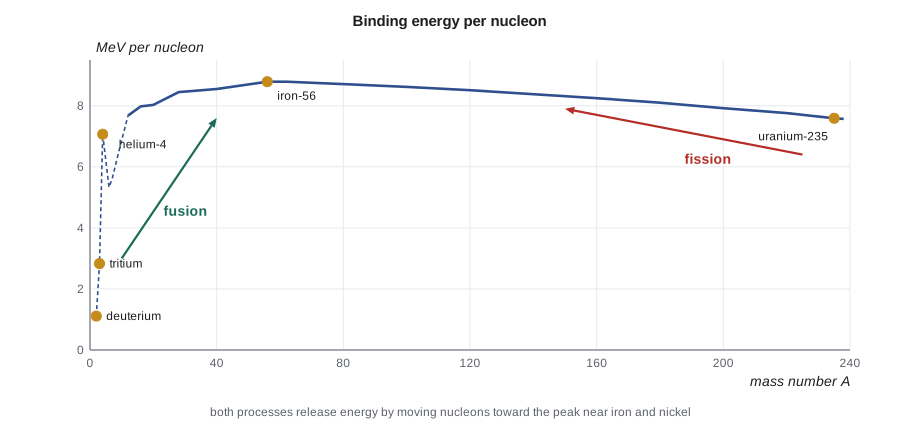
The mass of a nucleus is less than the sum of the masses of its protons and neutrons. The difference, the mass defect, multiplied by the square of the speed of light, is the binding energy: the energy that would be needed to pull the nucleus apart. Divided by the number of nucleons, the binding energy rises steeply from hydrogen to helium-4, keeps rising more slowly to a broad peak near iron and nickel, and then falls gently toward uranium. Any reaction that moves nucleons toward the peak releases energy. Splitting a heavy nucleus into two medium ones is fission; joining two light nuclei into a heavier one is fusion.
The steep rise at the light end is the reason fusion is attractive. Helium-4 is an unusually tightly bound nucleus, about 7.07 MeV per nucleon, while deuterium is bound by only about 1.11 MeV per nucleon. Forming helium from hydrogen isotopes therefore releases several MeV per nucleon, compared with about 0.9 MeV per nucleon when uranium-235 fissions. Per kilogram of fuel, deuterium-tritium fusion releases roughly four times as much energy as fission and about ten million times as much as burning natural gas.
The candidate reactions
Many light-nucleus reactions release energy, but only a few are fast enough to be useful. The energy released, the Q value, follows directly from atomic masses: the mass of the reactants minus the mass of the products, converted at 931.494 MeV per atomic mass unit. Using atomic rather than nuclear masses is convenient because the electrons cancel on both sides for these reactions.
Deuterium-tritium (D-T) fusion releases 17.6 MeV and has by far the largest reaction rate at temperatures that can be reached in the laboratory, which is why every near-term power plant concept uses it. The reaction has two drawbacks. Four-fifths of the energy leaves as a 14.1 MeV neutron, which cannot be confined by magnetic fields and damages the materials it hits, and tritium is radioactive, with a 12.3-year half-life, and scarce, so a plant must breed its own from lithium. Those two facts drive most of the engineering covered in lessons 5 and 6.
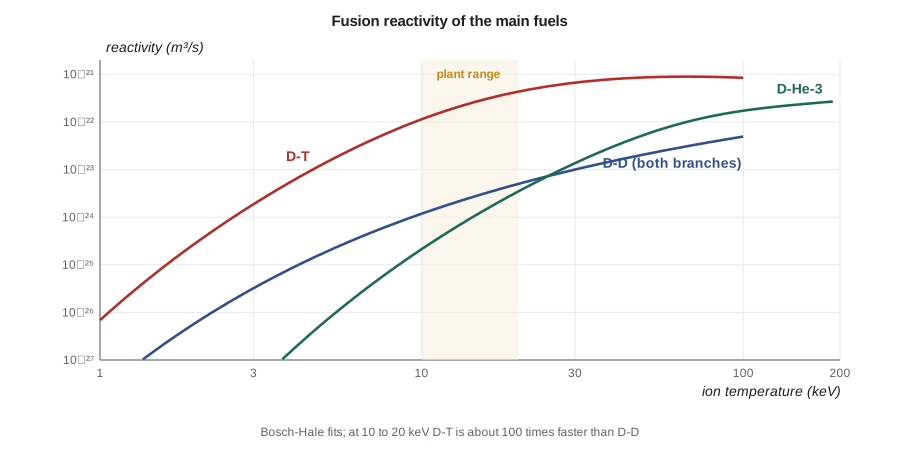
Deuterium-deuterium (D-D) fusion needs no tritium and uses a fuel present in all water, about one atom in 6,400 of hydrogen. It proceeds by two branches of almost equal probability, one making helium-3 and a 2.45 MeV neutron, the other tritium and a proton, but its rate is about a hundred times lower than D-T at 10 to 20 keV. Deuterium-helium-3 releases 18.3 MeV with charged products only, apart from neutrons from side D-D reactions, but needs temperatures several times higher and helium-3 is extremely rare on Earth. Proton-boron-11 produces three alpha particles and almost no neutrons, the ideal of aneutronic fusion, but its rate is so low and its radiation losses so high that a thermal plasma cannot reach net gain without extraordinary conditions.
| Reaction | Q value (MeV) | Charged-particle share | Rate relative to D-T at 15 keV | Main issue |
|---|---|---|---|---|
| D + T → He-4 + n | 17.6 | 20 percent | 1 | 14 MeV neutrons, tritium supply |
| D + D (two branches) | 3.3 and 4.0 | about 60 percent | about 0.01 | low rate |
| D + He-3 → He-4 + p | 18.3 | nearly all | about 0.004 | very high temperature, scarce He-3 |
| p + B-11 → 3 He-4 | 8.7 | all | far lower at these temperatures | radiation losses exceed fusion power |
Why fusion needs high temperature
Two nuclei must get within a few femtometres of each other for the strong force to act, but both are positively charged, and the Coulomb repulsion at that distance corresponds to a barrier of several hundred keV. Classically, a nucleus would need that much energy to fuse. Quantum tunnelling lets nuclei pass through the barrier with much less, but the tunnelling probability falls exponentially as the energy drops. The product of the falling number of particles at high energy in a thermal distribution and the rising tunnelling probability gives a narrow window, the Gamow peak, where most reactions actually happen.
Plasma physicists express temperature in energy units: 1 keV corresponds to about 11.6 million kelvin. A D-T plasma reaches its useful operating range at ion temperatures of 10 to 20 keV, roughly 100 to 200 million kelvin, which is far hotter than the core of the Sun. The Sun manages at about 1.3 keV because its fuel is confined by gravity in an enormous volume for billions of years; a power plant has to make up for that with temperature.
At these temperatures the fuel is a fully ionized plasma of nuclei and electrons. The quantity that sets the fusion rate is the reactivity, written with angle brackets as the average of the cross-section times the relative speed over a Maxwellian distribution of ion velocities. The fusion power density of a 50-50 D-T plasma with total ion density n is
so fusion power rises with the square of density, and with temperature through the reactivity. For D-T the reactivity climbs from about 1.1 × 10⁻²² m³/s at 10 keV to a broad maximum of about 9 × 10⁻²² m³/s near 65 keV. Beyond 20 keV or so it no longer grows as fast as the temperature squared, so the pressure needed for a given power climbs and there is little to gain by going hotter.
Power balance and the Lawson criterion
A hot plasma loses energy continually, by conduction and convection of particles and heat across the confining field, and by radiation, mainly bremsstrahlung from electrons deflected by ions. The energy confinement time τ_E is defined as the stored thermal energy divided by the rate of energy loss. It is not the time a particle stays in the plasma, but a measure of how well the thermal insulation works. The stored energy density of a plasma with equal ion and electron temperatures T is 3nT, counting both species.
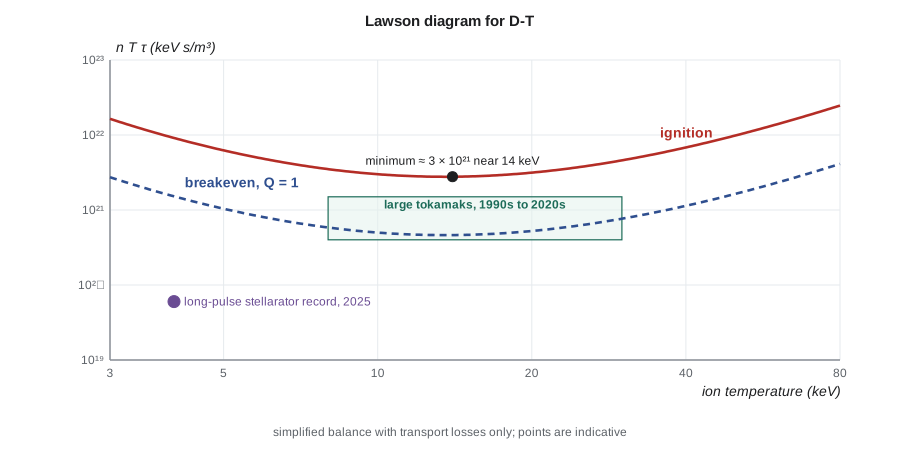
In 1955 John Lawson, an engineer at the UK atomic energy research establishment at Harwell, asked what a fusion plasma would need to produce more energy than it consumed. The modern form of his argument considers ignition, where the alpha particles, which carry 3.5 MeV and are confined by the magnetic field, heat the plasma enough to replace all the losses with no external heating. Setting the alpha heating power density equal to the loss rate gives
The right-hand side depends only on temperature. It has a minimum near 14 keV of about 3 × 10²¹ keV·s/m³, which is the famous ignition triple product for D-T. The triple product is the single most useful number for comparing fusion experiments, because it combines what each confinement scheme does well: a tokamak reaches modest densities with confinement times of seconds, while inertial confinement reaches enormous densities for less than a billionth of a second. Both have to clear the same bar.
# Energy released by fusion reactions from atomic mass defects, and the
# D-T ignition triple product n*T*tau_E as a function of temperature.
import math
u_MeV = 931.494                      # energy equivalent of one atomic mass unit (MeV)
m = {'n': 1.008665, 'p': 1.007825, 'D': 2.014102, 'T': 3.016049,
     'He3': 3.016029, 'He4': 4.002602, 'B11': 11.009305}
reactions = [('D + T  -> He4 + n', ['D', 'T'], ['He4', 'n']),
             ('D + D  -> He3 + n', ['D', 'D'], ['He3', 'n']),
             ('D + D  -> T + p',   ['D', 'D'], ['T', 'p']),
             ('D + He3 -> He4 + p', ['D', 'He3'], ['He4', 'p']),
             ('p + B11 -> 3 He4',   ['p', 'B11'], ['He4', 'He4', 'He4'])]
print("Q values from mass defect (atomic masses, so electrons cancel)")
for name, a, b in reactions:
    dm = sum(m[x] for x in a) - sum(m[x] for x in b)
    print(f"  {name:20s} dm = {dm:.6f} u   Q = {dm * u_MeV:6.2f} MeV")
# The products share momentum, so the lighter one carries most of the energy.
Q = (m['D'] + m['T'] - m['He4'] - m['n']) * u_MeV
E_n = Q * m['He4'] / (m['He4'] + m['n'])
print(f"D-T: neutron {E_n:.2f} MeV, alpha {Q - E_n:.2f} MeV ({(Q - E_n) / Q:.0%} stays in the plasma)")

def sv_dt(T):                        # Bosch-Hale D-T reactivity, T in keV, result in m^3/s
    BG, mc2 = 34.3827, 1124656
    c = (1.17302e-9, 1.51361e-2, 7.51886e-2, 4.60643e-3, 1.35e-2, -1.0675e-4, 1.366e-5)
    th = T / (1 - T * (c[1] + T * (c[3] + T * c[5])) / (1 + T * (c[2] + T * (c[4] + T * c[6]))))
    xi = (BG ** 2 / (4 * th)) ** (1 / 3)
    return c[0] * th * math.sqrt(xi / (mc2 * T ** 3)) * math.exp(-3 * xi) * 1e-6

E_alpha = 3.52e3                     # alpha energy in keV
print("\nIgnition condition n*T*tau_E >= 12 T^2 / (<sigma v> E_alpha)")
print(f"{'T (keV)':>8s}{'<sv> (m3/s)':>14s}{'nT tau (keV s/m3)':>20s}")
best = None
for T in (5, 8, 10, 12, 14, 16, 20, 25, 30, 40, 60):
    s = sv_dt(T); ntt = 12 * T ** 2 / (s * E_alpha)
    if best is None or ntt < best[1]: best = (T, ntt)
    print(f"{T:8d}{s:14.3e}{ntt:20.2e}")
print(f"minimum near T = {best[0]} keV: {best[1]:.1e} keV s/m3")Q values from mass defect (atomic masses, so electrons cancel)
D + T -> He4 + n dm = 0.018884 u Q = 17.59 MeV
D + D -> He3 + n dm = 0.003510 u Q = 3.27 MeV
D + D -> T + p dm = 0.004330 u Q = 4.03 MeV
D + He3 -> He4 + p dm = 0.019704 u Q = 18.35 MeV
p + B11 -> 3 He4 dm = 0.009324 u Q = 8.69 MeV
D-T: neutron 14.05 MeV, alpha 3.54 MeV (20% stays in the plasma)
Ignition condition n*T*tau_E >= 12 T^2 / (<sigma v> E_alpha)
T (keV) <sv> (m3/s) nT tau (keV s/m3)
5 1.366e-23 6.24e+21
8 6.222e-23 3.51e+21
10 1.136e-22 3.00e+21
12 1.747e-22 2.81e+21
14 2.406e-22 2.78e+21
16 3.072e-22 2.84e+21
20 4.330e-22 3.15e+21
25 5.655e-22 3.77e+21
30 6.681e-22 4.59e+21
40 7.998e-22 6.82e+21
60 8.908e-22 1.38e+22
minimum near T = 14 keV: 2.8e+21 keV s/m3The output shows why plants aim for 10 to 20 keV. Below about 8 keV the required triple product climbs steeply because the reactivity collapses; above 25 keV it rises again because pressure grows faster than the reaction rate. Including bremsstrahlung, which this simple form ignores, raises the curve at low temperature and sets an ideal ignition temperature of about 4.4 keV below which no confinement is good enough for D-T.
Gain, breakeven and ignition
Most experiments are not ignited; they rely on external heating. Their performance is measured by the fusion gain Q, the fusion power divided by the external heating power absorbed by the plasma. Scientific breakeven is Q = 1. Ignition is Q tending to infinity: the plasma sustains itself. Between them, Q = 5 is the point at which alpha heating equals external heating, a burning plasma, because the alphas carry one-fifth of D-T fusion power. ITER aims for Q = 10, where alphas provide two-thirds of the heating.
Plasma gain is not plant gain. The engineering gain counts the electricity needed to run heating systems, magnets, cryogenics and pumps, and the efficiency of converting fusion heat to electricity. A plant with a plasma Q of 10, heating systems that are 40 percent efficient from the wall plug and a 40 percent thermal cycle produces only modestly more electricity than it consumes once all its loads are counted. Commercial studies generally look for plasma gains of 20 to 30 or more, or ignited operation, so that the recirculating power is a small fraction of the output. The same distinction applies to inertial fusion, where a target gain above 1 says nothing about the efficiency of the laser that drove it, as lesson 3 shows.
Ingrid circles the gain discussion in Hana's draft. “Most of the confusion in the press comes from here,” she says. “When a company says it has reached breakeven, ask: which Q? Plasma gain, target gain or electricity in versus electricity out? For the consortium, only the last one pays the bills.”
Fuel resources
Deuterium is practically unlimited: a cubic metre of water contains about 33 grams of it, and it is separated industrially; heavy water production for CANDU reactors is one example of large-scale separation. Tritium is the constraint. The world's civilian inventory is a few tens of kilograms, much of it produced in heavy-water reactors as a by-product of neutron capture in deuterium, and it decays at about 5.5 percent a year. A 1 GW fusion plant burns about 56 kg of tritium per full-power year, so it must breed tritium from lithium-6 and lithium-7 in a blanket around the plasma. Lithium itself is abundant in minerals and seawater, but lithium-6 is only 7.6 percent of natural lithium and blankets usually need it enriched.
Canada holds a special place in the tritium story. The Darlington Tritium Removal Facility recovers tritium from the heavy water moderator of CANDU reactors, and OPG has long supplied tritium for research and industry. Tritium from CANDU reactors is expected to supply much of the inventory needed to start ITER's D-T operation, a point Ingrid wants in the chapter because it gives Canada a role in fusion even though it is not an ITER member.
Worked problem
Energy from a gram of D-T fuel
Estimate the energy released by fully burning 1 gram of a 50-50 (by number) mixture of deuterium and tritium, and compare it with the 55 MJ/kg heating value of natural gas.
Show solution
- One D-T pair has a mass of 2.014 + 3.016 = 5.030 u, so 1 g contains 6.022 × 10²³ / 5.030 = 1.20 × 10²³ pairs.
- Each reaction releases 17.6 MeV = 17.6 × 1.602 × 10⁻¹³ J = 2.82 × 10⁻¹² J.
- Energy = 1.20 × 10²³ × 2.82 × 10⁻¹² = 3.37 × 10¹¹ J, or about 337 GJ.
- Natural gas: 1 g gives 0.055 MJ, so the ratio is 3.37 × 10¹¹ / 5.5 × 10⁴ ≈ 6 × 10⁶.
Answer: About 340 GJ per gram, some six million times the energy of a gram of natural gas, and roughly 94 MWh of heat.
Common mistakes
MistakeFusion releases more energy per reaction than fission.
InsteadA D-T reaction releases 17.6 MeV, a fission about 200 MeV; fusion releases more per unit mass because the fuel nuclei are so light.
MistakeHotter is always better for D-T.
InsteadThe required triple product is lowest near 14 keV; beyond about 25 keV the pressure needed for a given power rises.
MistakeThe energy confinement time is how long a particle stays in the plasma.
InsteadIt is stored energy divided by loss power, a measure of thermal insulation.
MistakeQ = 1 means a power plant breaks even.
InsteadPlasma Q = 1 ignores heating efficiency, plant loads and thermal conversion; engineering breakeven needs far higher Q.
Summary and key terms
- Fusion of light nuclei releases energy because binding energy per nucleon rises steeply toward helium-4.
- D-T releases 17.6 MeV, 14.1 MeV of it in a neutron, and has by far the highest reactivity at 10 to 20 keV.
- Fusion power density scales as n² times the reactivity.
- The Lawson criterion for D-T ignition is a triple product n T τ_E of about 3 × 10²¹ keV·s/m³ near 14 keV.
- Plasma gain Q, target gain and engineering gain are different quantities; only engineering gain measures net electricity.
- Deuterium is abundant; tritium must be bred from lithium.
- Mass defect
- The difference between the mass of the separate nucleons and the mass of the nucleus.
- Q value
- The energy released by a nuclear reaction.
- Reactivity
- The Maxwellian average of cross-section times relative speed.
- Energy confinement time
- Plasma stored energy divided by the rate of energy loss.
- Triple product
- Density times temperature times energy confinement time.
- Ignition
- The state in which alpha heating alone balances all plasma losses.
- Fusion gain Q
- Fusion power divided by external heating power.
Practice problems
Work each problem on paper first, then reveal the answer to check.
What fraction of D-T fusion energy is carried by the alpha particle?
Show answer
About 20 percent, 3.5 of 17.6 MeV.
Why does the required triple product rise above about 25 keV?
Show answer
Reactivity grows more slowly than T², so more pressure is needed for the same alpha heating.
What plasma gain marks a burning plasma?
Show answer
Q = 5, where alpha heating equals external heating.
How many kilograms of tritium does a 1 GW fusion plant burn per full-power year?
Show answer
About 56 kg.
Why is p-B11 hard to use in a thermal plasma?
Show answer
Its reactivity is low and bremsstrahlung losses at the needed temperatures exceed the fusion power.
Lesson quiz · 5 questions
Score 60% or more to complete this lesson.
Create a free account to save your progress, take quizzes and earn a certificate.