
NUC-450 · Lesson 6 of 12 · 21 min
Tritium breeding
Marcel Thibodeau, who spent twenty years in operations at Darlington before joining Meridian, reads the tritium chapter outline and laughs. “Every CANDU operator knows tritium,” he says. “We spend real money keeping it in the heavy water and out of the air. Your fusion plant wants to burn a hundred and fifty grams a day of the stuff and make its own. That's a chemical plant bolted onto a reactor.” Ingrid agrees, and asks Hana to treat the fuel cycle as seriously as the plasma.
This lesson explains why a D-T fusion plant must breed its own tritium, how lithium reactions in the blanket produce it, and what determines the tritium breeding ratio a design can achieve. It follows tritium around the plant's fuel cycle, from the blanket and the plasma exhaust back to the fuelling system, and considers the inventories, losses and radiological controls that come with handling kilograms of a radioactive gas.
Why tritium must be bred
Tritium is a hydrogen isotope with one proton and two neutrons. It decays by low-energy beta emission to helium-3 with a half-life of 12.32 years, so any stock shrinks by about 5.5 percent a year. It occurs naturally only in trace amounts, produced by cosmic rays in the upper atmosphere. Civilian supplies come almost entirely from heavy-water reactors, where neutrons are captured by deuterium in the moderator and coolant, and the world's civilian inventory is a few tens of kilograms.
A 1 GW fusion plant burns about 150 grams of tritium a day, or 56 kg in a full-power year. That is more than the entire civilian stock, so a commercial fusion industry cannot rely on purchases. Each plant must breed at least as much tritium as it burns, plus enough to cover decay, losses and the start-up inventory of the next plant. ITER and early pilot plants can be started with purchased tritium, but proving self-sufficiency is one of the main goals of the generation of machines after ITER.
Breeding reactions
Tritium is bred from lithium. The two natural isotopes behave very differently:
The lithium-6 reaction releases energy and has a large cross-section for slow neutrons, rising as 1/v at low energy, so it is the main breeding reaction. Its 4.78 MeV adds usefully to the heat deposited in the blanket, so that the blanket's energy multiplication, the ratio of total blanket heat to incident neutron energy, is typically 1.1 to 1.3. The lithium-7 reaction absorbs energy and occurs only for fast neutrons above a threshold of about 2.8 MeV, but it has the advantage of returning a neutron that can go on to breed again. Natural lithium is 7.6 percent lithium-6 and 92.4 percent lithium-7; most blanket designs specify lithium enriched in lithium-6, from 30 to 90 percent, to raise the breeding rate in a compact blanket.
The tritium breeding ratio
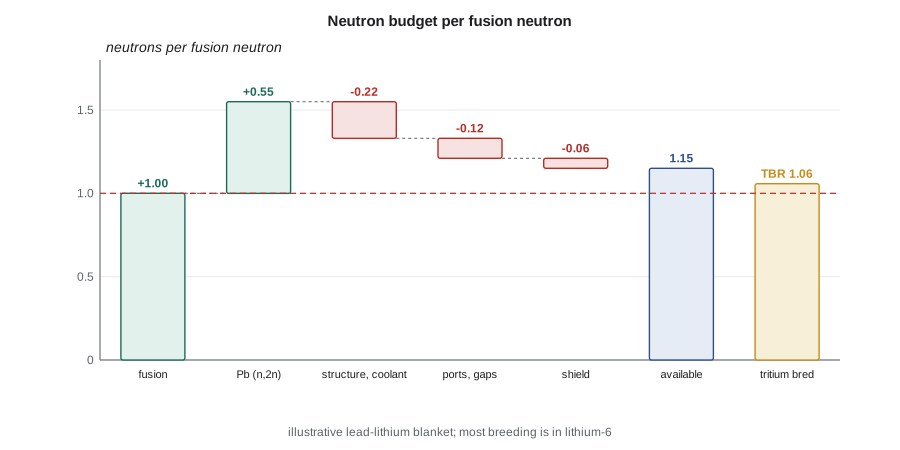
The tritium breeding ratio (TBR) is the number of tritium atoms produced in the blanket per tritium atom burned in the plasma, which is the same as per fusion neutron. Since each fusion consumes one triton and produces one neutron, a TBR of exactly 1 would require every neutron to be captured in lithium with nothing lost. In practice neutrons are absorbed in the steel structure, in coolants and armour, escape through ports for heating systems and diagnostics, or reach regions without breeder. To make up the shortfall, blankets include a neutron multiplier: beryllium or lead, whose (n,2n) reactions turn one fast neutron into two slower ones.
# Tritium bookkeeping for a D-T plant: burn rate, a breeding ratio budget,
# decay of a stored inventory, and the start-up inventory a plant must borrow.
import math
MeV = 1.602e-13
m_T = 3.016049 * 1.66054e-27                 # kg per tritium atom
P_fus = 1000e6                                # W of fusion power
rate = P_fus / (17.6 * MeV)                   # reactions (and tritons burned) per second
burn_kg_day = rate * m_T * 86400
print(f"1 GW fusion: {rate:.2e} reactions/s, burns {burn_kg_day * 1000:.0f} g of tritium per day, "
      f"{burn_kg_day * 365:.1f} kg per full-power year")
# A simple neutron budget per fusion neutron (illustrative values for a lead-lithium blanket)
budget = [("neutrons from fusion", 1.00), ("extra from Pb (n,2n)", 0.55),
          ("captured in structure and coolant", -0.22), ("lost through ports and gaps", -0.12),
          ("leaked or absorbed in shield", -0.06)]
avail = 0.0
for k, v in budget:
    avail += v
    print(f"  {k:36s}{v:+.2f}   running total {avail:.2f}")
f6, f7 = 0.88, 0.04                           # fractions captured in Li-6 and Li-7 (n,n'alpha)T
TBR = avail * f6 + avail * f7
print(f"tritium breeding ratio about {TBR:.2f} (Li-6 {avail * f6:.2f}, Li-7 {avail * f7:.2f})")
# Required TBR: burn + decay of inventory + losses + margin for start-up of the next plant
inventory = 2.0                               # kg held in plant systems
lam = math.log(2) / 12.32                     # per year
need = 1.0 + (inventory * lam) / (burn_kg_day * 365 * 0.8) + 0.02
print(f"breeding needed to cover burn, decay of {inventory} kg and 2 percent losses: {need:.3f}")
print(f"margin available to build up a start-up inventory: {TBR - need:+.3f}")
# Stored tritium decays at 5.5 percent a year
for yrs in (1, 5, 10, 20):
print(f" 1.00 kg stored for {yrs:2d} years -> {math.exp(-lam * yrs):.2f} kg")1 GW fusion: 3.55e+20 reactions/s, burns 153 g of tritium per day, 56.0 kg per full-power year neutrons from fusion +1.00 running total 1.00 extra from Pb (n,2n) +0.55 running total 1.55 captured in structure and coolant -0.22 running total 1.33 lost through ports and gaps -0.12 running total 1.21 leaked or absorbed in shield -0.06 running total 1.15 tritium breeding ratio about 1.06 (Li-6 1.01, Li-7 0.05) breeding needed to cover burn, decay of 2.0 kg and 2 percent losses: 1.023 margin available to build up a start-up inventory: +0.035 1.00 kg stored for 1 years -> 0.95 kg 1.00 kg stored for 5 years -> 0.75 kg 1.00 kg stored for 10 years -> 0.57 kg 1.00 kg stored for 20 years -> 0.32 kg
The example shows how thin the margins are. A blanket that achieves a calculated TBR of 1.06 might, after allowing for decay of the plant's inventory and processing losses, leave only a few percent to build up a start-up stock for another plant. Design studies therefore target calculated values of about 1.10 to 1.15 to cover uncertainties in nuclear data and modelling, which are themselves several percent. Every port that is cut through the blanket for heating or diagnostics, and every centimetre of extra steel, comes out of that margin, so the breeding requirement constrains the whole plant layout.
The fuel cycle
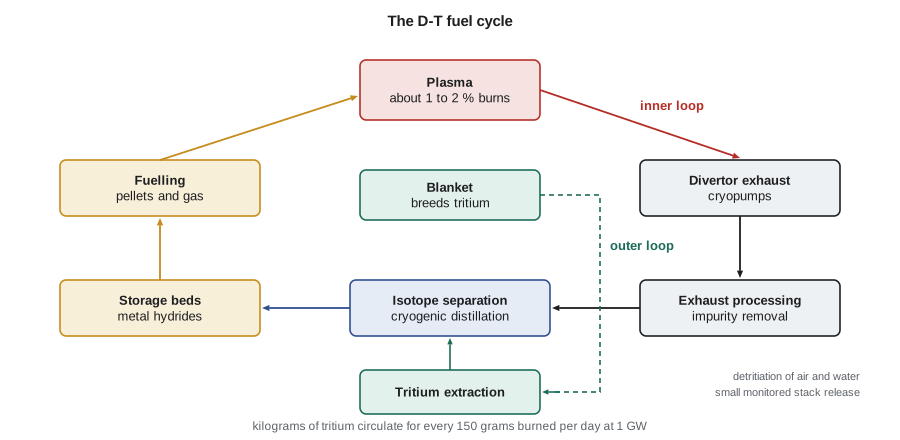
Tritium moves through two loops. In the inner loop, only a small fraction of the fuel injected into the plasma actually fuses before it is pumped out; in a tokamak the burn-up fraction is typically 1 to 2 percent, possibly more with efficient pellet fuelling. The rest, with helium ash and impurities, is pumped from the divertor by cryopumps, purified, separated into its hydrogen isotopes by cryogenic distillation, and returned to the pellet injectors and gas valves. Because so little burns on each pass, the flow of tritium through the inner loop is tens to a hundred times the burn rate, and the inventory held in pumps, pipework and processing systems can reach kilograms.
In the outer loop, tritium bred in the blanket must be extracted. In ceramic pebble blankets a helium purge gas sweeps it out as HT and T₂; in lead-lithium and molten salt blankets the liquid is circulated through extraction units, such as permeators or vacuum sieve trays, before returning to the blanket. Extraction must be fast enough to keep the tritium concentration, and hence the driving force for permeation, low.
Permeation is the defining engineering problem of tritium systems. Hydrogen isotopes dissolve in metals and diffuse through them, faster as temperature rises, so tritium in a hot blanket coolant tends to pass through heat exchanger tubes into the secondary coolant and toward the environment. Designs counter it with permeation barriers such as oxide or ceramic coatings, with intermediate loops, and with coolant chemistry that converts tritium into forms that are easier to capture. The stricter the release limits, the more important these measures become.
Inventories and start-up
The start-up inventory of a plant is the tritium needed in storage, in the processing systems and in the plasma before breeding can sustain operation. Studies suggest a few kilograms for a 1 GW plant if processing is fast and the burn-up fraction is reasonable, and much more if tritium lingers in systems for days. Reducing residence time in processing systems, raising the burn fraction and using direct internal recycling of unburned fuel all cut the inventory and the doubling time, the time a plant would take to breed enough surplus tritium to start another. The supply of start-up tritium is likely to be a constraint on how quickly a fusion fleet could grow in the 2040s.
Radiological safety
Tritium's beta particles have a mean energy of only 5.7 keV and cannot penetrate the skin, so it is hazardous mainly when taken into the body. As tritiated water, HTO, it is absorbed readily through the lungs and skin and distributes through body water, with a biological half-life of about ten days; as elemental gas, HT, it is some ten thousand times less radiotoxic because little is retained. Fusion plants therefore control tritium in layers: confinement in primary systems, gloveboxes and secondary enclosures; atmosphere detritiation systems that oxidize tritium and capture it as water; monitoring of rooms, stacks and effluents; and dose limits for workers and the public set by the regulator.
Marcel's experience transfers directly. CANDU stations manage tritium in their heavy water systems with dryers, vapour recovery and air monitoring, and the Darlington Tritium Removal Facility has handled kilogram quantities safely for decades. Canada's federal drinking water guideline for tritium is 7,000 Bq/L, and the CNSC requires licensees to report releases and keep doses as low as reasonably achievable. Hana notes that a fusion plant in Ontario would be licensed by the CNSC under the Nuclear Safety and Control Act, which already covers tritium facilities.
Worked problem
Tritium inventory decay during an outage
A fusion plant holds 3.0 kg of tritium in storage beds at the start of a 9-month maintenance outage, during which no tritium is bred or burned. How much is lost to decay, and how many days of full-power burn at 1 GW does the loss represent?
Show solution
- Decay constant λ = ln 2 ÷ 12.32 = 0.0563 per year.
- Remaining after 0.75 years: 3.0 × e^(−0.0563 × 0.75) = 3.0 × 0.9587 = 2.876 kg.
- Loss = 0.124 kg = 124 g.
- At 153 g per day, 124 g is about 0.8 days of full-power operation.
Answer: About 124 g, less than a day of burn, but over a plant's life decay of stored tritium is a steady cost that the breeding ratio must cover.
Measuring and accounting for tritium
A fusion plant must know where its tritium is, both for safety and because tritium is valuable fuel. Accountancy combines several measurements. Storage beds of metal hydrides, such as depleted uranium or zirconium-cobalt, absorb hydrogen isotopes reversibly and are weighed or monitored calorimetrically, since the decay heat of tritium, about 0.32 W per gram, reveals how much a bed holds. Process streams are analysed by gas chromatography, mass spectrometry and ionization chambers, and room air and stack effluents by bubblers that capture tritiated water and elemental tritium separately. The difference between what is bred, stored, burned and released must close within the measurement uncertainty, and an unexplained difference is investigated like any other abnormal event.
Tritium accounting also matters to regulators beyond radiation safety. Tritium is not a fissile material and is not subject to the same international safeguards as uranium and plutonium, but it is controlled under export rules in both Canada and the United States, and large inventories bring security requirements. A plant holding kilograms of tritium will have physical protection, access control and material control arrangements proportionate to that inventory, alongside its radiation protection programme.
Lessons from ITER and JET
Much of what is known about handling tritium at fusion scale comes from two sources. JET at Culham operated with tritium in 1997, 2021 and 2023, using an on-site active gas handling system that recovered and recycled the tritium through cryogenic distillation; its final campaign used about 0.2 milligrams of fuel to produce the 69 MJ record pulse while the plant handled grams. ITER's tritium plant, designed to process the exhaust of a 500 MW plasma, will be the largest of its kind, with isotope separation, water detritiation and atmosphere detritiation systems sized for an inventory limited by its French licence to a few kilograms on site. The experience of commissioning that plant will be a key input to the design of the first breeding demonstration facilities.
Common mistakes
MistakeA TBR of 1.0 is enough for self-sufficiency.
InsteadDecay, losses and start-up inventory for new plants require a calculated TBR of about 1.1 or more.
MistakeMost fuel injected into a tokamak fuses.
InsteadTypically only 1 to 2 percent burns per pass; the rest is recycled.
MistakeLithium-7 cannot breed tritium.
InsteadIt can, through an endothermic fast-neutron reaction that also returns a neutron.
MistakeTritium is dangerous mainly because of external radiation.
InsteadIts weak beta cannot penetrate skin; the hazard is intake, especially as tritiated water.
Summary and key terms
- A 1 GW D-T plant burns about 56 kg of tritium per full-power year, more than the world's civilian stock.
- Tritium is bred mainly by the exothermic lithium-6 reaction; lithium-7 contributes through a fast-neutron reaction.
- The breeding ratio must exceed 1 by enough to cover decay, losses, uncertainty and start-up of other plants.
- Neutron multipliers such as lead and beryllium make up for losses in structure and ports.
- Low burn-up fractions mean large tritium flows in the inner loop and kilogram inventories.
- Permeation through hot metals and intake as tritiated water drive tritium safety design.
- Tritium breeding ratio
- Tritium atoms bred per tritium atom burned.
- Burn-up fraction
- The fraction of injected fuel that fuses before being exhausted.
- Start-up inventory
- The tritium needed before a plant can sustain itself by breeding.
- Permeation
- Diffusion of hydrogen isotopes through solid materials.
- Detritiation
- Removal of tritium from air or water streams.
- Energy multiplication
- Total blanket heat divided by the energy of incident neutrons.
Practice problems
Work each problem on paper first, then reveal the answer to check.
Why is lithium-6 the main breeding isotope?
Show answer
Its reaction is exothermic with a large slow-neutron cross-section.
What is the purpose of a neutron multiplier?
Show answer
To produce extra neutrons through (n,2n) reactions so that breeding can exceed one.
Why is the inner-loop tritium flow much larger than the burn rate?
Show answer
Only 1 to 2 percent of injected fuel burns per pass.
Why does permeation become worse in a hot blanket?
Show answer
Diffusion through metals increases strongly with temperature.
Which chemical form of tritium is more radiotoxic?
Show answer
Tritiated water, HTO.
Lesson quiz · 5 questions
Score 60% or more to complete this lesson.
Create a free account to save your progress, take quizzes and earn a certificate.