
MSBA-330 · Lesson 9 of 12 · 20 min
Quality management
▶ Video coming soon A video version of this lesson is on the way.
Teodora brought a folder to the quality session. Inside were the paper inspection records for the past month: forms for incoming castings, seal kits and motors, each with a signature, a date and a pass or fail. Three of the failed forms had a note added later saying that the parts had reached the assembly line anyway, because the stores had not known about the failure. Her goal was that a failed part could never again be picked, and that the records would be in the system, searchable and linked to the vendor and the batch.
The parts of quality management
Quality management in Supply Chain Management is built from a small set of records. Once the relationships are clear, the setup follows naturally.
| Record | What it is | Example |
|---|---|---|
| Test instrument | A tool used to measure | Hardness tester, calipers |
| Test | A single check with a type and unit | Brinell hardness, outer diameter in millimetres |
| Test variable and outcomes | Possible results for a qualitative test, each pass or fail | Surface finish: smooth (pass), porous (fail) |
| Test group | A set of tests performed together, with sampling and acceptable quality level | Incoming high-chrome casting inspection |
| Item sampling | How much of a quantity to test | 5 percent, at least 2 pieces |
| Quality association | Which items, events and conditions create quality orders, using which test group | Purchase receipts of castings from any vendor |
| Quality order | An order to perform the tests on a quantity | QO-001245 for 6 castings from a receipt of 120 |
| Nonconformance | A record of a quality problem, its type and its handling | Porosity found on a casting batch |
| Quarantine order | An order that holds inventory in a quarantine warehouse until released or scrapped | Seal kits held after a failed test |
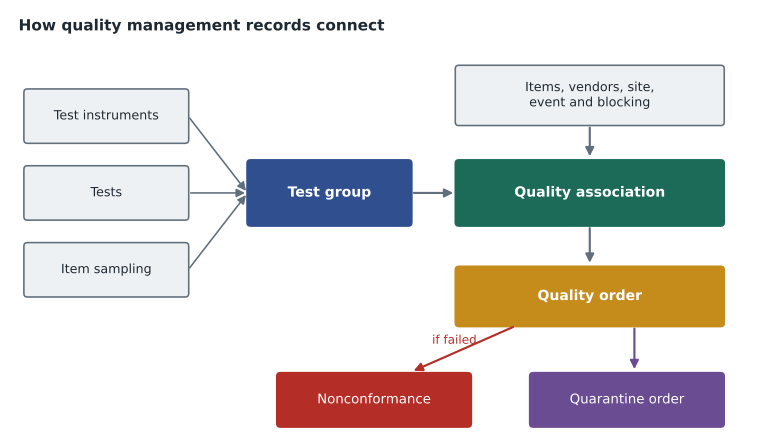
Quality management features, such as quality orders and nonconformances, must be enabled in the inventory management parameters before they appear, and the quality processes are activated per site. Cobalt Ridge enabled them for both plants and the distribution site.
Tests and test groups
A test has a type: quantitative tests record a number against a standard, minimum and maximum, in a unit; qualitative tests record an outcome from a list of test variable outcomes, each marked pass or fail. Tests can need a test instrument. A test group combines tests into one inspection, with an order of performance, an acceptable quality level percentage, and a sampling plan through item sampling. A test group can also be marked as destructive, which means that the sampled quantity is consumed by testing and posted out of inventory.
Worked problem
Building a casting inspection
Teodora wants every receipt of high-chrome castings tested for hardness between 600 and 700 on the Brinell scale, outside diameter within 0.5 millimetres of 220, and surface finish free of porosity. Five percent of each receipt should be tested, at least two pieces. What needs to be set up?
Show solution
- Create test instruments for the hardness tester and calipers.
- Create a quantitative test for hardness with standard 650, minimum 600 and maximum 700.
- Create a quantitative test for outside diameter in millimetres with standard 220, minimum 219.5 and maximum 220.5.
- Create a qualitative test for surface finish with test variable outcomes smooth (pass) and porous (fail).
- Create item sampling of 5 percent with a minimum of 2.
- Create test group HCC-IN with the three tests in order, the item sampling and an acceptable quality level of 100 percent.
Answer: Three tests, one item sampling and a test group, ready to be linked to receipts by a quality association.
Quality associations
A quality association decides when quality orders are created. It combines a reference type, such as purchase, production, sales, inventory or quarantine, an item code for one item, an item group or all items, an optional account code for vendors or customers, a site, and an event type with an execution setting. The event type says at which point in the process the order is created, such as on purchase registration, product receipt or production report as finished. The execution setting says whether the order is created before or after that event, and whether the process is blocked until the quality order passes.
| Setting | Choices | Cobalt Ridge casting association |
|---|---|---|
| Reference type | Purchase, production, sales, inventory, quarantine, route operation | Purchase |
| Item code | Table (one item), group (item quality group), all | Group: high-chrome castings |
| Account code | Table, group or all vendors | All |
| Site | A site | HAM plant |
| Event type | Such as registration, product receipt, report as finished | Product receipt |
| Execution | Before or after the event | After |
| Event blocking | None, or block a later process until the order passes | Block picking until passed |
| Test group | The test group to use | HCC-IN |
The event blocking setting is what Teodora needed. With blocking, the received castings are on hand but cannot be picked for production until the quality order passes, so a failed part can no longer reach the line. Quality orders can also be manual, created by a user when there is a reason, such as a customer complaint, without an association.
Item quality groups simplify the item code. Rather than create an association for each item, items are assigned to a quality group, and the association uses the group. Cobalt Ridge created quality groups for high-chrome castings, ductile castings, seal kits and motors, each with its own association and test group.
Processing quality orders
A quality order lists the tests from the test group, the quantity to test from item sampling, and the inventory dimensions of the quantity, including batch where tracked. An inspector opens the order, enters the results for each test, and validates the order. The system compares each result with the test's limits or outcomes and sets the order to pass or fail according to the acceptable quality level. Once validated, the blocking is lifted if the order passed. If it failed, blocking remains, and the next steps are a decision for quality.
- Open the quality order created by the receipt.
- Enter the results for each test and each sample, with the instrument used.
- Validate the order; the system sets it to pass or fail.
- If it passes, the stock becomes available for picking.
- If it fails, record a nonconformance, and decide whether to quarantine, return to the vendor, rework or scrap.
Quality orders can carry certificates of analysis, printed from the order for customers who require them, and results can be copied to batch attributes when the item is batch tracked, so a measured hardness becomes a searchable property of the batch. Lesson 10 returns to batch attributes.
Quarantine orders
Some items need to be physically separated, not just blocked. Quarantine orders move a quantity from its normal warehouse to the warehouse's quarantine warehouse, where it stays until the quarantine order is reported as finished, which returns accepted stock, or until it is scrapped or returned. Quarantine can be created automatically for every purchase receipt of items whose item model group has quarantine management enabled, or manually when there is a reason.
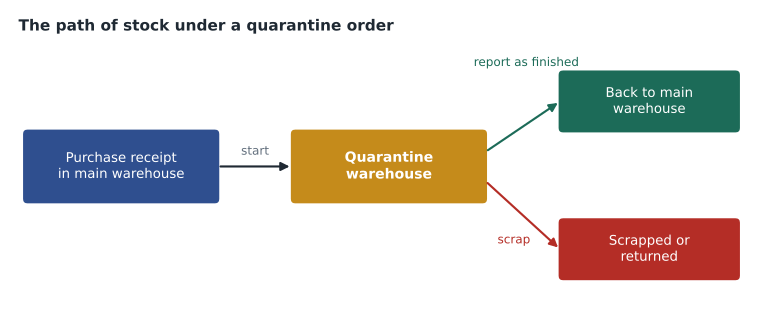
Teodora used both mechanisms. Castings, which are large and inspected where they lie, use quality orders with blocking. Seal kits, which are small and easy to mix up, go through quarantine: every receipt moves to the quality hold warehouse, is inspected there, and only then returns to the main stores. The study guide lists processing quarantine orders and quality orders as separate skills for exactly this reason.
Nonconformances
A nonconformance records a quality problem. It has a type, such as customer, vendor, service, production or internal, a problem type from a list the company defines, the item, the quantity and the reference, such as a purchase order or a quality order. A nonconformance is approved or refused, and once approved it can have corrections, the actions taken to fix it, and diagnostic types that classify the root cause. Nonconformances can also create a quality order to retest, or be linked to a quarantine order.
| Nonconformance type | Raised for | Example at Cobalt Ridge |
|---|---|---|
| Vendor | A problem caused by a supplier | Porous castings from Lakehead Forge |
| Customer | A problem reported by a customer | Seal leak reported by a water utility |
| Production | A problem found in production | Misaligned shaft during assembly |
| Internal | A problem in internal processes | Wrong labels printed for a batch |
| Service | A problem with a service order | Not used yet |
Problem types are defined per nonconformance type and can be linked to items, so that only sensible problems appear. Corrections record what was done, by whom and when, and can be planned with dates. Diagnostic types describe the root cause, such as material, method, machine or person. Over time, reports of nonconformances by vendor, problem type and diagnosis show where quality is improving and where it is not. Teodora planned to bring the nonconformance report to the monthly vendor review with Piotr's buyers, so that vendor performance would be judged on recorded facts.
Worked problem
A failed seal kit receipt
A receipt of 400 seal kits, batch SK-26-1187, arrives at Calgary. The quarantine order moves them to the quality hold warehouse. The quality order fails because 3 of 20 samples have a cracked O-ring. What should happen next?
Show solution
- The failed quality order keeps the stock blocked in the quality hold warehouse.
- Teodora creates a vendor nonconformance for the batch, problem type cracked O-ring, referencing the purchase order and the quality order.
- The nonconformance is approved, and a correction is planned: return the batch to the vendor and request a replacement.
- The buyer creates a return order to the vendor from the quarantine stock.
- The diagnostic type is recorded as material once the vendor's analysis arrives.
- The batch is also blocked manually at any other warehouse that holds stock of it, in case earlier receipts were affected.
Answer: No seal kit from the failed batch reaches the shelves; the problem, its correction and its cause are recorded against the vendor and the batch.
Quality beyond purchasing
Most of this lesson has followed incoming goods, but quality associations work for other reference types too. A production association can create a quality order when a production order is reported as finished, so that every finished pump is pressure tested before it can be put away for sale. A route operation association creates orders at a particular operation, such as after machining an impeller and before balancing it. A sales association can require a test before a shipment, for customers who demand a test certificate with each delivery, and an inventory association covers stock already on hand, such as a periodic retest of stored seal kits.
| Reference type | Cobalt Ridge use | Test group |
|---|---|---|
| Purchase | Incoming castings and motors | HCC-IN, MOTOR-IN |
| Quarantine | Seal kits held in the quality hold warehouse | SEAL-IN |
| Production | Hydrostatic pressure test of every finished pump | PUMP-PRESS |
| Route operation | Dynamic balancing after impeller machining | IMP-BAL |
| Sales | Witnessed test for utility contracts that require it | PUMP-WIT |
| Inventory | Annual retest of stored elastomer seals | SEAL-RETEST |
The production pressure test matters for traceability as well. Each finished pump is serial numbered, as lesson 10 explains, and the quality order records the serial number with the test results. When a utility asks years later whether its pump passed its pressure test, the answer is a search on the serial number rather than a hunt through filing cabinets. Teodora described this as the single biggest improvement in the project, and asked that the witnessed-test process be added in the second phase once the basic associations were stable.
Quality and costing
Testing can consume stock. With a destructive test group, the sampled quantity is posted out of inventory when the quality order is validated, to an account set in the posting setup, so the cost of testing is visible. Scrapping a quarantined quantity posts a loss in the same way. Ifeoma asked that both use a dedicated quality loss account rather than the general inventory profit and loss account, so that the cost of poor quality could be reported separately. Thandeka agreed and added it to the account design.
Common mistakes
MistakeCreating quality orders but no blocking.
InsteadUse event blocking so stock cannot be used before the order passes.
MistakeCreating a quality association for every item.
InsteadUse item quality groups and one association per group.
MistakeRecording failures only in quality order notes.
InsteadRaise nonconformances with problem types and corrections so they can be analysed.
MistakeUsing quarantine for large items that are inspected in place.
InsteadUse quality orders with blocking where moving stock adds no value.
Summary and key terms
- Quality management uses tests, test groups, item sampling and acceptable quality levels.
- Quality associations create quality orders for items, events and sites, and can block processes until the order passes.
- Quality orders are filled in, validated and passed or failed; results can update batch attributes.
- Quarantine orders move stock to a quarantine warehouse until it is released or scrapped.
- Nonconformances record problems by type, with problem types, corrections and diagnostic types for analysis.
- Test group
- A set of tests performed together with sampling and an acceptable quality level.
- Quality association
- The rule that creates quality orders for chosen items, events and sites.
- Event blocking
- A quality association setting that stops a later process until the quality order passes.
- Quarantine order
- An order that holds stock in a quarantine warehouse until released or scrapped.
- Nonconformance
- A record of a quality problem with its type, handling and corrections.
Practice problems
Work each problem on paper first, then reveal the answer to check.
Which setting makes received castings unavailable until inspection passes?
Show answer
Event blocking on the quality association.
What enables automatic quarantine for every purchase receipt of an item?
Show answer
Quarantine management in the item model group, with a quarantine warehouse on the receiving warehouse.
Name three types of nonconformance.
Show answer
For example vendor, customer, production, internal and service.
Lesson quiz · 5 questions
Score 60% or more to complete this lesson.
Create a free account to save your progress, take quizzes and earn a certificate.