
MSBA-330 · Lesson 1 of 12 · 19 min
Supply chain management overview
▶ Video coming soon A video version of this lesson is on the way.
Two weeks after the foundation sessions ended, Annelise Vorster-Kim started a new series for the people who would own products and stock at Cobalt Ridge Manufacturing. Piotr Vasquez-Lind, the supply chain manager, sat at the front with a list of complaints about the old system that ran to three pages. Beside him were Henrik Salo, who leads the Calgary warehouse, Teodora Brisebois, the quality manager at the Hamilton plant, and Ifeoma Ladipo-Ward, the cost accountant who reports to Thandeka Morrow. Annelise opened by asking each of them to say, in one sentence, what an item was. Piotr said it was a part number. Henrik said it was a bin label. Teodora said it was a certificate of conformance waiting to be checked. Ifeoma said it was a cost. Annelise wrote all four answers on the whiteboard and said that by the end of the series the system would have to hold every one of them.
This course follows that series. It covers the product and inventory side of Dynamics 365 Supply Chain Management: how products are defined, how they are measured, where they are stored, how they are valued, how stock moves and is counted, how quality is controlled and how batches and serial numbers are traced. These are the foundations that purchasing, sales, warehousing, production and planning all depend on, and they make up a large part of the MB-330 exam.
What Supply Chain Management is
Supply Chain Management is one of the finance and operations apps introduced in MSBA-141. It shares a platform, a database and many setup records with Dynamics 365 Finance. A purchase order raised in Supply Chain Management creates vendor transactions that the accounts payable team in Finance pays; a sales order creates customer transactions that the credit team collects. Inventory transactions post to the general ledger through the posting setup that finance owns. The two apps are licensed separately, but in a company like Cobalt Ridge they run as one system.
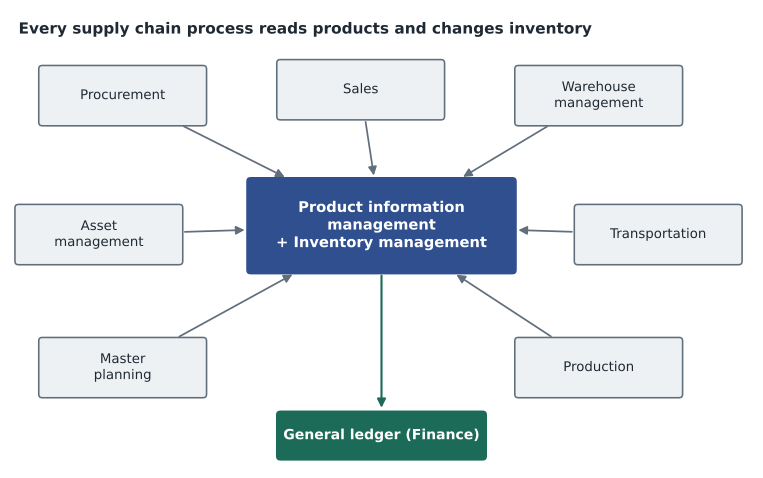
The application is organized into modules, each with its own menu, workspaces and parameters. The ones that matter most in this course are product information management and inventory management, but the others rely on them constantly.
| Module | What it covers | Course |
|---|---|---|
| Product information management | Shared products, released products, variants, dimensions, units, attributes, categories | This course |
| Inventory management | Journals, transfer orders, counting, inventory close, quality, batches and serials, reports | This course |
| Procurement and sourcing | Purchase requisitions, purchase orders, vendor collaboration, trade agreements | MSBA-331 |
| Sales and marketing | Sales orders, pricing, delivery, returns | MSBA-331 |
| Warehouse management | Locations, work, mobile devices, waves, license plates | MSBA-332 |
| Transportation management | Carriers, routes, freight rates, loads | MSBA-332 |
| Production control | Production orders, routes, operations, shop floor | MSBA-333 |
| Master planning | Planned orders, coverage, demand forecasts | MSBA-333 |
| Asset management | Assets, maintenance plans, work orders | MSBA-333 |
The MB-330 exam
This course belongs to the program that prepares for Exam MB-330, Microsoft Dynamics 365 Supply Chain Management Functional Consultant. The study guide lists skills measured as of October 21, 2026 in five domains. Product information management is the largest, and inventory and asset management is the next. Asset management is taught in MSBA-333; warehouse and transportation management in MSBA-332; supply chain processes such as procurement and sales in MSBA-331; and master planning in MSBA-333. A full review of every domain comes in MSBA-338.
| Domain | Weight | Where in this program |
|---|---|---|
| Implement product information management | 25 to 30 percent | Lessons 2 to 6 of this course |
| Implement inventory and asset management | 20 to 25 percent | Lessons 7 to 11 here; assets in MSBA-333 |
| Implement and manage supply chain processes | 15 to 20 percent | MSBA-331 |
| Implement warehouse management and transportation management | 20 to 25 percent | MSBA-332 |
| Implement master planning | 10 to 15 percent | MSBA-333 |
The passing score is 700 on a scale of 1,000, as for other role-based Microsoft exams. Like other associate certifications, the Supply Chain Management Functional Consultant credential must be renewed each year through a free online assessment on Microsoft Learn. Those details, and how to book the exam, are covered in MSBA-338.
Products, items and inventory
The vocabulary needs settling early, because the system uses several words that people often treat as the same.
A product is the definition of something the company makes, buys, sells or uses: its number, name, type, dimensions and descriptions. Products are created once, in a list called all products and product masters, and are shared across legal entities. A released product is a product that has been released to one legal entity, where it gets the settings that only make sense locally: item group, units, costing method, default warehouses, purchase and sales prices, and many more. The word item is used for released products in most of the application, so an item number is the identifier of a released product inside a company. Inventory is the stock of items: quantities held in particular places, in particular statuses, with particular batch or serial numbers, valued at a cost.
Annelise drew the relationship as a tree. At the top sits the shared product, described once for the whole group. Below it are released products, one per legal entity that uses it. Below those are the inventory transactions that record every receipt and issue, and summing those transactions gives the on-hand inventory at any combination of dimensions. Piotr's part number lives at the top of the tree, Henrik's bin label in the dimensions at the bottom, Ifeoma's cost in the item model group and the transactions, and Teodora's certificate in the quality and batch records.
Cobalt Ridge's starting point
Cobalt Ridge makes three families of products. Municipal centrifugal pumps for water utilities are built in a handful of sizes and configurations, mostly to order. Mining slurry pumps are heavier, built from hardened castings, and often sold with a long list of spare parts. Distributor units are smaller pumps built for stock and sold through industrial distributors. Around these finished goods sit thousands of purchased components: castings, impellers, shafts, bearings, mechanical seals, gaskets, motors, fasteners and fluids.
The old system held about 30,000 item numbers, many of them duplicates or dead. The migration plan from the foundation course moves only about 14,000 items with activity in the past three years. Piotr's three pages of complaints came down to five problems that the new setup had to solve.
| Problem in the old system | What the new design uses | Lesson |
|---|---|---|
| Every size and colour of a pump had its own item number, so there were hundreds of near-duplicates | Product masters with product dimensions | 3 |
| Steel castings were bought by weight but issued by piece, and conversions lived in a spreadsheet | Product-specific unit conversions | 4 |
| Nobody could say which seal kit batch went into which pump | Batch tracking on seal kits and serial numbers on pumps | 10 |
| Incoming inspection was on paper and failed parts sometimes reached the line | Quality associations, quality orders and quarantine | 9 |
| Standard costs were updated once a year in a batch that nobody trusted | Costing versions with reviewed pending prices | 6 |
Setup before transactions
Annelise spent the rest of the first session on one message: in this area of the system, the order of setup matters more than almost anywhere else. Some groups that are assigned to released products, especially the storage and tracking dimension groups and the item model group, become very hard to change once inventory transactions exist. Changing a tracking dimension group on an item with stock usually means emptying its inventory, changing the group and receiving the stock again, and some changes are blocked outright. A wrong item group posts transactions to the wrong ledger accounts. A wrong inventory unit makes every historic quantity misleading.
She therefore proposed a sequence for the project, and the team agreed to treat it as a rule.
- Agree units of measure, unit classes and standard conversions.
- Design product, storage and tracking dimension groups, and reservation hierarchies if warehouse management is used.
- Design item model groups with the costing method and inventory policies for each kind of item.
- Design item groups with Ifeoma and Thandeka so that posting goes to the right accounts.
- Build category hierarchies, product attributes and lifecycle states.
- Build product templates for each kind of product.
- Migrate shared products, release them, then migrate opening on-hand balances through journals.
- Test receipts, issues, counting, quality and costing in the CONFIG sandbox before user acceptance testing.
Ifeoma asked why item groups were on the list at all, since they seemed like an accounting concern. Annelise explained that item groups are the most common way of choosing the inventory, cost of goods sold, revenue and other ledger accounts for an item's transactions. If the supply chain team creates items without agreeing the item group design with finance, the first month-end will reveal it. Item groups are assigned on the released product and also used in reports and in filters, so they are worth designing as carefully as anything else.
Shared and company-specific settings
Cobalt Ridge has three legal entities: CRCA, CRUS and, from January 2027, CRMX in Monterrey. Many products exist in more than one of them. A distributor pump built in Hamilton might be stocked in both the Canadian and US companies and, from next year, the Mexican distribution hub. The shared product is created once. Each company then releases it and sets its own item group, costing, units for purchasing and selling, warehouses and prices.
| Held on the shared product | Held on the released product in each company |
|---|---|
| Product number and name, translations | Item number (usually the same as the product number) and search name |
| Product type and subtype | Item group, item model group, storage and tracking dimension groups |
| Product dimension group and dimension values | Inventory, purchase and sales units |
| Category assignments and product attributes | Cost price, purchase and sales prices, default order settings |
| Product master configuration technology | Product lifecycle state, buyer group, coverage group |
The storage dimension group and tracking dimension group can be set on the shared product as defaults, but they are effectively company decisions and are often maintained on the released product. The product dimension group, by contrast, must be the same everywhere, because it describes what the product is rather than how one company handles it.
The MB-330 lens
Microsoft's study guide frames the product domain in four groups of skills: creating and managing products, configuring the prerequisites for products, configuring additional product details, and managing inventory pricing and costing. The inventory domain covers journals and transfer orders, inventory closing and adjustment, inventory blocking, batch disposition codes and inventory reports including ABC classification, then quality management. Each lesson in this course is mapped to those skills, and the exam-readiness course revisits them with original practice questions. Bills of materials, which also appear in the product domain, are introduced here as a product concept and taught fully in MSBA-333 with production.
Worked problem
Placing a requirement in the right module
Henrik says the Calgary warehouse needs to stop pickers taking mechanical seals that are past their expiry date. Teodora says incoming seals must be tested before they can be used. Ifeoma says seal kits must be valued at actual cost. Which areas of the system handle each requirement?
Show solution
- Expiry dates come from batch tracking with shelf life settings on the item, so start with the tracking dimension group and batch settings (lesson 10).
- Blocking expired batches from picking is handled by batch dates, batch disposition codes and, in warehouse management, reservation rules (lessons 5 and 10).
- Incoming testing is quality management: a quality association on the purchase receipt event for seal kits (lesson 9).
- Actual cost valuation comes from the item model group's costing method, such as FIFO or weighted average, with inventory close (lessons 6 and 7).
Answer: Three different areas: tracking dimensions and batch settings, quality management, and the item model group. One item can rely on all three at once.
How the series ran
Annelise kept the format from the foundation course: a short explanation, a walkthrough in the CONFIG sandbox and an exercise using real Cobalt Ridge data. Each session ended with a decision log entry. By the end of November the log held forty decisions, from the unit class for lubricants to the counting frequency for the most valuable spare parts. That log became the main input to the configuration workbook, and the capstone in lesson 12 walks through it end to end.
Kiri Langford, the project manager, attended the first session only long enough to ask one question: which of these decisions could be changed after go-live without pain? Annelise's answer became the title of a slide used throughout the project. Categories, attributes, templates and lifecycle states can change at any time. Units and conversions can be added, though changing an item's inventory unit is restricted once it has transactions. Dimension groups and item model groups are very costly to change once stock exists. Kiri highlighted the last line in red and left.
Common mistakes
MistakeTreating a product and a released product as the same record.
InsteadShared products are defined once; each legal entity releases them and adds its own settings.
MistakeCreating items before agreeing dimension groups and item model groups.
InsteadDesign the groups first; they are hard to change once transactions exist.
MistakeLeaving item groups to the supply chain team alone.
InsteadDesign item groups with finance, because they usually drive ledger posting.
MistakeExpecting the product information domain to be a small part of MB-330.
InsteadIt is the most heavily weighted domain, at 25 to 30 percent.
Summary and key terms
- Supply Chain Management shares a platform and database with Finance; inventory transactions post to the ledger.
- Product information management and inventory management underpin procurement, sales, warehousing, production and planning.
- Products are shared definitions; released products carry company settings; inventory transactions build on-hand quantities.
- MB-330 weights product information management at 25 to 30 percent and inventory and asset management at 20 to 25 percent.
- Units, dimension groups, item model groups and item groups must be designed before products and stock are migrated.
- Product
- A shared definition of something a company makes, buys, sells or uses.
- Released product
- A product released to a legal entity, with that company's settings; called an item in most pages.
- On-hand inventory
- The quantity of an item available at a given combination of inventory dimensions, built from inventory transactions.
- Item group
- A grouping of released products used mainly to choose ledger accounts for their transactions.
- Item model group
- A group that sets the costing method and inventory policies for released products.
Practice problems
Work each problem on paper first, then reveal the answer to check.
Which list holds products shared by all legal entities?
Show answer
All products and product masters, in product information management.
Name two settings that live on the released product rather than the shared product.
Show answer
For example the item group, item model group, units, prices or default warehouses.
Why should item groups be designed with finance?
Show answer
Because they usually determine the ledger accounts used when inventory transactions post.
Lesson quiz · 5 questions
Score 60% or more to complete this lesson.
Create a free account to save your progress, take quizzes and earn a certificate.