
MSBA-330 · Lesson 12 of 12 · 18 min
Case study: setting up products for a manufacturer
▶ Video coming soon A video version of this lesson is on the way.
The last session of the series was a rehearsal. Annelise gave the team a new product family that engineering had just approved, the HX-90 high-pressure booster pump, and asked them to set up everything it needed in the CONFIG sandbox, from units to reports, using only the decision log and what they had learned. The booster pump was a good test because it touched every topic: it came in variants, used components bought by weight, needed batch-tracked seals and a serial-numbered motor, had incoming and production inspections, and would be stocked at both plants and the distribution warehouse. Kiri timed the exercise. This lesson follows it step by step.
The requirements
Engineering's release note and the sales plan gave the following requirements.
| Area | Requirement |
|---|---|
| Product | HX-90 booster pump in three pressure ratings (25, 40 and 63 bar) and two seal options (standard and high-temperature); all six combinations sold |
| Components | Duplex steel casing casting bought by kilogram, about 31.5 kilograms each; high-temperature seal kit with a 3-year shelf life; 15 kW motor with manufacturer serial number |
| Companies | Built at Hamilton in CRCA and CRUS; stocked at Calgary; CRMX to sell two variants from January |
| Quality | Incoming hardness and dimension check on casings; pressure test on every finished pump |
| Costing | Finished pumps at standard cost; seal kits FIFO; casings at standard cost |
| Traceability | Utilities require the seal kit batch and motor serial for every pump |
| Lifecycle | Pilot builds until engineering sign-off, then active |
Annelise asked the team to read the requirements twice and list every setup record they implied before touching the sandbox. The list ran to 31 items, and the team agreed to work through it in the same order as the course, from units to reports, ticking each item as they went.
Step 1: units and conversions
The team checked that every unit the family needed already existed: piece, kilogram and the box used for O-rings. They added a product-specific interclass conversion for the casing casting, 1 piece = 31.5 kilograms, and an intraclass conversion for O-rings, 1 box = 25 pieces. The inventory unit for every item was piece, following the rule from lesson 4 that the inventory unit is the unit in which an item is counted and consumed.
Step 2: dimensions and groups
No new groups were needed, which Annelise said was the sign of a good group design. The team chose from the existing set.
| Item | Product dimension group | Storage dimension group | Tracking dimension group | Item model group | Item group |
|---|---|---|---|---|---|
| HX-90 pump (master) | Configuration and Style | SWL at plants; SWLSP-WMS at distribution | Serial, active, physical | Standard cost | Finished municipal pumps |
| Casing casting CS-4090 | None | SWL | None | Standard cost | Castings |
| High-temperature seal kit SK-90H | None | SWL; SWLSP-WMS at distribution | Batch, active, physical | FIFO with quarantine management | Seal kits |
| 15 kW motor MT-15 | None | SWL | Serial, active, physical | Standard cost | Purchased components |
Configuration was used for the pressure rating, because each rating has its own BOM, and Style for the seal option, following the decision log rule that style means the second customer-chosen option. The team confirmed with Ifeoma that seal kits would move to a FIFO item model group with quarantine management enabled, matching the existing seal kit design. The storage dimension group differed by company only in that the distribution warehouse used warehouse management; because storage dimension groups are set on the released product, that was simply a different value in each company.
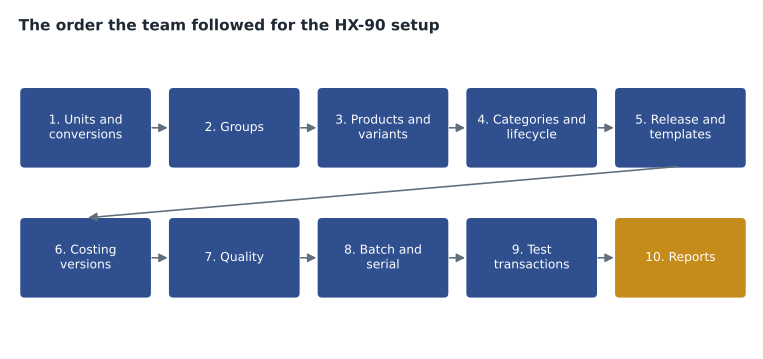
Step 3: shared products and variants
The HX-90 was created as a product master with configuration technology predefined variant. The configuration values 25, 40 and 63 bar and the style values standard and high-temperature were linked to the master, and Variant suggestions produced six variants. The components were created as distinct products. Spanish translations were added for the two variants CRMX would sell, and the old engineering prototype numbers were recorded as external item numbers so that test reports could be matched.
Step 4: categories, attributes and lifecycle
The pump was assigned to the municipal pumps node of the sales category hierarchy, and the components to castings, seals and motors in the procurement hierarchy. Product attributes for maximum pressure, wetted material and ATEX rating were filled in on the master. The released products were given the Pilot lifecycle state, which allows production and purchasing with a warning but blocks sales, so that pilot builds could be made but not sold before sign-off.
Step 5: release and templates
The master, all six variants and the components were released to CRCA and CRUS, and the two Mexican variants and their seal kit to CRMX. In each company, the matching shared template was applied: finished pump with serials, purchased component, purchased component with batches. The team then opened the released products with missing settings tile in the product information management workspace and confirmed it showed nothing for the HX-90 family. Default order settings were set so that pumps defaulted to the plant's finished goods warehouse for inventory and to the distribution warehouse for sales from stock.
Worked problem
A check the team nearly missed
After release, the CRUS buyer tries to create a purchase order for the 15 kW motor and gets an error about a missing cost price. Everything else looks complete. What is missing?
Show solution
- The motor uses a standard cost item model group, so it needs an active cost price on the transaction date.
- The template set the item model group but cannot set a price.
- Ifeoma enters a pending price for MT-15 in the current year's standard cost costing version for the AKR site.
- After review, she activates the pending price.
- The buyer retries and the purchase order line is accepted.
Answer: An active standard cost price. Standard cost items cannot be transacted until a price is active in a costing version.
Step 6: costing
Ifeoma entered pending prices for the casting and motor in the current standard cost version for each site, and calculated pending prices for the six pump variants from a draft BOM version supplied by engineering. She reviewed the results with Thandeka, who questioned the 63 bar variant's cost until engineering confirmed that its casing needed an extra machining operation. The prices were activated for the next day. She also entered the 2027 prices in the 2027-STD version as pending, to be activated on January 1 with the rest.
Step 7: quality
Teodora added the casing casting to the high-chrome castings item quality group, which already had an incoming quality association with blocking; she checked that the test group's hardness limits suited duplex steel and created a new test group, DPX-IN, when they did not. She created a production quality association for the HX-90 master with the event report as finished and the test group PUMP-PRESS, blocking put-away until the pressure test passed. The seal kits were covered by the existing quarantine process for seal kits at the distribution warehouse and by a new incoming association at the plants.
Step 8: batch and serial settings
The seal kit was marked as a shelf life item with a shelf life period of 1,095 days, a best before period of 120 days and a shelf advice period of 540 days. Its batches would be the vendor's lot numbers, entered on receipt. The pump used a serial number group with the format HX90-YY-#####, generated on report as finished, and the motor's serial numbers would be entered on receipt from the nameplate. The team confirmed that production picking would register the seal kit batch and motor serial against each production order, which is what makes the trace work.
Step 9: test transactions
Kiri's stopwatch showed two hours and forty minutes when the team began testing. They ran a script that touched every part of the setup.
| Test | Expected result | Outcome |
|---|---|---|
| Purchase 400 kg of casings | Order converts to about 12.7 pieces; receipt of 13 pieces; quality order created and stock blocked | Passed |
| Validate the casing quality order | Pass releases the stock for picking | Passed |
| Receive 20 seal kits with a vendor lot | Quarantine order moves them to the quality hold warehouse; batch dates calculated | Passed |
| Receive 5 motors with serial numbers | Five serial numbers required on receipt | Passed |
| Produce 2 pumps of the 40 bar, high-temperature variant | Batch and serials registered on picking; pump serials generated; pressure test order created | Passed after fixing the BOM version date |
| Try to sell a pilot pump | Lifecycle state blocks the sales order | Passed |
| Move the family to Active and sell one pump | Sales order accepted; serial and batch on the packing slip | Passed |
| Trace the pump serial backward | Shows the seal kit batch, motor serial and casing receipt | Passed |
| Count the seal kits | Counting journal line per batch; no difference | Passed |
| Run the inventory value report | Values at standard for pumps and casings, FIFO for seals, by site | Passed |
One test failed on the first try. The BOM version for the 40 bar variant had been approved with a from-date of the following week, so the production order could not find an active BOM. Engineering corrected the date and the test passed. Annelise pointed out that this was a production setup issue rather than a product information one, and a reminder that the product team and the production team share dates and versions.
Step 10: reports
Finally, the team added the HX-90 family to the reporting calendar. The seal kit appeared in Teodora's expiry view because it was batch tracked with shelf life. The pumps and casings would be included in the next ABC classification. Piotr added the family to a saved on-hand view for new products in pilot, which he reviews weekly during a product launch.
Teodora also checked the batch expiry view the next morning and found the 20 test seal kits listed with an expiration date three years out, exactly as the shelf life settings predicted. She added the HX-90 seal kit to her weekly review list before the first real receipt had even been planned.
The debrief
The whole exercise took three hours and fifteen minutes. In the old system, setting up a new pump family had taken about two weeks of emails and spreadsheets. Annelise asked each person what had made the difference. Piotr said the product master: six variants instead of six items, each with three or four related records. Henrik said the templates: nothing was forgotten in any company. Teodora said that quality blocking meant she could stop worrying about the line. Ifeoma said that pending prices let her check costs before they mattered.
Kiri asked the question she had asked at the first session: what could still go wrong? Annelise listed three things. If engineering added a new pressure rating, the team would need a new configuration value and new variants, which was easy. If sales wanted a new option, such as a coating, it would need a product dimension that the master did not have, which would mean a new master, so the dimension design should anticipate it. And if the seal kits turned out not to need batch tracking, removing it would be harder than adding it had been. She recommended writing those three points into the decision log, and Kiri did.
- Units and conversions confirmed and added before any product.
- Existing dimension, model and item groups reused; no new groups created.
- One product master with six variants; components as distinct products.
- Categories, attributes, translations and a pilot lifecycle state set before release.
- Templates applied in each company; no released product left with missing settings.
- Standard costs entered as pending, reviewed and activated.
- Quality associations with blocking for casings and pumps; quarantine for seals.
- Shelf life, batch and serial settings confirmed and traced end to end.
- A test script run in the sandbox and every failure explained.
Common mistakes
MistakeCreating new dimension or model groups for each new product family.
InsteadReuse a small set of well-designed groups; a new family rarely needs new groups.
MistakeReleasing products before categories, attributes and lifecycle states are set.
InsteadComplete shared settings first so every company inherits them.
MistakeForgetting active standard costs for standard cost items.
InsteadEnter and activate prices in a costing version before transactions.
MistakeTesting only the happy path.
InsteadTest blocking, lifecycle restrictions and tracing as well as receipts and sales.
Summary and key terms
- A new product family touches units, dimensions, products, categories, lifecycle, release, costing, quality, tracking and reports.
- Good group design means new families reuse existing dimension, model and item groups.
- Product masters with predefined variants, templates and lifecycle states keep setup consistent across companies.
- Costing versions, quality associations with blocking and batch and serial settings must be in place before the first transaction.
- A test script in the sandbox proves the setup end to end and surfaces dependencies on other teams.
- Decision log
- A project record of agreed design decisions and their reasons.
- Pilot lifecycle state
- A state that allows limited processes, such as production, before a product is released for sale.
- Test script
- A planned set of transactions with expected results used to verify a setup.
- BOM version
- A dated, approved link between a bill of materials and a released product at a site.
- Variant suggestions
- The function that proposes variants for linked dimension values.
Practice problems
Work each problem on paper first, then reveal the answer to check.
Why did the motor purchase fail after release?
Show answer
It used standard cost and had no active cost price in a costing version.
Which lifecycle state allowed pilot builds but blocked sales?
Show answer
Pilot.
What would make adding a coating option to the HX-90 difficult?
Show answer
The master has no dimension for it, and dimensions cannot be added to an existing master with variants and transactions.
Lesson quiz · 5 questions
Score 60% or more to complete this lesson.
Create a free account to save your progress, take quizzes and earn a certificate.