
MSBA-330 · Lesson 10 of 12 · 19 min
Batch and serial tracking
▶ Video coming soon A video version of this lesson is on the way.
Two months before the series began, a water utility had called Cobalt Ridge about a leaking municipal pump. The seal had failed after eleven months, which was far too early. The utility wanted to know whether other pumps it had bought might have seals from the same lot. Nobody could say. The old system knew which pumps had been shipped to the utility, but not which seal kit was inside each one. Piotr retold the story at the start of the session, and Annelise said that by the end of it the team would know how to make that question take thirty seconds to answer.
Tracking dimensions
Lesson 5 introduced the three tracking dimensions: batch number, serial number and owner. They are activated in a tracking dimension group assigned to the released product. Like storage dimensions, each can be active, physical and financial, and there are extra options for when numbers are assigned.
| Tracking dimension | Identifies | Cobalt Ridge use |
|---|---|---|
| Batch number | A lot of items made or received together, sharing properties and dates | Seal kits, elastomer O-rings, lubricants, coatings |
| Serial number | An individual unit | Every finished pump and every motor |
| Owner | Who owns the stock, for consignment inventory | Not used yet; a vendor consignment pilot is planned for motors |
| Tracking group setting | Effect |
|---|---|
| Active | Numbers are recorded on transactions |
| Active in sales process (serial only) | Serial numbers are captured only when the item is shipped, not on receipt or in stock |
| Physical and financial inventory | On-hand and cost are kept separately by number |
| Blank receipt allowed and blank issue allowed | Transactions can be posted without a number |
| Primary stocking | Master planning plans by the dimension, which is rarely wanted for batch or serial |
| Number group | A number group that generates batch or serial numbers automatically |
Batches
A batch number identifies a lot. For purchased items it is usually the vendor's lot number, recorded on receipt; for manufactured items it is generated when the production order is reported as finished. Each batch has its own record with dates, attributes and a disposition, which is what makes batches useful for quality and expiry control.
Batch numbers can be generated by a number group, a format with a prefix, a counter and optional date segments, so that a production batch might be SK-26-1187 for the 1,187th seal kit batch of 2026. Purchased batches are usually entered by the receiver, and the item can be set to require a batch on receipt so that none are forgotten.
Shelf life and batch dates
Items with a limited life need shelf life settings on the released product. The item is marked as shelf life item, and three periods are set in days.
| Period | Meaning | Seal kit SK-75 |
|---|---|---|
| Shelf life period | Days from the manufacturing date to the expiration date | 1,825 days (five years) |
| Best before period | Days before expiration when quality may begin to decline | 180 days |
| Shelf advice period | Days after which the batch should be inspected | 730 days |
| Customer shelf life (on customers and items) | Remaining life a customer requires on delivery | Utilities require at least 1,095 days |
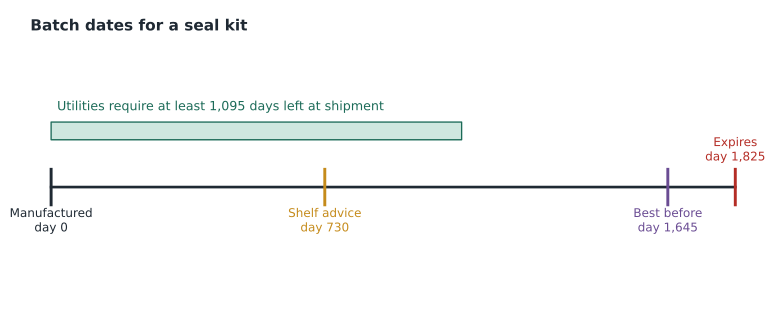
From these periods, each batch gets an expiration date, a best before date and a shelf advice date, calculated from its manufacturing date. The batch dates are used in reservations and picking, and with warehouse management the reservation can follow FEFO, first expired first out, so that the batch closest to expiry is picked first. Customer-specific requirements for remaining shelf life can block batches that would expire too soon after delivery. Expired batches cannot be reserved for sales.
Batch attributes
Batch attributes record properties of a specific batch, such as hardness, viscosity or the vendor's certificate number. An attribute is defined with a type, such as integer, real, string or date, and a range or list, then assigned to items with optional target values. Values are entered on the batch, or copied from quality order results when a test is linked to the attribute. Batch attributes can be used in reservations, for example to require a batch whose hardness falls in a customer's range, and in searches.
Teodora linked the hardness test from lesson 9 to a batch attribute for the elastomer O-rings, so that each batch's measured hardness was stored on the batch. When a mining customer later asked for O-rings at the harder end of the range, customer service could filter batches by the attribute.
Batch disposition codes
A batch disposition code sets a batch's status and controls what can be done with it. Each code has settings such as whether the batch can be reserved, picked and shipped, or is blocked. A disposition code is assigned to a batch manually, by quality processes, or from a default on the item. The study guide lists creating batch disposition codes as a skill.
| Disposition code | Reserve | Pick and ship | Used when |
|---|---|---|---|
| RELEASED | Yes | Yes | Batch passed inspection |
| HOLD | No | No | Awaiting quality decision |
| RESTRICT | Yes | Internal use only | Usable in production but not sold as spares |
| REJECT | No | No | Failed; awaiting return or scrap |
Batch disposition codes, batch dates and inventory blocking overlap, but each has its use. Dates handle expiry automatically. Disposition codes handle decisions about a whole batch, wherever it is. Inventory blocking handles a quantity in particular dimensions. Teodora's process uses the disposition code HOLD for any batch under investigation, which stops it everywhere at once.
Serial numbers
A serial number identifies one unit. Every finished pump at Cobalt Ridge gets a serial number when it is reported as finished from production, and motors arrive with the manufacturer's serial number, which is recorded on receipt. Serial numbers can be generated by a number group or entered, and the item can require a serial number for every unit, so that a quantity of five needs five serial numbers.
The Active in sales process option suits items that are stocked without serial numbers but must be serialized when shipped, such as some consumer products where the serial number is printed on the box and scanned only at shipping. Cobalt Ridge did not use it for pumps, because the serial number is stamped on the pump's nameplate in production and is needed for the pressure test record. Motors, by contrast, could have used it, but the team wanted motor serial numbers on every receipt for warranty claims with the motor vendor.
| Question | Batch | Serial |
|---|---|---|
| How many units per number? | Many | One |
| Typical source | Vendor lot or production order | Nameplate or production order |
| Dates and shelf life | Yes, per batch | Not usually |
| Attributes | Batch attributes | Not available in the same way |
| Use in quality | Disposition codes, quality orders per batch | Quality orders record the serial |
Tracing
With batches and serials recorded, the system can trace them. The inventory tracer, opened from an item's batch or serial number, shows every transaction that used it, forwards and backwards. Tracing forward from a seal kit batch shows every production order that consumed it and the serial numbers of the pumps produced, and from there the sales orders that shipped them and the customers who received them. Tracing backward from a pump serial number shows the production order and every batch-tracked component consumed in it, back to the purchase receipts and vendors.
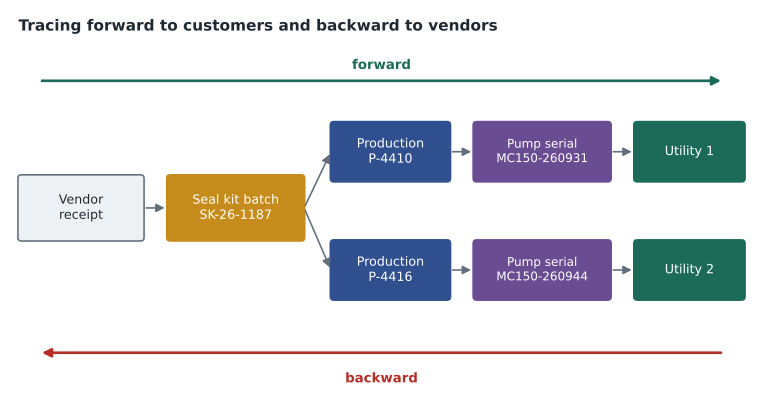
Tracing works only if batches and serials are recorded at every step. For production, that means the batch of each component consumed must be registered on the production order's picking list, which warehouse management does automatically when the picker scans it. Without that, the trail breaks between component and product, which was exactly the gap in the old system.
Worked problem
Answering the utility's question
The utility reports a seal failure on pump serial MC150-260931. Find which other pumps contain seals from the same batch, and which customers received them.
Show solution
- Open the inventory tracer for serial MC150-260931 and trace backward.
- The trace shows production order P-4410, which consumed seal kit batch SK-26-1187.
- Trace forward from batch SK-26-1187.
- The trace shows two production orders, P-4410 and P-4416, and twelve pump serial numbers.
- Following the sales transactions shows that eight pumps went to the same utility and four to a second utility.
- Set the batch disposition code of SK-26-1187 to HOLD so remaining stock cannot be used, and raise a nonconformance.
Answer: Twelve pumps, at two utilities, contain seals from the batch; the rest of the batch is held. The answer took one backward and one forward trace.
Batches and serials in daily work
Tracking changes the work of everyone who touches the stock, so the team walked through each role. Receivers at the distribution warehouse scan or type the vendor's lot number for every batch-tracked line and the manufacturer's serial number for every motor; the mobile app will not let them finish the receipt without them. Pickers scan the batch they take, and with FEFO reservation the app directs them to the batch that expires first. Production operators report pumps as finished with serial numbers generated from the number group and print nameplates from them. Customer service sees batch and serial numbers on packing slips and invoices, which utilities had been asking for.
| Role | What changes with tracking |
|---|---|
| Receiver | Records vendor lot and serial numbers on every receipt |
| Picker | Scans the batch or serial picked; follows FEFO where set |
| Production operator | Registers component batches and creates pump serial numbers |
| Quality inspector | Tests by batch and records results as batch attributes |
| Customer service | Quotes batch and serial numbers to customers; starts traces |
| Inventory controller | Counts by batch and serial where tracked; investigates differences by number |
Counting also changes. A counting journal line for a batch-tracked item is per batch, so a bin with two batches of seal kits needs two lines, and a difference may be a batch mix-up rather than a loss. Henrik's team found in the pilot that most batch differences at the distribution warehouse were exactly that: the right quantity, recorded against the wrong batch. Scanning on receipt and pick fixed it.
Batch merge and other tools
A few other batch functions are worth knowing. Batch merge combines several batches of the same item into one, for example when lubricants from several drums are blended, and records the relationship so that tracing still works. Batch numbers can be changed on a batch record in some circumstances, and batch attributes can be updated after receipt when results arrive late. For serial numbers, a serial number registration report can list all serials of an item and their location.
Owner and consignment
The third tracking dimension, owner, records who owns stock that sits in the company's warehouse. It is used for vendor consignment, where a vendor's goods are stored on site but remain the vendor's property until they are consumed, at which point ownership changes and the purchase is recorded. Cobalt Ridge plans to pilot consignment with its motor vendor in the second phase: motors would be stored at the Hamilton plant under the vendor's ownership, and an ownership change journal or consumption on a production order would transfer each motor to Cobalt Ridge. Because the owner dimension, like batch and serial, is set in the tracking dimension group, the pilot will use a new tracking group for consigned motors with both serial and owner active, agreed before any consigned stock arrives.
Getting the setup right
Tracking dimension groups are as hard to change as storage dimension groups. Activating batch tracking on an item that already has stock means that existing stock has no batch, so the stock must be emptied and received again with batch numbers. The tracking design workshop therefore went item family by item family, asking three questions: does a recall or complaint need to know which lot or unit this is; does the item expire; and does a customer or regulator require it. Seal kits, O-rings, lubricants and coatings answered yes to at least one and got batches. Pumps and motors got serials. Everything else, from castings to fasteners, was left untracked, because tracking adds work at every receipt and issue and should be used only where it pays.
Common mistakes
MistakeActivating batch tracking on items whose lots never need tracing.
InsteadTrack only where recalls, expiry or customer requirements need it; tracking adds work at every step.
MistakeExpecting the system to pick by expiry without shelf life settings.
InsteadSet shelf life periods and use FEFO reservation where available.
MistakeNot registering component batches on production picking.
InsteadRegister batches when components are consumed, or tracing breaks.
MistakeBlocking a suspect batch location by location.
InsteadUse a batch disposition code to hold the batch everywhere at once.
Summary and key terms
- Tracking dimensions are batch, serial and owner, activated in a tracking dimension group with options for when numbers are captured.
- Shelf life periods give each batch expiration, best before and shelf advice dates used in reservations and picking.
- Batch attributes record measured properties; batch disposition codes control whether batches can be reserved, picked and shipped.
- Serial numbers identify individual units and can be required at receipt, at production or only in the sales process.
- The inventory tracer follows batches and serials forward to customers and backward to vendors.
- Tracking dimension group
- The group that activates batch, serial and owner dimensions for a released product.
- Shelf life period
- The number of days from manufacture to expiry for a batch-tracked item.
- Batch attribute
- A property recorded on a batch, such as a measured hardness.
- Batch disposition code
- A code that controls whether a batch can be reserved, picked and shipped.
- Inventory tracer
- A tool that follows a batch or serial number through every transaction, forward and backward.
Practice problems
Work each problem on paper first, then reveal the answer to check.
A seal kit made on March 1, 2026 has a shelf life period of 1,825 days. When does it expire?
Show answer
About five years later, at the end of February 2031.
Which option captures serial numbers only when an item is shipped?
Show answer
Active in sales process on the tracking dimension group.
What must be recorded on production picking for backward tracing to work?
Show answer
The batch or serial number of each tracked component consumed.
Lesson quiz · 5 questions
Score 60% or more to complete this lesson.
Create a free account to save your progress, take quizzes and earn a certificate.