
MSBA-130 · Lesson 10 of 12 · 20 min
The Center of Excellence
▶ Video coming soon A video version of this lesson is on the way.
In late October, word got around Lumenvale that the registrar's office was building its own app. Within two weeks Rupert had eleven emails from other departments: athletics wanted an equipment loan tracker, the library wanted a study room booking app, student services wanted an agent to answer questions about bursaries, and the Ridgeview campus wanted to automate its practicum placement forms. "This is the moment that decides whether the platform helps us or buries us," he told the group. "We need a Center of Excellence."
What a Center of Excellence is
Microsoft describes a Center of Excellence (CoE), also called a Center of Enablement, as a team that drives innovation and improvement and provides leadership, best practices, research, support and training for a focus area, in this case Power Platform. It brings together people with similar goals to share knowledge and success, while providing standards, consistency and governance. Microsoft also stresses that a CoE needs people, communication and defined processes; tools are a means to an end. A CoE is not a separate department in most organizations. It is usually a small group with a mix of skills that meets regularly and owns the platform's direction.
| Role | Responsibilities | At Lumenvale |
|---|---|---|
| Executive sponsor | Sets goals, secures funding, removes obstacles | The colleges' vice-president of finance and administration |
| Platform administrator | Environments, policies, licences, capacity, monitoring | Rupert Ellingsworth |
| Professional developer | Custom connectors, complex logic, code reviews, ALM | Signe Tavernier-Mbeki |
| Data and reporting lead | Data standards, reporting, analytics on adoption | Kwabena Asante-Lowe |
| Champions | Experienced makers who support others in their departments | Maribeth for the registrar; one maker at Lakeshore |
| Privacy and security advisers | Review solutions that handle sensitive data | The privacy officer and IT security |
What a CoE does
A CoE works on three fronts at once: enabling makers, governing the platform and nurturing a community.
To enable makers, the CoE publishes guidelines, provides templates and reusable components, runs training, holds office hours and keeps a list of approved connectors and patterns. Lumenvale's first guideline was a two-page document called "Before you build": check whether a solution already exists, choose the right environment, never put student data in the default environment, name an owner and a backup owner, and ask the CoE before using any premium connector.
To govern, the CoE owns the environment strategy, data policies, licence assignment, release processes and the regular review of what exists. It decides which projects should be built by departments, which need professional developers and which should not be built on Power Platform at all.
To nurture a community, the CoE celebrates good work, shares stories, connects makers with each other and runs events such as a "build day" where makers spend an afternoon on their ideas with experts on hand. A healthy community is one of the strongest controls: makers who know the rules and know whom to ask make far fewer risky choices.
Choosing an operating model
Organizations organize their CoE in different ways. In a centralized model, the CoE builds and runs most solutions itself. In a decentralized model, departments build what they like within light rules. Most organizations settle on a hybrid, or hub and spoke, model: a central hub sets standards, manages the platform and builds critical solutions, while trained makers and champions in departments, the spokes, build their own solutions within those standards.
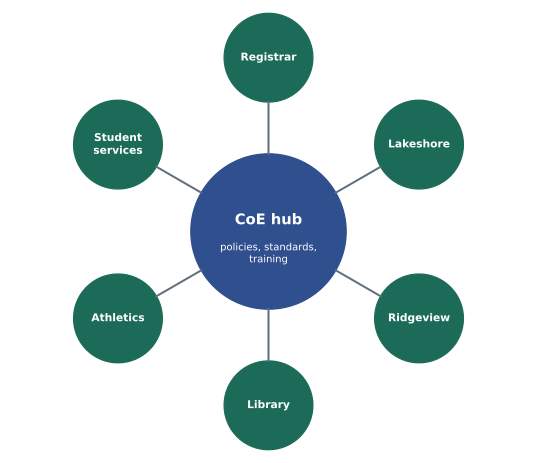
Lumenvale chose hub and spoke. The CoE hub was Rupert, Signe and Kwabena, meeting every second Thursday. Each department that wanted to build named a champion who completed the colleges' maker training and attended a monthly champions call.
Handling new ideas
The eleven emails needed a process. A CoE usually runs an intake process, where anyone can submit an idea through a short form, often built in Power Apps itself, and the CoE reviews each idea against simple criteria.
| Question | Why it matters |
|---|---|
| What problem does it solve, and for whom? | Confirms there is a real need and an owner |
| Does something already exist? | Avoids duplicates; maybe an existing app can be extended |
| How sensitive is the data? | Decides the environment, roles and reviews needed |
| How many users, and how often? | Shapes licensing and support |
| Who will build and who will support it? | Decides between a department maker, the CoE or a developer |
| How will success be measured? | Gives the business case a test |
Rupert sorted the eleven ideas into three groups. The study room booking app and the equipment loan tracker were self-service: departments could build them in their own environments with the champion's help. The bursary agent and the practicum forms were assisted: the CoE would help design them because they involved student financial and placement data. One idea, a replacement for the colleges' timetabling system, was not suitable for Power Platform: it was a core system with complex optimization requirements and needed a proper procurement.
The CoE Starter Kit and the admin center
For several years Microsoft offered the CoE Starter Kit, a free collection of Power Platform solutions that a CoE could install to collect inventory, monitor usage, nudge makers about inactive apps and run governance processes. Microsoft's documentation now states that the CoE Starter Kit is no longer actively maintained and that its core capabilities are part of the Power Platform admin center, with managed environments expected to replace remaining features over time. Microsoft recommends starting with the built-in capabilities of the admin center and managed environments, which are fully supported. Some things the kit did, such as bulk updates to permissions, clean-up of abandoned resources, surveys of makers and estimating the return on ideas, may still need a CoE's own processes or tools.
For Lumenvale, that meant there was nothing extra to install. Rupert used the admin center's inventory and tenant-level analytics, the weekly usage insights email from managed environments and a simple process for abandoned resources.
Worked problem
Cleaning up after a departure
A Ridgeview staff member who owned four apps and nine flows in the default environment has left the colleges. Two of the flows still run every week and email reports to managers. What should the CoE do?
Show solution
- Find the resources in the admin center inventory, filtered by owner.
- Contact the person's former manager to learn which resources are still needed.
- Reassign ownership of needed apps and flows to a current staff member, and fix any connections that used the former employee's account.
- Move important resources out of the default environment into a managed environment as a solution.
- Turn off, then delete after a waiting period, anything nobody needs.
Answer: Identify, consult, reassign or retire, and move anything important into a governed environment. Every solution should have an owner and a backup owner so that departures do not leave orphans.
Measuring adoption
Leadership would judge the CoE by results. Kwabena built a small Power BI report on the admin center's analytics showing the number of active makers, apps and flows in managed environments, the number of resources still in the default environment, spreadsheets retired, licence costs and hours saved from the business cases. He also tracked two risk measures: resources without an owner and data policy violations. A CoE that can show both value and control earns the trust to grow.
Building a maker community
The CoE's most visible work was training. Lumenvale ran three levels. Explorer was a one-hour session open to all staff about what Power Platform is, the default environment rules and how to ask for help. Maker was a four-session course, built on Microsoft Learn paths, covering Dataverse, canvas apps, flows, agents and the colleges' standards; completing it unlocked a personal developer environment. Champion added governance, solutions and pipelines, and champions met monthly to share what they had built and to review the CoE's guidelines.
| Guideline | Reason |
|---|---|
| Use the department prefix in every name, such as REG for registrar | Makes inventory and ownership obvious |
| Give every app, flow and table a description | Helps others understand and support it |
| Name an owner and a backup owner | Prevents orphaned solutions when people leave |
| Never put student or staff personal data in the default environment | The default environment is open to all makers |
| Ask the CoE before using a premium or custom connector | Licensing and data policy implications |
| Run the accessibility checker before sharing an app | Inclusive design and legal obligations |
Growing maturity
Organizations tend to move through stages in their use of a platform like this. At first, use is ad hoc: a few people build in the default environment with no rules. Next comes repeatable practice: environments, policies and a few standards. Then defined practice: a CoE, an intake process, training and release management. Finally managed and optimized practice: metrics, regular reviews and continuous improvement. Microsoft's adoption guidance describes a similar maturity model. Lumenvale had been at the first stage in August; by November it was somewhere between repeatable and defined, which Rupert considered good progress for one term.
Celebrating results
A CoE also tells stories. When the transcript pilot cut advisers' status emails by four-fifths, Kwabena wrote a short article for the staff newsletter with a quote from an adviser and a screenshot of the app. Within a week three more departments asked about training. Recognition matters to makers, who usually build in addition to their main job, and it shows leadership that the platform is producing value. Lumenvale planned a small annual showcase where makers would present what they had built, with an award for the solution that saved the most time and another for the best accessible design.
| Activity | Frequency | Purpose |
|---|---|---|
| CoE hub meeting | Every second Thursday | Platform decisions, intake reviews |
| Champions call | Monthly | Share solutions, update guidelines |
| Office hours | Weekly | Help makers with specific problems |
| Governance review | Monthly | Inventory, usage, capacity and policy checks |
| Showcase | Yearly | Recognize makers and share results |
Funding and staffing the CoE
A CoE needs time, and time needs funding. In many organizations the CoE starts as part of people's existing jobs, as Lumenvale's did, and grows as the platform proves its value. Rupert asked leadership for a modest commitment for the first year: about a fifth of his own time for administration and governance, a day a week of Signe's time for connectors, reviews and support, and a few hours a month from Kwabena for reporting. The champions' time came from their own departments, with each department head agreeing to it when the department joined. At the end of the first year the CoE would report the hours saved, the spreadsheets retired, the risks reduced and the costs, and leadership would decide whether to expand it.
Worked problem
Sizing the CoE's workload
Rupert expects about 12 new solution ideas a term. Each intake review takes about 30 minutes, each assisted project needs about 6 hours of CoE help, and about a third of ideas become assisted projects. Roughly how many hours a term does the CoE spend on intake and assisted projects?
Show solution
- Intake reviews: 12 ideas times 0.5 hours equals 6 hours.
- Assisted projects: a third of 12 is 4 projects.
- Help for assisted projects: 4 projects times 6 hours equals 24 hours.
- Total: 6 plus 24 equals 30 hours a term, before training, office hours and governance reviews.
Answer: About 30 hours a term on intake and assisted projects. Estimates like this help leadership see what the CoE costs and why it needs protected time.
The exam asks only for the basics of a CoE: what it is for, what kind of people belong to it, and the fact that Microsoft now points organizations to the admin center and managed environments rather than the old starter kit.
Common mistakes
MistakeTreating the CoE as a team that says no.
InsteadA CoE enables, governs and nurtures; most of its work helps makers succeed.
MistakeInstalling tools and assuming the CoE is done.
InsteadA CoE needs people, communication and processes; tools support them.
MistakeStarting a new CoE by installing the CoE Starter Kit.
InsteadStart with the admin center and managed environments; the kit is no longer actively maintained.
MistakeAllowing solutions with a single owner.
InsteadRequire an owner and a backup owner for every production solution.
Summary and key terms
- A Center of Excellence is a team that provides leadership, best practices, support, training and governance for Power Platform.
- Typical roles include an executive sponsor, platform administrator, professional developers, data leads, champions and privacy advisers.
- A CoE enables makers, governs the platform and nurtures a community.
- Hub-and-spoke operating models combine central standards with building in departments.
- An intake process sorts ideas into self-service, assisted and not suitable.
- The CoE Starter Kit is no longer actively maintained; its core capabilities are in the admin center and managed environments.
- Center of Excellence
- A team that leads, supports and governs an organization's use of a platform such as Power Platform.
- Champion
- An experienced maker who supports others in their own department.
- Hub and spoke
- A CoE model with a central team setting standards and departments building within them.
- Intake process
- A process for submitting and reviewing new solution ideas.
- CoE Starter Kit
- A former collection of governance tools for Power Platform that is no longer actively maintained.
- Executive sponsor
- A senior leader who sets goals and supports the CoE.
Practice problems
Work each problem on paper first, then reveal the answer to check.
Name the three fronts a CoE works on.
Show answer
Enabling makers, governing the platform and nurturing a community.
What does Microsoft now recommend instead of installing the CoE Starter Kit?
Show answer
Starting with the built-in capabilities of the Power Platform admin center and managed environments.
In a hub-and-spoke model, who builds most departmental solutions?
Show answer
Trained makers and champions in the departments, within standards set by the central hub.
Lesson quiz · 5 questions
Score 60% or more to complete this lesson.
Create a free account to save your progress, take quizzes and earn a certificate.