
MSBA-122 · Lesson 3 of 12 · 18 min
Governance and responsible AI policy
▶ Video coming soon A video version of this lesson is on the way.
Wendell Pike-Amari had written Quillfield's first AI-use policy in a weekend in September. It was two paragraphs long and said, in effect, "Use only your work account, and check what AI gives you." It had done its job: nobody had pasted client files into a consumer chatbot, and staff knew the rule. But as agents spread and the council began approving systems that touched client data, the two paragraphs could not answer the questions people were asking. Could an agent recommend a coverage level? Who decided whether an agent was fair to clients who wrote in plain language rather than insurance terms? What happened when an agent was wrong?
This lesson covers the first part of the AB-731 implementation domain: aligning an AI strategy with Microsoft's responsible AI policies. The study guide lists four skills: explain the importance of responsible AI, establish governance principles for AI use, establish an AI council, and ensure that AI solutions meet responsible AI standards, including fairness, reliability, safety, privacy, security, inclusiveness, transparency and accountability. Lesson 2 covered the council. This lesson covers the principles, the policy and the review process that put them into practice.
Why responsible AI matters to a business
Responsible AI is sometimes presented as a constraint on innovation. Leaders who have run AI programs tend to see it the other way round: it is what makes scaling possible. Four reasons come up again and again.
Trust. Clients, employees and regulators will accept AI only if they believe it is being used carefully. One visible failure, such as an agent giving a client wrong coverage information or an AI summary that misrepresents a complaint, can set adoption back months.
Risk. Generative AI can produce confident but wrong answers, reveal information to people who should not see it, reflect biases in its training data or sources, and be manipulated by crafted inputs. Each of these has legal, financial and reputational consequences.
Regulation. Expectations are rising. In Canada, federally regulated financial institutions face the Office of the Superintendent of Financial Institutions' Guideline E-23 on model risk management, which applies to AI models and takes effect in May 2027; insurance brokers are regulated provincially and are watching the same direction. Elsewhere, the European Union's AI Act is being phased in. Leaders do not need to be lawyers, but they need a program that can show regulators how AI is governed.
Quality. The habits that make AI responsible, such as testing on real examples, keeping people in the loop for important decisions and monitoring results, are the same habits that make it work well.
Microsoft's responsible AI principles
Microsoft organizes its responsible AI approach around six principles, set out in its Responsible AI Standard. The AB-731 study guide lists the qualities as fairness, reliability, safety, privacy, security, inclusiveness, transparency and accountability; Microsoft groups reliability with safety and privacy with security, which is why the same ideas appear as six principles in Microsoft's own materials.
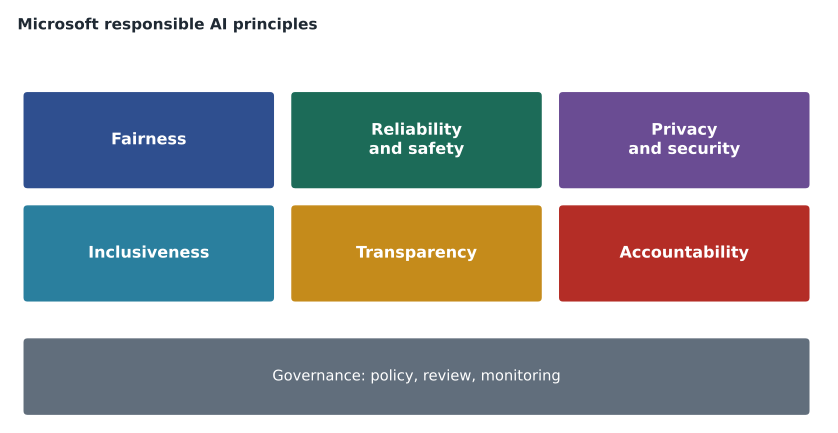
| Principle | What it asks | An insurance brokerage example |
|---|---|---|
| Fairness | AI should treat people equitably and not disadvantage groups | An agent that answers coverage questions should give the same quality of answer to a client who writes informally as to one who uses insurance terms |
| Reliability and safety | AI should perform consistently and safely, including in unexpected situations | The Coverage Explainer is tested on hard questions and says when it does not know |
| Privacy and security | AI should protect data and resist misuse | Agents see only the content their users may access; client data stays in work-account tools |
| Inclusiveness | AI should empower everyone, including people with disabilities and different needs | Agent answers work with screen readers and in plain language |
| Transparency | People should understand when they are dealing with AI and how it reaches results | Client-facing chat says it is an AI assistant; answers cite the source |
| Accountability | People remain responsible for AI systems and their outcomes | Every agent has a named owner; a person approves client-facing content |
Microsoft applies these principles to its own products: Microsoft 365 Copilot respects the permissions on the content it retrieves, filters harmful content, cites its sources and is covered by Microsoft's commercial data protection commitments. But a vendor's principles cover the vendor's product. When an organization builds an agent, chooses its knowledge sources, writes its instructions and decides who can use it, the organization takes on responsibility for how that agent behaves. That is why the study guide asks leaders to ensure that their own AI solutions meet responsible AI standards.
From principles to a policy
Principles are necessary but not sufficient; nobody can apply "be fair" to a specific agent without more detail. A responsible AI policy turns the principles into rules and processes. Wendell's rewrite, approved by the council in November, had seven sections.
1. Scope and definitions. What counts as an AI system at Quillfield: Copilot Chat and Microsoft 365 Copilot, agents, AI features in business applications, and any third-party AI tool. Clear definitions stop arguments about whether a feature "really" counts.
2. Principles. The six principles in Quillfield's words, with one sentence each on what they mean for a brokerage.
3. Acceptable and prohibited uses. What staff may and may not do. Prohibited uses at Quillfield included putting client or company data into non-approved tools, using AI to make final decisions on coverage or claims without human review, using AI to evaluate employees' performance, and creating synthetic voices or images of real people.
4. Risk tiers. How AI systems are classified by risk, and what each tier requires. This is the heart of the policy and is covered below.
5. Roles. Who owns AI systems, who reviews them, who approves them and who monitors them, with a link to the council's decision rights.
6. Incidents. How to report a problem, who decides whether to pause a system, and how lessons are shared.
7. Review. The policy is reviewed every six months and whenever regulation or products change materially.
Risk tiers
Not every AI use carries the same risk, and a policy that treats a meeting summary like an underwriting recommendation will either slow everything down or be ignored. Risk tiers solve this by matching the level of review to the potential for harm. Quillfield used three tiers.
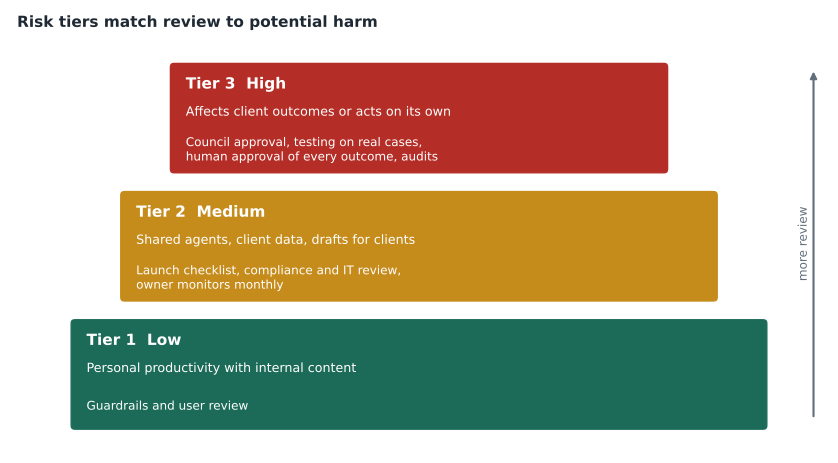
| Tier | Typical uses | What is required |
|---|---|---|
| 1 Low | Drafting internal emails, summarizing one's own meetings, personal agents over one's own files | Follow the guardrails; the user reviews the output |
| 2 Medium | Shared agents over internal content; anything that uses client data; drafts that will go to clients | Agent launch checklist; compliance and IT review; named owner; monthly check of quality and cost |
| 3 High | Anything that influences a client's coverage, price or claim; agents that send messages or change records on their own | Council approval; testing on real cases including hard ones; a person approves every outcome; quarterly audit |
The tier is decided by the most sensitive feature of the system. An agent that summarizes complaints is Tier 2 because it uses client data. If it also emailed clients on its own, it would be Tier 3, regardless of how simple the task seemed.
Worked problem
Classifying an AI use
Daria's team wants an agent in Copilot Studio that reads a home insurance client's renewal questionnaire, compares it with the current policy and suggests coverage changes for the account executive to discuss with the client. The account executive will decide what to recommend. Which tier applies, and what does the policy require?
Show solution
- Data: the agent reads client questionnaires and policy details, which is client data, so at least Tier 2.
- Influence: its suggestions feed directly into what coverage a client is offered. Even with a person deciding, the agent influences a client outcome, which is Tier 3 under Quillfield's policy.
- Autonomy: it does not send anything or change records itself, which helps, but does not lower the tier.
- Requirements: council approval; testing on a set of real questionnaires, including unusual ones; the account executive approves every recommendation; a quarterly audit of a sample comparing suggestions with what was offered.
Answer: Tier 3. The account executive's review is necessary but not enough on its own, because people tend to accept a system's suggestions; testing and audits check whether the suggestions are good and fair.
That last point is called automation bias: the tendency to trust a system's output and stop checking it, especially when it is usually right. A human-in-the-loop rule only works if the human is given the time, information and encouragement to disagree. Quillfield's audits looked specifically at how often account executives changed the agent's suggestions; a rate near zero would suggest rubber-stamping rather than review.
Governance principles for AI use
The study guide also asks candidates to establish governance principles for AI use. Governance principles are the organization-wide commitments that sit above individual policies and decisions. Quillfield adopted five.
Every AI system has an owner. A named person, not a team, is accountable for each agent or AI solution: its purpose, its knowledge sources, its users, its cost and its behaviour.
Risk sets the level of review. Oversight grows with data sensitivity, reach, autonomy and influence on people.
People decide what matters. AI can draft, summarize, suggest and sort, but decisions that affect clients' coverage, claims or money, and decisions about employees, are made by people.
We can see what AI is doing. Usage, cost, incidents and quality are measured and reported; there are no unmonitored AI systems.
We tell people when they are dealing with AI. Clients and employees know when content or answers come from AI.
Making the policy usable
A policy that people cannot find or understand is not governance. Wendell's team took three steps to make the new policy work in practice.
First, they published a one-page summary alongside the full policy, with the guardrails, the three tiers and examples of each. Second, they built the tier questions into the agent request form, so that anyone proposing an agent answered them before the request reached anyone else. Third, they ran short sessions with each department, using that department's own examples. Dolores, who had once said she would never let AI near a client email, helped lead the commercial lines session; her account of how she checked Copilot's drafts did more to explain "a person reviews anything sent to a client" than the policy text.
Governance is not only policy
Policy says what should happen. Technical controls make it happen and monitoring shows whether it did. Lesson 4 covers the security and compliance controls in Microsoft 365, such as sensitivity labels, data loss prevention and the oversharing tools, and Lesson 9 covers the controls for agents. A good responsible AI program links all three: each policy rule names the control that enforces it, where one exists, and the report that shows whether it is working.
Handling incidents
Even a well-governed program will have incidents: an agent that gives a wrong answer, a summary that leaves out something important, a file that turns out to be overshared. The policy's incident section set out four steps. First, anyone who sees a problem reports it through the help desk or to the system owner, with no blame for reporting. Second, the owner and IT decide within a working day whether to pause the system. Third, the owner finds the cause and fixes it, for example by updating a knowledge source or narrowing an agent's audience. Fourth, the council reviews the incident and any lesson for other systems. The out-of-date price list agent was Quillfield's first recorded incident; the lesson for every agent owner was to check the date of each knowledge source at every six-month review.
Common mistakes
MistakeAssuming Microsoft's responsible AI commitments cover every agent an organization builds.
InsteadThe organization is responsible for the agents it designs, grounds and deploys.
MistakeApplying the same review to every AI use.
InsteadUse risk tiers so review matches the potential for harm.
MistakeTreating human review as enough for high-risk uses.
InsteadAdd testing and audits to guard against automation bias.
MistakePublishing a long policy and assuming people will read it.
InsteadAdd a one-page summary, build the rules into request forms and train with local examples.
MistakeLeaving systems without a named owner.
InsteadAssign a named person accountable for each AI system.
Summary and key terms
- Responsible AI builds trust, manages risk, meets rising regulatory expectations and improves quality.
- Microsoft's six principles are fairness, reliability and safety, privacy and security, inclusiveness, transparency and accountability; the AB-731 guide lists them as eight qualities.
- A vendor's principles cover its products; organizations are responsible for the agents they build and deploy.
- A responsible AI policy covers scope, principles, acceptable and prohibited uses, risk tiers, roles, incidents and review.
- Risk tiers match review to potential harm; the most sensitive feature decides the tier.
- Human review must be real: guard against automation bias with testing and audits.
- Responsible AI
- Designing, building and using AI in ways that are fair, reliable, safe, private, secure, inclusive, transparent and accountable.
- Responsible AI Standard
- Microsoft's internal framework that turns its responsible AI principles into requirements for its products.
- Responsible AI policy
- An organization's rules and processes for using AI in line with its principles.
- Risk tier
- A category of AI use that determines the level of review and control required.
- Automation bias
- The tendency to accept a system's output without enough scrutiny.
- Human in the loop
- A design in which a person reviews or approves an AI system's output before it takes effect.
Practice problems
Work each problem on paper first, then reveal the answer to check.
Name Microsoft's six responsible AI principles.
Show answer
Fairness; reliability and safety; privacy and security; inclusiveness; transparency; accountability.
An agent drafts internal meeting summaries from the user's own meetings. Which Quillfield tier applies?
Show answer
Tier 1, low: personal productivity with internal content.
Why did Quillfield's audits look at how often account executives changed the agent's suggestions?
Show answer
To detect automation bias; a change rate near zero would suggest rubber-stamping.
Lesson quiz · 5 questions
Score 60% or more to complete this lesson.
Create a free account to save your progress, take quizzes and earn a certificate.