
MSBA-122 · Lesson 10 of 12 · 18 min
Working with partners
▶ Video coming soon A video version of this lesson is on the way.
Quillfield's IT team had five people, and Bram Oosterhuis was the only one who had built anything in Microsoft Foundry. When the council looked at its backlog, it saw a problem of capacity, not ideas. The hail-claim photo triage project alone would need a labelled set of past photos, a model evaluation, integration with the claims system and a Tier 3 review. Bram estimated six months on his own, alongside everything else he did. "We can do this ourselves slowly," he told the council, "or we can do it with help and learn as we go."
This lesson covers when and how to work with partners in an AI program: deciding what to do in-house and what to buy, choosing a partner, structuring the work so the organization learns, and governing a partner's access and output. Partners are not named in the AB-731 study guide as a separate skill, but they affect almost every item in the implementation domain, from readiness and adoption to cost and responsible AI.
What partners do in an AI program
Microsoft sells much of its business software through and alongside partners: consulting firms, systems integrators, managed service providers, independent software vendors and specialist AI firms. Microsoft runs the Microsoft AI Cloud Partner Program, in which partners can earn designations that show capability in areas such as modern work and data and AI, and specializations in narrower fields. Organizations can search Microsoft's partner directory by location, industry and expertise.
Partners typically help in five ways.
| Kind of help | Examples | When it makes sense |
|---|---|---|
| Readiness | Oversharing assessments, labelling projects, security reviews | When the organization lacks time or tools for a one-off clean-up |
| Adoption | Change management, training design, champion programs | For large rollouts or when in-house adoption skills are thin |
| Building | Copilot Studio agents, Power Platform solutions, Foundry projects, integrations | For complex or high-risk solutions, or to add capacity |
| Specialist advice | Responsible AI reviews, model evaluation, regulatory questions | For Tier 3 systems or new regulatory areas |
| Running services | Managed support, monitoring, cost management | When ongoing operation is not a core skill |
Microsoft also offers some direct help. Programs such as FastTrack for Microsoft 365 provide deployment and adoption guidance to eligible customers, and Microsoft's adoption site publishes the Copilot Success Kit and other free material. Eligibility and scope change, so leaders should ask their Microsoft account team what applies to them before paying for help the organization may already be entitled to.
Build, partner or buy
For each item in the backlog, the council asked three questions.
Is this a core capability we want to own? Skills the organization will need again and again, such as building agents in Copilot Studio, measuring adoption or running the council, should be built in-house, even if a partner helps at first. Skills needed once, such as a large oversharing clean-up, can be bought.
Do we have the capacity and skill now? Even a core capability may need outside help to start on time. The question is then how to make sure the help leaves skills behind.
Is there a ready-made product? Sometimes the best answer is neither building nor hiring but buying: a Microsoft-built agent, a feature in Dynamics 365 or an independent software vendor's solution that already does the job. Buying is usually faster and cheaper than building when the need is common across many organizations.
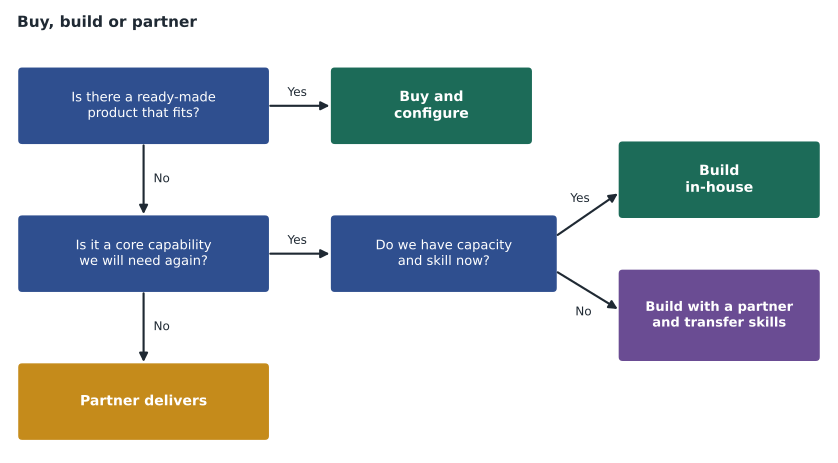
Applied to Quillfield's backlog, the answers were mixed. Agents for internal procedures stayed in-house: Yusra and the makers could build them, and it was a skill Quillfield wanted to grow. The oversharing clean-up for the remaining sites was small enough to finish internally. The hail-claim photo triage project was a core capability for the claims team in the long run, but Quillfield lacked the experience to do it safely now, so it became a candidate for building with a partner. A request for an AI tool to read medical reports in group benefits claims went to the "buy" path first, because specialist products existed.
Choosing a partner
The council wrote a short set of criteria for any AI partner, weighted toward the things that would matter most if something went wrong.
| Criterion | What to look for |
|---|---|
| Relevant experience | Similar projects in similar industries, with references the organization can call |
| Microsoft capability | Relevant designations or specializations and certified staff on the actual team |
| Responsible AI practice | A clear method for testing, fairness checks and documentation, not only a statement of principles |
| Security and privacy | How they handle access to the organization's data and systems, and where their staff work |
| Skills transfer | A plan for the organization's people to work alongside them and take over |
| Commercial terms | Clear scope, fixed or capped costs where possible, ownership of what is built |
| Fit | Whether their people work well with the organization's people |
The council invited three partners to respond to a two-page brief for the photo triage project. One proposed a large program with a long discovery phase. One proposed to build the solution quickly but had no plan for Quillfield's staff to learn. The third proposed a twelve-week project in three phases, with Bram working on the team throughout and a final phase in which Quillfield's people did most of the work with the partner reviewing. The council chose the third, although it was not the cheapest, because it fitted the strategy's aim of building skills.
Structuring the work
A statement of work describes what a partner will deliver. For AI work, the council insisted on several points that are easy to leave out.
Outcomes and measures. What the solution must achieve, such as the share of photos correctly sorted into severity bands on a test set, not just what will be built.
Responsible AI deliverables. Testing results on real cases, a fairness review across claim types and regions, documentation of the model and data used, and a summary for the council's Tier 3 review.
Data access. Exactly what data the partner may use, for what purpose, where it will be processed and how it will be removed at the end.
Ownership. Who owns the solution, the configurations and any custom code. Quillfield required ownership of everything built for it.
Knowledge transfer. Named Quillfield staff working on the project, documentation, and a handover period.
Run costs. An estimate of the ongoing cost of running the solution after the project, including Foundry Tools consumption.
Worked problem
Comparing partner and in-house options
For the photo triage project, Bram estimates six months of his own time working alone, during which about 40 percent of his other work would be delayed. The chosen partner quotes 12 weeks for a fixed fee, with Bram spending half his time on the project. The partner's fee is about 95,000 Canadian dollars. The claims team estimates the solution will save about 250 adjuster hours a month once live. If going in-house means the solution goes live about three months later, how many adjuster hours does the partner option gain in the first year?
Show solution
- Earlier go-live with the partner: about three months sooner.
- Hours gained: 3 months times 250 hours = 750 adjuster hours in the first year.
- Bram's time: half time for 12 weeks rather than full time for six months, freeing several months of his capacity for other work.
- The fee must be weighed against those hours, the freed capacity and the lower risk of a first Tier 3 project done with experienced help.
Answer: About 750 adjuster hours in the first year, plus several months of Bram's capacity. The figures are illustrative, but the method is the point: compare total value and risk, not only the fee.
Governing partners
A partner working on an AI system is part of the organization's AI governance for the duration of the work. Quillfield applied the same rules to partners as to staff: the partner's accounts were created in Microsoft Entra with only the access they needed and an end date; client data used for training and testing was minimized and removed at the end; the partner's work went through the same risk tier review as internal work; and the solution had a Quillfield owner from the first day, not only at handover. The partner also attended the council once, to present its testing results, which gave the council confidence and the partner a clear view of what Quillfield cared about.
Avoiding dependence
The risk with partners is not usually that they do poor work. It is that the organization ends up unable to change, fix or extend the solution without them. Three habits reduce this risk: insisting on ownership and documentation; making sure internal people do real work on the project rather than watching; and keeping the platform standard, so that the solution is built with tools the organization already knows, such as Copilot Studio, Power Platform and Microsoft Foundry, rather than with proprietary components only the partner understands.
At the end of the photo triage project, Bram and a claims analyst would be able to retrain the model, update the rules and monitor results without the partner. That was the real deliverable.
Working with Microsoft directly
Larger organizations often have a Microsoft account team, and even smaller ones can work with Microsoft through partners and through Microsoft's online resources. Leaders should know what to ask for: briefings on the product roadmap that affects their plans; help understanding licensing options and promotions; access to adoption resources such as the Copilot Success Kit; and, where eligible, deployment and adoption programs. Microsoft's responsible AI resources, including its published standard and transparency notes for its products, are also useful when writing an organization's own policy and when answering regulators' questions about the products in use.
Partners and responsible AI
A partner that builds an AI system for an organization should be able to show how it tests and documents its work. The council asked each shortlisted partner three questions: How do you test a solution for accuracy and fairness before handover? What documentation will we receive about the model, data and limits? How will you help us monitor the system after go-live? Vague answers, or answers that relied only on Microsoft's own commitments, counted against a partner. The chosen partner provided an example test report from a previous project, with client details removed, which showed exactly what Quillfield would receive.
| Question for a partner | A strong answer includes |
|---|---|
| How do you test for accuracy? | A test set of real cases, agreed success measures and results by category |
| How do you test for fairness? | Comparison of results across relevant groups, such as regions or claim types |
| What documentation do we receive? | Purpose, data used, model choice, known limits and how to monitor it |
| How do you support monitoring? | Dashboards or reports, alert thresholds and a handover to named staff |
The same questions work for software vendors whose products include AI. Many independent software vendors now add AI features to existing products, and those features may process an organization's data in ways its policy needs to cover.
Ending a partner engagement
The end of a partner engagement deserves as much planning as the start. Quillfield's statements of work required a handover checklist: documentation reviewed by the internal owner, all partner access removed in Microsoft Entra on the last day, any client data used in testing deleted with confirmation, and a final session in which the internal team demonstrated that it could operate and change the solution. Only then was the final payment released.
Common mistakes
MistakeHiring a partner for every AI project.
InsteadBuild core capabilities in-house; use partners to add capacity, specialist skill or one-off help.
MistakeBuilding custom solutions for common needs.
InsteadCheck for a ready-made product or Microsoft-built agent first.
MistakeChoosing the cheapest proposal by default.
InsteadWeigh experience, responsible AI practice, security, skills transfer and fit.
MistakeLeaving responsible AI deliverables out of the statement of work.
InsteadRequire testing results, fairness reviews and documentation.
MistakeAssigning an internal owner only at handover.
InsteadName an owner from day one and have internal staff do real work on the project.
Summary and key terms
- Partners help with readiness, adoption, building, specialist advice and running services.
- The Microsoft AI Cloud Partner Program uses designations and specializations to show partner capability; Microsoft also offers some direct help such as FastTrack for eligible customers.
- Decide whether to buy, build in-house, build with a partner or have a partner deliver, based on whether a product exists, whether the capability is core and whether you have capacity now.
- Choose partners on experience, Microsoft capability, responsible AI practice, security, skills transfer, terms and fit.
- A statement of work for AI should cover outcomes, responsible AI deliverables, data access, ownership, knowledge transfer and run costs.
- Govern partners like staff and avoid dependence through ownership, real internal involvement and standard platforms.
- Microsoft AI Cloud Partner Program
- Microsoft's program for partners, with designations and specializations that show capability.
- Solutions partner designation
- A Microsoft recognition that a partner has shown capability in a solution area.
- Statement of work
- A document describing what a partner will deliver, how, when and at what cost.
- Knowledge transfer
- The process by which a partner's skills and understanding pass to the client's staff.
- FastTrack
- A Microsoft program that provides deployment and adoption guidance to eligible customers.
- Vendor dependence
- A situation in which an organization cannot change or support a solution without the supplier.
Practice problems
Work each problem on paper first, then reveal the answer to check.
What three questions decide whether to build, partner or buy?
Show answer
Is there a ready-made product? Is it a core capability? Do we have the capacity and skill now?
Why did the council choose the third photo triage proposal?
Show answer
It built Quillfield's skills, with Bram on the team and a final phase led by Quillfield staff.
Name three habits that reduce dependence on a partner.
Show answer
Insist on ownership and documentation, have internal people do real work, and keep to standard platforms.
Lesson quiz · 5 questions
Score 60% or more to complete this lesson.
Create a free account to save your progress, take quizzes and earn a certificate.