
MSBA-122 · Lesson 12 of 12 · 18 min
Case study: a year-one AI roadmap
▶ Video coming soon A video version of this lesson is on the way.
For the last session of the series, Celestine gave the council a different organization to plan for. "We have spent months on our own program," she said. "Let's see whether we can do it for someone else in an afternoon." The case below is fictional. Silverpine Credit Union is not part of Quillfield; it is a planning exercise that pulls together every lesson in this course. Work through each step before reading the council's answer.
The organization
Silverpine Credit Union is a member-owned financial co-operative with about 520 employees, 24 branches and a head office in Kamloops, British Columbia. It serves about 140,000 members with chequing and savings accounts, mortgages, small business loans and insurance products sold through a subsidiary. It is regulated as a financial institution and takes regulatory expectations on model risk, privacy and consumer protection seriously.
Its current state, as described by its chief executive, Rosalyn Thibodeaux-Kahn:
Technology. All staff have Microsoft 365 E3. Copilot Chat has been available since the summer, but nobody has said how it may be used. IT has eight people and no one with Copilot Studio or Microsoft Foundry experience.
Activity. About 150 staff have tried Copilot Chat. A branch manager built an agent that answers questions about lending policy and shared it with all branches. The marketing team uses a consumer AI image tool. Two members of the lending team asked whether they could use AI to draft credit memos.
Pressures. Member complaints about slow call-centre responses; a loan process that takes too long for small businesses; staff turnover in the call centre; a board that has asked for "an AI plan" by the spring.
Budget. The board will consider up to about 900,000 Canadian dollars in the first year, including licences, consumption, partners and staff time, if the plan is convincing.
Step 1: The one-page strategy
Draft the ambition and choose up to three priorities.
The council's answer: Ambition: "We use AI to give members faster, clearer answers and our staff more time for the conversations that matter, while protecting members' trust and data." Priorities: (1) faster member service in the contact centre and branches; (2) a quicker small business lending process; (3) everyday productivity for head office staff. The council noted that the second priority would involve credit decisions, so it would be designed with people making every decision and AI preparing information.
Guardrails: member and company data only in work-account AI tools; a person reviews anything sent to a member; no AI makes or recommends a final credit decision without human review and a Tier 3 assessment; every AI system has a named owner. Platform: Copilot Chat for all staff; Microsoft 365 Copilot for selected roles; Copilot Studio for agents; Microsoft Foundry only with a partner in year one.
Step 2: Sponsorship and the council
Who should sponsor the program, and who should sit on the council?
The council's answer: the chief operating officer as sponsor, because the priorities are operational and she owns the contact centre and lending operations. The council would include the chief financial officer, the chief risk officer, the head of IT and security, the head of member service, the head of lending, the head of human resources, an adoption lead as secretary, and one front-line champion. Decision rights would follow Quillfield's pattern, with a lower threshold for anything touching member data, given the regulatory setting.
Step 3: Governance and the first decisions
What should happen to the activity already under way?
| Existing activity | Risk | Decision |
|---|---|---|
| Copilot Chat used without guidance | Staff unsure what is allowed; possible member data in prompts | Publish guardrails within two weeks; train all staff on the basics |
| Branch manager's lending policy agent, shared with all branches | Unknown knowledge sources; no owner review; may be out of date | Review knowledge sources; assign the manager as owner; test before keeping it shared |
| Consumer AI image tool in marketing | Company content in a non-approved tool; licensing of images unclear | Stop using it for company work; evaluate an approved option |
| Request to draft credit memos with AI | Influences credit decisions | Tier 3: put into the plan-and-prepare backlog with a full review |
The council also recommended a responsible AI policy with three risk tiers, and that the chief risk officer link it to the credit union's existing model risk framework, because regulators would expect AI models that influence lending to be governed like other models.
Step 4: Readiness
What must be ready before licences are expanded?
The council's answer: an oversharing review of SharePoint and OneDrive, focusing on member files, lending and human resources; sensitivity labels on member and lending content; retention settings for Copilot interactions agreed with compliance; phishing-resistant sign-in for licensed users; a privacy impact assessment for any agent that uses member data; and budgets and alerts for metered agents. The council estimated eight to twelve weeks for the oversharing work, given that IT had no previous experience, and suggested a partner for that one-off task.
Step 5: First use cases
Score these five candidate use cases on value, feasibility and safety (1 to 5 each), then choose the first two.
| Use case | Value | Feasibility | Safety | Total |
|---|---|---|---|---|
| Contact centre agent answering staff questions on products and procedures | 4 | 4 | 4 | 12 |
| Microsoft 365 Copilot for small business lenders to prepare meetings and summarize files | 4 | 4 | 3 | 11 |
| Everyday productivity training for head office | 3 | 5 | 5 | 13 |
| AI-drafted credit memos for lenders to review | 5 | 2 | 2 | 9 |
| Member-facing chat agent on the website | 4 | 3 | 2 | 9 |
The council's answer: start with everyday productivity training (13) and the contact centre staff agent (12), both of which can show results within weeks; add Microsoft 365 Copilot for small business lenders (11) once readiness work on lending content is done. The credit memo idea (9) is valuable but needs data preparation, a Tier 3 review and probably a partner; it goes into "plan and prepare" for the second half of the year. The member-facing chat agent (9) waits until the staff agent has proved its knowledge base and the organization has experience with Copilot Studio.
Step 6: Adoption, champions and training
Size the champions network and the training hours. Use one champion per 40 staff, with at least one per major area, and these training assumptions: all staff 1.75 hours; 80 licensed users 3 more hours each; 6 makers 16 hours; 8 IT staff 20 hours; 20 leaders 4 hours.
Worked problem
Sizing champions and training
Silverpine has 520 staff. Calculate the minimum number of champions at one per 40 staff, and the total training hours using the assumptions above.
Show solution
- Champions: 520 divided by 40 = 13.
- All staff: 520 times 1.75 = 910 hours.
- Licensed users: 80 times 3 = 240 hours.
- Makers: 6 times 16 = 96 hours.
- IT staff: 8 times 20 = 160 hours.
- Leaders: 20 times 4 = 80 hours.
- Total: 910 + 240 + 96 + 160 + 80 = 1,486 hours.
Answer: 13 champions and about 1,486 training hours. With champions giving about 2 hours a week, the champions network adds about 26 hours a week of protected time.
The council also recommended that branch managers be briefed before their staff, that the chief executive speak openly about jobs (the credit union's turnover in the call centre was the real staffing problem, and AI was meant to make those jobs more manageable), and that the adoption team use the Copilot Success Kit's planning checklist and scenario library rather than designing everything from scratch.
Step 7: Measures
Choose one adoption, one impact and one outcome measure for each of the first two use cases.
| Use case | Adoption | Impact on work | Business outcome |
|---|---|---|---|
| Everyday productivity | Share of staff using Copilot Chat weekly | Time on three measured tasks per team, before and after | Overtime hours at head office |
| Contact centre staff agent | Share of contact centre staff using the agent weekly | Average handle time and time searching for answers | Member satisfaction and first-contact resolution |
The council insisted on baselines before launch: a two-week timing study of the three tasks per team, and the contact centre's existing handle time and resolution figures. It also added risk measures: agents without owners (target zero), overshared sites remaining and metered spend against budget.
Step 8: Partners
Where should Silverpine use partners in year one?
The council's answer: a partner for the one-off oversharing and labelling project, because IT lacks experience and time; possibly a partner for adoption design if the adoption lead is new to the role; and a partner for the credit memo project in the second half, with a statement of work requiring responsible AI testing, fairness reviews, documentation, ownership and knowledge transfer. Agents for internal procedures should be built in-house, so the credit union develops makers of its own.
Step 9: The roadmap
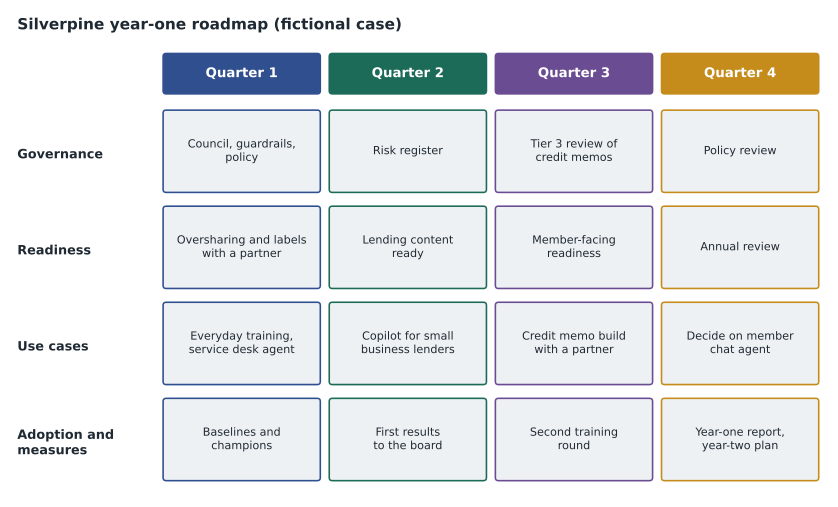
Put it all into a year-one roadmap by quarter. The roadmap below is a plan for the coming year.
| Quarter | Main milestones |
|---|---|
| 1 | Council and sponsor in place; guardrails published; all-staff basics training; oversharing and labelling project with a partner; baselines; champions recruited; contact centre agent built and tested |
| 2 | Contact centre agent live with budget and alerts; Microsoft 365 Copilot for 80 users including small business lenders; first results to the board |
| 3 | Credit memo project with a partner under Tier 3 review; second training round; member-facing readiness work |
| 4 | Decision on the member chat agent; policy and strategy review; year-one report; year-two plan |
Step 10: The budget
Estimate the first-year cost. The council used rounded, illustrative figures and stated them in the board's currency.
| Item | Basis | Estimate |
|---|---|---|
| Microsoft 365 Copilot licences | 80 users for about nine months at an enterprise list price of about 30 US dollars per user per month | About 30,000 Canadian dollars |
| Agent consumption | Contact centre agent and others on pay-as-you-go, with budgets | About 10,000 Canadian dollars |
| Partners | Oversharing project, adoption design, credit memo project | About 300,000 Canadian dollars |
| Internal staff time | Adoption lead, champions, training hours, IT and risk effort | About 350,000 Canadian dollars |
| Contingency | About 15 percent | About 100,000 Canadian dollars |
The total of about 790,000 Canadian dollars sat within the board's limit. As at Quillfield, licences were a small share of the total; implementation, partners and people's time were most of it.
Step 11: The message to the board
Write the one-sentence answer the chief operating officer would give the board in the spring.
The council's answer: "We have a governed AI program that will give members faster answers and staff more time, starting with the contact centre and everyday productivity; the main risks are under control through clear rules, data clean-up and human review of anything that affects members; and we ask the board to approve a first-year budget of about 790,000 Canadian dollars, with results reported each quarter."
The debrief
When the council compared notes, the members found they had made nearly the same choices, for the same reasons, as they had for Quillfield. Dolores pointed out why: "The tools are different in the details, but the questions are the same. What are we trying to do? Who decides? What could go wrong? Are people actually using it? Is it making a difference?"
Celestine closed the series with the point she wanted the council to remember. "A strategy is not a document. It is a set of decisions we keep making, in the open, with numbers in front of us. The page helps us remember what we decided and why."
Adapting the roadmap
A year-one roadmap is a plan, not a promise. The council advised Silverpine to review the roadmap every quarter against the scorecard and to change it when results or circumstances changed: moving the member chat agent earlier if the staff agent performed well, or delaying the credit memo project if the readiness work on lending content took longer. A roadmap that never changes usually means nobody is looking at it.
Common mistakes
MistakeStarting a roadmap with the most ambitious use case.
InsteadStart with feasible, measurable use cases and prepare the larger ones.
MistakeExpanding licences before readiness work is done.
InsteadFix oversharing, label sensitive content and set controls first.
MistakeBudgeting for licences only.
InsteadInclude consumption, partners, staff time and contingency.
MistakeIgnoring AI activity that is already under way.
InsteadReview existing tools and agents early and bring them under governance.
MistakePresenting a plan without measures or baselines.
InsteadDefine adoption, impact and outcome measures and collect baselines before launch.
Summary and key terms
- A year-one roadmap applies every part of the strategy: ambition and priorities, sponsor and council, governance, readiness, use cases, adoption, measures, partners and communication.
- Existing AI activity should be reviewed early and brought under governance.
- Score use cases and start with those that are feasible, measurable and safe; prepare higher-risk ideas such as credit memos with full review.
- Size champions and training explicitly and include the time in the budget.
- In a regulated organization, link the responsible AI policy to existing model risk management.
- Licences are usually a small part of first-year cost; partners and people's time dominate.
- Roadmap
- A time-based plan showing what will happen, in what order, across the areas of a program.
- Model risk management
- A framework for governing models whose outputs influence decisions, increasingly applied to AI.
- Contingency
- An amount added to a budget to cover uncertainty.
- Plan and prepare
- The group of use cases with high value but lower feasibility that need preparation before starting.
- Year-one report
- The summary of a program's first year of results, lessons and next steps.
- Credit union
- A member-owned financial co-operative that provides banking services.
Practice problems
Work each problem on paper first, then reveal the answer to check.
Why did the council put the credit memo idea in "plan and prepare"?
Show answer
It is valuable but influences credit decisions, needs data preparation and a Tier 3 review, and probably a partner.
How many champions does an organization of 520 staff need at one per 40 staff?
Show answer
13.
What should happen to an agent a branch manager built and shared with every branch without review?
Show answer
Review its knowledge sources, assign the manager as owner and test it before keeping it shared.
Lesson quiz · 5 questions
Score 60% or more to complete this lesson.
Create a free account to save your progress, take quizzes and earn a certificate.