
MSBA-122 · Lesson 2 of 12 · 19 min
Executive sponsorship and an AI council
▶ Video coming soon A video version of this lesson is on the way.
Quillfield's AI work began, as it does in many organizations, with enthusiasts. Yusra built her first agent because she was tired of answering the same questions about service procedures. Hamish measured time savings because he was curious. Bram tried Microsoft Foundry on a weekend. By September there were enough moving parts that Celestine asked a blunt question at the leadership meeting: "If something goes wrong with one of these agents tomorrow, who decides what we do?" Nobody could answer with a name. Two weeks later Quillfield had an AI council.
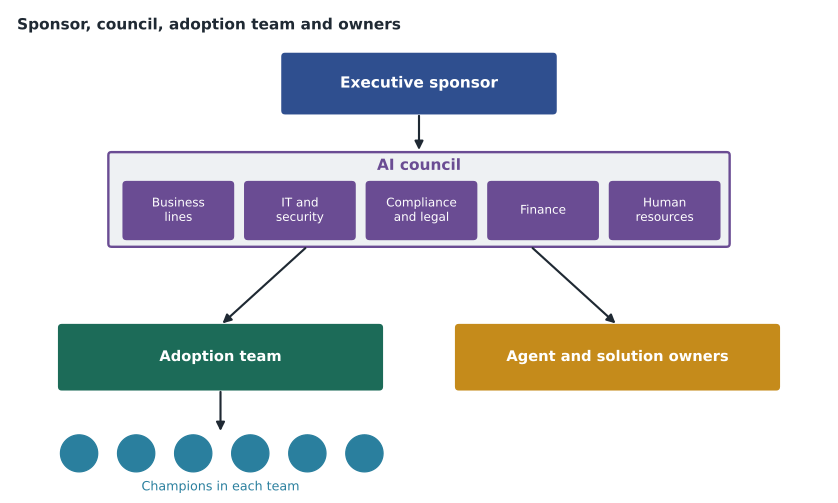
This lesson covers the two leadership structures the AB-731 study guide names: an executive sponsor who is accountable for the program, and an AI council that guides strategy, provides oversight and keeps the functions of the business aligned. It also covers how both relate to the adoption team and champions that later lessons describe.
What an executive sponsor does
An executive sponsor is the senior leader who is accountable for an AI program's results. Accountable means that when the board asks whether the investment is working, the sponsor answers. The sponsor does not run the program day to day; that is the job of a program lead or adoption team. The sponsor's work is narrower and more senior.
Setting direction. The sponsor owns the ambition and priorities in the strategy and makes sure they stay tied to business goals.
Securing resources. AI programs need money, people's time and attention from other leaders. The sponsor negotiates for all three.
Removing obstacles. When a department refuses to share data, when legal review is stuck or when a manager blocks training time, the sponsor is the person who can resolve it.
Modelling the behaviour. Employees watch what leaders do. A sponsor who uses Copilot visibly, talks about what worked and what did not, and asks for AI-prepared briefings sends a stronger signal than any announcement.
Making the hard calls. Stopping a pilot that is not working, pausing an agent after an incident, or saying no to a popular idea that does not fit the strategy all need a senior decision-maker.
Celestine was a natural choice at Quillfield: as chief operating officer she already owned the processes AI was changing, she controlled the operations budget, and she had the authority to ask other leaders for time. In other organizations the sponsor may be the chief executive, a chief digital officer or the head of the business unit where AI will matter most. What matters is seniority, a direct stake in the outcomes and enough time to do the job. A sponsor in name only, who attends the launch and then disappears, is one of the most common reasons AI programs stall.
Why a council, and not just a sponsor
AI touches almost every function at once. Compliance cares about client data and regulatory expectations. IT cares about security, identity and cost control. Finance cares about the budget and the return. Business leaders care about whether the work actually gets better. Human resources cares about skills, roles and how employees feel. No single leader holds all those perspectives, and decisions made by one function alone tend to fail in another.
An AI council brings those functions together. The AB-731 study guide describes its purpose in three words: strategy, oversight and cross-functional alignment. In practice that means the council shapes and updates the AI strategy, oversees how AI is used and whether it meets the organization's responsible AI standards, and makes sure the functions are pulling in the same direction.
Who sits on the council
A council works best when it is small enough to decide and broad enough to see the whole picture. Six to ten members is typical. Quillfield's council had eight.
| Member | Role at Quillfield | What they bring |
|---|---|---|
| Chair | Celestine Nwachukwu-Hale, chief operating officer and sponsor | Direction, budget, authority to resolve conflicts |
| Finance | Lorne Macpherson-Ibe, chief financial officer | Investment cases, cost tracking, scepticism about returns |
| Compliance | Wendell Pike-Amari, compliance officer | Responsible AI policy, regulatory expectations, client data |
| IT and security | Saoirse Ndlovu-Park, head of IT | Identity, data protection, licences, technical controls |
| Business line | Daria Velikova, head of personal lines | Front-line needs and the effect on teams |
| Service | Tomasz Rybak, contact centre manager | High-volume processes and agent ideas |
| Adoption lead (secretary) | Hamish Quarrington, operations analyst | Measurement, training plans, the backlog of ideas |
| Employee voice | Dolores Ventimiglia, senior account executive and champion | What it is really like to use AI with clients |
Two seats are worth noting. Dolores was not a manager, but she represented the champions and had started as a sceptic; the council wanted at least one person who would say when something was not working. Hamish served as secretary and adoption lead, which kept the council's decisions connected to the work. Human resources was not a permanent member at Quillfield, which is small; its director joined when skills, roles or workforce questions were on the agenda. A larger organization would usually give HR a permanent seat.
Bram, the solutions architect, and Yusra, the citizen developer who built many of the agents, were regular guests rather than members. That was deliberate. The council needed to hear from builders, but builders should not approve their own work.
Writing a charter
A council without a written charter tends to drift into either a talking shop or a bottleneck. A charter is a one- or two-page document that sets out the council's purpose, membership, decision rights and way of working. Quillfield's covered six points.
Purpose. "To set and update Quillfield's AI strategy, oversee the use of AI against our responsible AI policy, and align business, technology, compliance and finance decisions about AI."
Decision rights. What the council decides itself, what it recommends to the leadership team, and what it leaves to others. This is the most important part of the charter and is covered below.
Membership and quorum. Who the members are, who may attend as a guest, and how many members must be present for decisions; Quillfield required five, including the chair or a delegate and either compliance or IT.
Cadence. Every two weeks for the first six months, then monthly. Urgent decisions, such as pausing an agent after an incident, could be made by the chair with compliance and IT between meetings and reported at the next meeting.
Inputs and outputs. What comes to the council (the idea backlog, adoption and risk reports, incident reports, investment requests) and what it produces (decisions, the updated strategy, a quarterly report to the leadership team and board).
Review. The charter itself is reviewed after six months.
Decision rights
Most councils fail on decision rights. If everything must come to the council, it becomes a queue and people route around it. If nothing must come to it, it has no influence. The answer is to set thresholds based on risk, reach and cost, and to delegate everything below them.
| Decision | Who decides at Quillfield |
|---|---|
| A user builds a personal agent grounded in their own files | The user, within the guardrails; no approval needed |
| An agent shared with a team of up to 25 people, using internal content only | The team manager, using the agent launch checklist |
| An agent shared with more than 25 people, or using client data | AI council, after compliance and IT review |
| An agent that takes actions on its own, such as sending or updating records | AI council; drafts-only for the first six months |
| New spend above 25,000 Canadian dollars a year | AI council recommends; leadership team approves |
| Changes to the strategy or the responsible AI policy | AI council recommends; leadership team approves |
| Pausing an AI system after an incident | Chair with compliance and IT, immediately; reported to the council |
The thresholds are illustrative; every organization sets its own. What matters is that they are written down, that they get stricter as risk rises, and that the council reviews them once it sees how they work. At Quillfield the 25-person threshold proved too low: within a month, six agents for whole departments were queued for council review, and the review was slowing good work. The council raised the threshold for internal-content agents to 60 people and added a lighter check by IT for agents between 25 and 60.
Worked problem
Is this a council decision?
Tomasz wants to give the 45 contact centre staff an agent that summarizes the day's complaint calls and drafts suggested responses for a supervisor to review. The agent will read call notes that include client names and policy numbers. It will not send anything itself. Under Quillfield's original decision rights, who decides?
Show solution
- Reach: 45 people, which is above the 25-person team threshold.
- Data: call notes include client data, which sends any agent to the council regardless of reach.
- Autonomy: the agent drafts only and a supervisor reviews, so the stricter rule for autonomous agents does not apply.
- Cost: the agent will be billed in Copilot Credits; Hamish estimates well under the spend threshold, so no leadership approval is needed.
Answer: The AI council decides, after compliance and IT review, because the agent uses client data. Leadership approval is not required because the cost is below the threshold.
Running the meetings
Quillfield's council meetings followed a standing agenda that fitted in an hour.
Two habits made the meetings useful. First, every item that needed a decision arrived with a one-page summary prepared in advance: what was proposed, the business priority it served, the data it used, the risks, the cost and the recommendation. Hamish drafted many of these with Microsoft 365 Copilot from the request forms and then checked them. Second, every decision was recorded with an owner and a date, and the next meeting began by reviewing them. A council whose decisions are not tracked soon finds itself making the same decision twice.
The council and the adoption team
The council decides; it does not do the work. The adoption team turns decisions into training, communications, support and measurement, and the champions spread practical know-how inside each team. Lesson 6 covers both. At Quillfield the adoption team was small: Hamish as lead, half of one IT specialist's time, and a communications adviser for about a day a week. In larger organizations the adoption team may have a dozen people and its own budget. Either way, the council needs a clear line to it, which is why the adoption lead usually serves as the council's secretary.
When the council works
By the middle of November the council had met six times. It had approved the Coverage Explainer for the contact centre with a monthly credit budget, sent back two agent requests that duplicated existing ones, set the criteria for the next round of Microsoft 365 Copilot licences, and approved Wendell's responsible AI policy for the leadership team. After the October voice-cloning attempt, in which a voicemail imitating Celestine asked staff to change a refund's bank details, the chair, compliance and IT agreed within a day on a new call-back rule for payment changes; the council confirmed it at its next meeting. That was the charter working as written: a quick decision by the right people, then oversight by the whole council.
Lorne summed up the change at the leadership meeting: "A year ago I would have said AI was IT's project. Now I know who owns each piece, what it costs and who signs off. I can defend that to the board."
When the sponsor and council disagree
Occasionally the council and the sponsor will see a decision differently. Quillfield's charter settled this in advance: the council advises and the sponsor decides, but any member may ask for a disagreement on a Tier 3 matter to be recorded and reported to the leadership team. In practice this happened once, when Wendell asked that his concerns about an early version of the renewals-mailbox agent be minuted. Celestine agreed to the drafts-only rule he proposed, and the record showed the leadership team that the council's oversight was real rather than ceremonial.
Common mistakes
MistakeNaming a sponsor who attends the launch and then disappears.
InsteadChoose a sponsor with authority, a stake in the outcomes and time for the role.
MistakeFilling the council with technology people only.
InsteadInclude business, IT and security, compliance, finance and human resources perspectives.
MistakeSending every AI decision to the council.
InsteadSet risk-based thresholds and delegate decisions below them.
MistakeLetting builders approve their own agents.
InsteadInvite builders as guests; approval sits with the council or delegated owners.
MistakeMaking decisions without owners and dates.
InsteadRecord each decision with an owner and review them at the next meeting.
Summary and key terms
- The executive sponsor is accountable for the AI program: setting direction, securing resources, removing obstacles, modelling behaviour and making hard calls.
- An AI council guides strategy, provides oversight and keeps business, technology, compliance, finance and HR aligned, as the AB-731 guide describes.
- A charter sets out purpose, decision rights, membership, quorum, cadence, inputs and outputs.
- Decision rights should be risk-based: stricter as data sensitivity, reach, autonomy and cost rise, with everything below the thresholds delegated.
- A standing agenda, one-page decision summaries and tracked actions keep the council useful.
- The council decides; the adoption team and champions carry out the work.
- Executive sponsor
- The senior leader accountable for an AI program's direction and results.
- AI council
- A cross-functional group that sets AI strategy, oversees AI use against responsible AI standards and aligns decisions across functions.
- Charter
- A short document setting out a council's purpose, membership, decision rights and way of working.
- Decision rights
- Written rules for who may decide what, usually based on risk, reach, autonomy and cost.
- Quorum
- The minimum number of members who must be present for a council's decisions to be valid.
- Adoption team
- The group that turns AI decisions into training, communications, support and measurement.
Practice problems
Work each problem on paper first, then reveal the answer to check.
Name five things an executive sponsor does.
Show answer
Sets direction, secures resources, removes obstacles, models the behaviour and makes the hard calls.
What three purposes does the AB-731 guide give for an AI council?
Show answer
Strategy, oversight and cross-functional alignment.
Why did Quillfield raise its threshold for internal-content agents?
Show answer
At 25 people too many department agents queued for council review, slowing good work; the council raised it to 60 and added a lighter IT check in between.
Lesson quiz · 5 questions
Score 60% or more to complete this lesson.
Create a free account to save your progress, take quizzes and earn a certificate.