
MSBA-122 · Lesson 11 of 12 · 18 min
Communicating results
▶ Video coming soon A video version of this lesson is on the way.
In the middle of November, Celestine had to present the first results of Quillfield's AI program to the leadership team, and a summary would go to the board the following month. She had more data than she needed: dashboard exports, timing studies, survey results, cost reports, an incident log and dozens of stories from champions. "The risk," she told Hamish, "is that we bury the answer. They want to know three things: is it working, is it safe, and what do we do next?"
This lesson covers how to communicate the results of an AI program to different audiences. Communication is an adoption tool as much as a reporting duty: honest, specific results build the trust that lets a program grow, and vague or inflated ones destroy it. The skills here support every part of the AB-731 implementation domain, from the council's oversight role to the adoption team's work with employees.
Know the audience
Different audiences need different things from the same results.
| Audience | What they need to know | Best format |
|---|---|---|
| Board | Is the investment working, are risks controlled, what is the plan? | One page plus a short discussion |
| Leadership team | Results by area, decisions needed, resources | A few slides or a short paper with the scorecard |
| Managers | How their teams are doing and what to do next | Team-level dashboard views and a briefing |
| Employees | What has changed, what it means for them, how to get help | Short stories, examples, an all-staff update |
| Clients | How AI affects the service they receive and their data | Plain-language notices and answers to questions |
| Regulators and auditors | How AI is governed and controlled | Policy, risk register, evidence of controls |
The council's rule was to start from the audience's question, not from the data available. The board did not need app-by-app usage figures. Employees did not need the cost model. Regulators needed evidence, not enthusiasm.
The shape of a good results message
For leaders and the board, Celestine used a simple structure: the answer first, then the evidence, then the risks, then the decision.
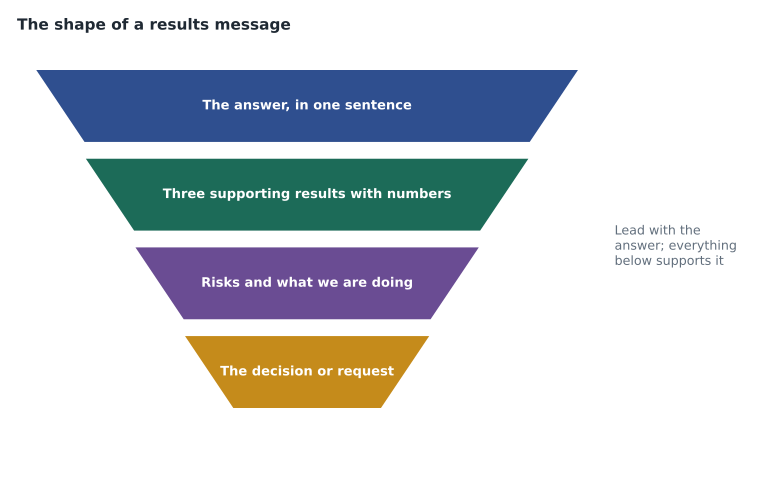
The answer. One sentence: "The pilot is working: licensed staff save about three hours a week on measured tasks, the main risks are under control, and we recommend expanding to 120 licensed users in the new year."
Three supporting results. Not twenty. Celestine chose the measures most closely tied to the strategy's priorities: renewal summaries down from 38 to 17 minutes; about 3.2 hours a week saved per pilot user on five measured tasks; and the HR Leave Assistant resolving about three in four employee questions without an adviser.
Risks and what we are doing. The overshared sites (fifteen of seventeen fixed, two excluded from Copilot until fixed), the October voice-cloning attempt and the new call-back rule, and agent sprawl and the clean-up.
The decision. What the audience is being asked to approve or note: the expansion, the budget and the date of the next report.
Numbers that persuade
A few habits make numbers more credible.
Show the baseline. "Down from 38 to 17 minutes" persuades; "17 minutes" alone means nothing.
Say how it was measured. "Timed on a sample of real renewals before and after" is stronger than "users report".
Use the right unit. Minutes per task and hours per week are easy to picture. Large annualized figures, such as "thousands of hours a year," invite suspicion unless the calculation is shown.
Separate estimates from measurements. The Copilot Dashboard's assisted hours are a useful estimate; a timing study is a measurement. Saying which is which protects credibility.
Connect time to outcomes. Say where the time went: more prospect meetings, shorter queues, an earlier month-end close.
Worked problem
Turning results into a headline
Hamish's data shows renewal summary time fell from 38 to 17 minutes. Twenty commercial lines account executives each prepare about 12 renewal summaries a month. Write a headline result with the percentage reduction and the monthly hours saved across the team.
Show solution
- Saving per summary: 38 minus 17 = 21 minutes.
- Percentage reduction: 21 divided by 38 is about 0.55, or about 55 percent.
- Monthly time saved: 20 executives times 12 summaries times 21 minutes = 5,040 minutes, or 84 hours.
- Headline: "Renewal summaries take about 55 percent less time, saving the commercial lines team about 84 hours a month, measured on real renewals."
Answer: About 55 percent less time and about 84 hours a month across the team. Both figures can be traced back to the timing study, which is what makes them credible.
Reporting what did not work
Programs that report only successes lose trust quickly, because everyone in the organization knows that not everything worked. Celestine's report included a short section called "What we learned," with three items: the feature-tour training that led to little use (replaced by task-based training); the agent that answered client questions from an out-of-date price list (retired and replaced by a governed version); and the third of pilot users who had barely used Copilot after the first week (now about one in six, after manager briefings and champion coaching).
Lorne said afterwards that this section was the reason he believed the rest. "If you had told me everything went well, I would have assumed you were not looking."
Communicating with employees
Employees care less about the aggregate figures and more about what changes for them. The adoption team's communications to staff followed three principles.
Stories over statistics. A short account from a colleague, in their own words, about a task that got easier, travelled further than any chart. The champions collected these stories each fortnight, with permission.
Honesty about change. When the expansion was announced, the message repeated the leadership commitment on jobs and said plainly that some tasks and roles would change.
Practical next steps. Every message ended with what to do: where to find the prompt library, when the next training was, who the team's champion was.
Communicating with clients
Clients were affected by AI in two ways: through work that staff prepared with Copilot, which a person always reviewed, and through agents that clients might talk to directly in future. The council agreed that Quillfield would tell clients when they were interacting with an AI assistant, would always offer a way to reach a person, and would describe in its privacy notice how AI was used with client information. It would not advertise AI as a selling point; it would advertise faster, better service and explain AI's role when asked.
Communicating with regulators and auditors
Regulators and auditors want evidence that AI is governed. Wendell maintained a short pack that could be shared on request: the responsible AI policy, the AI council charter and minutes, the register of AI systems with their risk tiers and owners, testing records for Tier 3 systems, the incident log and the readiness checklist. Keeping this pack current took little effort once the council was working, and it meant that a regulator's question could be answered in days rather than weeks.
A regular rhythm
One-off announcements fade. The council set a rhythm: the scorecard at every council meeting, a short results paper to the leadership team each quarter, a one-page summary to the board twice a year, a monthly update to managers and a fortnightly story to all staff. Each report used the same measures, so that trends were visible and nobody could be accused of choosing whichever numbers looked best that month.
Telling the story over time
Results communication works best as a series, not a single event. Each report should connect to the last one: what was promised, what happened and what comes next. Celestine began each quarterly paper with a short table showing the targets set in the previous quarter and whether they had been met. When a target was missed, the paper said why and what would change. This structure made it hard to drift into reporting only good news, and it gave the leadership team a sense of steady progress rather than a series of disconnected announcements.
| Target set last quarter | Result | Comment |
|---|---|---|
| 85 percent of licensed users active monthly | 85 percent | Met |
| Renewal summary time 20 minutes or less | 17 minutes | Met; measured on real renewals |
| All overshared sites fixed | 15 of 17 | Not met; 2 excluded from Copilot until fixed |
| Zero agents without owners | 3 without owners | Not met; clean-up under way, monthly report added |
Recognizing people
Communication is also a chance to recognize the people who made results happen. Quillfield's reports named the champions, the makers whose agents were working well and the managers whose teams had adopted fastest. Recognition reinforced the behaviour the program needed, and it showed staff that AI results came from people, not from software alone. Yusra's HR Leave Assistant, for example, was described in the board summary as "built by a service coordinator in her own time, now answering three in four employee leave questions," which did more to explain the potential of agents than any product description.
When results are disappointing
Sometimes a use case does not deliver. The council's rule was to report it as plainly as a success: what was tried, what the results were and what was decided. Quillfield's first attempt at an agent to help personal lines advisers answer billing questions did not reduce call times, because the billing system's data was not available to the agent and advisers still had to look it up. The council stopped the agent, recorded the lesson that agents without access to the key data rarely help, and moved the idea to "plan and prepare" until integration was possible. Reporting this openly cost nothing and strengthened the credibility of everything else in the report.
Writing for executives
Executives read quickly and often on a phone. Reports for them should use short paragraphs, plain words and numbers that need no explanation. Copilot can help draft such reports from longer material, but the author must check every number against its source and make sure the message says what the evidence supports. Hamish used Copilot to produce a first draft of each quarterly paper from the scorecard and council minutes, then spent an hour checking and rewriting it. The draft saved time; the checking protected credibility.
A one-page board summary
For the board, Celestine reduced the quarterly paper to a single page with four parts: the one-sentence answer, a small table of three results against targets, two or three risks with their status, and the decision or note requested. A board member could read it in two minutes and know what to ask. The full paper, the scorecard and the evidence pack were available to anyone who wanted more detail, but the one page carried the message.
| Part | Quillfield example |
|---|---|
| Answer | The pilot is working and risks are controlled; we recommend expanding to 120 licensed users |
| Results | Renewal summaries 38 to 17 minutes; about 3.2 hours a week saved per pilot user; HR agent resolving about three in four questions |
| Risks | Two overshared sites still being fixed; voice-cloning attempt led to a new call-back rule |
| Decision | Approve the expansion and budget; next report in three months |
The format also made it easy to compare quarters, because each summary had the same four parts in the same order.
Checking every number
Before any report left the council, a second person checked every number against its source: the dashboard export, the timing study spreadsheet, the billing report or the incident log. Errors were rare, but the habit mattered. A single wrong figure in a board paper, once discovered, would have cast doubt on every other figure in it and on the program behind them. Hamish kept a short source note for each number, so that anyone could trace a result back to where it came from in a few minutes.
Common mistakes
MistakePresenting every available number.
InsteadLead with the answer and support it with a few numbers tied to the strategy.
MistakeReporting results without baselines or methods.
InsteadShow before and after, and say how each number was measured.
MistakeHiding what did not work.
InsteadInclude a short section on lessons learned; it makes the rest credible.
MistakeSending employees the same report as the board.
InsteadUse stories, honesty about change and practical next steps.
MistakeChanging measures from report to report.
InsteadKeep the same measures so trends are visible and trusted.
Summary and key terms
- Start from each audience's question: board, leadership, managers, employees, clients and regulators need different things.
- For leaders, lead with the answer, give three supporting results, be clear about risks and end with a decision.
- Credible numbers show baselines, methods and units, separate estimates from measurements and connect time to outcomes.
- Reporting what did not work builds trust in what did.
- Employees respond to stories, honesty about change and practical next steps; clients need transparency and a way to reach a person.
- Keep an evidence pack for regulators and a regular reporting rhythm with consistent measures.
- Results message
- A short communication that states whether a program is working, with evidence, risks and a decision.
- Baseline comparison
- Presenting a result alongside the measurement before the change.
- Lessons learned
- A record of what did not work and what changed as a result.
- Story card
- A short template for sharing an employee's experience of a change.
- Evidence pack
- A maintained set of documents that shows how AI is governed, for regulators and auditors.
- Reporting rhythm
- A regular schedule of reports to each audience using consistent measures.
Practice problems
Work each problem on paper first, then reveal the answer to check.
A task falls from 50 to 30 minutes. What is the percentage reduction?
Show answer
40 percent.
What four parts did Celestine's results message have?
Show answer
The answer, three supporting results, risks and actions, and the decision.
What did Lorne say made him believe the results?
Show answer
The section on what did not work.
Lesson quiz · 5 questions
Score 60% or more to complete this lesson.
Create a free account to save your progress, take quizzes and earn a certificate.