
MSBA-120 · Lesson 9 of 12 · 18 min
Data readiness
▶ Video coming soon A video version of this lesson is on the way.
The renewal-briefing pilot had gone well for six weeks when an account manager in personal lines asked Copilot to summarize a client's history and received, among the useful details, a line from a spreadsheet of staff bonus calculations. The spreadsheet had been saved to a team site three years earlier and shared with everyone in the company. Nobody had opened it in two years. Copilot had found it in seconds.
The incident caused no harm, because the account manager reported it at once, but it changed the agenda of the ninth workshop. "Copilot did not leak anything," Bram explained. "It showed us what we had already exposed. Our data was not ready."
Generative AI is only as good as the information it can reach, and only as safe as the permissions on that information. This lesson covers what data readiness means for business value: the types of data AI uses, the qualities that make data useful, how grounding works, the permissions and protection problems that surface at scale, and how leaders can assess readiness before they invest.
How AI uses an organization's data
A general-purpose language model knows a great deal about the world in general and nothing about Quillfield in particular. To answer a question about a client's policy, it must be given the relevant information at the moment it answers. This is called grounding.
The most common way to ground a model in company information is retrieval-augmented generation (RAG). When a user asks a question, the system first searches the organization's content for passages relevant to the question, then sends those passages to the model together with the question, and asks the model to answer using them. The model does not learn or keep the content; it reads it for that one answer. Microsoft 365 Copilot works this way, retrieving content from Microsoft Graph, such as emails, files, chats and meetings that the user has permission to see, and from connected sources.
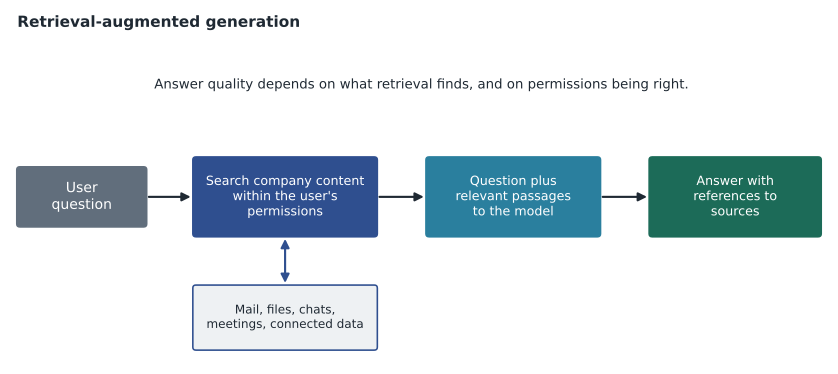
RAG has two important consequences for leaders. First, answer quality depends on retrieval quality: if the right document is missing, out of date or hard to find, the answer will be weak or wrong, however good the model is. Second, answers respect permissions, which means permissions must be right: the system retrieves what the user can access, so content shared too widely will appear in answers to people who should not see it.
Grounding is not the only way to make a model fit a business. Fine-tuning adjusts a pretrained model by training it further on examples, which can teach it a style, a format or specialized vocabulary. Fine-tuning is more expensive and harder to keep up to date than grounding, and it does not by itself give the model access to current facts. For most business uses, grounding comes first and fine-tuning is considered only for specific needs.
Types of data
Structured data lives in tables with defined fields: policy records, premiums, claim amounts, dates. Unstructured data is free text, documents, emails, call recordings and images: policy wordings, inspection reports, client correspondence. Semi-structured data sits between, such as forms with some fixed fields and some free text.
Generative AI's particular strength is unstructured data, which makes up much of the information in most businesses and which older tools struggled to use. Structured data is often better handled by reporting tools or by an AI that writes and runs queries, such as the Analyst agent working on a spreadsheet. Many valuable use cases combine the two, for example a renewal briefing that pulls premium history from a policy system and client concerns from email.
| Data type | Quillfield examples | How AI typically uses it |
|---|---|---|
| Structured | Policy records, premiums, renewal dates | Queries, calculations and charts, often through tools or connectors |
| Unstructured | Policy wordings, emails, call notes, inspection reports | Search, summarizing, extraction, drafting |
| Semi-structured | Application forms, certificates of insurance | Extracting fields and checking completeness |
Data quality
Data quality has several dimensions, and each affects AI output in a predictable way.
- Accuracy: the information is correct. Inaccurate source documents produce confident, inaccurate answers.
- Completeness: the information needed is present. Missing documents produce answers that leave things out or fill gaps with guesses.
- Currency: the information is up to date. An old version of a guideline produces outdated advice.
- Consistency and uniqueness: there is one authoritative version. When three versions of a procedure exist in three places, the AI may retrieve any of them.
- Accessibility: the information is stored where the AI can reach it, in a readable format. Scanned images without text, files in personal drives or content in systems with no connector are invisible.
Information professionals often describe the clutter that undermines quality as ROT: redundant, obsolete and trivial content. Cleaning up ROT, by archiving or deleting old versions and applying retention policies, is one of the most effective data readiness tasks, because it improves retrieval and reduces exposure at the same time.
Worked problem
Diagnosing a poor answer
A broker asks the guidelines agent which insurers accept restaurants with deep fryers. The agent names an insurer that stopped writing restaurants last year. What data quality problem is most likely, and what should be fixed?
Show solution
- The model answered from a document that said the insurer accepted restaurants.
- The insurer's change was not reflected in that document, or a newer document existed but an older one was retrieved instead.
- This is a currency and consistency problem: an outdated version of the appetite guide is still in the knowledge source.
- Fix: make one authoritative appetite guide with an owner and a review date, archive old versions, and point the agent only at the current one.
Answer: A currency and consistency problem in the source content, fixed by owning, updating and de-duplicating the documents, not by changing the model.
Representative data and bias
When AI is used to summarize, classify or recommend across many cases, the data it learns from or is tested on must represent the full range of cases. If an agent that classifies complaints was tested only on complaints written in fluent English, it may perform worse on complaints from clients who write in another language or in a less formal style. If a predictive model is trained on past decisions that were themselves biased, it will reproduce the bias. Representative datasets cover the variety of real cases, including minority and unusual ones, and testing should confirm that results are similar across groups.
Permissions, oversharing and protection
The bonus-spreadsheet incident is common. Over years, content gets shared with large groups for convenience, team sites outlive their teams, and links shared with "anyone in the organization" are forgotten. Before AI, this oversharing was mostly hidden, because nobody went looking. With AI, a single question can surface it.
Microsoft's guidance for Microsoft 365 Copilot deployment therefore puts data access early in the plan. In practice, organizations use several kinds of controls, most of them in SharePoint administration and Microsoft Purview:
- Find and fix oversharing: reports that identify sites and files shared widely, followed by owners tightening access.
- Restrict discovery while remediation continues: options that exclude selected sites from Copilot and organization-wide search until they are cleaned up.
- Sensitivity labels: tags on confidential content that can apply encryption and restrict access, which Copilot respects.
- Data loss prevention: policies that detect sensitive information, such as personal or financial data, and prevent it from being shared or processed inappropriately.
- Retention and lifecycle: policies that remove or archive content that is no longer needed, shrinking both clutter and exposure.
For a leader, the important point is cost and timing. Data readiness work takes weeks or months, needs content owners across the business, and belongs in the budget and plan before broad rollout, not after the first incident.
Bringing in data from other systems
Much valuable business information lives outside Microsoft 365, in policy administration systems, customer relationship management systems, finance systems and insurer portals. There are two main ways to make it available to AI. Connectors bring content into the search index so Copilot and agents can retrieve it, which suits documents and records that people search. Actions let an agent call a system at the moment it needs to, to look up a value or do something, which suits live data such as a claim's current status. Both need the outside system to offer a suitable interface, and both need permissions designed so that people see only what they are entitled to.
When machine learning adds value
Some business problems are better solved by training a machine learning model on the organization's own historical data than by a general-purpose language model. Predicting which policies will lapse, estimating claim severity, detecting unusual transactions and forecasting call volumes are examples. These problems have a clear target to predict and a history of past examples with known outcomes.
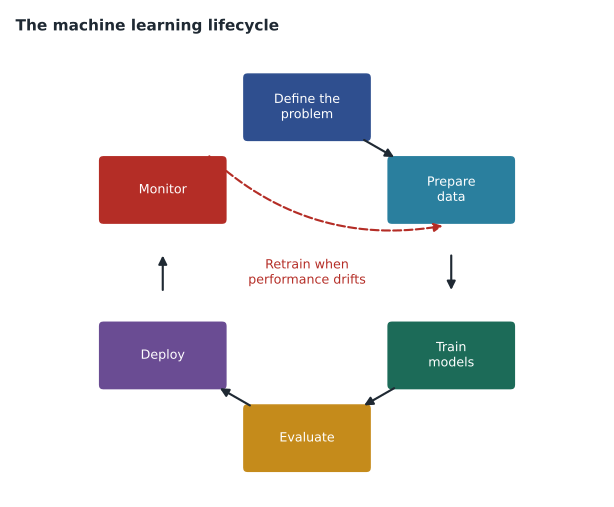
A machine learning solution follows a recognizable lifecycle: define the problem and the measure of success, collect and prepare data, train candidate models, evaluate them on data they have not seen, deploy the chosen model, and monitor it in use, retraining when performance drifts because the world has changed. Each stage depends on data readiness, and the monitoring stage never ends. For a leader, the lifecycle explains why machine learning projects need data skills, time and ongoing ownership, and why their business case should include the cost of keeping the model accurate.
Assessing readiness before investing
A data readiness assessment for an AI use case asks a short set of questions. Where does the information the use case needs live? Who owns it? Is there one current version? Are permissions right, and has oversharing been checked? Is sensitive content labelled and protected? Can the AI reach it through Microsoft 365, a connector or an action? Is the data representative of the cases the AI will handle? And who will keep it accurate after launch?
Each "no" is a task with a cost and an owner. Adding those tasks to the business case, rather than discovering them during rollout, is the difference between a realistic plan and an optimistic one.
| Question | Renewal-briefing use case | Action needed |
|---|---|---|
| Where does the information live? | Email, SharePoint policy folders, policy system | Connector for policy system summaries |
| Is there one current version? | Mostly; old templates remain | Archive old templates |
| Are permissions right? | No: several sites shared with everyone | Oversharing review and fix |
| Is sensitive content protected? | Partly | Apply sensitivity labels to HR and finance sites |
| Who keeps it accurate? | Unclear | Name a content owner per folder |
Quillfield paused its broader Copilot rollout for five weeks while site owners reviewed permissions, HR and finance content was labelled, and two old team sites were archived. Lorne added the cost to the business case. "It is the cheapest insurance we will ever buy," he said.
Keeping data ready
Data readiness is not a one-time project. New sites are created, documents are copied, people change roles and keep access they no longer need, and policies and guidelines are updated. Without ongoing care, the problems fixed before rollout return within a year. Quillfield made three habits part of normal operations: every knowledge source used by an agent had a named owner and a review date; a monthly report of sites shared broadly was sent to their owners for confirmation; and sensitivity labels were applied by default to new HR and finance sites. The cost was small, a few hours a month spread across owners, and it protected the value of everything built on top.
| Habit | Owner | Frequency |
|---|---|---|
| Review each agent knowledge source | Named content owner | Quarterly, or when the process changes |
| Confirm broadly shared sites | Site owners, with IT | Monthly |
| Apply default labels to sensitive sites | IT, with HR and finance | When sites are created |
| Archive inactive sites | IT | Twice a year |
Common mistakes
MistakeBlaming the AI when it surfaces overshared content.
InsteadTreat it as a permissions problem; fix oversharing and label sensitive content before broad rollout.
MistakeTrying to fix poor answers by changing the model.
InsteadCheck the source content first: accuracy, currency, single versions and accessibility.
MistakeAssuming fine-tuning is needed to make AI know the business.
InsteadUse grounding first; consider fine-tuning only for specific style or format needs.
MistakeLeaving data readiness out of the budget.
InsteadCost the clean-up, protection and ownership work and schedule it before scale.
Summary and key terms
- Grounding gives a model company information at the moment it answers; retrieval-augmented generation searches first, then answers from what it found.
- Answer quality depends on retrieval quality, and answers respect permissions, so permissions must be right.
- Data quality means accuracy, completeness, currency, single versions and accessibility; clearing ROT helps all of them.
- Representative data and testing across groups reduce bias.
- Oversharing remediation, sensitivity labels, data loss prevention and retention belong in the plan before broad rollout.
- Grounding
- Giving a model relevant information at the moment it answers so its response is based on that information.
- Retrieval-augmented generation (RAG)
- A pattern that retrieves relevant content and sends it to the model with the question.
- Fine-tuning
- Further training a pretrained model on examples to adjust its style, format or vocabulary.
- Oversharing
- Content accessible to more people than should see it, often through broad sharing links or old sites.
- ROT
- Redundant, obsolete and trivial content that clutters retrieval and increases exposure.
- Representative dataset
- Data that reflects the full variety of real cases, including unusual ones.
Practice problems
Work each problem on paper first, then reveal the answer to check.
Why did Copilot find the bonus spreadsheet?
Show answer
Because it had been shared with everyone, so the account manager had permission to see it; Copilot retrieves what users can access.
What is the difference between a connector and an action?
Show answer
A connector brings content into the search index for retrieval; an action calls a system at the moment the agent needs live data or to do something.
Name the six stages of the machine learning lifecycle.
Show answer
Define the problem, prepare data, train, evaluate, deploy, monitor (and retrain).
Lesson quiz · 5 questions
Score 60% or more to complete this lesson.
Create a free account to save your progress, take quizzes and earn a certificate.